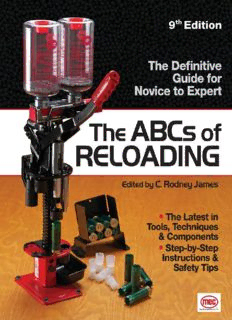
Table Of Contentth
9 Edition
The Definitive
Guide for
Novice to Expert
The ABCs of
RELOADING
Edited by C. Rodney James
Thank you for purchasing this Gun Digest eBook.
Sign up for our newsletter and receive special offers, access to free content, and
information on the latest new releases and must-have firearms resources! Plus,
receive a coupon code to use on your first purchase from GunDigestStore.com
for signing up.
or visit us online to sign up at
http://gundigest.com/ebook-promo
Contents
Special Offers
Introduction
Chapter 1. Safety First, Last & Always
Chapter 2. The Cartridge Case
Chapter 3. Understanding Pressure and Headspace
Chapter 4. Primers
Chapter 5. Blackpowder and Its Variants
Chapter 6. Smokeless Powder
Chapter 7. Bullets
Chapter 8. Casting Bullets
Chapter 9. Bullet Sizing and Lubricating
Chapter 10. Tooling Up for Reloading
Chapter 11. Rifle Cartridge Reloading
Chapter 12. Handgun Cartridge Reloading
Chapter 13. Shotgun Ammunition Reloading
Chapter 14. Ballistics
Chapter 15. Sources and Resources
Introduction to Gun Digest Reloading Archives
Chapter 16. Reloading Ammunition by Lt. Col. E. Naramorer
Chapter 17. Ammunition Guide by Maurice H. Decker
Chapter 18. Casting Lead Alloy Bullets by Col. Townsend Whelen
Chapter 19. Special Bullet Sizing Dies by E. J. Krava
Chapter 20. Practical Pressures by John Maynard
Chapter 21. Early Loading Tools by Richard H. Chamberlain
Chapter 22. Better Handloads by Kent Bellah
Chapter 23. New Brass for Old by George C. Nonte
Chapter 24. Case Neck Variations by Norman E. Johnson
Chapter 25. Handloading Philosophy by Don Martin
Chapter 26. Shot Loads for Revolvers by Edward Dams
Chapter 27. Pressures and the Revolver by William M. Caldwell
Chapter 28. Square Shot and Little Flying Saucers by Roger Barlow
Chapter 29. Smokeless Loads for Double Rifles by Ray Marriage and Dick
Vogt
Chapter 30. The Lyman Story by Mason Williams
Chapter 31. Double Bullets! by V. R. Gaertner
Chapter 32. Compact Loading Bench by William F. Greif
Chapter 33. Shooting Lead Bullets by Ron Wozny
About the Author
About the Cover
Acknowledgments
Copyright
FREE Firewarms e-book
High Caliber Sweepstakes
Introduction
THERE ARE AT least five good reasons for reloading. First is economy.
Someone who has come to enjoy the sport of shooting soon discovers that the
cost of factory ammunition has become almost prohibitive. A pleasant afternoon
of target shooting, banging through a half dozen boxes of cartridges or more, can
run past the hundred dollar mark if you use anything other than 22 rimfires. By
reloading brass centerfire cartridge cases with commercially available bullets,
primers and smokeless powder you can reduce this cost by better than 60% over
commercial ammunition. Even if empty cases are purchased new, the savings
over commercially-made ammunition is still better than 25%, because you
supplied the labor to make the finished ammunition. If you cast your own lead-
alloy bullets, you can save even more since good bullets can be made from scrap
alloys that can be bought for very little or even obtained for free.
Second is accuracy. Firearms and ammunition are standardized — more or
less — with a range of tolerances which means that your average gun will
function properly with your average commercial ammunition, producing
acceptably accurate results. For those who want better than “acceptable,”
handloading your ammunition allows you to make custom-crafted ammunition,
loaded to draw the maximum degree of accuracy from your gun because the
powders and bullets are selected by you and tested by you to produce the best
accuracy in your particular gun.
A third reason might be termed “usefulness.” While commercial ammunition
may be available in perhaps two or three loadings, handloaded ammunition can
extend this to more than a dozen. Low-power cast-bullet loads can be made for
short-range practice, allowing economical shooting with low noise and low
recoil. This means not only less wear and tear on your gun, but on yourself as
well. Heavy hunting loads can be fabricated for taking the largest game possible
within the limits of a particular rifle or handgun. Light, flat-shooting bullets,
designed to expand rapidly on small game, can be loaded to turn a “deer rifle”
into a varmint rifle offering extended use for spring and summer varmint
shooting. Reduced-velocity loads can turn a varmint rifle into a good small game
rifle that will kill effectively without destroying edible meat. Thus the usefulness
of a gun is doubled by the simple expedient of altering the ammunition.
Necessity, that mother of invention, is a fourth reason to reload. There are
any number of older guns, both foreign and domestic, for which commercial
ammunition is simply not available. Cartridge cases may be formed by reshaping
and trimming from similar cartridge cases that have the same size head and a
similar size body. In some instances the cartridge cases you need may be
commercially available, but the commercial loadings are not suitable for your
gun which, because of its age, may require a lighter load or one of black instead
of smokeless powder.
A final reason is added enjoyment. Mastering a craft that will improve your
shooting is an extension of the shooting sport. You will gain a better
understanding of the dynamics involved in the shooting process. Good shooting
is far more than simply good “aiming.” Good aim and proper shooting technique
are necessary for hitting what you shoot at, but you will score far more hits if
you have a clear understanding of the ammunition in your gun and what it is and
is not capable of doing and why.
Who should reload? This is a question firearms writers hear fairly often. It's
not for everyone. The casual shooter, satisfied with rimfire ammunition
performance, the person who targets his gun once or twice a year, the person
with no time for hobbies, will find little use for this avocation. Then there are
those who may wish to join the reloading clan, but for reasons of safety would
be best advised not to. This category includes those persons who persist in
drinking or smoking while reloading, the chronically careless, the forgetful and
accident prone, and those given to dangerous experimentation. Reloading is far
safer than driving a car, but you have to pay attention to what you are doing.
Reloading is as safe or as dangerous; as economical or expensive; as simple or
complicated as YOU make it.
How do you get started? As an educator facing eager students champing at
the bit to get going with the “hands on” part, I began my classes with an
apologetic: “Yes, I applaud your enthusiasm, but I really think you should know
a little something about what you are you are going to be doing.” Those who
don't have a bad habit of breaking equipment, getting poor results and having no
clue as to why the above happened. You can't learn from your mistakes unless
you can figure out what they were and why they happened. To put it another way
— some people live and learn, others just live, but never as long or as happily.
What kinds of guns are we loading for? This book is designed basically for
shooters of modern guns designed for metallic cartridges using smokeless
powder. With the increase in interest the shooting of vintage guns, with light
smokeless loads, blackpowder and blackpowder substitutes, a chapter has been
added on this subject. The bibliographic material in Chapter 12 will direct the
reloader to what is considered advanced reloading. These resources will touch on
loading for black powder guns, early smokeless guns which may not be up to
modern loads or may have chamber and bore dimensions different from those of
current manufacture. This book is not a manual containing loading data, but an
overview of the reloading process — to cover those things critical to the craft,
but not found in loading manuals.
Chapter 1
Safety First, Last & Always
Before beginning any activity, a solid foundation is needed to build upon,
and reloading is no different.
WHAT IS A MODERN GUN?
WHEN I WAS GROWING up in the 50's and 60's, cartridge boxes carried the
warning that “these loadings are for modern arms in good condition.”
Contemporary loading manuals did too. But what is a modern gun? Like any
other arbitrary definition, it has fuzzy edges. Modern gun designs (such as
modern-looking double-action revolvers) came into being in the late 1880's.
Modern semiautomatic pistols were on the market by 1900. Bolt-action, 30-
caliber rifles intended for high pressure (40,000 to 60,000 psi) smokeless powder
ammunition were in general military use by 1895. Roughly speaking, the era of
modern gun making begins around 1886–1900.
The real issue is whether the gun for which you wish to reload can take the
pressures of modern ammunition. For instance, a solidly-built, tightly-locking
Winchester low-wall, single shot or Stevens target rifle from the last century can
be safely used with modern, high-velocity 22 Long Rifle ammunition. To use
such ammunition in a light revolver or pistol from the same era will soon destroy
it. Even guns made as recently as the 1920's may not be safe with the high
pressures generated by the high velocity loadings. The 22 LR Reising automatic
Description:A step-by-step guide to reloading rifle and handgun cartridges and shotshells!In these days of widespread ammunition shortages, it pays -literally - to know how to "roll your own" cartridges. But don't think it's some kind of rocket science. Let The ABCs of Reloading show you how! With the help of T