Table Of ContentQ)
Q)
6
(II
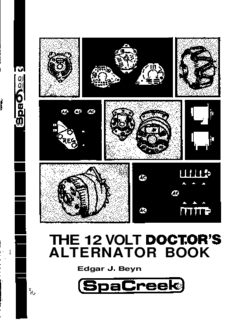
THE 12 VOLT DOCZOR'S
ALTERNATOR BOOK
l
1
Edgar J. Beyn
I
Is;..
The 12 Volt Doctor's Alternator Book
The 12 Volt Doctor's Alternator Book continues in the same familiar and well loved style as
"The 12 Volt Doctor's Practical Handbook" to help simplify the mysteries of the boat's
alternator-the prime source $power on almost kv43ry boat.
Simple drawing and clear instructions abound, helping you to identify your alternator and
understand how it works.
Get to know your alternator-it could save your battery's life.
(Spacreek)
Division of
North Amerlcan Dlvlslon
222 Severn Avenue
Annapolis, Maryland U.S.A.
21 403-2569
INTRODUCTION
Alternators are all around us. There is hardly an engine which does
not have one, running alongside in cars, trucks, buses, recreational
vehicles, boats, aircraft, farm machines, earth moving equipment, and
all kinds of stationary engines. Obviously, the alternators are doing
their job very well since we hear so little about them.
And if something does go wrong, most of the more popular models
have their replacement available almost instantly, waiting on dealer
shelves, in alternator shops, often even in department stores.
How different things become though if you want something
Published by C. PLATH NORTH AMERICAN DIVISION slightly out of the ordinary, an alternator with greater output, some
222 Severn Avenue added feature, unusual application, or if you and your vehicle or
Annapolis, MD 21403 vessel happen to be in a place where technical services are less
abundant. Where you are the available technical service. Or when
you want your alternator to do something new or different and, even
though the expert may have told you it could'nt be done, you are not
quite ready to give up.
On top of that, it does not help that alternators on their way from
the manufacturer to the engine or car factory take on a new name : a
@
1986 Spa Creek Inc. Annaplis, kryland Delco alternator may become a Buick or Perkins, a Motorola one may
become known as a Volvo or Universal. Just try to find a Hitachi or
AIl rights reserved. Mitsubishi alternator in an auto store : there it may only be known as
a Mazda, while at an engine dealer's it may be called Westerbeke
Notice : Names, brands, and designs appearing or Yanmar.
in this bookare registered trademarks or service This book tries to make you see how alternators work, what they
marks which belong to the respective proprietary have in common, and how they differ in some details. The sketches
companies. should help to identify brands and types, if not models. And the
dimensions should help when you have to replace one with another.
If you are lucky, you will never need the trouble shooting and
emergency repair instructions. But if you do, I hope they help. They
should at least make you more fluent on the subject.
Annapolis, April 1986 Edgar Beyn
CONTENTS
.. .
-
Introduction - Ill NAMES : GENERATOR ALTERNATOR
Names : Generator Alternator, Difference 2
Coi Is and Magnets 3
Have you wondered what the difference is or which might be the proper
Why Not Permanent Magnets 7
name 3 Our subiect is a generator. But just as with "light bulbs" which
Of Rotor Poles and Stator Coils 10
properly should be called "lamps", the popular name alternator is now
The Stator 11
in common use. The story behind it is the change, in the early sixties,
Alternating Current 12
from a generator with big coils and brushes but very modest.output to a
Three Phase Alternating Current 14
new machine of different design. It was then called a Self-Rectifying
Intermediate Summary 17
AC Generator and some other complicated names. Improvements were
Rectifying Diodes 19
made in rapid succession and the new machine needed a new name
The Three Phase Rectifying Circuit 26
because it was much different from the old. Even though some makers
Rectifying Diodes : Mechanical 27
still avoid calling it anything but a generator, the name alternator has
Auxiliary Diodes 28
become official for the new design.
Isolating Diode 29
Voltage Regulators 3 1
THE DIFFERENCE
Type P and Type N 37
Excitation 40
Direct current generators have at least two brushes in contact with a
Battery 43
commutator : a ring of copper contacts. The generated current has to
Wiring Diagrams, Schematics 46
flow from the copper contacts to the brushes which had to be big to
Voltage Regulator Testing : in Operation 48
carry high current. Most alternators still have brushes, but for a
Test Regulator Separately 49
different purpose, to carry a few Ampere of field current. Main feature
Voltage Regulator and Battery Charging 50
of alternators is that the power generating coils of wire are fixed in
Voltage Regulator Setting 51
one place instead of rotating. That improvement over the conventional
Manual Alternator Controls 54
generators has been made possible by solid state silicon rectifiers :
Specific Voltage Regulators 59
since the stationary generating coi Is produce alternating current or AC,
Repairs, Trouble Shooting 79
this alternating current must first be converted to direct current before
Alternator Output Test, Field Current Test 80
it can be used to charge a battery. Very compact but powerful silicon
Voltage Regulator Setting Test 83
diodes are located directly within the alternator housings. and are
Testing Alternator Off Engine 84
solidly connected directly to the power generating coils Details in
Disassembling the Alternator 92
the following sections will show you how that works.
Emergency Repairs 102
Alternator Dimensions 1 14
-
Alternator File 116 216
lN DEX 21 8
the soft iron becomes magnetic and also formes poles. Soft iron means
To make this important point clearer, consider sketch @which has eight
any iron or steel which will not become permanently magnetic. In
sketch @, the poles of a magnet with solid letters is shown near a bar coils arranged aroIu nd a rotating permanegnet nmeraagtnee pt.u lsSeins coef eaaltcehr ncaotiinl gw ill
of soft iron which has current, the coil output must be
become magnetic as recified or converted to direct
indicated by the dotted current with diodes. As in the
letter poles. Note that previous examples, we can
the North and South again connect pairs of coils in
SOF polesat@band c series : the coils which are at
have the same effect the poles of the rotating magnet
.:: . . on the iron bar. at the same time. We can
Compare this with the connect in series coils 1 and 5,
poles shown in 2 and 6, 3 and 7, 4 and 8.
@ .
sketch Opposite C O w j But we can not connect the
poles at opposite ends 5
pain together, their output .
6 of thesame coil will must be rectified first which requires two diodes each, or a total of 8
increase the magnetic flux and em hasize each othen effect. This points to our next improvement, of the ma netic rotor. The same
Next step : look at sketch again. We can improve that design even number of generating coils in sketches and @ show two
0
by having four coils instead of just two. As before, we will connect different magnetic rotors. The coils in at best can be wired in
two coils in series, the
three separate groups of two coils, the same coils with the new rotor in
ones which are at oppo-
site ends of the magnet,
@ .
sketch This design
will generate twice the
power of that in
@
sketch : for each
revolution of the magnet,
8 therewillbeonepulse
at terminals A B, then
a pulse at C D, then
at A B again except
with opposite polarity,
then at C D with
0
opposite polarity. We sketch can all be wired together and then require only one set of
have to make a point here. Obviously it is an improvement to arrange rectifying diodes. The reason is that here all coils generate their pulse
as many coils as possible all the way around the rotating magnet. Why at the same time because all have a rotor magnet pole pass by at the
is there a problem with that concept ? With our bar magnet as the same time. The coils can be wired in series for highest voltage, or in
rotor, pulses are generated in the coils at different times. The output parallel for highest current. The alternators in real life are made with
at A and B will have to be rectified separately from the output of heavy wire and few turns per coil , but then have many such coils wired
,
C and D only then can the direct current output be connected to in series, to allow high current but at sufficiently high voltage .We
common DC output terminals. With each additional pair of coils, an will see in a moment exactly how that is done and what other tricks are
additional pair of rectifying diodes would become necessary. We will used in the designs.
see how an improved rotor will simplify this complication.
3
Now let's improve our design one step at a time. We will stay with the
COILS AND MAGNETS
@
bar magnet as in sketch to make the next point : in that design
we had only one generating coil. An improvement is to have two coils
Induction is the phenomenon which makes an electric pulse appear in a
@,
wire when magnetism changes in the vicinity of the wire. The emphasis as in sketch each has a magnet
is on "change" : a pulse is generated when the magnetic field becomes pole passing by at the same time. To
stronger or weaker or changes poles. You will remember most of this , increase output voltage, we have both
and we should iust mention that the coils connected in series. At one
K -
magnetism can come from permanent instant, the voltage peak of one coil
magnets or electromagnets, that a is added to that of the other coil. One
m- pulse is a momentary voltage which can Ld thing to watch out for : both coils must
d
0 create a momentary current : power. have the wire wound in the same
Our first design at left shows a wire 3 direction so that pulses are generated
coil around a bar of iron. More turns in the same direction or polarity.
of the wire give higher voltge at the What about polarity ? Look at
@
terminals A and B when the magnet sketch : the North pole of a
COIL
is moved back and forth. Moving the magnet is moving .in to the low end of
horseshoe magnet back and forth is not a coil as in@a Let us assume that
very practical. Easier is to rotate a the coil is wound to have this make the
bar magnet as in our second design. top terminal plus as sketched. Moving
When a North pole passes the coil, A the North pole aw.a y will generate a pulse with minus at the top
terminal as at b Moving a South pole in toward the same coil as at
a pulse appears at terminals A and
B , and when a South pole passes c will again have minus at the top terminal, and the opposite again
next, another pulse appears at A
0
and B but in the opposite direction. B
If A is plus at first, it will be
minus with the next pulse and then t
plus again : alternating current is
being generated.
The iron bar is not only
convenient to hold the wire coil,
@
it also serves to collect and orient when that pole is moved away. If you look at our design in sketch
again, you will note that the two poles at opposite ends of the same
the magnetic field of the magnet
and improves the induction effect. curved coil generate pulses in the same direction
Even better is our third design I-3 which then amplify each other, the same effect
with the coil wound on a U shaped as that from a stronger magnet. Sketched as the
@
iron core which collects as much coils above, the the generator of sketch
of the magnetic field as possible by 6:U": Eb4 would look like sketch @ : opposite magnet
extending all the way from North to poles moving together but at opposite ends of
South pole of the magnet. When + the same coil.
the magnet is rotated on the axis, @ All of that is easier to sort out if you
induction occurs in the coil. think about the way in which a permanent magnet
attracts a piece of soft iron : opposite poles
attract each other, and as the magnet approaches,
7
WHY NOT PERMANENT MAGNETS ? Patience please, follow this one step further : if we place two iron bars
across the ends of the magnet in sketch 1 the bars develop two new
0
North a!?&uth poles. Very similarly,
Our new and improved rotor in sketch has several magnetic North
we generate the needed poles at the
and South poles. It would be easy to make such rotor from permanent
edge of the alternator rotor with a single
magnets or to make a single permanent magnet in that shape. Permanent @ ,
electromagnet. In sketch we are
magnets are used for example in outboard motors and magneto ignition
splitting the magnetic flux into two
systems to generate electricity. But in our case, the main feature of a
channels to form two North poles which
permanent magnet is also its drawback : that it is permanent and that its
will not be as strong as the original
magnetism cannot be switched off.
N pole of the electromagnet. To make
In the alternators, at least some degree of regulation is needed : S S th e number of magnet poles of the
the more capable the alternator is to generate high output, the more
alternator rotor sufficiently strong, a
important it becomes to be.able to turn down its output, for example
when the alternator is kept running after batteries have been recharged. strong electromagnet is made with a so calle.d field coil which i,s placed
@
As attractive as permanent magnet rotors would be, our alternator has around the alternator shaft as in sketch Instead of the few turns
@ . in the sketch, the field
an electromagnet instead. An electromagnet is shown in sketch
coil typically has a few
It consists of an iron core with a coil of wire
hundred turns of magnet
wound around it. When direct current flows
wire which is a solid
through the wire, the core becomes a magnet, with
copper wire with a thin
North and South .poles at its ends. It becomes
coating of lacquer or
stronger with increased current and looses almost
varnish as insulation,
all of its magnetism when the current is interrupted.
made to allow maximum
Such electromagnet is used for example in electric
number of turns and
door bells where it attracts and releases the clapper
minimum space taken up
as it switches its own coil current on and off.
by insulation.
The core is made from soft iron or a grade of steel
The field coil is
which will not become a permanent magnet. In the alternator rotor, some
faced by two steel disks
small level of sa called residual magnetism can be desireable as we will
. which, if they were left
see later on
as in the sketch, would
Interesting about magnets is that their
develo~N orth and
North and South poles close to pieces
South poles at their edges as shown here. In reality, the edges of these
of iron create magnetic poles in the
.
disks are shaped to have star like extensions which form individual
iron See the electromagnet in sketch
@ North and South poles , bent sa that they form the outer edge of the
: it turns the rectangular pieces
rotor. Current for the field coil is supplied through carbon brushes which
of iron into magnets which have North
are in contact with insulated smooth copper rings which are called slip
and South poles as shown in the sketch
and which attract each other, as rings. They are fasten.e d to the shaft and rotate with it but are
opposite poles are known to do. The electrically insulated Other alternator designs use a stationary field
coil without brushes or slip rings. Here the magnetic flux of the field
magnetic field, instead of spreading
coil reaches the rotating magnet poles through a gap between stationary
out into space from the ends of the
and rotating components.
magnet, prefers to follow the iron
pieces which contain or conduct the
.
magnetic flux
10
OF ROTOR POLES AND STATOR COILS
For a general understanding of alternators, this section is not essential.
But to be complete, a look at the stator is needed, at that component
which contains the power generating coils and which, in contrast to the
conventional generators, produces alternating current. The transition to
alternators on a broad scale became possible when capable and
inexpensive solid state rectifying diodes became available. And with
them, the "self rectifying AC generator1' made use of several phenomena
related to alternating current to improve its performance and reduce its
size. In this section, we will see how present alternators use three phase
alternating current, as well as high frequency AC, to make conventional
generators obsolete.
The stator coils or stationary power generating coils produce pulses
.
@ of electricity when the magnetic poles of the rotor pass by. We have
FNin aaln ldy , Ss k,et cthhe y ares hsopwasc ead t yfapri ceanlo urogtho rf romPo eleasc ahr oet hmearr ktoe dh wavieth t hleet ters seen earlier (sketch @ @@ ) that impulses from N poles have the
magnetic flux pass through the stator instead of being short circuited by opposite polarity of those from S poles. Our goal is to have0 ma n.y coils
located around a rotor with many magnet poles as in sketch We did
flowing directly between rotor North and South poles. In the alternator,
not connect the coils there because we have to do some thinking first.
the iron core of the stator with its generating coil windings would be
If we move the magnet in
located directly at the magnet poles of the rotor, with just enough @
sketch along ;he
clearance to let the rotor spin freely.
coils and want to connect
Between the magnet poles, the wire windings of the field coil are
the coils in series, so that
sketched. The ends of the coil wire are passed through two holes and
we get highest generated
are connected to the slip rings. Alternators which use a needle bearing
lain voltage, we must connect
at the slip ring end of the shaft will have the end of the shaft as
as indicated by the dotted
sketched here. If a ball bearing is used, its inner race will be press
lines. That is because
fitted on the shaft and the outer race will then be located directly next
pu lses generated, for
to the two slip rings and will usually also have the same diameter as
example, in coils 1 and
the rings.
2 will always have
Note that there are a number of alternators with stationary field
opposite polarities, plus
coils. Although they also have rotors with similar magnetic poles, the
and minus at opposite
field coil will not need slip rings or brushes. Details are shown with the
ends. To have the coils push in the same direction, or correctly add the
specific alternators which include several Delco and Marchal models.
Also note that some alternators with field brushes have one voltage of one coil to tehat of t he next, there are three practical wah S :
cylindrical slip ring as shown here and with a radial brush, and one ei Sketch ,
all coils wound
disk shaped slip ring, about like a large washer, with one axial brush V ,
in the same
in its contact, the brush oriented parallel to the shaft.
And in the transition from conventional generators to alternators, , *-. ... . . . -; a--.- -.... dcoirnenceticotnio nbsu t
some early alternators had rotors which resembled the generator rotors, '*S S-*
change .^Or
with four individual magnet poles each wound with its own field coil. ,
sketch
The outer dimensions of these early alternators also had the proportions
all connections
of the longer and narrower generators.
? . are the same
but winding
I
direction
12
changes back and forth. Or, sketch @ , windings and connectiona are
ALTERNATING CURRENT
- 1 same in all
- @ coils but the If the rotor in sketch @ had@ magnet poles, namely 5 North poles
.- . . B winding, skip and 5 South poles, then the stator would have 10 generating coils. If
* the locations
of the opposite
magnet pole.
All these stator winding methods are actually used in alternators. The
@
apparent waste of method in reality is overco.m e by having amther we wind them left, right, left, right, all in series, they will be about
group of coils in the positions which were skipped The output of the as in sketch @ except, of course , located all the way around the
two groups of coils however must be rectified separately.
stator and rotor. For each turn of the rotor, there will be five pulse.s
with plus at terminal A , and five pulses with plus at terminal B
THE STATOR
Voltage at terminal A will change back and forth from plus to minus.
When A is at its highest positive voltage, B is at its highest negative
Please allow me to sketch stator and rotor details in this section in a
voltage. Our a.l ternator generates so called full phase alternating
straight line, rather than in the round as they actually are. It saves
current or AC
space and keeps the sketches simpler which, I hope, will help them make
You probably have seen curves which represent voltages of AC
their point more readily. versus time. For terminals A and B , such curves would look like this :
NOTE : STATOR AND ROTOR IN REALITY ARE CIRCULAR, NOT * As voltage climbs at A
STRAIGHT AS SKETCHED IN THIS SECTION@. , v - + to the maximum positive
magnetW peo lehsa vaero tuhned a ilttse rendagteo, r rthoeto rp, olsekse atcrhe alternatweliyth N e voer nSly pspoalecse.d / R?, '6 \ voltage, terminal B falls
To have the greatest possible magnetic flux pass through the generating I / @ . to the maximum negative
I \ voltage. The actual
coils, they are wound on a core of laminated iron which has its pole m. / ' 3 \. values depend on the
number of turns in the
T~YE+,/( coils, rotor speed, and
, /'\
' strength of rotor
4
magnetism. In 12 Volt
--\ * \ \ I alternators, AC voltage
'.W L amt olopaedn tceornmniencatlesd, , wciathn
easily approach l00 Volt.
. HOWd oes the alternator AC compare with household 110 V AC ? The
@
pSiiemcielasr etxot ethned evxearym cplloesse i nto s ktheetc mheasg@ne t paonlde s @of t h,e m roatgonr,e tsick efltucxh between frequency of our household AC is@ 60 Hertz, the terminals at an outlet
90 through the curves in sketch sixty times each second. The
N and S poles then is concentrated in the iron stator. The sketch also frequency of an alternator with 10 rotor magnet poles has to make only
shows the small extensions at the stator poles which help to hold the coil six full revolutions per second, or run at 360 RPM to generate AC of
wires in place. Note that the rotor S poles are shown interconnected 60 Hertz (Hz). Usually, alternators are belted with pulley sizes which
while the N poles are coming up from behind : this would be the appea- twke alternators run twice as fast or faster than the engine. An engine
rance ofQ the rotor wh.e n looking at the South pole side of the rotor, see operated at 2000 RPM would have its alternator run at 4000 RPM or
sketch 15 and O16 66.6 turns per second, generating AC of 666 Hz. As an average, the
@ ,
To p ace-generating coil windings on the stator in sketc.h we alternator frequency will be about 10 to 20 times that of household AC.
can use any of the methods in sketches @ , @ , or @ Most often,
@
method appears to be practiced : for example, wire wound in .
right turns where a N pole is shown and left turns where S ples are
The main advantage of higher frequency is smaller size, or greater power THREE PHASE ALTERNATING CURRENT
from a given size of alternator. Military equipment often operates with
400 Hz alternating current : if you have a chance, see how much smaller We have looked at the output of alternating current (AC ) from a sinb le .
@ ,
motors or transformers are when compared to 60 Hz units of same generating coil, for example that in sketch traced in sketch
horsepower or wattage. If we had two coils instead, their output pulses would be either
The alternating current from the alternator of sketch @ - @, completely alike or completely opposite to each other. But in each case,
traced in sketch @ , is called full phase. You may have heard the we can connect the coils in parallel by choosing the correct pairs of
term split phase : it describes the kind of AC supplied by most 1 10 V AC terminals. The result would be alternating current as from a single coil.
oskuetltecths , @for ,ex baumt polef 2in20 h oVuoslet hoorl dsso., Miso ssut popftleiend, bfyu ltlh eph ealseec AtrCic acso minp any. BAuCt ipfu wlsees h farodm th ereaech s eopcacruart ei ng aen e1ra -ti n2g - c o3i l-s , 1 s-p a2c e-d 3 e vfeanslhyi oson thaas t tihne
If just one of the two wires, for example terminal A , is connected to , and then rectified
an outlet and the other outlet terminal connected to ground ( the so output from each coil
called neutral wire), then the voltage between the outlet terminals can \. as sketched in @ , you
can see that the result
can reac9h a maximum of
llOV. see MAX in is much closer to smooth
.
direct current. Even
sketch The outlet
though the voltage of
carries sp it phase AC.
The other terminal, B , each coil terminal is at
'
zero, the horizontal
of the original full phase
axis, between pulses,
220 V AC is also used,
the rectified output of
possibly for some other
outlets. The only all three coils combined , or connected to one .c ommon output terminal,
@
difference between the does not look like the tracings in sketch Instead, when the
voltage from the first
outlet on A and any
coil or phase begins to
outlet on B is that ;he
@ fall, the pulse from the
AC pulses do not occur at the same time : sketch shows you that
time passes between maximum. plus (up in the sketch) voltage at B and next coil is near and then
maximum plus voltage at A takes over, to keep the
There is another term : three phase AC, the kind which our TIME. voltage up. Then the
pulse from the third coil
alternators are generating inside before it is being rectified. If we would
is next, and so on. In
rectify the usual alternating current, for example by throwing a switch
at the right moment, see sketch @ , the result would be a chopped reality, the voltage at
the output terminal is
determined by the highest peak in effect at any moment. It looks like
@ .
curve in sketch
The voltage difference
between the crests and
valleys is called ripple.
Ri.p .p le disa.p .p eors almost
entirely when the alter-
nator is connected to a
battery.
direct current as shown on the rig-h t. The AC wlses are switched and f l HE.
now all go in the same direction. This direct current is useful to charge
batteries, it can be made into smooth DC when necessary.
Description:Helps simplify the mysteries of the boat's alternator--the prime source of power on almost every boat. Simple drawing and clear instructions abound, helping you to identify your alternator and understand how it works. Contents: 224-page alternator "Survival Manual"; field wire connections; brushes;