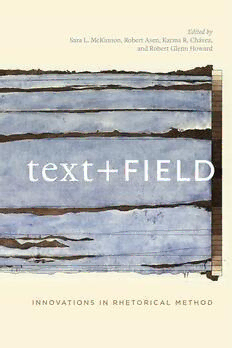
Table Of ContentEdited by
Sara L. McKinnon, Robert Asen, Karma R. Chávez,
and Robert Glenn Howard
+field
t e x t
INNOVATIONS IN RHETORICAL METHOD
D
L
E
I
F
+
t
x
e
t
text +
Edited by
Sara L. McKinnon, Robert Asen, Karma R. Chávez,
and Robert Glenn Howard
+
FIELD
text + FIELD
Innovations in Rhetorical Method
The Pennsylvania State University Press | University Park, Pennsylvania
Library of Congress Cataloging-in-Publication Data
Names: McKinnon, Sara L. (Sara Lynn), 1979– , editor. | Asen, Robert, 1968– ,
editor. | Chávez, Karma R., editor. | Howard, Robert Glenn, editor.
Title: Text + field : innovations in rhetorical method / edited by Sara L. McKinnon,
Robert Asen, Karma R. Chávez, and Robert Glenn Howard.
Other titles: Text and field
Description: University Park, Pennsylvania : The Pennsylvania State University
Press, [2016] | Includes bibliographical references and index.
Summary: “Explores the benefits of utilizing field methods for studying rhetoric as
a complement to text- based approaches in order to address questions about text,
context, audience, judgment and ethics”—Provided by publisher.
Identifiers: LCCN 2016002017 | ISBN 9780271072104 (pbk. : alk. paper)
Subjects: LCSH: Rhetoric— Methodology. | Rhetoric— Fieldwork.
Classification: LCC P301 .T44 2016 | DDC 808—dc23
LC record available at http:// lccn .loc .gov /2016002017
Copyright © 2016 The Pennsylvania State University
All rights reserved
Printed in the United States of America
Published by The Pennsylvania State University Press,
University Park, PA 16802–1003
The Pennsylvania State University Press is a member of the Association of American
University Presses.
It is the policy of The Pennsylvania State University Press to use acid-free paper.
Publications on uncoated stock satisfy the minimum requirements of American
National Standard for Information Sciences—Permanence of Paper for Printed
Library Material, ANSI Z39.48–1992.
This book is printed on paper that contains 30% post-consumer waste.
Contents
Acknowledgments vii
Introduction: Articulating Text and Field in the Nodes
of Rhetorical Scholarship 1
Sara L. McKinnon, Robert Asen, Karma R. Chávez,
and Robert Glenn Howard
1 Interrogating the “Field” 22
Samantha Senda- Cook, Michael K. Middleton,
and Danielle Endres
2 Rhetorical Field Methods in the Tradition of Imitatio 40
Joshua P. Ewalt, Jessy J. Ohl, and Damien Smith Pfister
3 From Guåhan and Back: Navigating a “Both/Neither” Analytic
for Rhetorical Field Methods 56
Tiara R. Na'puti
4 Feeling Rhetorical Critics: Another Affective- Emotional Field
Method for Rhetorical Studies 72
Jamie Landau
5 Embodied Judgment: A Call for a Phronetic Orientation
in Rhetorical Ethnography 86
Aaron Hess
6 “Pa’ que tú lo sepas”: Experiences with Co- presence
in Puerto Rico 101
Kathleen M. de Onís
7 It’s Like a Prairie Fire! Rhetorics of Trust and Reciprocity
in the Texas Coal Plant Opposition Movement 117
Valerie Thatcher
8 Being, Evoking, and Reflecting from the Field: A Case for Critical
Ethnography in Audience- Centered Rhetorical Criticism 133
Alina Haliliuc
9 Holographic Rhetoric: De/Colonizing Public Memory
at Pueblo Grande 148
Roberta Chevrette
10 Context Drives Method: Studying Social Media Use
in a War Zone 163
Lisa Silvestri
Afterword: Decentralizing and Regenerating the Field 177
Phaedra C. Pezzullo
List of Contributors 189
Notes 193
Index 226
s
nt
e
nt
o
C
|
vi
ACknowledgments
This project has emerged from periodic conversations over the past few years
that occurred in the department hallways, at colloquia and other events, and
in social settings. Purposefully and serendipitously, each of us has found our-
selves engaged in fieldwork as a complement to the methods of textual analysis
that we employ as rhetorical scholars. Recognizing this confluence, we had
entertained the possibility of working on a book project together— and we
finally decided to make this possibility into a reality.
First and foremost, then, we want to acknowledge one another, as friends,
colleagues, collaborators, sounding boards, allies, debate partners, counselors,
and more. Before we started this project, our mutual connections were strong.
Our work together on this project has only deepened our mutual connections
and regard for one another.
We have been fortunate to work in an intellectually diverse and excep-
tional department with colleagues who study various aspects of rhetoric and
communication. Our department colleagues— all of them— have fostered an
environment in which faculty and graduate students are encouraged to push
the boundaries of our respective subfields. Over the years, the Department
of Communication Arts at the University of Wisconsin–Madison has been an
intellectual leader in the discipline, and we hope that this project will continue
in this tradition.
Our work with Penn State University Press has been productive and
enjoyable. Kendra Boileau has been a terrific supporter of this project. Her
vision for this project and for Penn State’s books in rhetoric and communi-
cation have produced innovative scholarship and brought together scholars
across the discipline. Hannah Hebert was a great source of information and a
responsive communicator during the development of this project at the Press.
Jennifer Norton steered us ably through the production process, and Regina
Starace designed a great cover. We are grateful to Liz Barr and Hana Masri
for their proofreading and indexing skills, and Nicholas Taylor was a careful
copyeditor.
Chuck Morris and Jeff Bennett reviewed the manuscript for the Press. Their
feedback was crucial for bolstering the volume. We have the utmost personal
and professional regard for Chuck and Jeff, and their insights provided yet
another example of their trenchant critical perspectives and their commitment
to the discipline.
Our development of this project benefited from a National Communica-
tion Association preconference seminar we organized and a department col-
loquium. We wish to thank all the attendees at the seminar, titled “Text +
Field,” which occurred in conjunction with the 2013 NCA annual convention in
Washington DC. The daylong seminar enabled us to discuss themes from this
project with a wonderful group of attendees. Further, some of the chapters in
this volume started out as position papers submitted by participants in our
seminar. We also had an opportunity to present a draft of the introduction to
this volume at a Rhetoric, Politics, and Culture colloquium in the Department
of Communication Arts at UW–Madison. We want to thank our super- smart
colleagues and graduate students for their insightful feedback.
At the 2014 NCA convention in Chicago we organized a panel in which we
presented the introduction and asked a few esteemed colleagues to respond.
As respondents, Dan Brouwer, Robin Claire, and Jim Jasinski offered helpful
feedback. Their insightful remarks enabled us to rethink and reconceptualize
some key issues.
Innumerable conversations with colleagues and friends have allowed us to
develop and bolster our ideas and aims for this project and our understanding
of the relationships among text and field, including Sarah Amira de la Garza,
Kelly Jakes, Jenell Johnson, Steve Lucas, Christa Olson, Phaedra Pezzullo,
Jerry Rosiek, Sarah Tracy, and Mike Xenos.
We wish to thank Sue Robinson and Megan Zuelsdorff for their support,
feedback, and inspiration. And we have been inspired, too, by people we have
met and engaged with in our fieldwork.
s
nt
e
m
g
d
e
wl
o
n
k
c
A
|
viii
Introduction
Articulating Text and Field in the
Nodes of Rhetorical Scholarship
Sara L. McKinnon,
Robert Asen,
Karma R. Chávez, and
Robert Glenn Howard
In his 1965 book Rhetorical Criticism, Edwin Black set in motion a methodolog-
ical shift in rhetorical studies that would forever change what it meant to ana-
lyze rhetorical discourse. Black excoriated the reigning critical method of his
day—a n approach that took its name from a classical figure yet, in Black’s view,
stifled the quality of judgment that Aristotle associated with rhetoric. The lim-
its of neo- Aristotelianism seemingly indicated to Black the limits of methods
altogether, as he expressed a desire to refocus criticism on the judgment of the
critic. In clarifying this move in his preface to the 1978 reprint of Rhetorical Crit-
icism, Black asserted that “a specific person—t he critic—i s the sole instrument
of observation” for rhetorical criticism.1 Whereas some methods, like geometric
equations, appeared to function similarly regardless of who performed them,
rhetorical criticism occupied the end of a methodological continuum where
the performer left a unique and indelible imprint on the subject. Rhetorical
criticism belonged to a group of methods “that require personal choices at every
step, methods that are pervaded by contingencies.”2 As a subjective method,
rhetorical criticism resisted systematization, which meant, as a consequence,