Table Of ContentT E C H N I Q U E S O F
W O V E N T A P E S T R Y
Archie Brennan
Susan Martin Maffei
Filmed by Garry Benson
Dragon Design
South Australia
Woven Tapestry Techniques
Contents
Page
1. Front cover
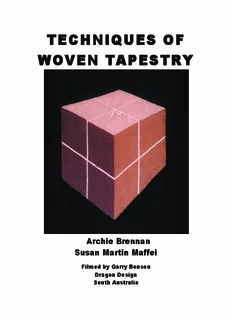
Package III (woven tapestry) 2008
Archie Brennan 111/ x 10 inches, 10 epi (warps per inch)
2
2. Contents
3. Introduction
4. Details of DVDs 1 - 4
5. Details of DVDs 5 - 8
6. Diagrams for DVD 6 - highs & lows
7. Tapestry terms
8. Tapestry terms contd.
9. Biographies
10. - 13. Instructions - using a DVD
14. - 15. Tapestry Studies – Archie Brennan
16. Back cover - loom design
2
Woven Tapestry Techniques
INTRODUCTION
Woven Tapestry
Woven tapestry is about the imagery, the subject matter, the concept – all-resulting from the process.
It is not merely about demonstrating the techniques. Such techniques are simply the language, the
medium, being used. But the reality is that the weaver, the maker, needs these skills to acquire
image-making ability. In time they may become virtually second nature – even a subconscious act.
But it is a slow and laborious learning process.
Traditionally, skills were acquired by sitting alongside an experienced tapestry weaver. In time the
more formal apprenticeship system became the norm – and it was a long apprenticeship. However
the popularity of the individual designer/weaver today makes this approach less available. There
are some workshops that still make this possible, but not many. And there is a number of “how
to” books, but I have found that they can confuse as much as clarify. Unless a long-term teaching
establishment is available, it seems to us that visual and spoken explanations, as in film making,
are the way to go.
We have produced some sixteen hours of tapestry weaving instruction on DVD, examining
classical skills, with the possibility to select – replay again and again, freeze frame, slow or fast
forward. This is not the whole tapestry story. It is important to consistently review and reconsider
each step. This product is based on my training as an apprentice over seven years; of our teaching
graduate courses and running shorter “workshops” with many students, all around the world,
and above all with the experiences as practising tapestry makers that Susan Martin Maffei and I
have garnered over a combined eighty five years in the medium.
These eight DVDs focus on the technical process of our approach. It is important to recognise
that this is our chosen way – not the only way. It is, however a way that we have settled on with
much thought. We have been very fortunate to have worked with Garry Benson as filmmaker and
editor; a former student and a regular tapestry maker in his own right.
These DVD’s also show examples of our work from over the years, exploring and exploiting the
tapestry weaving process.
Archie Brennan
March 2010
Copyright© 2010 Brennan Maffei Tapestry
Copyright© 2010 Garry Benson
3
Woven Tapestry Techniques
Contents of Woven Tapestry Techniques
DVD package
DVD 1
❖ Copyright & opening titles
❖ Choosing the Right Loom
Archie’s introduction to the series
Types of Looms
❖ Warping
Types of Warp
Spacing the warp
Types of Bobbins
❖ Basic Weaving
Weft Slection
Starting to Weave
The ‘Stolen’ pass
The ‘Half’ pass (more information on DVDs 7 & 8)
Weaving two rectangles
❖ Setting Up Leashes
DVD 2
❖ Copyright & opening titles
❖ Weaving adjoining shapes
❖ Weaving higher Angles
❖ Weaving triangles
❖ Weaving smaller adjacent shapes
DVD 3
❖ Copyright & opening titles
❖ Weaving low angles
❖ Weaving Rectangles
❖ Warping up second sampler
❖ Completing possible steps to make a curve
❖ Inking on
DVD 4
❖ Copyright & opening titles
❖ Slide show 1
❖ Slide show 2
❖ Slide show 3
❖ Slide show 4 (see notes page 9)
DVD 5
❖ Copyright & opening titles
❖ Eccentric Weaving including test woven circle
❖ Inking on for a refined circle
❖ Pulling warp round & down
4
Woven Tapestry Techniques
DVD 6
❖ Copyright & opening titles
❖ Joining slits, sewing & hatching
❖ Hatching 2
❖ Weaving summary (See diagrams on page 6 (using high & low steps)
DVD 7
❖ Copyright & opening titles
❖ Hatching & half passes continued
❖ Taking a Line for a Walk
❖ Weaver! s Mark
DVD 8
❖ Copyright & opening titles
❖ Four selvedge weaving
❖ Dersu Usala
❖ Susan on half-passes & hatching
❖ Half-passes & hatching continued
❖ Minimising steps by pulling demo
❖ Archie & Susan series farewell
5
Woven Tapestry Techniques
Notes for using high & low steps in DVD 6
A -2 sequence where, by turning on the high (H) warp with the weft, the appearance of the step
will be maximized.
A -2 sequence where, by turning on the low (L) warp with the weft, the appearance of the step
will be minimized and will make a lower angle than a +1 sequence.
In a +1H / +2L sequence, the steps will be the same height- more so than a simple +1 sequence,
but will make a steeper angle. That a +1H looks similar in height to a +2L can be exploited in
many ways to refine shape making.
6
Woven Tapestry Techniques
Tapestry Terms
Warp
The underlying vertical strings to be completely covered by the weaving.
They can be of linen, wool or cotton, cotton being preferred.
Warp Set
The selected number of warps per inch/centimetre (e.p.i./e.p.c.)
Warp Spinning
The preferred warp is a 3-ply strand, counter spun in an s twist then z twist to build in a degree of
elasticity.
Warp Weight
International suppliers offer different counts for different thicknesses, i.e. 12/12 – 12/18 etc. that
confuses. Each warp count offered needs to be tested for the chosen warp set.
Warp Spacing
The space between each warp is critical. Ideally this space should be fractionally wider than the
warp width when under tension.
Weft
The actual weaving material, which covers the warp. (Pre spun or plied for suitable strength and
flexibility:wool,linen,silk,cottonetc.)
Full Pass
Weaving across the warp then back, in order to cover all the warps.
Half Pass (or shed)
Weaving in one direction, thus covering every second warp.
Dividing Rod (or shed stick)
Usuallyawoodendowel,approx.½”diametersetbetweeneverysecondwarpacrossthewarpto
setafixedopenshed.
Open Shed
Whentheweftispassedthroughthefixedopenshed.
Closed Shed
When the weft is passed through by picking up the back (closed) warps in order to cover the warps
not covered by the open shed.
Leashes
An optional set of hanging loops (made of the same warp material) around each back, or closed,
warp – to speed up weaving.
Highs
Where every 2nd warp is covered, as a result of either shed.
Lows
Where every 2nd warp is uncovered as a result of either shed.
Ribbing
Where the woven surface is distorted as a result of uneven weft tension. (Usually the open shed is
too tight).
Twacking
Checkingthequalityofthewovenclothbythefingers.-AnoldScottishwordthatisanaturalbut
dangerous habit (felting).
Slits
Because tapestry weaving has the option to weave each shape independently, two rectangles ad
joining,forexample,willresultintheweavingofaverticalslit.
The Bead
The small shape covering each warp. This can be quite circular or elliptical, depending on the weft
thickness,flexibility&density.
Weft Tension
Themostdifficultskilltoacquirebecauseshapemakingandsurfacecontrolrequiresfrequentwefttension
adjustment, dependent on the shape, size and location.
7
Woven Tapestry Techniques
Sewing Slits
Thisisaspecificsewingtechniquewhereslitsareindependentlyjoinedduringtheshapemakingprocess.
Interlocking
An alternative to sewing slits that makes a good join but has the disadvantage of rejecting tapestry’s ability
to focus on one shape at a time. (Try weaving twenty squares in line by interlocking the vertical edges).
Double Weft Interlocking
Amoresophisticatedbutmorecomplextechniqueforjoiningslits.(Normallywovenfromtheback)
Warp Drifting
Warps wandering off the vertical as a result of poor weft tension control and uneven weft beating down,
particularly at the edge of shapes and the tapestry’s edge.
Pulling
Again the result of a too tight weft tension.
Buckling
When the tapestry cloth surface deforms like wet paper by a weft tension that is too loose, usually when
making small shapes.
Half Hitch
The basic tapestry knot used with many variations throughout the process.
Double Half Hitch
Thismakesalockedknot,usedrightacrossthewarpatthetapestry’sstartandfinishtolockunravelling
weftsandtopermitasimplecleanedge,thensewingbackeachwarpendstofinishoff.
Tying Down (tying off)
Usingahalfhitchtosecurethestartandfinishofeachwovenshape.
Looping
Carrying the weft across the back of the tapestry from a completed shape to begin a new shape of the same
colour, with not cut end at the back of the tapestry.
Steps
The sequence of weft turns to make a non-vertical, non-horizontal shape.
Angles
Weaving a straight line at varying angles by repeating the same step sequence of the same height.
Curves
Using a sequence of changing step heights progressively increasing or decreasing the step height to make a
curve- or a circle.
Hatching
Acomplextraditionaltechniqueofstepped,flat,wedgeshapestocreate3ormoreweftshades.
Bar hatching
A vertical, light to dark transition by using two colours with graded pass thickness on the vertical
Blends
Usingavarietyofthincontrastingcolouredstrandstomakeupabrokenmixture,thusmakingupan
appropriate weft thickness.
Stealing
The process of adjusting woven levels or step heights for subtle shape making.
Selvedge
The woven tapestry edge where the weft returns, uncut.
Four Selvedge
Makingacompletetapestryclothbyusingacomplexthreepartwarpingtechniquethatwillproduceafour
selvedgefinishwithnotcutwarpends.
Cartoon
A full size working line drawing or full coloured painting of the planned design, to hang behind the warp.
Inking On
The process of marking on the warp an inked line as a guide for the weaving to follow.
Inking Round
The process of marking round each dot or line on the warps (the warps gently rotate and lose the inked on
dot as weaving progresses)
8
Woven Tapestry Techniques
Archie Brennan has been a practicing tapestry maker since 1948, first as an apprentice, then as
director, Dovecot studio, Edinburgh; as an arts graduate and teacher, lecturer and tapestry maker
world wide.
Susan Martin Maffei began her training in tapestry in 1984 with Mary Lane at Parsons University.
In 1985 she studied with Jean Pierre Larochette and Yael Lurie in Berkeley California and Michele
Mesnage in the south of France. In 1986 she apprenticed at Scheuer Tapestry Studio in NYC and
in 1987 and 1988 was a foreign student at the Gobelins in Paris. Since 1988 she has practiced as an
independent tapestry maker, collaborated with Archie Brennan in teaching workshops, exhibited
and lectured worldwide.
They are recipients of many awards of distinction as practising artists.
Garry Benson is an artist, a cinematographer & filmmaker of international experience, an educator
and a tapestry maker since 1976. He directed and produced this DVD series.
9
Woven Tapestry Techniques
Using the DVDs
Introduction
This series is recorded on DVD-R computer disks. It should play without problems on most modern computers
and fairly recent DVD recorders (2000 on) that are listed to play DVD-R disks.
At the start of each DVD there is a Copyright Warning. Please don’t copy the DVDs for friends or family.
Apart from the legal aspects we have tried to create a package that is value for money - the contents of the
series make up the equivalent of a hands-on six week course. We are a small independent group of artists
who are trying to bring you a unique and lasting record of the design & weaving of tapestries.
Handy Hints
On the computer you can use the on-screen control (example below) or the navigation arrows:
On a DVD player the remote has similar features. Once the DVD starts you can select the segment you want
by using the mouse or navigation arrows on the computer or the remote. The ‘live’ segment has a yellow dot
next to it:
You then usually have two choices. You can Play the Movie or if the segment has short-cuts embedded, you
can select Scene Selection:
10
Description:Because tapestry weaving has the option to weave each shape independently, two rectangles ad joining,forexample,willresultintheweavingofaverticalslit. The Bead