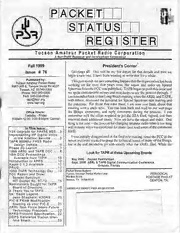
Table Of ContentP A CK; T
e
S T ' A ' T l J S
s
i
R S I T E R
n
Tucson Amateur Packet Radio Corporation
____________4 Non-Profit Research and Development Corporation__________
Fall 1999 President's Corner
Issue # 76 Greetings all. This will be my hist report tor this decade and then we
begin a new one. I have been wanting to write that for a while.
Published by:
I his past month we saw something happen that the organization has been
Tucson Amateur Packet Radio
working on lor over five years now, the report and order on Spread
8987-309 E. Tanque Verde Rd #337
Spectrum from the I'CC was published. TAPR began to push this issue and
Tucson. AZ 85749-9393
Phone: 940-383-0000 we spent considerable money and man hours to sec the process through. I
FAX- 940-500-2544 can remember back to that Long Beach meeting when the ARRL and TAPR,
[email protected] with others, discussed the potential for Spread Spectrum rule making and
www.tapr.org
the concerns. For those that were there. I am sure you think about that
meeting with a smile now. You can look back and read on our web page
the filings, comments, and reply comments during the process. I can
Office Hours:
Tuesday - Friday remember well the effort required to get the STA filed, signed, and then
9:00am-12 00. 3:00-5:00pm Central renewed three additional limes. Now we have the report and order. One
thing is lor sure -- the process for changing amateur radio rules is too long
and in many ways too emotional lor many (just read some of the comments
In This Issue...
Y2K Upgrade for AA4RE BBS . ..3 filed).
Implementing HF Digital Voice
I was initially disappointed at the final rule making, since the FCC in the
in the Amateur Service ..........3
report and order seemed to grasp the technical issues of many of the filings,
TAPR SOOMhz FHSS Radio
Design Update ...... 6 but in the end decided to go with mostly what the ARRL filed. While the
Phase 3D Launch ..........................7
1999 ARRL and TAPR DCC.......8
Look for TAPR at these Upcoming Events
18th DCC Proceedings
Available from TAPR ... ..... 10
May 2000 Dayton HamVention
Introduction to APRS..................12
Sept. 2000 ARRL & TAPR Digital Communication Conference
Xastir 0 1 2 Available 12
Orlando, Florida
PRUG...............................................13
1999 TAPR Technology Day ... 13 Packet Status Register
FCC Report and Order I noon Amuteur Packet Kailiu Corp. PERIODICAL
Spread Soecirum PO Box 51114 POSTAGE PAID AT
Drnlon.TX 76206-0114 DENTON, TX.
WT Docket No. 97-12.............14
Nominations Sought for lAPR
Board of Directors 19
ADUKKSKCOKKKCrriON REQUESTED
A Thank You to TAPR.............. IS
SK: Radio Legend
Jean Shepherd, K20RS 20
PIC-E FRAM Modification:
Souping up your PIC-E........21
ARRI. Task Force Seeks Future
Technology Proposals..........22
APRS Protocol Specification... 22
DGPS Reference Station Inter
face Board..................................23
President's Comer, continued-_______________
Entire contents Copyright £ 1999 Tucson Amateur thicket Radio
rule making is flawed in several ways, it still is a huge (Nirp. Unle.« otherwise indicated. explicit permission is granted to repro
step forward for the amateur radio community and TAPR duce any materials appearing herein for non-commercial Aniutcui |ml>ii-
catinns provided that credit is given to both I fit* author and TAPR. along
can be proud of our effort over the past several years on
with the TAPR phone number (940-3S3-COCO). Other reproduction is
this issue. TAPR at its last Hoard meeting voted not to prohibited without written permission from TAl’R.
file a petition of reconsideration on the report and order Opinions expressed ;itr those of the authors and ix* necessarily those
based on the recommendation of the regulatory affairs of TAPR. the Board of Directors. Officers, or the Editor. Acceptance of
advertising ill ►us mil ounsliluli: ciidDisciricnl. by TAI’R. of the products
committee.
advertised APRS is registered to Rob tlnininga. WR4APR
The amusing thing is that many might think this issue MIC-E is a trademark of Bob Bruninga. WB-APR
is over. Far from it. The issue of changing the rules in P<r.lma.ster. Send address changes toTAl'R. I’.O. Box .11114. Denton.
TX. 76206*0114. I’arii't Slants Regiitrr (ISSN 1(152-3626. US PS 005-
order to promote technology innovation must continue
419) is publislvad quarterly by the Tucson Amateur Packet Radio Corpo
and will. We now have Ultra Wide Hand (IJW'B) starting ration. 14IX Rv.Iyectesl. Denton. TX 76205. Memlwisinp in Tucson
to be discussed at the FCC. While many of the proponents Amateur Packet Radio, including a subscription to Packet Status Register,
is S20.G0 per year in the U.S-and possessions, of which S12.00 is allocated
of IJWB seem to have vaporware for theory and
in f’tirkel Sltilitt Mcytsler. \lcinlv.islnp is $20.(10 in (lanaila nisi Mexico,
technology others are showing some interesting
and S25.CO elsewhere, payable in U S funds. Membership and Packet
technology demonstrations and the outcome over the next Slants Register cannot I>e separated. Periodical postage paid at Denton.
year or two is going to impact some aspects of what we TX
rSK Editor:
might have available for technology. The amateur radio
Rob Hansen. N2GDF.
community as a whole must see and understand that if we
P.O. Box 1902. lilmtru. N.Y. 14902-1902
don't allow the experimenters and visionaries in our fiitciiiei: |wr<Rtapir.org
hobby a more liberal hand at whaflhey want to try and Advertising:
experiment on, we will continue to see less innovation Com act the TAPR office.
TAFR Officers:
coming from within our ranks. The attitude of some for
President Greg Jones, WD5IVD
maintaining the status quo and of trying to protect static
Vice President John Ackarmann, N8UR
usage of the bands is and will continue to lake its toll.
Secretary Steve Stroh, N8GNJ
Treasurer Jim Neely, WA5LHS
Now that we have the report and order behind us. we
TAPR Bonn! of Directors:
must continue to develop technology. On that front.
Board Member Term internet
TAPR has signed a technology transfer and production
Greg Jones. Y/D5IVD 2000 wd5ivdgtapr.org
agreement with the Dandin Group. The Dandin Group, John Koster, W9DDD 2000 [email protected]
is focused on many of the same goals as TAPR, that of Mel Whitten, KOPFX 2000 [email protected]
providing low cost wireless solutions. The synergy John Ackermann, N3UR 2001 [email protected]
Barry McLarnon, VE3JF 2001 [email protected]
between our two groups and the l’acl that Dandin has
Doug McKinney.KC3RL 2001 [email protected]
money to pump into the project to get it into production
Steve Bible, N7HPR 2002 [email protected]
in the near future makes this a good agreement for TAPR Bob Hansen, N2GDE 2002 [email protected]
and its members. Steve Oimse, K4HG 2002 [email protected]
Date is expiration of term on Board of Directors.
As to the current progress and status of the FI 1SS radio Tut* Tucson Am&cui Packet Radio Corporation is a non-pmtii scion
project, a design review and handoff meeting for the RF tific research and dcve.lnpir.-rt cnipotahon [Section 50l(e)t3) of the U.S.
tax crelej. Contiiliulions are deductible to the extent allowed by U.S. lax
section was held in Dallas in October. The outcome was
laws. TAPR is chartered in :1k: State ot Arizona for the purpose of
very positive. Wc continued to be faced with a pan here designing and developing new system* fur lEivital radio communication
or there gelling dropped by a manufacturer, but we are in the Amateur Radio Service, and for disseminating informatics reiprirwd
eliminating those design issues and moving forward. The dumig. and obtained from, such rweaidL
next revision of the RF board is in layout now, with a Article submission deadlines for iiprciminx issues:
prototype expected to be in the hands of the design team Winter 2000 December 15,1999
I lie first of December. We have now gone from a 6-8 Spring 2000 March 15,2000
Summer 2000 June 15,2000
month cycle to less than 2 months. That right there is
Fall 2000 September 15,2000
going to help the project a lot! .Steve Bible. N7HPR. has
Submission Guidelines:
been added to the design team this quarter and will be
t APR is always intemreil in icecivuij information and articles for
responsible lor the IMG development on the radio. The publication. It you have an idea for an article you would like to see. or
next step later in October will be to get closure on the you. or someone you know, is doing something that would interest digital
«>iniriii:i:catois. please contact the nlitm so that youi work cap. be shared
technical issues of the digital board and hold a design
with the Amateur ciummmiiy.
review of that board and gel it into a quick production
I'lte preferred format for articles is plain ASCII text; the preferred
cycle. The team is energized and we should have
graphic formats aie HPCL or PCX. However, we can accept many popular
significant news to report in the next f‘SK. Tom word processor anJ graphic formats. All submissions on diskette should
be formatted for MS DOS.
Page 2 Packet Status Register Fall 1999 - Issue -76
McDermott. N51 i(i, made a detailed report on the project A Practical Approach to Implementing H.F.
at tiic IXX and the audio is available on our web site.
Digital Voice in the Amateur Service
Hie IXX has come and gone and ii was another very
successful conference. Attendance was up this year and Charles Brain. 040110
we hope that the Orlando location next year will allow us [email protected]
to boost attendance again. The full report is later in the
[From the 19V9 ARRL ami TAPR Digital Communica
P&R. I w as very happy to see several of the ongoing HF
Digital projects presented at the conference. There are tions. Conference]
some exciting tilings happening in this field currently. If
TAPR is currently working with Charles to make his
you haven't been following events, take a moment to
Vocoder project available us a kit. Keep an eye out in the
listen to the conference audio. Special thanks to Tina
next issue for further details.
Stroh. Sheila Bible, and Jody Ackermunn.
TAPR will shortly be hack in the CD-ROM business. Abstract
We will he focusing on more special i?ed CDs mi her than This paper describes a practical approach to building a
die generic all-in-one CD we did the past several years. working digital voice system suitable for N VIS operation
We simply outgrew try ing to get all the information we on the HF Amateur hands.
had on one CD that had to he mass duplicated in the
hundreds to make it profitable. Our new system will allow Introduction
us to create several different CDs focused on more I his whole project began due to a comment a friend
specific information needs. Initially, the software library Andy. G4JNT. made over the telephone; he said that it
will be offered. Then we will expand to CDs covering would be fun to transmit real time digital speech on the
the DCC audio and later searchable PSR and DCC amateur bands. Now there was a challenge! As he was
proceedings on CD. Mpre next quarter. located some 70 km away over a fairly obstructed path it
would have to he on I !.!•'. even more ofa challenge!
Don't forget dial nominations for the TAPR Board are
due in December. If you are interested in running for the
Choosing the Vocoder
TAPR Board, please read over the information in the
\ number of candidate systems were studied. The
nominations section. If you have questions about duties,
Vocoder had to operate at a low data rate, be inexpensive,
led free to drop me an e-mail.
he standalone and relatively available. The systems
Until next quarter. looked at were, I.PC-lOe, MEI.P, AM I-BE and various
CELP systems.
Cheers - Greg. WD5IVD
I experimented with LPC-lOe and even managed to
Y2K Upgrade for AA4RE BBS
implement a version of it on a Motorola 56002EVM. the
speech was understandable hut I never did manage to gel
Mike Fahmic. WA67.7Y it to track the pilch correctly. Having listened to a
[email protected] commercial implementation of I.IX-IOs I decided that it
did not have acceptable speech quality anyway.
I am about to distribute the Y2K upgrade to the A A4RJj
BBS program (V2.13S). If you arc running AA4RF.. you I then went on to lind an implementation of MELP (the
new DOD standard) on the Internet, I managed to gel the
should he aware that it will crash on New Years Day
without this upgrade. code to compile and added some Win95 sound handling
routines. The speech quality was much better, but it
To receive it via email, drop me a note and tell me
consumed about 90% of the CPU resources on my
which version you use; RiiAL mode (bb.exc) or
Pentium 133 machine. Also after contacting the patent
PROTECTED mode (bbdprni.exe) and I will send it to
holders. I was told that they were not at all happy with
you within a few weeks.
what 1 was doing.
[Aho try looking on the TAPR FTP site,
I then looked at CELP-bascd systems, these require
ftp. I opr. org/soflware_ I ihJ
large codebooks and clever search algorithms, something
I thought was beyond the ROM capability of the Motorola
KVM and my programming skills!
So finally I settled on the AMBE vocoder chip
manufactured by DVS INC. this chip is relatively cheap,
has very good sound quality', is scaleable between 2400
Fall 1999 - Issue #76 Packer Sforus Register Page 3
bps and 9600 bps and Ihe manufacturer would sell me samples. These 32 samples form the 4ms guard period.
some! I he data is differentially coiled and mapped to the output
phases using Gmy coding before transmission.
Choosing the Modem
After the preamble has been sent the modem sends a
After a literature search I came to the conclusion that
reference sector, i.e. transmits a known phase on each of
the modem would have to use parallel tone technology.
the 36 tones, it follows this by a sync sequence. When the
This was because it was easy to implement, was well
receiving modem delects the sync sequence it ceases
proven, would run on my EVV1 and was more suitable for
hunting for the preamble and starts passing (hopefully)
digital voice transmission than serial tone modems. Serial
valid data to the vocoder board.
tone modems tend to produce long bursts of errors when
the equalizer fails rather than the more random errors
The use of FEC
produced by a parallel lone modem. Speech is unlike
The modem has no inherent Forward Error Correction
computer data, in that the occasional error does not
(IHC) embedded in it. instead it uses the FEC in the
significantly affect the intelligibility.
AMBlv vocoder chip itself. The vocoder tailors the FEC
to mateh the significance of the bits in the data stream, so
Designing the Modem
it can probably do a much better job than 1 can. I lowcvcr
Amateur radio equipment has very poor filtering
it was a shame to not be able to use die soft decision
compared to military equipment. The filters lend to be
information generated by the modem.
quite narrow anil have poor group delay characteristics.
This means the modem has to use a narrower bandwidth The AMBE chip uses both Golay and I lamming codes
than the equivalent military one would. This ruled out the for correction and detection. It follows Ihe normal
Ml I.-STD m -\ 10A 39 tone modem. convention during periods of errors, try ing to guess w hat
was sent by looking at previous frames then eventually
In the end I decided on a 36 lone modem, with a
giving up. The formal used is 2400 bps speech and 12(H)
baudrale to match the 20ms frame length of the AMBE
bps FEC.
vocoder chip. This provided a raw data rate of 3600 bps
and enough lime fora 4ms guard period. The guard period The lirst tests were done without the FEC enabled,
was required to give the modem multipath tolerance. The (whoops) the sy stem worked quite well but occasionally
data was modulated using I )QPSK w bich meant that each very' loud screeches came out of it. however after the FEC
tone carried 2 bits of data during each baud interval. was enabled fewer strange noises came from the system.
Unlike military modems my modem has no Doppler When the modem was initially tested without the FEC,
correction lone and no slow sync on data facility. So far 13 of the tones were in fact transmitting no data
l>oth of these facilities have proven unnecessary. The whatsoever and were therefore wasting energy.
modern remains in lock ibr long periods of time (well
beyond my ability to carry on a monologue). The use of Interleaving
Some experiments were done using an interleaver but
I then did some MATI.AB computer simulations that
were abandoned because the interleaver adds a large delay
showed that the modems had to be within 5Hz of the
to the voice and during deep fades or periods of
correct frequency to work properly.
interference spreads the errors over multiple vocoder
To achieve initial timing and frequency offset frames and so prolongs the dropout.
correction the modem used three BPSK modulated
preamble tones. It differentially decodes them using a Development of the Vocoder PCB
delay ol'one baud interval it then integrates the received 1 he vocoder board consists of a Motorola MC
symbol over that time, from this it deduces the timing 14LC54X0P codec using mu 1 aw coding, an AMBE chip,
epoch. Then by looking at the energy in the IT T bins on a PIC 17C44JW microcontroller, some 74HC series glue
either side of the preamble tones it calculates the logic and a RS232 interface, the AMBE is a 100 pin SMT
frequency error and make a correction hy translating the chip, which had to hand solder onto the board, it was when
received signal in frequency using a complex mixer. The 1 got up to board number 5 that 1 began to get tired of
reason for three tones is to provide some frequency doing it!
diversity as on air testing showed a single lone can gel
For the PCB I used the services of ExpressPCB in the
lost during deep fades.
US. This in hindsight was a mistake as their free PCB
Each sy mbol consists of 160 samples with a sample software is not compatible with anyone else, so it pretty
rate of Xk.tfs. The 36 tones were created by using a 128 much locked me into using them once I had started. Their
point complex I-FT. the guard period is added by taking service is very good however, I emailed the files on
the last 32 samples from the output oflhe and adding them Monday and had the boards back in the UK. by Thursday.
to the beginning of the samples to form a total of 160 1 also sourced most of the components from Digikcy in
Page 4 Packet Status Register Fall 1999 - Issue #76
G4GU0 Parallel Tone Modem
the U.S. as well, as it worked out cheaper than buying The weakest pan of the modern is the preamble phase,
them in the U.K.. especially the microcontrollers. to help solve this 1 added the ability to save the frequency
offset correction and timing epoch after each successful
1 used the 17C44 PIC microcontroller, fora number of
preamble synchronization. If for some reason the
reasons, first, so I could use one crystal to drive both the
receiving modem misses the start of the transmission it is
AMBE and the PIC (the AMBt requires a 27-30 Mhz
then possible to press a button on the front panel and
clock). Second, (he 17C44 PIC has enough ROM
revert to the last set of sync information. In a one to one
available to allow quite complex code to be added at a
QSO this works most times.
later date. In fact I have since done a version of my
software that can encrypt the speech using triple DPS Another change that was made to the modem was to
encryption in real-time. Finally, because I already had the allow the different tones to be given different amplitudes
development tools available. to compensate for the amplitude response of the
transceiver. The group delay in the transceiver will
The boards cost me about SI 50 each to make and I have
however reduce the modem's tolerance to multipath.
so far made 5.
With the new generation of 11F DSP radios this will not
On Air Testing a problem as their 1'ilter characteristics are much more
The system has been tested over a 70km path using suited to this kind of operation.
frequencies in the 40m band. Andy and I made our first
As well as HF testing I have also used it on 2m both on
successful contact at the first attempt on the 27th of March
SSB and FM, and there is no reason it would not work via
1999. This is not a weak signal mode and requires about
a repeater as there is no ARQ (hut I have not tried it).
25 db S/N to function. I lowever when working, it makes
HF sound like a telephone conversation. There is no
Conclusion
background noise, total silence, except for the comfort
It is now possible for the home constructor to build for
noise inserted during gaps in the speech by the vocoder
about $300, a portable, working digital voice for HF, with
itself. The system can tolerate strong CW interference and
near phone quality audio. This system can equally be used
also the multipath induced selective fading found on HF.
to experiment with digital speech using different DSP
SSB interference is more troublesome as it affects more
modems on different frequencies.
than one of the tones. If R'ITY/CW interference gels loo
had it is even possible to switch a DSP notch filter in For further information and a full technical description
circuit, there is enough power in the FEC to cope with the plus some sound files surf along to my website -
missing tones, however the notch filter must be switched http://www.chbrain.dircon.co.uk/dvhf.html
out during the preamble phase.
Foil 1999 - Issue #76 Packer Stilus Register Page 5
TAPR 900Mhz FHSS Radio Design Update
(irca Junes. WD51VD
TAPRhas signed an agreement with the Dandin Group
to take the TAPR design Jrorn its current state into
production, from which TAPR has access to production
units lor sale back into the amateur radio community.
1 his is an agreement we have been working on lor several
months. The bringing together of TAPR’s and Dandin's
capabilities will help the speed of the project
tremendously. We will be reporting more information in
the next PSP about the progress of development.
Steve Bible, Tom McDermott, and David Cummings, rev iewing issues
resuming the PIC processor Oil the RK Board.
TAPR/Dandin RF Design Review - Status
Report 10/6/99 Interfaces
The Dandin and TAPR groups meet Sunday. October The group resolved interface issues and
3rd, in Dallas. Texas to hold the RF design review in order assigned/ehanged interface specs to reflect current state
to move the Rl- design from TAPR into Dandin's of development. Further resolution on the interface was
production schedule. made later during the schematic review.
Attending the meeting: Greg Jones, Torn McDermott,
Connectors
Steve Bible. Steve Ludvik, David Cummings'. John
The group resolved for the prototype run the connector
Schorcdcr. Bob Stricklin, and John Koster.
issues. Later in the meeting the master connector was
broken into two connectors (Analog and Digital).
Layout and Physical Issues
The group discussed the layout and physical issues of
the design. Steve L. showed one of his examples of RF
packaging. It was agreed later in the meeting that the
current foot print would be kept during the layout of the
board, but if the design allowed shrinkage Dandin would
shrink the layout on the current size board.
The I APR TIISS Project Team. (L-R) Bub Stricklin. John Schnretler.
David Cummings Steve Bible. Turn McDermott. and Cret> Jones.
Functional Review
Tom went through die functional and operational
design of the project. Steve L. had brought his block-
diagrams of the design and the group used this as a tool
to follow the discussion and resolve identification of
blocks to overall operations within the radio.
Sieve Lud'iU. of the DunUiii Group, working on u circuit anulyds with
Bob .Stricklin nn<l t orn McDermott.
Page 6 Packet Status Register Fall IS99 • Issue F76
Schematic Review Specific details of the launch agreement were not
The group did a component by component review of released.
the design. Several changes and corrections were made
AMSAT-NA President Keith Baker, KB1SF, was
to the master schematic as the group discussed the current
elated with die latest news. "I’m very pleased to see that
design. Several actions items were produced during this
AMSAT-DL’s negotiations with Arianespaee have
review which will he handled in the coming week.
resulted in a launch contract for Phase 3D, and I'm
delighted we are again slated to lly on an Ariane vehicle,"
PIC
he said. "Following the resounding success of Ariane
The group discussed the PIC controller on the RF
Flight 503, the Ariane 5 has now proven itself to l>e a very
Board. Steve Bible, who will be taking on the PIC
capable launcher."
programming, reviewed the PIC device and Inc group
reviewed and made changes to the schematic in order for Maker said that given past successes with ESA and
the design to work properly with the PIC selected. The Ariane, "I believe we now have an unbeatable
group reviewed the operational working of the PIC with combination." Once in orbit. Baker said, "the Phase 3D
the overall design. satellite will not only help us usher in the new
Millennium, it will also signal the dawn of a brand new
Conclusion era lor Amateur Radio."
I want to thank everyone that attended the RF review While both AMSA'T presidents expressed optimism for
for making it such a successful meeting. The goals of 1. an early launch of the satellite, Mein/er expressed caution
anain closure on the issues regarding the RF board. 2. be that the wait for the "first suitable" flight could still turn
able to allow Dandin to take over RF layout and following out to be a long one. "While the launch of Phase 3D could
production. 3. gain clear understanding of goals for the come as early as die first half of the year 2000, we must
next 2*4 months, and 4. increase the communications
remember that Ariane's launch manifests arc continually
between the two groups and the participant members were being updated to accommodate market changes as well as
all achieved. the availability of other payloads," he explained. Meinzer
said "one or more changes" to P3D’s anticipated launch
The next step will be to hold a design review on the
date as well as its specific Ariane 5 mission number "are
digital board and start the process of technology transfer
a very real possibility before our satellite actually flies."
with the second half of the project.
ARRL Executive Vice President David Sumner.
Phase 3D Accepted for "First Suitable"
K17.7.y welcomed the AMSA T announcement.
Ariane 5 Launch "Congratulations to AMSAT’s Phase 3D team on moving
another important step closer to launch." Sumner said.
[From ARRL Headquarters] "For those w ho have been putting off getting their stations
ready for Phase 31), the time for procrastination is just
AMSAT-NA says the Phase 3 Amateur Radio satellite
about over." I he League has been a major contributor to
has been accepted as a payload for the "first suitable”
the Phase 3D project.
Arianespaee Ariane 5 vehicle launch. The announcement
came today from Phase 3D Project Leader and Based on its new ’standby’ launch status, Phase 3D is
AMSAT-Germany President Karl Mein/er, DJ4ZC. who slated to be delivered to the Guiana Space Center in
said a launch opportunity could come during the first half Kourou. French Guiana, later this month to be ready once
of next year. a specific Ariane 5 launch is identified.
"As the primary agency responsible for securing a 1 he Phase 3D project has been an international elTorl
launch opportunity for Phase 3D. I am pleased to that has worked with donated resources. In addition to
announce that AMSAT-Gerrnany and Arianespaee have AMSA'T-DL and AMSAT-NA teams, AMSAT groups
now come to an agreement calling for the launch of P3D from Austria, Great Britain. Japan. Canada, Finland,
as a secondary payload aboard the 'first suitable' Ariane Russia. Belgium, the Czech Republic, Slovenia. France,
5 flight," Meinzer said in a statement from Marburg. New Zealand and Hungary also have participated.
Germany. "From the very beginning of the Phase 3D
AMSAT says that while Phase 3D's primary focus is
project, we considered the Ariane 5 series our primary
on improved worldwide satellite communication, the
launch vehicle. Our long history of success and mutual
satellite also will have a very positive influence on the
cooperation with both the I European Space Agency and
future of Amateur Radio. "Phase .31) will be Amateur
Arianespaee, coupled with our need to lift 1*31) into a high
Radio’s premier vehicle to continue the quest for new
geostationary transfer orbit, made the Ariane 5 the
communications technologies for generations yet
unanimous choice by AMSAT."
unhorn," the AMSAT announcement said.
Fall 1999 - Issue 1>76 Packet Status Register Page 7
APRS ICQ
1999 ARRL and TAPR Digital
Tom Schaefer, NY4I
Communications Conference
Phoenix, Arizona Microcontrollers and APRS
Steve Bible, N7HPR
Greg Jones. WD5IVD
APRS Working Group Update
John Aekcnnann, NSUR
Another grand Digital Communications Conference!
Special thanks go out to the workers at MARC l'or hosting
locally and to PRIJG (www.prug.or.jp) for being our
international co-host again. Also, a very special thanks
to Geoff Bachr. N6LXA. Chief Network Officer of Sun
Microsystems, for attending and giving the dinner talk on
Saturday. Steve Stron. NXGNJ. and Tina Stroh did an
excellent job in working the arrangements with the hotel
in Phoenix once it was selected. Tina wasn’t able to
attend because they arc in the midst of adopting a child.
Congralualtions to Tina and Steve. Sheila Bible was a big
help and will be working with Tina in the coming years
to help coordinate the conferences as I take a lesser role
in the conference. As in the past, audio and photos from
the conference will be available on the TAPR web site
Keith Sproul W t 2Z and Guy Story, KC5C0I
(www. lapr.org/dee).
Next year’s DCC will he hosted in Orlando, IT.. The
The Friday Technical Seminttr on HDTV by Allen
date of the conference should lie selected by the end of
Finnc, KB5SQK was cancelled at the last minute when
the year.
Allen cound not attend.
The conference started Friday afternoon w ith the third
Friday night saw the annual DCC social, which was
annual APRS National Symposium moderated by Steve
sponsored by PRIJG. After the social. PRIJG presented
Dimse, K4HC. I he symposium was full of talks and
a technical paper highlighting their current development.
projects. I during the symposium yet another new mystery
The papers focused on what had been happening with
hardware project was discussed. This year's was a sneak
their protoly pe direct-sequence radio operating in the 2.4
preview provided by Kenwood to all those attending the
GHz band. This prototype appears to he very well
DCC of their new mobile APRS equipped radio. The
designed from an experimentation point of view.
following people spoke at the APRS Symposium.
As with past years. Saturday was split into two strands
APRSdos and TrakNcl update
- a paper session and a session featuring selected topics.
Bob Bruninga, WB4APR
As in previous years, the selected topic strand had fewer
MacAPRS/WinAPRS Update topics with more time to present. Four selected topics
were presented. Steve Bible. N7HPR. presented an
Keith Sproul, WU27.
introduction to PIC’s. Guy Story. KC5G0I, presented an
XAPRS overview to APRS and discussed some of the latest
Keith Sproul, WU2Z happenings in the mode. Johan Forrer, KC7WW, did an
APRS-SA Update
Brent llildcbrant, KH2Z
Internet and APRS
Steve Dimse. K4HG
WinCE version
Rob Winner. KZ5KW
Kenwood TH-D7 Tricks, Treats, and Tragedies
Stan Horzepa, WAII.OU
Arizona APRS
David McCarthy. KC7AYX Johan forrer, KC7WVV, Charles Brain, <i4GU0. Frank Perkins,
W B5IPM, and Tom McDermott, N5KG captured in the hall during
one «r the breaks.
Page 8 Packet Status Register Fall 1999 - Issue #76
Steve Bible, jN'HI'K anil Bob M<C»icr,N4HV.
Proposal for a Spread Spectrum Transponder Payload on
the International Space Station
Fried lie) n, WA6WZ0 snd CreJ Jones, W05IVD Manhew Luus, N2MJI
UWB (Ultra Wide Band) Technology
overview and current status on III- communications. Bob
Dewayne Hendricks, WA8D/.P
Nielsen, \V6SWIi, did a talk on the current status of Linux
in the amateur community. Thanks to all the selected topic Status Report on TAPR 900Ml lz SS Radio Project
speakers for taking the lime to present more in-depth Torn McDermott. N5F.G
materials during the IX.'C.
A Low-Cost HF Channel Simulator for Testing and
The paper sessions included the following talks: Evaluating HF Digital Systems
Johan Forrer, KC7WW
Regulatory Issue and Update
Dewayne Hendricks, WA8DZP (Non Technical) Lessons to be learned from the PSK31
Phenomena
ARRI . Technology Taskforce & The Technology Work
Eduardo Jacob. LA2BAJ
ing Croup
Rich Moscson. W2VU A software Implementation for Federal Standard 1052
(Mil. Sid. 188-110A HF Modems)
Arizona Packet Radio, Past Present and Future
Robert MeGwier, N4HY
Keith Justice, Kl;7'TP & Dan Meredith. N7MRP
A Practical Approach to Implementing HF Digital Voice
APRS Mic-Lilc
in the Amateur Service
Boh Bruninga, WB4APR
Charles Brain, G4GUO
APRS for X-Windows (Linux)
Keith Sproul, WU2Z
Automatic Weather Bulletins via APRS
Keith Sproul, WIJ2Z
APRS Generic Digipcaling Satellites for HT and Mobile
Satellite Communications
Rob Bruninga, W134APR
XMI. and APRS
Steve Dimse, K4110
APRN: Automatic Picture Relay Network and SSTV
Picture Server
Keith Sproul. WU2Z & Bob Bruninga. WB4APR
APRS Stand Alone Message Receiver
Dorothy Jones, KA5DWR and Jody Ackermann. KCSKIK!
Keith Sproul. WU2Z
Fall 1999 - Issue #76 Packet Status Register Page 9
Ham Web and HamStation Title: XML and APRS
Dale Ihickctt, KOHYI) Author: Steve Dimsc K4IIG ([email protected])
Abstract: Recently, a number of pundits have been
For ihc banquet speaker, we were very fortunate to
calling XML (extensible Markup Language) the
have GeoffBachr, N6LXA, Chief Network OiiieerofSun
"Next Big Thing" on the Web. New XML aware
Microsystems. Geo IT gave a very interesting and
applications aie being released all the time. Over the
thought-provoking talk on the future of the Internet and
next few years, more and more information will be
networking in general and gave some comments on the
made available in XML. The ability to easily ma-
future of amateur radio. We were very fortunate to have
ehine-intcrprel this information will be a watershed
Geoff attend the conference and much thanks goes to
Dewayne Hendricks. WAXIJZP, lor helping arrange event in the development of the Internet. APRS will
another good banquet talk. not be left out! In this paper I detail the first efforts
in making APRS data available in XML.
The Sunday morning seminar was a more
time-intensive version of last year’s introductory session Title: Proposal for a Spread Spectrum Transponder
on PIC.' development. Steve Bible. N7HPR, Steve Dimsc. Payload on the International Space Station
K4HG. John Hansen. W2FS. and Byon Garrahrant, Author: Matthew Ellus N2MJI ([email protected])
N6BG gave a 5 hour long seminar on PIC' development Abstract: A satellite payload Ibr the International
and programming issues. They showed lots of interesting Space Station is proposed, which would provide
projects and answered a lot of questions from the high bandwidth, wide-area data communications ca
audience. pabilities for radio amateurs. Key features of the
system are a simple space segment and low cost
Thanks to all those that I missed mentioning who
ground stations. Varying tiers of service can be
helped with the DCC anti I look forward to seeing you
provided depending on end-user equipment invest
next year!
ment, from low-cost paging, through digital voice
18th DCC Proceedings Available from and high speed data communication.
TAPR $15 Title: A Low-Cost HF Channel Simulator for Test
ing and Evaluating HF Digital Systems
Title: Ham Web Node Author: Johan Forrer KC7WW ([email protected])
Authors: John Bandy WOUT Abstract: Ihc incentive and justification lor this project
([email protected]) and Dale Puckett was inspired by the authors desire to develop HF
KOH YIX ([email protected]) digital communications devices that effectively deal
Abstract: This paper describes an existing amateur with the variable nature of the ionospheric propaga
packet node that provides many graphic and text tion medium. Simulating the behavior of the iono
services to other amateur packet stations in the ama sphere in real lime allows Ibr bench testing of HF
teur radio 2 meter band. modems and other communications devices. In the
past, these so-called "HF* channel simulators" used
Title: Ham Web Station
exotic and expensive computing hardware that was
Authors: John Bandy WOUT
not available to the average amateur experimenter.
([email protected]). Dale Puckett
The simulator presented in this article is based on a
KOI I YD. ([email protected])
low-cost floating-point I)SI‘ evaluation kit that accom
Abstract: This paper explains the requirements for an
modates a wide range of simulated conditions, includ
amateur radio station that communicates with an
ing CCIR 520-1. The simulation model is an imple
amateur radio web station, node on the 2 meter band.
mentation of the Watterson. Gaussian-scatter, HF iono
It uses a graphic user interface (GUI) desktop of a
spheric channel model which is the de facto standard
personal computer (PC).
for this kind of work. The article concludes with a
Title: A practical Approach to Implementing II.K. summary of test results for a number of contemporary,
Digital Voice in Ihc Amateur Serv ice forward error-correcting (FIX') HF digital systems
Author: Charles Brain G4GUO (chbrain@dir- tested on this HF channel simulator: PSK.3I. CBPSK,
con.co.uk) and M l 63. This simulator is a worthy addition to
Abstract: This paper describes a practical approach to
anyone's array of testing tools for developing DSP
building a working digital voice system suitable lor modem algorithms, routing or protocol development
NVIS operation on the II.F. Amateur bands.
for 1 IF communication systems.
Page 10 Packer Status Register Full 1999 - Issue H76