Table Of ContentS ustainab le H ousing
Reconstruction
Through (cid:400)(cid:401) case studies from (cid:3)ustralia, (cid:6)angladesh, (cid:15)aiti, Sri Lanka,
the (cid:38)S(cid:3) and (cid:40)ietnam, Sustainable Housing Reconstruction f ocuses on
the housing reconstruction process after an earthquake, a tsunami, a
cyclone, a (cid:89)ood or a fire. (cid:9)esign of post-disaster housing is not simply
replacing the destroyed house but, as these case studies highlight,
a means not only to build a safer house but also a more resilient
community(cid:312) not to simply return to the same condition as before the
disaster, but an opportunity to build back be(cid:130)er.
T h e b ook ex p lores tw o main th emes:
(cid:334) Housing reconstruction is most successful when involving the users in the
design and construction process.
(cid:334) Housing reconstruction is most effective when it is integrated with community
infrastructure, services and the means to create real livelihoods.
The case studies included in this book highlight work completed by different
agencies and built environment professionals in diverse disaster-affected
contexts. With a global acceleration of natural disasters, often linked to
accelerating climate change, there is a critical demand for robust housing
solutions for vulnerable communities.
This book provides professionals, policy-makers and community stakeholders
working in the international development and disaster risk management sectors,
with an evidence-based exploration of how to add real value through the design
process in housing reconstruction. Herein then, the knowledge we need to build,
an approach to improve our processes, a window to understanding the complex
domain of post-disaster housing reconstruction.
es t h e r ch a r le s w o r t h is Associate Professor and the Director of the Humanitarian
Architecture Research Bureau (HARB) in the School of Architecture and
Design, RMIT University, Melbourne, Australia. Esther is the Founding Director
of Architects Without Frontiers (AWF). Her most recent book, H umanitarian
Architecture: 15 Stories of Architects Working after Disaster, was published by
Routledge in 2014.
i(cid:91)ekhar ahmed is a Research Fellow in the Humanitarian Architecture Research
Bureau (HARB), School of Architecture and Design, RMIT University, Melbourne,
Australia. His research interests span the areas of disaster risk reduction, climate
change adaptation, urbanisation and community development.
Far too many disaster reconstruction projects regard
the efficient delivery of rows of faceless houses as
the measure of success. However, in this vital study
Esther Charlesworth and Iftekhar Ahmed move well
beyond this notion. They claim, in twelve well-chosen
international case studies, that housing reconstruction
can be sustainable, delivering ‘added-value’. This can
include newly acquired building skills that strengthen
livelihoods, safety from hazard forces, community
resilience and a close identification of users with their
creation. The book is a joy to read, aided by a splendid
layout and deligh(cid:127)ul illustrations and must qualify
as the best looking book on disaster recovery ever
p ubli shed!
Ian Davis, Visiting Professor in Disaster Risk
Management in Copenhagen, Lund, Kyoto and Oxford
Brookes Universities
The daunting task of rebuilding after disaster requires
strong inclusion of affected people and governments,
and after decades of such programmes, Esther
Charlesworth and Iftekhar Ahmed have added
significantly to the debate with Sustainable H ousing
Reconstruction. This detailed and colourful book is
essential reading for those involved, covering a range of
disasters, typologies and program approaches, pu(cid:2478)ng
the interests of affected people at the centre of the
debate.
Brett Moore, Global Shelter, Infrastructure and
Reconstruction Advisor, World Vision International
Post-disaster politicians always say, ‘We shall
rebuild here now’. What rubbish. The disaster struck
accidentally but the damage is no accident. Damaged
buildings and housing are the result of hastily and
poorly built structures that could not sustain the
forces of nature. So, rebuilding has to be carefully
tho ugh t out and w ell ex ecuted so ther e is not a rep eat
of the catastrophe that occurred. Sustainable H ousing
Reconstruction is a timely antidote to the rush to rebuild
by laying out with cases how human and physical
repair has to occur for the reconstructed post-disaster
community to be fit for the future.
Edward J. Blakely, Honorary Professor of Urban Policy,
United States Studies Centre at the University of
Sydney and Director of Recovery post-Katrina for the
City of New Orleans 2007–2009
S ustainab le H ousing
Reconstruction
D esigning resilient housing
a(cid:91)er natural disasters
es t h e r ch a r l e s w o r t h and i(cid:91)ekhar ahmed
First published 2015
by Routledge
2 Park Square, Milton Park, Abingdon, Oxon OX14 4RN
and by Routledge
711 Third Avenue, New York, NY 10017
Routledge is an imprint of the Taylor (cid:349) Francis Group, an
informa business
(cid:353) 2015 Esther Charlesworth and Iftekhar Ahmed
The right of Esther Charlesworth and Iftekhar Ahmed to
be identified as authors of this work has been asserted
by them in accordance with sections 77 and 78 of the
Copyright, Designs and Patents Act 1988.
All rights reserved. No part of this book may be
reprinted or reproduced or utilised in any form or by
any electronic, mechanical, or other means, now known
or hereafter invented, including photocopying and
recording, or in any information storage or retrieval
system, without permission in writing from the
publishers.
Trademark notice: Product or corporate names may be
trademarks or registered trademarks, and are used only
for identification and explanation without intent to
infringe.
British Library Cataloguing-in-Publication Data
A catalogue record for this book is available from the
British Library
Library of Congress Cataloging-in-Publication Data
Charlesworth, Esther Ruth, author.
Sustainable housing reconstruction: designing resilient
housing after natural disasters / Esther Charlesworth
and Iftekhar Ahmed.
p ages cm
Includes bibliographical references and index.
1. Disaster victims--Housing--Case studies.
2. Ecological houses--Case studies. 3. Buildings--Repair
and reconstruction--Case studies. 4. Disasters--Social
aspects--Case studies. I. Ahmed, Iftekhar, 1962- author.
II. Title.
HV554.5.C43 2015
363.5’83--dc23
2014034933
ISBN: 978-0-415-70260-7 (hbk)
ISBN: 978-0-415-70261-4 (pbk)
ISBN: 978-1-315-73541-2 (ebk)
Typeset in Lato
Book design, layout and typese(cid:2478)ng by HD Design
Original Book design concept by Adrian Marshall
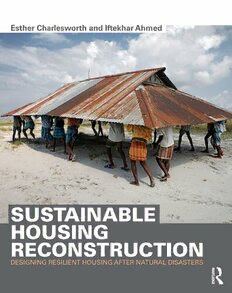
Cover photo by Jonas Bendiksen
C ontents
Figures vi
Foreword: Learning from the Shelter Sector viii
GRAHAM SAUNDERS
Acknowledgements x i
introduction: More than a roof overhead: post-disaster x ii
housing reconstruction to ena(cid:48)le resilient communities
part i xiv
overview: achievements in housing reconstruction
despite mounting odds
part ii 2
the case studies
bush(cid:67)re (cid:327) australia 4
Black Saturday bushfires, 2009 7
Linking temporary and permanent housing: Kinglake
Black Saturday bushfires, 2009 1 7
Linking temporary and permanent housing: Marysville
Cyclone (cid:327) bangladesh 26
Cyclone Aila, 2009 29
Owner-driven reconstruction
Cyclone Aila, 2009 37
Community-based reconstruction
earth(cid:116)uake (cid:327) haiti 48
Earth(cid:116)uake, 2010 51
Community redevelopment program
Earth(cid:116)uake, 2010 59
Integrated neighbourhood approach
tsunami (cid:327) sri lanka 68
Indian Ocean tsunami, 2004 7 1
Community resettlement
Indian Ocean tsunami, 2004 79
Owner-driven reconstruction
hurricane (cid:327) usa 88
Hurricane Katrina, 2005 91
Consultative housing reconstruction
Hurricane Katrina, 2005 99
Musicians’ Village
typhoon (cid:327) Vietnam 108
Typhoon Xangsane, 2006
Typhoon Ketsana, 2009 1 1 1
Housing reconstruction and public awareness
Typhoon Xangsane, 2006 119
Child-centred housing reconstruction
P a r t iii 128
Conclusion: lessons from the case studies
Bibliography 134
Index 136
(cid:1354)
F igures Terry and Sharon; their house; and the floor plan of their
house. 22
Norman Fiske. 23
Foreword Cyclone (cid:325) Bangladesh
Meeting local needs: An IFRC-supported community overview
rain water tank in Bangladesh. ix At risk: The Khulna District shoreline, typical of
Technical advice: IFRC supervision helps to ensure Bangladesh’s highly vulnerable coast. 26
appropriate housing reconstruction in Haiti. x Stabilised: A UNDP-built house on an earthen plinth
stabilised with cement. 29
Introduction
owner-driven reconstruction
Safer: Post-disaster housing in Vietnam ‘built back better’ Map of Bangladesh showing the location of
than before. xiii Khulna District and Dacope Sub-district. 29
Teamwork: Many people’s skills contribute to a house being Low-lying: Dacope and its coastal environment. 31
rebuilt in Marysville after the Black Saturday bushfires. xiii Clean: A newly built community pond sand filter. 32
Built for all: The community latrine and bathroom building. 33
Part I Overview
Multiple benefits: Roads built through the cash-for-work
program serve as dykes. 33
Range of stakeholders: Even children contribute to the
Safe from floods: This school playground was raised above
reconstruction task in Bangladesh. xiv
flood level through the cash-for-work program. 33
Complex tasks: Rebuilding after a massive earthquake
Moyna; her house; and floor plan. 34
in Haiti. 1
Yusuf; his house; and its floor plan. 35
Part II The case studies
Community-(cid:48)ased reconstruction
Aquaculture: A view from Shyamnagar showing its
Bushfire (cid:325) Australia
low-lying environment and large fish-farming ponds. 37
overview Map of Bangladesh showing location of Satkhira. 37
Aftermath: Marysville soon after the bushfire. 4 Water for many needs: Ponds in front of each house
Architects’ contribution: Narbethong Community Hall. 7 provide fish and are used for bathing and washing. 39
High and dry: By piling earth from pond excavations, the
kinglake
settlement is raised to protect it from high water. 40
Map of Victoria Australia showing location of Kinglake. 7
Model approach: The design workshop with community
Forested: Kinglake and the hills of the Kinglake Range. 9
members at BRAC University. 41
Student-led: The community barbeque pavilion in the
Saleha; her house; and its floor plan. 42
temporary village, designed and built by Monash
Anisur; and his house. 43
University Architecture students. 11
Primary: The school is a key community facility. 45
Central: The children’s playground set at the heart of the
Kinglake temporary village. 11 Earth(cid:116)uake (cid:325) Haiti
Well-sited: Aerial view and site plan of the Kinglake
temporary village. 12 overview
Jacqueline Marchant; the Re-Growth Pod being craned Vulnerable: Informal settlements such as this are
in; installed; and after five years; and Design drawings widespread in Port-au-Prince, Haiti. 48
for the Re-Growth Pod. 14 Relocation: A newly built settlement at Zoranje, north of
Greg Rogers; a floor plan of a two-bedroom cottage at Port-au-Prince. 51
the temporary village. 15 Villa rosa
Map of Haiti showing the location of Port-au-Prince. 51
Marysville
Destruction: A resident at the remains of his house. 17 Poor-quality: A view of Villa Rosa. 53
Map of Australia showing location of Marysville. 17 Infrastructure: Walkways, drainage and streetlights built
Future promise: Temporary village housing (later used as by AFH. 54
school camp buildings). 19 Tesie; and his house. 55
Trees retained: Site plan of the Marysville temporary village. 20 Clerge. His house is the red one beside the basketball court. 55
Innovations: The tools library (right) and belongings storage Mutilus; her house; and its floor plan. 56
shed (left) were important community facilities in the Venite; her house; and its floor plan. 57
Marysville temporary village. 21 integrated neigh(cid:48)ourhood approach
Room for all: The community dining hall in the temporary On the hill: A view from Delmas 30. 59
village (now used in the school camp). 21 Infrastructure: Paved walkway with drainage in Delmas 30. 61
vi
Figures
Solar: Street lights in Delmas 30 use solar power. 62 Musicians(cid:317) Village
Well-built: Stone retaining wall in Delmas 30. 63 Retaining heritage: the Musicians’ Village. 99
Marie; her house; and its floor plan. 64 Map of the Gulf Coast showing location of New Orleans. 99
Viergemene; and her house. 65 Not only houses: The support activities undertaken by
NOAHH are broad ranging and include running this
Tsunami (cid:325) Sri Lanka
shrift shop 101
Special care: Front view of duplexes for the elderly. 103
overview
Key: The Ellis Marsalis Center for Music. 103
An island country: Sri Lanka has extensive coastal
Play this: The children’s park in the Musicians’ Village. 103
communities. 68
Multiple components: Site plan of Musician’s Village. 103
Inland: Donor-driven housing in Hambantota New Town,
Smokey; his house; and its floor plan. 104
one of the largest post-tsunami resettlement projects in
Alvin; and his house. 105
Sri Lanka. 71
Rhonda; and her house. 105
Community rese(cid:130)lement
Map of Sri Lanka showing location of Seenigama. 71 Typhoon (cid:325) Vietnam
On the Indian Ocean: A view from Seenigama showing its
overview
coastal environment. 73
Disaster-prone: A view from coastal Hue, Vietnam. 108
Well-planned: A view from Victoria Gardens showing
Safe-refuge: A house built in the government’s ‘716
community facilities. 75
Program’. 110
A good place for living: Site Plan of Victoria Gardens. 75
Shantha, his house and its floor plan. 76 housing reconstruction and pu(cid:48)lic awareness
Sureka; and her house. 77 Coastal wetlands: A view from a typhoon ravaged area
Gamini; and his house. 77 in Hue. 111
Himali; and her house. 78 Map of Vietnam showing location of Hue. 111
In the community: The FOG centre. 78 Unsafe: Houses such as this in Hue are vulnerable to
disasters. 113
owner-driven reconstruction
Yen; her house; and its floor plan. 116
Lakeside: A view from Tissa showing its rural environment. 79
Dung; and his house. 117
Map of Sri Lanka showing location of Tissamaharama. 79
Cu; and his house. 117
Typical: A mud house in Tissa. 81
Talking through issues: Consultation with beneficiaries
Owner’s choice: Houses of diverse forms and appearances
was a key aspect of DWF’s work. 118
were built in Uddhakandara through the owner-driven
process. 83 Child-centred housing reconstruction
Building for the future: The community centre. 83 City on the water: Danang showing its coastal location. 119
Life-sustaining: Rainwater tanks were provided to all the Map of Vietnam showing location of Danang. 119
beneficiary households. 84 Verandah added: The SCUK houses had a provision for
Anura; and his house. 85 adding a front verandah, which most beneficiaries had
Nishanti; her house; and its floor plan. 85 built. 121
Rehabilitated: A pre-school in the SCUK project. 122
Hurricane (cid:325) USA
Anh; her house; and its floor plan. 123
Strength: Design drawing showing the three continuous
overview
reinforced concrete bands that contribute to the house’s
Exposed: Gulf Coast: Biloxi, Mississippi, hit hard by
typhoon-resistance. 124
Hurricane Katrina. 88
Dangerous buildings: Thin brick walls were common,
International architects: Houses built in the Make It Right
making houses vulnerable to typhoons. 124
project in the Lower Ninth Ward, New Orleans. 91
Secured: Metal angles on the roof protect the roofing
Consultative housing reconstruction
sheets against strong wind. 125
Map of the Gulf Coast showing location of Biloxi. 91
Sub-tropical: The project is located in Biloxi’s coastal Part III: Conclusion
wetlands environment. 93
More than housing: Support for livelihoods makes
David; his house; and its floor plan. 95
housing reconstruction more effective. 128
Owner-detailed: A house with exterior colour of the
Urban challenge: Rebuilding a community takes more
beneficiary’s choice: note the timber sidings used instead
than good house design. 131
of vinyl. 96
Beneficial outcomes: Life after sustainable housing
Kept: Houses were designed to blend in with nature, such
construction in Seenigama 133
as with the oak trees that survived the hurricane. 96
(cid:1354)
Flora; her house; and its floor plan. 97
vii
(cid:13)ore(cid:137)ord housing, schools and infrastructure. Housing is a primary
human need, and is often a household’s most valuable asset.
Quantifying the scale of the humanitarian shelter sector
and the housing needs resulting from disasters and crises
Learning from the shelter
is a challenge. It is interesting to note that 75 per cent of
sector the disaster response activities of the 189 National Red
Cross and Red Crescent Societies (excluding health and food
Graham Saunders security emergencies) included the provision of housing
assistance to affected populations. The scale of need remains
head(cid:311) shelter and se(cid:130)lements
significant, as disasters in recent years have highlighted. The
International Federation of Red Cross and Red Crescent extensive flooding in Asia in 2007 resulted in the homes of
Societies more than 60 million people being damaged or destroyed,
the 2010 floods in Pakistan destroyed 1.6 million homes,
Meeting shelter needs after natural disasters, military and over 1 million homes in the Philippines were damaged or
conflicts and other crises, through the provision of destroyed by the typhoon that struck in late 2013. Population
emergency shelter relief and longer-term reconstruction displacement as a result of conflict and civil unrest leads to
assistance, is not a new field of endeavour. The Red the need for both short- and longer term housing assistance,
Cross Red Crescent Movement archives reveal that in with over 2 million households displaced as a result of the
1889, after the South Fork Dam burst in Pennsylvania, crisis in Syria, 250,000 in the Central African Republic and
USA, the American Red Cross built six wooden, two- 100,000 in South Sudan in early 2014. However, the financial
storey buildings to temporarily house those whose and material resources to assist the households affected
homes had been damaged or destroyed by the flood by such disasters,from both the affected governments
waters. However, some would argue that the ‘business’ themselves and the international donors, can meet only some
of providing post-disaster housing has changed little of these needs.
since, highlighting the recent example of the large
For the majority of people, outside of a disaster or conflict,
numbers of wooden ‘sheds’ constructed to house those
ensuring adequate or appropriate housing is an iterative
rendered homeless by the 2010 earthquake in Haiti. In
process over time. The house may have been inherited,
2012 alone, some 32.4 million people were forced to
and adapted through repair or extension. Alternatively, the
leave their homes as a result of disasters, reflecting a
property or land may have been purchased, with a loan,
steady increase on preceding years. This new caseload
with cash, or through exchange, or constructed by the
of people requiring shelter or housing assistance is in
household themselves with their own labour or through the
addition to the 100 million slum dwellers whose lives
formal or informal engagement of others. Accommodation
were targeted for significant improvement by 2020 as
may be owned, or rented, may be substantially constructed
part of the Millennium Development Goals. How has
and durable or of simple construction to enable rapid
the approach to addressing housing and settlement
adaptation or relocation. Such processes are informed by
risks and vulnerabilities developed, and what have been
local housing typologies and building technologies, forms
the key lessons from what has been defined as the
of tenure for both land and property, social and familial
humanitarian shelter sector? These critical questions on
norms, and the economic and financial systems used by the
how to provide effective housing solutions are explored
respective community. In the recovery and reconstruction
through this innovative and timely book through looking
phase following a major disaster, typically when the scale
at housing reconstruction case studies in six countries.
of both national and international assistance decreases,
While every case study has presented its own unique
these processes are re-established over time as the affected
successes and challenges, Esther Charlesworth and
community strives to return to normality. However, in the
Iftekhar Ahmed have tried to identify what are the core
aftermath of disaster, particularly a rapid onset emergency
components of effective post-disaster housing; no easy
such as an earthquake, a hurricane, a landslide or sudden
task!
flooding, humanitarian shelter interventions typically ignore
The annual economic impact of disasters has been or inhibit such processes through external supply or product-
estimated by the United Nations as totalling US(cid:362)200 driven activities, such as the provision of tents or other forms
billion since the start of the twenty-first century, of prefabricated temporary housing. Although consideration is
resulting from the increasing frequency of smaller and often given to cultural concerns and the use of locally sourced
medium-scale disasters, increasing vulnerabilities through labour, such approaches typically do not fully capitalise on
urbanisation and social and economic marginalisation, existing housing processes. Perhaps of greater consequence
and the impacts of climate change. Following the Indian are the potential economic benefits that this book explores,
Ocean tsunami in 2004, it was estimated that nearly 50 such as investment in livelihood opportunities that could
per cent of the economic loss suffered by Indonesia was enable the affected community to recover from the disaster,
related to damage to the built environment, including
viii
Meeting loCal neeDs: (cid:3)n (cid:17)(cid:13)R(cid:7)-supported community rain water tank in (cid:6)angladesh.
and increased knowledge and understanding of the housing is to be done at both the programmatic level but crucially
and settlement risks that need to be addressed to reduce at the institutional level. Some of the case studies in this
the future vulnerability of both people and property. All the book, particularly from Haiti and Australia, show an emerging
examples in this book show how well-programmed post- recognition of the link between short- and long-term housing,
disaster reconstruction activities have economically benefited a pointer to dealing with this crucial challenge.
local businesses and construction workers, as well as building Key challenges for both strategic decision-makers and
local capacity and reducing disaster risk through building practitioners in addressing post-disaster housing needs
resilient housing. include defining the most appropriate interventions
The provision of rapid emergency housing assistance has addressing the risks and vulnerabilities, and understanding
significantly improved over the last decade, through improved the technical and regulatory environment to ensure the rapid
coordination, the advances in the quality and consistency of and equitable provision of assistance. Government ministries
shelter relief items, including plastic sheeting and tents, and and local authority offices often do include personnel
the provision of standardised housing kits, tools, materials and with relevant backgrounds in the built environment, but in
cash to enable self-recovery by affected households. There these times of lean central government and an increasing
is also far greater recognition of the need to identify and reliance on the contracting-in of expertise and capacity
address key housing and settlement risks and vulnerabilities when required, the in-house specialist know-how is not
from the outset of a response, through informed relief necessarily readily available. Similarly, many humanitarian
interventions and the inclusion of awareness-raising activities sh elter agencies lack dedicated sp ecialists w h o can address
or training as part of the on going programming. However, these issues, which has resulted in poor-quality programming,
the widely varying standard and scope of both interim and inadequate housing solutions or conflict with the regulatory
longer term housing assistance in Haiti following the 2010 authorities.
earthquake, in Pakistan following the 2010 and 2011 floods, It is alarming to note that not all the major international
and other major disasters, highlight how much more work non-governmental organisations which implement large-scale
ix