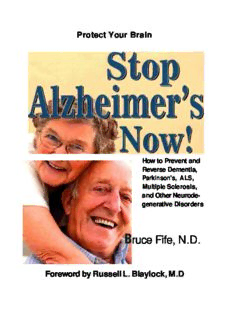
Table Of ContentProtect Your Brain
How to Prevent and
Reverse Dementia,
Parkinson's, ALS,
Multiple Sclerosis,
and Other Neurode
generative Disorders
ruce Fife, N.D.
Foreword by Russell L. Blaylock, M.D
Stop Alzheimer's Now!
More than 35 million people have dementia today. Each year 4.6 million new cases occur
world-wide—one new case every 7 seconds. Alzheimer's disease is the most common form of
dementia. Parkinson's disease, another progressive brain disorder, affects about 4 million
people worldwide. Millions more suffer with other neurodegenerative disorders. The number
of people affected by these destructive diseases continues to increase every year.
Dementia and other forms of neurodegeneration are not a part of the normal aging
process. The brain is fully capable of functioning normally for a lifetime, regardless of how
long a person lives. While aging is a risk factor for neurodegeneration, it is not the cause!
Dementia and other neurodegenerative -disorders are disease processes that can be prevented
and successfully treated.
This book outlines a program using ketone therapy and diet that is backed by decades of
medical and clinical research and has proven successful in restoring mental function and
improving both brain and overall health. You will learn how to prevent and even reverse
symptoms associated with Alzheimer's disease, Parkinson's disease, amyotrophic lateral
sclerosis (ALS), multiple sclerosis (MS), Huntington's disease, epilepsy, diabetes, stroke, and
various forms of dementia.
The information in this book is useful not only for those who are suffering from
neurodegenerative disease but for anyone who wants to be spared from ever encountering one
or more of these devastating afflictions. These diseases don't just happen overnight. They take
years, often decades, to develop. In the case of Alzheimer's disease, approximately 70 percent
the brain cells responsible for memory are destroyed before symptoms become noticeable.
You can stop Alzheimer's and other neurodegenerative diseases before they take over your
life. The best time to start is now.
"Stop Alzheimer's Nowl...will not only be beneficial for Alzheimer's but also for a
wide variety of other diseases. I strongly recommend reading this book!"
Sofie Hexeberg, MD, PhD
"A must read for everyone concerned with Alzheimer's disease...the author explains
how diet modifications and the addition of coconut oil can drastically change the course
of the disease."
Edmond Devroey, MD, The Longevity Institute
"The author's dietary recommendations are a valuable aid to nutritional therapy of
chronic neurodegenerative diseases. I recommend this enlightening book to both
physicians and those who simply want to better understand how our brain functions/
Igor Bondarenko, MD, PhD
"A must read for any and all health care professionals, as well as any family members
or friends of those stricken by these maladies."
Jeffrey Grill, MD
•gl Piccaaddiillllyy Books, Ltd.
WJ www. piccadillybooks.com
How to Prevent and Reverse Dementia,
Parkinson's, ALS, Multiple Sclerosis, and Other
Neurodegenerative Disorders
Bruce Fife, ND
Foreword by
Russell L. Blaylock, MD
Piccadilly Books, Ltd.
Colorado Springs, CO
Every effort has been made to ensure that the information contained in this book is
complete and accurate. However, neither the publisher nor the author is engaged in
rendering professional advice or services to the individual reader. The ideas, procedures,
and suggestions contained in this book are not intended as a substitute for consulting
with your physician. All matters regarding your health require medical supervision. Nei
ther the author nor the publisher shall be liable or responsible for any loss or damage
allegedly arising from any information or suggestion in this book.
Grateful acknowledgment is given to Wikimedia Commons for the use of photographs
on pages 20,22,25,26,32,35,38,39,42,46, 70,90,91, 111, 119,130, 133, and to Mary
Newport, MD for the photos on pages 173 and 174.
Copyright © 2011, Bruce Fife
All rights reserved. No part of this book may be reproduced in any form without permis
sion in writing from the publisher.
Piccadilly Books, Ltd.
P.O. Box 25203
Colorado Springs, CO 80936, USA
[email protected]
www.piccadillybooks.com
Library of Congress Cataloging-in-Publication Data
Fife, Bruce, 1952-
Stop Alzheimer's now!: how to prevent and reverse dementia, Parkinson's, ALS,
multiple sclerosis, and other neurodegenerative disorders / by Bruce Fife ; foreword
by Russell L. Blaylock.
p. cm.
Includes bibliographical references and index.
ISBN 978-0-941599-85-6
1. Alzheimer's disease—Prevention—Popular works. 2. Alzheimer's disease—
Diet therapy—Popular works. 3. Nervous system—Diseases—Prevention—Popular
works. 4. Nervous system—Diseases—Diet therapy—Popular works. 5. Nervous
system—Degeneration—Prevention—Popular works. 6. Nervous system—
Degeneration—Nutritional aspects—Popular works. 7. Ketonic acids—Therapeutic
use—Popular works. I. Title.
RC523.2.F53 2011
616.8'31—dc22
2010037444
Published in the USA
Table of Contents
Foreword 5
Chapter 1: Is There a Cure for Alzheimer's? 9
Chapter 2: The Human Brain 17
Chapter 3: The Many Faces of Neurodegeneration 25
Chapter 4: Premature Aging and Neurodegeneration 45
Chapter 5: Insulin Resistance and Neurodegeneration 58
Chapter 6: Trauma 69
Chapter 7: Drugs 74
Chapter 8: Environmental Toxins 88
Chapter 9: Toxic Metals 100
Chapter 10: Infections 115
Chapter 11: The Dental Connection 129
Chapter 12: Cholesterol is Good for You 139
Chapter 13: The Ketone Miracle 158
Chapter 14: The Facts on Fats 177
Chapter 15: The Ultimate Brain Food 192
Chapter 16: Malnutrition and Neurodegeneration 208
Chapter 17: Brain Boosters 218
Chapter 18: Low-Carb Therapy 235
Chapter 19: The Alzheimer's Battle Plan 257
Chapter 20: Recipes 269
Appendix A: Mental Status Test 294
Appendix B: Parkinson's Disease Rating Scale 297
Appendix C: Drugs Seniors Should Avoid 302
Appendix D: Net Carbohydrate Counter 308
References 320
Index 346
"Stop Alzheimer's Now! by Dr. Bruce Fife offers a diet strategy based on metabolic
understanding that will not only be beneficial for Alzheimer's but also for a wide variety of other
diseases. 1 strongly recommend reading this book!"
Sofie Hexeberg, MD, PhD
"This is an important book which describes fundamental biochemical and physiologic
processes that occur within us in a very readable fashion. As such, it demythologizes much
current belief about causality of most degenerative diseases. Of particular importance is the
discussion of fats, a much maligned source of sustenance, as well as correctly challenging the
notion that the cause of many conditions is the lack of a pharmaceutical agent."
Jean R. Eckerly, MD
"The book Stop Alzheimer's Now! by Dr. Bruce Fife is a must read for everyone concerned
with Alzheimer's disease. After a comprehensive review of the factors contributing to the actual
Alzheimer's epidemic, the author explains how diet modifications and the addition of coconut oil
can drastically change the course of the disease."
Cdmond Devroey, MD, The Longevity Institute, www.longevinst.org
''Stop Alzheimer's Now! represents a major step forward in Alzheimer's disease, exposing
the reality that Alzheimer's and other brain diseases are inflammation-related disorders and
therefore can be effectively treated and potentially completely prevented by reversing
inflammation through better nutrition and healthy lifestyles. Thank you Dr. Fife for writing a
book that can inspire people to take a second look at what they eat."
Catherine Shanahan, MD
Author of Deep Nutrition: Why Your Genes Need Traditional Food
"Dr. Fife has written a superlative treatise on the subject of medium chain triglycerides and
the treatment of neurodegenerative diseases including: Alzheimer's disease (dementia),
amyotrophic lateral sclerosis (ALS), and Parkinson's disease. This seminal work is a 'must read'
for any and all health care professionals, as well as any family members or friends of those
stricken by these maladies. The meticulous research contained in Dr. Fife's manuscript is nothing
short of'miraculous.'"
Jeffrey Grill, MD
This book describes, clearly and in a plain language, the mechanisms by which nutritional
deficiencies damage the body. It also helps to understand the links between hypoxia, imbalances
of carbohydrate turnover, environmental toxicity, and neurodegeneration. The author's dietary
recommendations are a valuable aid to nutritional therapy of chronic neurodegenerative diseases.
I recommend this enlightening book to both physicians and those who simply want to better
understand how our brain functions.
Igor Bondarenko, MD, PhD
Deputy Director of Research Oceania University of Medicine
In this book Stop Alzheimer's Now!, Dr. Bruce Fife has assembled the disparate facts of
neurodegeneration, environmental toxins, inflammation, fats and cholesterol into a new
understanding of mental health built on solid science. With the depth and breadth of his
knowledge, Dr. Fife has made the fearful topic of Alzheimer's disease understandable and has
provided us with evidence for an equally accessible cure—the coconut. I encourage you to read
this book and follow his advice!
Fabian M. Dayrit, PhD
Dean, School of Science & Engineering
Department of Chemistry, Ateneo de Manila University
Foreword
1 am often asked to write forwards to new books and have tried to be rather
discerning in agreeing to do so. When Dr. Fife asked me to write a forward to his
book Stop Alzheimer's Now, I told him I would have to read the manuscript first to
see if 1 agreed with what he was saying. He did so without hesitation.
As 1 began to read through the various chapters I was pleased to see that Dr.
Fife had not only read a great deal of scientific and medical literature concerning
degeneration of the human brain, but that he had a real understanding of the
mechanisms that were leading up to these devastating disorders, such as Alzheimer's
dementia, Parkinson's disease, and Lou Gehrig's disease (ALS).
For many years neuroscientists were puzzled by the occurrence of such
neurodegenerative diseases as Alzheimer's dementia and Parkinson's disease. These
diseases seemed to resist all efforts to understand why a select number of people
developed either focal or widespread degeneration of their brains and why it
occurred with increased frequency with aging.
It seemed that a great many things were associated with these disorders, such
as exposure to heavy metals (mercury and lead), certain light metals (aluminum,
cadmium), pesticides/herbicides, fungicides, head injury, infections, and inheritance of
certain genes (APOE4). Despite massive amounts of data and pathological
examination of thousands of affected brains, neuroscientists still had little to explain
the phenomenon.
While they knew that certain microscopic pathological changes were frequently
found with each of the neurodegenerative diseases, they understood little of how and
why these changes were taking place. They knew, for example, that an abnormal
constructed protein called beta-amyloid accumulated in certain areas of the
Alzheimer's brain and that the neurotubules within dendrites were abnormal (called
neurofibrillary tangles—composed of hyperphosphorylated tau proteins). But, what is
causing these changes?
Despite tens of millions of dollars of research money being spent on studying the
biochemistry of beta-amyloid and tau proteins, few answers are forthcoming.
Meanwhile, millions of cases of neurodegenerative diseases are being diagnosed
each year and, of great concern, these diseases arre increasing in incidence and are
5
6 Stop Alzheimer's Now!
rapidly moving into younger age groups—that is, younger people, even in their forties,
are developing dementing diseases that were once thought to be limited to the elderly.
In this book, you will learn why this growth in devastating neurological disorders
is occurring. Over the past decade neuroscientists have discovered a number of
surprising findings. Most important is that as we age our brain become increasingly
inflamed and for some, this increase is tremendous. It is these individuals who are
at the highest risk for developing one of the neurodegenerative diseases.
Dr. Fife's book will lead you though this tangle of information in a way that is
understandable and makes logical sense. The human brain is an incredibly complex
structure, one that still defies a full understanding. Unlike many organs, brain function
is dependent on a miraculous interplay of trillions of connections, tens of thousands
of biochemical reactions, biophysical structures of incredible complexity and an
interplay of neurons, glia cells, neurotransmitters, neuromodulators, and
neuropeptides, most of which are changing constantly.
Central to our understanding of the cause of these neurodegenerative diseases
is an understanding of the brain's unique immune system, which is controlled by an
interplay of intrinsic brain immune cells, microglia and astrocytes, and immune cells
from the body, macrophages, monocytes, and T-cells.
Normally, these brain immune cells are in a quiescence, resting state until the
brain is disturbed, and when disturbed, for any reason, these immune cells leap into
action. When active they can pour out very destructive immune cytokines,
excitotoxins, and massive amounts of free radicals and lipid peroxidation products—
some pretty nasty customers. Their purpose is to kill bacteria, viruses, or fungi
invading the brain. Under normal conditions, this attack is quickly contained and the
microglial cells then switch to a mode that tries to repair the damage it had to do to
kill the invaders—that is, it cleans up the collateral damage (called bystander injury).
It is now evident that a similar process is occurring with neurodegenerative
diseases of many types, including Alzheimer's dementia, frontotemporal degeneration,
dementia with Lewy bodies, vascular dementia, Huntington's disease, ALS, multiple
sclerosis, and even aged-related memory loss. For a number of reasons, the brain's
immune system is activated, but rather than shutting off, as it should, it continues to
release the destructive cytokines, excitotoxins and free radicals. This can continue
for decades.
In Dr. Fife's book you will learn of the vital importance of brain energy
production in this process. Most cell energy, including neurons, is generated by the
mitochondria. The mitochondria is also the source for most of the free radicals and
lipid peroxidation products as well. It is now known that a loss of mitochondrial
energy production occurs decades before any neurological symptoms occur—that is,
before memory problems, disorientation, or confusion present themselves.
One study of men of an average age of 55 having the APOE4 gene found
significant suppression of their mitochondrial energy production in the same areas of
the brain affected in Alzheimer's dementia. This was decades before the onset of
the disease. An even more startling study examined brain metabolism in APOE4
carrier young men, average age 30.7 years, and found that even at this young age
their brain mitochondrial energy production was significantly impaired in these same
Foreword 7
regions. So, it is firmly established that brain energy metabolism begins to fail
decades before any symptom surfaces. The big question is—what is causing our
mitochondria to fail?
We now live in a sea of toxic chemicals in our environment, that is, in our
drinking water, the air we breathe, and the foods we eat. Compelling evidence
indicates that many of these chemicals impair the ability of mitochondria to make
energy. It is also known that many of these chemicals interact in a way that
enhances each other's toxicity; that is they are synergistic. What this means is that
when neurotoxic chemicals in doses below what normally causes toxicity are mixed
they become fully toxic. The EPA and FDA rarely consider or check for chemical
synergism in their evaluations.
Mercury, lead, cadmium, fluoride, aluminum, many pesticides, herbicides and
fungicides are toxic to mitochondria. We are all exposed to all of these toxins. No
one can escape them. There is also compelling evidence that all of these toxins also
cause brain inflammation by chronically activating microglia. The resulting
neurological disorder depends on which group of microglia is activated. The highest
concentration of microglia is seen in the substantia nigra area of the midbrain
(Parkinson's disease) and the areas affected by Alzheimer's disease.
Ironically, it has also been shown that triggering inflammation, as by vaccination,
can increase the neurotoxicity of a number of these environmental toxins—especially
pesticides. It is also known that the receptors for excitatory neurotransmitters and
inflammatory cytokines crosstalk (interact) to enhance excitotoxicity. I have coined
the name immunoexcitotoxicity to describe this destructive interaction between brain
inflammation and excitotoxicity. There is compelling evidence that
immunoexcitotoxicity is playing a central role in a great many neurological diseases
and disorders, including neurodegenerative diseases, strokes, MS, head injury, and
brain infections. This explains why so many things can be associated with these
conditions.
There is also a link to mitochondrial dysfunction as well. It is known that
excitotoxicity itself impairs mitochondrial function, dramatically increases oxidative
stress and lipid peroxidation and impairs the essential migration of mitochondrial from
the neuron cell body to the synapse. Interestingly, brain inflammation has the same
effect. Immunoexcitotoxicity has also been shown to produce all of the
characteristics of the neurodegenerative diseases themselves, including beta-amyloid
accumulation and neurofibrillary tangles.
It is also well established that mitochondrial suppression, no matter the cause,
greatly enhances excitotoxicity. It may well be that mitochondrial dysfunction
precedes the immunoexcitotoxic process itself and magnifies it once it occurs. This
explains why people with mitochondrial abnormalities can have normal brain function
for such a long time before the symptoms of dementia set in. Studies have shown
that moderate reduction of mitochondrial function by itself rarely impairs brain
function. But, over time, oxidative stress and lipid peroxidation triggered by
mitochondrial dysfunction can damage the connections and dendrites to a degree that
it begins to impair brain function. At this stage, the microglia are activated and
perpetuate the pathological process by immunoexcitotoxicity.
8 Stop Alzheimer's Now!
As this book explains, by causing the body to produce more ketones and by
supplying ketones from medium-chain triglycerides, one not only dramatically
improves mitochondrial energy production, but also, as shown in several studies, at
the same time causes the mitochondria to produce fewer free radicals. It has also
been shown that ketones have strong anti-inflammatory properties and strongly
protects the brain from excitotoxicity.
While increasing ketones is key to correcting the metabolic and
immunoexcitotoxic problems, even more protection is provided by combining certain
dietary changes and the use of special supplements, as described in this book. For
example, curcumin has been shown to protect against excitotoxicity, reduce brain
inflammation and offer powerful protection against some of the most harmful brain
reactive oxygen and nitrogen species, something that vitamin antioxidants are
powerless to do. A number of plant flavonoids have shown similar effects, including
apigenin, luteolin, hesperidin, ellagic acid, and tea catachins.
I was particularly impressed by the book not only by the quality of its overall
scholarship, but also because of the detailed discussion of the importance of
controlling chronic infections, especially oral infections. These infections are major
players in initiating and driving brain immunoexcitotoxicity. As Dr. Fife has shown,
coconut oil has been shown to significantly reduce oral infections as well as systemic
infections. Another major player in our protection is vitamin D3. His discussion of the
antimicrobial peptides generated by vitamin D3 is one of the best I have read.
Finally, this book is more than a scientific treatise on the neuropathological
causation of neurodegenerative disease, Dr. Fife outlines a specific battle plan to
combat these disorders, one that fits very nicely with what we know of these
disorders and is easy to follow. I would encourage everyone faced with the possibility
of encountering neurodegenerative disease, which now includes most of us, to read
this book carefully. It is a treasure trove of invaluable information and practical
advice.
Russell L. Blaylock, M.D., CCN
Theoretical Neurosciences Research, LLC
Visiting Professor of Biology.
Belhaven University, Jackson, MS
www.blaylockwellness.com
www.russellblaylockmd.com
Russell L. Blaylock, MD is a board certified neurosurgeon and formerly a clinical assistant
professor of neurosurgery at the University of Mississippi. He has written three books,
Excitotoxins: The Taste the Kills, Health, Nutrition Secrets That Can Save Your Life, and
Natural Strategies for Cancer Patients, and co-authored the book Cellular and Molecular
Biology of Autism Spectrum Disorders. Dr Blaylock serves on the editorial staff of the Jour
nal of the American Nutraceutical Association and the Journal of American Physicians and
Surgeons. He is currently a visiting professor of biology at Behnaven University in Jackson,
Mississippi and is the president of Theoretical Neurosciences Research, LLC.
Description:Dementia and other forms of neurodegeneration are not a part of the normal aging process. You should not expect to develop dementia as you grow older. The brain is fully capable of functioning normally for a lifetime, regardless of how long a person lives. While aging is a risk factor for neurodegen