Table Of ContentStandOut
2.0
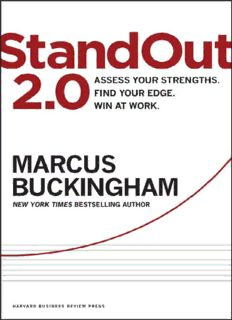
StandOut
2.0
ASSESS YOUR STRENGTHS.
FIND YOUR EDGE.
WIN AT WORK.
MARCUS
BUCKINGHAM
HARVARD BUSINESS REVIEW PRESS
BOSTON, MASSACHUSETTS
HBR Press Quantity Sales Discounts Harvard Business Review Press titles are available at
significant quantity discounts when purchased in bulk for client gifts, sales promotions, and premiums.
Special editions, including books with corporate logos, customized covers, and letters from the
company or CEO printed in the front matter, as well as excerpts of existing books, can also be created
in large quantities for special needs.
For details and discount information for both print and ebook formats, contact
[email protected], tel. 800-988-0886, or www.hbr.org/bulksales.
Copyright 2015 One Thing Productions, Inc.
All rights reserved
No part of this publication may be reproduced, stored in or introduced into a retrieval system, or
transmitted, in any form, or by any means (electronic, mechanical, photocopying, recording, or otherwise),
without the prior permission of the publisher. Requests for permission should be directed to
[email protected], or mailed to Permissions, Harvard Business School Publishing, 60 Harvard
Way, Boston, Massachusetts 02163.
The web addresses referenced in this book were live and correct at the time of the book’s publication but
may be subject to change.
Library of Congress Cataloging-in-Publication Data Buckingham, Marcus.
StandOut 2.0 : assess your strengths, find your edge, win at work / Marcus Buckingham.
pages cm
ISBN 978-1-63369-074-5 (hardback) 1. Employee motivation. 2. Ability. 3. Success. 4. Performance—
Psychological aspects. I. Title.
HF5549.5.M63B833 2015
650.1—dc23
2015009861
Contents
Preface
Birthday Wishes—Toward a Stronger Future
1. Your Genius
Find Your Edge and Make It Work for You
2. The New StandOut Assessment
What It Measures, How It Works, and How to Take It
3. How to Stand Out
Three Lessons for Building Your Strengths
4. “Whistles for Everybody!”
How Strengths-Building Accelerates Innovation
5. The Nine Strength Roles
Advisor, Connector, Creator, Equalizer, Influencer, Pioneer,
Provider, Stimulator, Teacher
Appendix
Strengths Assessment Technical Summary
Index
Acknowledgments
About Marcus Buckingham
About Dr. Courtney McCashland
PREFACE
Birthday Wishes—Toward a
Stronger Future
It’s Sunday, a rainy Sunday in Los Angeles, and, as it happens, my birthday—a
good day to stop and look back. Fifteen years ago, in First, Break All the Rules,
my colleagues at Gallup and I presented the world with a deceptively simple
discovery—that although the world’s best managers have different styles,
personalities, and methods, they all share one insight: to get the most out of
people, you must build on their strengths and manage around their weaknesses.
This might seem like common sense to you, but it caused quite a stir because, at
the time, all management thinking and practice was based on the conviction that,
to help people grow, you must first fix them. Pinpoint their weaknesses, label
these “areas of development” or “areas of opportunity,” and then work diligently
to turn these weaknesses into strengths. In this remedial world, a world in which
polls revealed a global fascination with fixing weaknesses, this strengths-based
approach was an eye-opening jolt to the conventional wisdom.
Not so anymore. If you walked into the offices of Harvard Business Review
today and announced that the best managers focus on strengths, the staff would
nod politely and say, “Yes, thank you. We know.” In the intervening years, this
unconventional truth has become conventional. Positive psychology is now one
of the most fertile and popular fields for academic research, appreciative inquiry
has taken hold as a model for strengths-based organizational change, and more
than nine million people have taken the StrengthsFinder assessment, introduced
in my second book Now, Discover Your Strengths. In fact, this truth is now so
widely held that one sure-fire way to get people’s attention is to rail against it—
hence, books such as Fear Your Strengths and articles with titles like “When
Your Strengths Become Your Weaknesses.”
Yet, look more closely and you discover something rather odd. Although the
strengths-based approach to managing people is now conventional wisdom, the
forms and systems for people inside organizations—the performance appraisal
forms, the training interventions, and succession planning systems—remain
stubbornly remedial. When you have your first performance review—and every
performance review thereafter—you will still be rated on how you stack up
against a preset list of competencies, your gaps will be identified, and you will
be told that to secure a bigger bonus and a desirable promotion, you must
knuckle down and plug your skill gaps. Management theory and management
practice have become separated and are now utterly and unhelpfully out of sync.
It’s as if we are now all aware that the earth is round, yet our maps and
navigation tools persist in representing it as flat.
What to do? This is no idle question, because when it comes to revolutions—
and we were certainly trying to start one—the forms and processes always trump
the ideas. The forms always win. Change the ideas and keep the forms the same,
and you will have changed little. Teach people that to excel they must discover
and apply their strengths, but leave in place all the remedial forms and systems,
and all you will net is confusion and frustration and an inexorable slide back to
the old ways of doing things.
This is where we all are today. The situation is undoubtedly frustrating and
unproductive for students, team members, team leaders, and organizations the
world over. To remove these frustrations, increase productivity, and bring actual
practice up to date with thinking, my team and I created this new version of
StandOut.
First, we’ve taken the StandOut strengths assessment and dramatically
increased its power. When we launched it in 2011, it was an assessment that
simply identified your most dominant strengths and then presented them to you
in a report. This was useful, though, like all reports, it inevitably wound up
hidden in a drawer somewhere, alongside your StrengthsFinder report, Myers-
Briggs report, and all the other personality tests you may have taken. Being
made aware of your strengths at a point in time is one thing, but if you’re not
deliberate about keeping your strengths front and center, then people—including
you—gradually lose sight of them, leaving you vulnerable to the distractions of
weakness-fixing forms and systems.
To make your strengths visible, we designed for you a StandOut Snapshot
that you can use to present the very best of yourself to your team and your
company. Based on your assessment results, the snapshot describes your greatest
value to any team and what others need to know to see you at your best. You can
customize these insights as you see fit and post any pictures, videos, articles, or
quotes that you think will add to people’s understanding of you at your best at
work. You can export this snapshot to LinkedIn, Facebook, or any other social
network, where its unique contribution will always be to present your strengths
to the world credibly, precisely, and vividly. Of course, if you happen to lead a
team, you can make a team dashboard where each person’s snapshot will serve
as your cheat sheet to help you know the right moves to make with each team
member.
Second, we wanted to give you a way to keep learning. After all, the point of
teaching you about your strengths is to help you excel, and excellence, as
Aristotle reminds us, is created not by one act but by what you repeatedly do. So,
to guide what you repeatedly do, this new version of StandOut provides you with
your own personal learning channel. Once you’ve completed the fifteen-minute
online assessment, you will receive not only your report with the ranking of your
strengths and action suggestions, but also a weekly tip, insight, technique, or
idea, something that will help you know how you can do your best work this
week. Faced with a noisy world that is ignorant of you and your strengths, this
weekly pulse will help you take a stand for what you bring to your team and
your organization and guide you to bring it most intelligently.
Third, we made the StandOut assessment the front door to an online
performance system that is entirely strengths-based. Think of StandOut as a
toolbox, in which each tool is designed to tackle one aspect of performance and
engagement.
To help you do more of your best work, you’ll find a simple Check-In tool
that captures your weekly priorities and tracks how engaged you feel week by
week. This Check-In tool comes with coaching advice customized to each
person’s strengths so that, as a team leader, you can know just what to say or do
to keep each person motivated and on track.
Team leaders will also find a simple but powerful employee survey tool that
you can use whenever you want to see what your team is thinking and feeling,
and a performance tool to evaluate the performance of each team member. Your
organization can then aggregate the data from these tools to reveal the real-time
performance and engagement of every team.
Each tool can be used separately, of course, but together they comprise an
integrated system expressly designed to help you and your team do more of what
always happens on the best teams: leverage your strengths and manage around
your weaknesses. We hope and believe that this StandOut system can replace the
legacy remedial systems and finally allow practice to catch up to thinking.
As you can see, we have joined forces with Harvard Business Review Press.
We figured that if we want to change the world, we need the most influential and
credible partners possible, and of course, Harvard Business Review is the
unquestioned authority on how the most effective leaders think and what they
do. Together, with you, we can accelerate the speed of change toward a world in
which each of us knows how to identify, contribute, and develop the very best of
ourselves. That is our wish, for you and your team.
— Marcus
Los Angeles, January 11, 2015
Description:The Groundbreaking Strengths Assessment from the Leader of the Strengths RevolutionIn the years since the publication of First, Break All the Rules and Now, Discover Your Strengths, millions have come to the simple but powerful realization that to get the most out of people, you must build on their