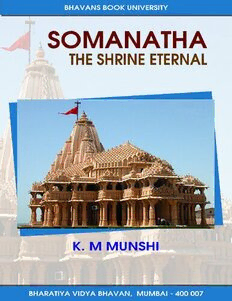
Table Of ContentSOMANATHA
THE SHRINE ETERNAL
by
K. M MUNSHI
Let noble thoughts come to us from every side
-Rigveda 1-89-i
BHAVAN’S BOOK UNIVERSITY
SOMANATHA
THE SHRINE ETERNAL
By
K. M MUNSHI
2016
BHARATIYA VIDYA BHAVAN
Kulapati K. M Munshi Marg, Mumbai 400 007
ALL RIGHTS RESERVED
Bharatiya Vidya Bhavan
K. M Munshi Marg,
Mumbai 400007
First Published: 1951
email: [email protected]
website : www.bhavans.info
GENERAL EDITOR’S PREFACE
THE BHARATIYA VIDYA BHAVAN—that Institute of Indian Culture in
Bombay-needed a Book University, a series of books which, if read, would
serve the purpose of providing higher education. Particular emphasis,
however, was to be put on such literature as revealed the deeper impulsions
of India. As a first step, it was decided to bring out in English 100 books, 50
of which were to be taken in hand almost at once. Each book was to contain
from 200 to 250 pages and was to be priced at Rs. 2.50.
It is our intention to publish the books we select, not only in English, but
also in the following lndian languages : Hindi, Bengali, Gujarati, Marathi,
Tamil, Telugu, Kannada and Malayalam.
This scheme, involving the publication of 900 volumes, requires ample
funds and an all-lndia organisation. The Bhavan is exerting its utmost to
supply them.
The objectives for which the Bhavan stands are the reintegration of the
Indian culture in the light of modern knowledge and to suit our present-day
needs and the re- suscitation of its fundamental Values in their pristine
vigour.
Let me make our goal more explicit:
We seek the dignity of man, which necessarily implies the creation of social
conditions which would allow him freedom to evolve along the lines of his
own temperament and capacities; we seek the harmony of individual efforts
and social relations, not in any makeshift way, but within the frame-work of
the Moral Order; we seek the creative art of life, by the alchemy of which
human limitations are progressively transmuted, so that man may become
the instrument of God, and is able to see Him in all and all in Him.
The world, we feel, is too much with us. Nothing would uplift or inspire us
so much as the beauty and aspiration which such books can teach.
In this series, therefore, the literature of India, ancient and modern, will be
published in a form easily accessible to all. Books in other literatures of the
world, if they illustrate the principles we stand for, will also be included.
This common pool of literature, it is hoped, will enable the reader, eastern
or western, to understand and appreciate currents of world thought, as also
the movements of the mind in India, which, though they flow through
different linguistic channels, have a common urge and aspiration.
Fittingly, the Book University ’s first venture is the Mahabharata,
summarised by one of the greatest living Indians, C. Rajagopalachari; the
second work is on a section of it, the Gita, by H. V. Divatia, an eminent
jurist and a student of philosophy. Centuries ago, it was proclaimed of the
Mahabharata: “What is not in it, is now-where.” After twenty-five
centuries, we can use the same words about it. He who knows it not, knows
not the heights and depths of the soul; he misses the trials and tragedy and
the beauty and grandeur of life.
The Mahabharata is not a mere epic; it is a romance, telling the tale of
heroic men and women and of some who were divine; it is a whole
literature in itself, containing a code of life, a philosophy of social and
ethical relations, and speculative thought on human problems that is hard to
rival; but, above all, it has for its core the Gita, which is, as the world is
beginning to find out, the noblest of scriptures and the grandest of sagas in
which the climax is reached in the wondrous Apocalypse in the Eleventh
Canto.
Through such books alone the harmonies underlying true culture, I am
convinced, will one day reconcile the disorders of modern life.
I thank all those who have helped to make this new branch of the Bhavan’s
activity successful.
1. QUEEN VICTORIA ROAD,
NEW DELHI:
3rd October
1951
K. M. MUNSHI
PREFACE TO THE FIRST EDITION
ON the occasion of the installation of Somanatha, I decided to collect
whatever I knew or had done in connection with Somanatha. I am no
scholar. The book has been written in great hurry under the stress of
pressing preoccupations of a varied nature. I hope, therefore, the reader will
overlook all shortcomings. Someday a scholar will examine the subject and
rewrite the story in a more systematic manner.
To me, however, the satisfaction is of something done at the proper time.
The ruins of Kumarapala’s Temp1e- what I have called The Fifth Temple -
are no more. The underground secrets of the temple are sealed up by the
plinth of the present temple, but before its construction I had excavations
conducted by Shri B.K.Thapar of the Archaeological Department of the
Government of India who undertook the work with rare conscientiousness
and unbounded enthusiasm. The results obtained have been out of all
proportion to the amount of work put in. His report on the excavations
forms indeed a valuable chapter of the book-Part III. I am indebted to him
for the help he gave me. Grateful acknowledgement is also due to Shri S. K.
Joglekar, the Town Planner of the Government of India, for assistance in the
line drawings.
There are many myths connected with this temple. But in the course of my
study, its history, as disclosed by the excavations, was before me and I have
tried to present my conclusions in Part II- “Romance in Stone.” I hope it
will prove useful to the students of history.
NEW DELHI :
25th April
1951
K. M. MUNSHI
PREFACE TO THE SECOND EDITION
THE first edition of this work, being profusely illustrated, was found to be
beyond the reach of the ordinary reader. The illustrations and line drawings
of that edition are of great value to the student of History, Archaeology and
Architecture, but by reason of the high price, the book had become
inaccessible to many. It was, therefore, decided to publish this popular
edition and to include it in the Book University, more for the value of the
subject-matter, rather than the worth of the book.
NAINITAL:
21st June
1952
K.M.MUNSHI
PUBLISHERS’ NOTE: THIRD EDITION
“Somanatha-the Shrine Eternal” has been out of print for a considerable
time and we have pleasure in publishing the third edition of the book,
suitably revised and enlarged.
The first edition of the book was written by the author in great hurry so as
to synchronise its publication with the installation ceremony of Somanatha
in May 1951. Within a year thereafter a second edition had to be published.
Some important material connected with the restoration of this Shrine
Eternal could not be included in the previous editions. We have therefore
thought it advisable in order to complete the records, to include in the
present edition as an Appendix the Chapter entitled ‘Somanatha Rises
Again’, from “Munshi: His Art & Work”, Vol. IV, which was published by
Shri K. M. Munshi 70th Birthday Citizens’ Celebrations Committee.
CONTENTS
PART I
THE STORY OF SOMANATHA
CHAPTER
I SOMANATHA - LORD OF SOMA, THE MOON
GOD
II PRABHASA IN HISTORICAL
TRADITION
III DEHOTSARGA - THE HALLOWED
SPOT
IV SHIVA GUARDIAN OF NATIONAL
RESURGENCE
V SHIVA AND HIS
WORSHIP
VI THE FIRST AND THE SECOND
TEMPLES
VII THE THIRD
TEMPLE
VIII THE GUARDIAN GOD OF
GUJARAT
IX RISE OF A
DESTROYER
X DESTRUCTION OF THE THIRD
TEMPLE