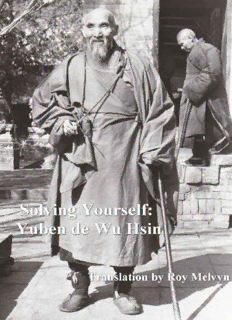
Table Of ContentSolving Yourself: Yuben de Wu
Hsin
Translated by Roy Melvyn
Solving Yourself: Yuben de Wu Hsin
Translated by Roy Melvyn
Copyright 2013 Roy Melvyn
Summa Iru Publishing
Boulder, Colorado 80020
Table of Contents
Translator’s Preface
Welcoming
January (Dōng Yuè)
February (Là Yuè)
March (Zhēng Yuè)
April (Èr Yuè)
May (Sān Yuè)
June (Sì Yuè)
July (Wǔ Yuè)
August (Liù Yuè)
September (Qī Yuè)
October (Bā Yuè)
November (Jiǔ Yuè)
December (Shí Yuè)
Closing
“The point when the words of Wu Hsin are accepted as true and are
lived spontaneously and in every aspect of daily life, is the gateway of
realization.”
Translator’s Preface
In ancient China, there were certain isolated, mountainous areas in the
rural regions that were known as places reserved for intense, secretive trainings.
What was taught was believed to be so powerful that it was rumored that there
were those who realized their true nature in a single instant.
One such place was the compound of Wu Hsin in Hunan province.
Once a year, on the day following the second full moon, the compound
opened its doors for new students. Inside, they gathered to receive what was to
be an initial thirty days of instruction. At the end of the thirty days, novices
could opt to depart or remain for an additional eleven months.
Wu Hsin's style for this teaching was to speak numerous times during the
course of a day, twice at length and other times quite sparingly. Each time was
followed by a period of silence. The silence was seen as clearing away any and
all conceptual processes in order to facilitate Wu Hsin's direct transmission.
In addition, on arrival, each received a scroll containing the Yuben or
Compendium of the Master’s Aphorisms, which were 400 contemplatives to be
used by the students. At regular times during the day, the students were
responsible for making copies of the scroll for themselves and for future
students.
A typical day in a student's life began with arising well before dawn,
before they can see the lines in the palm of their hand. After their morning toilet
duties, they gathered in the main hall where the daily Yuben was read aloud and
a period of sunrise contemplation ensued.
Next came breakfast, usually rice with a modest portion of vegetables,
and subsequent cleanup. Afterward, each student met individually with Wu
Hsin in his quarters, where the student's understanding of the Yuben was
examined.
Once dismissed, the students would attend to the garden and grounds of
the property. After lunch (the main meal of the day with its leftovers constituting
supper) and cleanup, there was more work in the garden, planting and
harvesting, as well as repairing the buildings or other maintenance chores. Mid-
afternoon, there is a second discourse by Wu Hsin in the garden followed by
silent contemplation on said discourse.
The balance of the day was filled by cleaning and upkeep of the interior
of the buildings. Then, as nightfall descended, the evening bell rang out to
signify the work day's end.
During the evening, the student will spend an hour or more making
additional copies of the Yuben. Too, they may sit in contemplation of the daily
reading. Finally, late in the evening, they went off to bed.
Solving Yourself: Yuben de Wu Hsin focuses on the transcendence of
the body and mind, which results in sudden insight into one's true nature. It
produces an involuntary reversion to one's essence, a clear seeing that there is no
place that one can call the center or a reference point here. There is nothing
substantial that would allow one to declare ‘This is where I begin, this is what I
really am.’
Wu Hsin's words take their stand outside any scriptures, and are sourced
solely from his direct experience and subsequent realization. Its foundation was
Li-shih, the interconnectedness of Noumenon and phenomena. He teaches that
our true natures are always pure and luminous and that personality is an acquired
add-on. Awakening occurs when we pierce through the obscurations that we
have created and allow our original purity to shine forth. His words were spoken
from the standpoint of the Ultimate, the non-dual reality underlying our
everyday unenlightened experience of separation and division.
He assigns no value to volitional activity, yu wei. To awaken, Wu Hsin
stresses the spontaneous cessation of thought, no-thought (wu nian), a non-
conceptual state of mind that allows one to experience reality directly, as it truly
is.
His ideas sketch out a distinctive worldview of dynamic, interactive
relationships that unfold in the natural course of things. In this perspective, one
can obstruct one’s inherent tendencies or open conscientiously into a more free
and responsive way of engagement. The latter is the natural way of being. As
such, this awakening is the natural result of seeing into this innate but hidden
potential and allowing it to manifest in every moment.
He targets the self-conscious sense of separation that tends to arise out of
deliberative thinking and living. His focus therein is short on the theoretical.
Instead, he advises that one mustn't get distracted with philosophical or
speculative thought but instead realize one’s true nature in the present moment.
One can see the obvious similarities between this approach and the
Daoist notion of wei wu wei and of jnana yoga as outlined in the Bhagavad-Gita.
His unique teaching style makes frequent use of paradoxical statements
aimed at jolting students out of their habitual mental processes. He is highly
provocative; although he teaches briefly yet it is filled with a concise efficiency.
Those unfamiliar with Wu Hsin will discover a new source of ageless
wisdom filled with pointers to one's natural essence.
Over the years, I have used the scroll for reflection on an inscription in
the same fashion as was done thousands of years ago. I consider the contents of
such value that I have translated them, consolidated the 400 into 366
representing them herein as a daily contemplative to create Solving Yourself. As
has been the case with previous Wu Hsin translations, I have taken a bit of
license in translating his words into more contemporary expression.
Those who are familiar with Wu Hsin will quickly see the Yuben to be of
considerable value. The sayings can act as a stimulant; they are not so much
about what Wu Hsin says but about what they evoke and how we respond.
To my way of thinking, what makes the work of Wu Hsin such a pearl of
great price is that the articulation of his experience pre-dates, by many hundreds
of years, the expressions of the great Channa (Ch’an) masters of the T’ang
Dynasty, often considered to be the apogee of Chinese thought.
In that sense, Wu Hsin was the herald of the great insights to come.
Welcoming
Description:Solving Yourself: Yuben de Wu Hsin focuses on the transcendence of the body and mind, which results in sudden insight into one's true nature. It produces an involuntary reversion to one's essence, a clear seeing that there is no place that one can call the center or a reference point here. There is