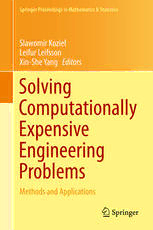
Table Of ContentSpringer Proceedings in Mathematics & Statistics
Slawomir Koziel
Leifur Leifsson
Xin-She Yang Editors
Solving
Computationally
Expensive
Engineering
Problems
Methods and Applications
Springer Proceedings in Mathematics & Statistics
Volume 97
Moreinformationaboutthisseriesathttp://www.springer.com/series/10533
Springer Proceedings in Mathematics & Statistics
Thisbookseriesfeaturesvolumescomposedofselectcontributionsfromworkshops
and conferences in all areas of current research in mathematics and statistics,
includingORandoptimization.Inadditiontoanoverallevaluationoftheinterest,
scientific quality, and timeliness of each proposal at the hands of the publisher,
individual contributions are all refereed to the high quality standards of leading
journals in the field. Thus, this series provides the research community with
well-edited, authoritative reports on developments in the most exciting areas of
mathematicalandstatisticalresearchtoday.
Slawomir Koziel • Leifur Leifsson
Xin-She Yang
Editors
Solving Computationally
Expensive Engineering
Problems
Methods and Applications
123
Editors
SlawomirKoziel LeifurLeifsson
SchoolofScienceandEngineering SchoolofScienceandEngineering
ReykjavikUniversity ReykjavikUniversity
Reykjavik,Iceland Reykjavik,Iceland
Xin-SheYang
SchoolofScienceandTechnology
MiddlesexUniversity
London,UnitedKingdom
ISSN2194-1009 ISSN2194-1017(electronic)
ISBN978-3-319-08984-3 ISBN978-3-319-08985-0(eBook)
DOI10.1007/978-3-319-08985-0
SpringerChamHeidelbergNewYorkDordrechtLondon
LibraryofCongressControlNumber:2014950072
Mathematics Subject Classification (2010): 97M10, 65K10, 65D17, 90C26, 90C31, 49Q10, 76B75,
74P05,74P10
©SpringerInternationalPublishingSwitzerland2014
Thisworkissubjecttocopyright.AllrightsarereservedbythePublisher,whetherthewholeorpartof
thematerialisconcerned,specificallytherightsoftranslation,reprinting,reuseofillustrations,recitation,
broadcasting,reproductiononmicrofilmsorinanyotherphysicalway,andtransmissionorinformation
storageandretrieval,electronicadaptation,computersoftware,orbysimilarordissimilarmethodology
nowknownorhereafterdeveloped.Exemptedfromthislegalreservationarebriefexcerptsinconnection
with reviews or scholarly analysis or material supplied specifically for the purpose of being entered
and executed on a computer system, for exclusive use by the purchaser of the work. Duplication of
this publication or parts thereof is permitted only under the provisions of the Copyright Law of the
Publisher’slocation,initscurrentversion,andpermissionforusemustalwaysbeobtainedfromSpringer.
PermissionsforusemaybeobtainedthroughRightsLinkattheCopyrightClearanceCenter.Violations
areliabletoprosecutionundertherespectiveCopyrightLaw.
Theuseofgeneraldescriptivenames,registerednames,trademarks,servicemarks,etc.inthispublication
doesnotimply,evenintheabsenceofaspecificstatement,thatsuchnamesareexemptfromtherelevant
protectivelawsandregulationsandthereforefreeforgeneraluse.
While the advice and information in this book are believed to be true and accurate at the date of
publication,neithertheauthorsnortheeditorsnorthepublishercanacceptanylegalresponsibilityfor
anyerrorsoromissionsthatmaybemade.Thepublishermakesnowarranty,expressorimplied,with
respecttothematerialcontainedherein.
Printedonacid-freepaper
SpringerispartofSpringerScience+BusinessMedia(www.springer.com)
Preface
Thecostsofextensivecomputationalsimulationsusedforengineeringdesignscan
be very expensive, and thus can be a serious bottleneck for the design process
in many applications. Nowadays prototyping is heavily involved in design and
verification using computermodels, and such computationalapproachescan have
many advantages such as the reduction of the overall design costs and design
cycles as well as finding good solutions to ‘what-if’ scenarios. However, the
computationcostsincurredbyextensivecomputationaltimecanstillbeveryhigh.
Though the speed of the computer power has steadily increased over past the
decades, computationally extensive tasks are still a challenging issue. One of the
reasons is the ever-increasing demand of the high-accuracy, high-fidelity models
forsimulatingcomplexsystems.Formanyapplicationssuchasthoseinaerospace
engineering,microwaveengineeringandbiologicalapplications,asinglesimulation
task can take hours, even days or weeks on modern computers. While in other
applicationssuchascombinatorialoptimizationproblems,theevaluationsofevery
possiblecombinationcanbeprohibitivebecausesuchnumbersofcombinationscan
be astronomical. For continuous problems such as computational fluid dynamics
andelectromagneticwavesimulation,someformsofefficientapproximationssuch
as surrogate-basedmodelsare needed,while for combinatorialproblems,efficient
algorithms should be used, though there are no efficient algorithms for genuinely
NP-hardproblems.
In addition, other challenges associated with such problems include numerical
noise in the simulation data, multimodality with multiple local optimum designs
duetohighnonlinearity,aswellasmultiple(potentiallyconflicting)objectives.All
these make computationallyexpensive design tasks even more challenging. Thus,
it is timely to edit a book to address such problems with the focus on the latest
developments.
From the computationalpointof view, three key issues should be emphasized:
approximation models, optimization algorithms and multi-objectives. Approxi-
mation models often use the so-called surrogates that can reliably represent
v
vi Preface
the expensive, simulation-based model of the system/device of interest. If such
surrogates are designed properly, they can speed up the simulation significantly.
However, such surrogates tend to work for the local, smooth design landscape,
andformultimodalproblems,goodapproximationsarenoteasytoconstruct.This
book will include some of the latest developmentsin this area when dealing with
nonlinearproblemswithcomplexdesignobjectives.
Evenwithefficient,computationalmodels,efficientoptimizationalgorithmsare
also crucial to ensure design optimization that can be carried out successfully
in a practically acceptable time scale. Traditional algorithms such as the trust-
region method,the interior-pointmethod and gradient-basedalgorithms can work
well for local search, but for multimodal global optimization, heuristic and meta-
heuristicalgorithmsstarttodemonstratetheirefficiency.Swarmintelligencebased
approacheswillbeintroducedandreviewedinthisbook.
In almost all engineering applications, there are multiple design objectives
and these objectives can often be conflicting, resulting in very complex objective
landscapesin the design space. Inaddition,complexconstraintscan often modify
thesearchregionssignificantlyandthusmakeitevenmorechallengingforsearch
algorithms. Furthermore,the computationalcosts for multi-objectiveoptimization
willincreasemultifold,comparedtothecounterpartofsingleobjectiveoptimization
problems. For example, multi-objective optimization can be very challenging in
imageprocessingapplications,andwewillalsobrieflytouchthisareainthisbook.
Thiseditedbookprovidesatimelysnapshotofsomeofthelatestdevelopmentsin
surrogate-basedmodels,optimizationalgorithmsandmulti-objectivedesignappli-
cations.Topicsincludesurrogatemodelsinengineeringdesign,surrogate-basedand
PDE-constrainedmodelsinclimateapplications,shape-preservingresponsepredic-
tions,simulation-drivendesignforantennadesigns,spacedimensionreductionfor
multi-objectivedesign, large-scale optimizationvia swarm intelligence, clustering
ofradarimages,classificationoflaserpointclouds,knowledge-basedmodellingby
artificialneuralnetworksandothers.However,asthelengthofthebookislimited,it
isnotourintentiontocovereverything.Asaresult,manytopicsthatareveryactive
in thefield maynotbe coveredatall. Butwe hopeallthe topicswe havecovered
canformabasiswithenoughliteratureforfurtherresearchintherelevantareas.
The editorshopethattopicscoveredin thisbookwill allowthe readersto gain
understandingof basic mechanisms of surrogate modeling process and surrogate-
basedoptimizationalgorithms,tofollowthetrendofswarmintelligenceandimage
processing, and to see the ways of dealing with multi-objective optimization.
Ultimately,thismayhelptoreducethecostsofthedesignprocessaidedbycomputer
simulations. Therefore, this book can serve as a timely reference to researchers,
lecturersand engineersin engineeringdesign,modellingandoptimizationas well
asindustry.
May2014 SlawomirKoziel
Reykjavik,Iceland LeifurLeifsson
London,UK Xin-SheYang
Contents
Surrogate-BasedandOne-ShotOptimizationMethodsfor
PDE-ConstrainedProblemswithanApplicationinClimateModels...... 1
ThomasSlawig,MaltePrieß,andClaudiaKratzenstein
Shape-PreservingResponsePredictionforSurrogateModeling
andEngineeringDesignOptimization......................................... 25
SlawomirKozielandLeifurLeifsson
NestedSpaceMappingTechniqueforDesignandOptimization
ofComplexMicrowaveStructureswithEnhancedFunctionality.......... 53
SlawomirKoziel,AdrianBekasiewicz,andPiotrKurgan
AutomatedLow-FidelityModelSetupforSurrogate-Based
AerodynamicOptimization..................................................... 87
LeifurLeifsson,SlawomirKoziel,andPiotrKurgan
DesignSpaceReductionforExpeditedMulti-ObjectiveDesign
OptimizationofAntennasinHighlyDimensionalSpaces................... 113
AdrianBekasiewicz, SlawomirKoziel,
andWlodzimierzZieniutycz
Numerically Efficient Approach to Simulation-Driven
Design of Planar Microstrip Antenna ArraysBy Means
ofSurrogate-BasedOptimization .............................................. 149
SlawomirKozielandStanislavOgurtsov
OptimalDesignofComputationallyExpensive EM-Based
Systems:ASurrogate-BasedApproach ....................................... 171
Abdel-KarimS.O.Hassan, HanyL.Abdel-Malek,
andAhmedS.A.Mohamed
vii
viii Contents
Atomistic Surrogate-Based Optimization
for Simulation-Driven Design of Computationally
ExpensiveMicrowaveCircuitswithCompactFootprints................... 195
PiotrKurganandAdrianBekasiewicz
KnowledgeBasedThree-StepModelingStrategyExploiting
ArtificialNeuralNetwork....................................................... 219
MuratSimsek
Large-ScaleGlobalOptimizationviaSwarmIntelligence................... 241
ShiCheng,T.O.Ting,andXin-SheYang
EvolutionaryClusteringforSyntheticApertureRadarImages............ 255
ChinWeiBongandXin-SheYang
AutomatedClassificationofAirborneLaserScanningPointClouds ...... 269
ChristophWaldhauser,RonaldHochreiter,JohannesOtepka,
NorbertPfeifer,SajidGhuffar,KarolinaKorzeniowska,andGerald
Wagner
A Novel Approach to the Common Due-Date Problem
onSingleandParallelMachines................................................ 293
AbhishekAwasthi,JörgLässig,andOliverKramer
OnGaussianProcessNARXModelsandTheirHigher-Order
FrequencyResponseFunctions................................................. 315
KeithWorden,GraemeManson,andElizabethJ.Cross
Surrogate-Based and One-Shot Optimization
Methods for PDE-Constrained Problems
with an Application in Climate Models
ThomasSlawig,MaltePrieß,andClaudiaKratzenstein
Abstract We discuss PDE-constrained optimization problemswith iterative state
solvers. As typical and challengingexample,we presentan applicationin climate
research,namelyaparameteroptimizationproblemforamarineecosystemmodel.
Therein, a periodic state is obtained via a slowly convergent fixed-point type
iteration.Werecallthealgorithmthatresultsfromadirectorblack-boxoptimization
of such kind of problems, and discuss ways to obtain derivative information to
use in gradient-based methods. Then we describe two optimization approaches,
the One-shotand the Surrogate-basedOptimizationmethod.Both methodsaim to
reduce the high computational effort caused by the slow state iteration. The idea
of the One-shot approach is to construct a combined iteration for state, adjoint
and parameters, thus avoiding expensive forward and reverse computations of a
standardadjointmethod.IntheSurrogate-basedOptimizationmethod,theoriginal
modelisreplacedbya surrogatewhichisherebasedona truncatediterationwith
fewer steps. We compareboth approaches,provideimplementationdetails for the
presentedapplication,andgivesomenumericalresults.
Keywords Optimization • Climatemodel • Marineecosystemmodel • One-shot
method • Surrogate-basedoptimization
1 Introduction
Climate simulations are a very challenging task in applied mathematics and
scientific computing. The underlying mathematical systems have a high number
of uncertainties with respect to initial values, model parameters, or the relevant
processestobeincluded.Moreover,thestateequationsolversofteninvolveiterative
algorithmsto compute steady or periodic solutions. To identify modelparameters
and to assess the models, model-to-data misfit functions are minimized using
T.Slawig((cid:2))•M.Prieß•C.Kratzenstein
DepartmentofComputerScienceandKMSCentreforInterdisciplinaryMarineScience,
Christian-Albrechts-UniversitätzuKiel,24098Kiel,Germany
e-mail:[email protected]
©SpringerInternationalPublishingSwitzerland2014 1
S.Kozieletal.(eds.),SolvingComputationallyExpensiveEngineeringProblems,
SpringerProceedingsinMathematics&Statistics97,
DOI10.1007/978-3-319-08985-0__1