Table Of ContentCopyright © 2022 by Javier Zamora
All rights reserved.
Published in the United States by Hogarth, an imprint of Random House, a division of Penguin
Random House LLC, New York.
HOGARTH is a trademark of the Random House Group Limited, and the H colophon is a trademark of
Penguin Random House LLC.
ISBN 9780593498064
Ebook ISBN 9780593498071
randomhousebooks.com
Book design by Barbara M. Bachman, adapted for ebook
Cover design: Anna Kochman
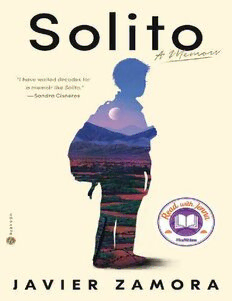
Cover illustration: Daniel Liévano
ep_prh_6.0_141009069_c0_r1
Contents
Cover
Title Page
Copyright
Author's Note
Epigraph
Chapter One
Chapter Two
Chapter Three
Chapter Four
Chapter Five
Chapter Six
Chapter Seven
Chapter Eight
Chapter Nine
Epigraph
April 5, 2021
Dedication
Acknowledgments
Also by Javier Zamora
About the Author
The events and the people depicted in this book are real. To protect the
identity of some, I’ve changed their names or used nicknames.
Our bodies are the texts that carry the memories and
therefore remembering is no less than reincarnation.
—
KATIE CANNON
( The Body Keeps the Score)
QUOTED IN
Both boys and girls for example, made references to
the time lost and particularly to the uniqueness of a
mother’s love. More than one also described feeling as
if they had a hole in their heart due to their mothers’
absence. In this way, they were always enveloped by a
sense of longing.
— .
LEISY J ABREGO
Sacrificing Families
CHAPTER ONE
La Herradura, El Salvador
MARCH 16, 1999
T
rip. My parents started using that word about a year ago—“one day,
you’ll take a trip to be with us. Like an adventure. Like the one Simba
goes on before he comes home.” Around that same time they sent me
Aladdin, Jurassic Park, and The Lion King, alongside a Panasonic VHS
player for my eighth birthday.
“Trip,” they say now as I’m talking to them at The Baker’s, where
Abuelita Neli, Grandpa, and I go to call them—we don’t have a phone at
home, but we do have a color TV, a brand-new fridge, and a fish tank.
“¡Javiercito!” Abuelita Neli waves her hand at me. She’s always called
me that. I think my nickname, Chepito, reminds her too much of what the
town calls Grandpa: Don Chepe.
“Your parents say you’ll soon be with them,” Abuelita says, and smiles,
showing off her two top middle teeth lined in gold. Her dimples dig deeper
into her round face. Tía Mali, who also has a round face, isn’t here, because
she’s working at the clinic. She and Abuelita have been using the word
more and more. Trip this, trip that. Trip trip trip. I can feel the trip in the
soles of my feet. I see it in my dreams.
In some dreams I’m Superman, or I’m Goku, flying over fields, rivers,
over El Salvador, over all the countries, over the people, towns, all the way
to California, to my parents. I ring their bell. They open their huge door, tall
and wide, made from the brownest wood, and I run to them. They show me
their living room. Their huge TV. Their backyard with a swimming pool, a
lawn, fruit trees, a mini soccer field, a white fence. I climb their marañón
trees, eat their mangos, play in their garden…
Every night, between praying and sleeping, I lie in bed and think about
them. ¿What type of bed do they sleep on? ¿Is it big? ¿Is it a waterbed like
in the movies? ¿Are the sheets soft? I imagine cuddling right in the middle.
The comfiest white sheets. Mom to my left, Dad to my right, a mosquito net
like a crown covering all of us.
Whenever a plate breaks, whenever I find an eyelash, whenever I see a
shooting star, I wish to be in that bed with both of them in La USA, eating
orange sherbet ice cream. I never tell anyone—if I tell anyone my wish it
won’t come true.
I have bad dreams también. Bad dreams of growing a beard with my
parents still not here. Bad dreams where I’m not up there with them—¡and
I’m thirty years old! Bad dreams of being chased by pirates, or running
down a hill during a mudslide.
“The bad dreams, those you have to tell first thing in the morning so
they don’t stay in your mind. And never in the kitchen, or else they get in
your stomach. That’s how you get indigestion,” Mom told me, and I never
forgot.
Trip. I’ve started using the word at school. I began telling my closest
friends: “Fijáte vos, one day I’m taking a trip. Like a real-real game of hide-
and-seek.”
In first grade, I was the only one who didn’t have both parents with me.
Mali says they left because before I was born there was a war, and then
there were no jobs. Now, most of my friends don’t have their dad or mom
here either. A few lucky friends have left to be with their parents in La
USA. Most left inside giant planes.
At recess, my friends and I talk about eating our first pepperoni pizza
like the Teenage Mutant Ninja Turtles, eating lasagna like Garfield, eating
McDonald’s, watching the new Star Wars inside a theater with air-
conditioning, eating “popcorn” with butter. I’ve never tried any of these
things except for pizza from Pizza Hut, and that was last Christmas.
“¿But will you miss me? ¿Will you?” my friends ask.
“Puesí,” I say, but I don’t really know.
I ask them if they will miss me. “Absolutely,” they say, because no one
who’s left to La USA has ever come back to visit. Sometimes their grandma
or grandpa will walk by on the street and we’ll ask them how So-and-So is,
and they respond, “So-and-So says hi”—that’s the closest they come to
remembering us. “Oh, gracias, doña, gracias, don. Tell them we say hi.” But
we never hear from them again.
The Baker is still here. His wife and all six of his kids también. They
look happy. I want what The Baker’s family has: everyone in the same
room. All my friends and I want to be with our parents, where everything is
new, fresh, where garbage is collected by trucks, where water comes out of
silver faucets, where it snows the whitest snow, where people have
snowball fights and cut real pine trees for Christmas—not spray-paint
cotton branches in white like we do here.
It’s because our parents are not here and we’re not there that Mays and
Junes are sad. For most of us, our grandparents are the ones who show up
for Mother’s and Father’s Day assemblies. It’s not that we don’t love them.
We do. I love Abuelita so much. I love her cooking. The way my face gets
stuck in her curly, frizzy hair that she dyes black, her short hair that makes
her look like a microphone, her hair that smells like pupusas when she hugs
me. I love her two dimples when she smiles. Her wide and flat nose with its
dark-brown mole in the middle that she has to check at the hospital every
year to see it doesn’t get too big. And I love her fake eyebrows she draws
thin with a pencil first thing in the morning.
I love my mom, también. I’ve never met my dad—or I have, but I don’t
remember him. I was about to turn two when he left. He sounds nice over
the phone. His voice is deep and raspy, but it’s still soft, like a sharp stone
skipping over water. I always talk to him second, after I talk to Mom. I
remember everything about her. Her harsh voice like a wave crashing when
she got mad at me. Her breath like freshly cut cucumbers.
Now I talk to her first, and then she hands the phone to Dad. Sometimes
I’m so shy with Dad, Mom has to be on the phone at the same time. Other