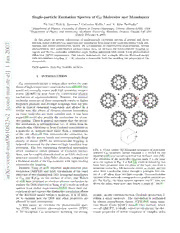
Table Of ContentSingle-particle Excitation Spectra of C Molecules and Monolayers
60
Fei Lin,1 Erik S. Sørensen,2 Catherine Kallin,2 and A. John Berlinsky2
1Department of Physics, University of Illinois at Urbana-Champaign, Urbana, Illinois 61801, USA
2Department of Physics and Astronomy, McMaster University, Hamilton, Ontario, Canada L8S 4M1
(Dated: February 6, 2008)
In this paper we present calculations of single-particle excitation spectra of neutral and three-
7 electron-dopedHubbardC60 moleculesandmonolayersfromlarge-scale quantumMonteCarlosim-
0 ulations and cluster perturbation theory. By a comparison to experimental photoemission, inverse
0 photoemission, and angle-resolved photoemission data, we estimate the intermolecular hopping in-
2 tegralsandtheC60 molecular orientation angle,findingagreement withrecentX-rayphotoelectron
diffraction (XPD) experiments. Our results demonstrate that a simple effective Hubbard model,
n
a with intermediate coupling, U =4t, provides a reasonable basis for modeling the properties of C60
compounds.
J
1
PACSnumbers: 73.61.Wp, 78.20.Bh,02.70.Uu
]
l
e I. INTRODUCTION
-
r
t
s C60 compoundsoccupyauniqueplacewithinthe pan-
t. theonofhigh-temperaturesuperconductors.1,2,3,4,5,6 One
a
would not normally expect such high transition temper-
m
atures (30-40K) to arise from the conventional phonon
- mechanism of superconductivity. However, the unusual
d
n molecularstructureofthese compoundsresultsinhigher
o frequency phonons and stronger couplings than are pos-
c sible in typical elemental compounds and alloys.7 In a
[ similar way, the effects of electron-electron interactions
2 on these molecules are more complex and, it has been
v argued,8,9 could also provide the mechanism for attrac-
3 tive pairing. There is generalagreementthat the attrac-
2 tive mechanism is intramolecular, i.e., it arises from in-
8
tramolecularvibrationsorfromCoulombcorrelationson
0
a molecule or, perhaps most likely, from a combination
1 K
of the two effects.10 This intramolecular attraction, to-
6
0 gether with the narrow bands and correspondingly large Γ M
/ density of states (DOS) for intermolecular hopping, is
t
a believedtoaccountfortheobservedhightransitiontem-
m peratures. The two contrasting theoretical approaches,
FIG.1: (Coloronline)2Dhexagonalmonolayerofidentically
d- wtiohnicsh,ceamnpbhearsoizuegheliythcehrarpahctoenroiznesdoarsaCnoLulDomAbeleincttreornacic- oriented C60 molecules (lattice constant a = 10.02˚A for the
n superlattice11)anditscorrespondingfirstBrillouinzone(BZ).
structure coupled to Jahn-Teller phonons, compared to
o The definition of the molecular rotation angle θ is the same
a Hubbardmodel ofthe C molecule with tight-binding
c 60 asinthecaptionofFig. 4ofRef.11,whichisdefinedbytwo
: intermolecular hopping. lines, both projected onto the plane of the layer, one from a
v Recently Yang et al.11 reported angle-resolved pho- molecularcentertoaNNmolecularcenter,asshown,andthe
i
X toemission (ARPES) and LDA calculations of the band other from a molecular center through a pentagon face cen-
r structureoftwo-dimensional(2D)hexagonalmonolayers ter. θ =0o when these two lines coincide. Counterclockwise
a of C and K C on the surface of silver, and Wehrli rotationofthemoleculecorrespondstoapositiverotationan-
et al.6102 have p3rop60osedanelectron-phononmechanism to gle. ForK3C60,theblacksquaresrepresenttwoK+ ions,one
explaintheDOSobservedinYangetal.’sstudyaswellas abovethe other, while gray ones denote a single K+ ion.11
spectra from earlier experiments.13,14,15 Since their cal-
culationsdonotcapturethedistinctivecorrelationeffects
of the Hubbard model within a molecule, it is of inter- atomic, on-site electron-electron Coulomb interaction U
est to examine how the DOS and other properties are within a single molecule. The calculation is performed
affected by such correlations. by cluster perturbation theory (CPT)16,17 using quan-
In this paper, we calculate the photoemission spec- tum Monte Carlo (QMC) data.18 This method, which
tra (PES) and inverse photoemission spectra (IPES) we callQMCPT,is ideally suited to calculating the elec-
of 2D hexagonal C monolayers including the strong, tronic properties of solids composed of complex units
60
2
suchasfullerenemolecules. Todistinguish,weshallrefer
(a) C , N=60
to the standard CPT approach16,17 as EDCPT since it 60
uses exact diagonalization (ED) results. By comparing
thecalculatedsingle-particleexcitationspectra,forinter-
)
s
mediate interaction strength, U =4t, with experimental nit
data,11,19 wecanestimatetheintermolecularhoppingin- u
′ b.
tegrals t and the molecular orientation angle, θ, which r
a
are useful for an effective Hubbard model Hamiltonian y ( (b) C , N=63
description of C compounds. From the best fit param- sit 60
60 n
eters, we find a rotation angle of θ = 64o (as defined in nte
Fig. 1, and assuming that the C molecules are all ori- I
60
ented identically) which is consistent with experimental
measurements.11,20
-6 -4 -2 0 2 4 6
(E-E )/t
F
II. MODEL
FIG. 2: (Color online) DOS of (a) C60 and (b) C360− single
molecules from QMC and MEM for U = 4t and βt = 10. A
TheHamiltonianforthe2DhexagonalC superlattice
60 total of 465 and 620 binsof space-time Green’s functions are
is given by collected for C60 and C630−, respectively, for MEM analysis.
Eachbinisanaverageover100space-timeGreen’sfunctions,
H = H +V, (1)
0 which are collected after each QMC sweep over the whole
H0 = XH0I, (2) space-time lattice.
I
where where Rˆ is a unit vector along radial direction, dˆ =d/d
is a unit vector pointing from atom Ii to Jj, and
H0I =− X tij(c†iσcjσ +h.c.)+UXni↑ni↓ (3)
d
hIi,Ijiσ i∈I V (d)=−4V (d)= exp[−(d−d )/L], (6)
σ π 0
d
0
is the Hubbard model on the Ith C molecule, and
60
with L=0.505˚A, and d =3.0˚A.23 We leave the overall
0
V =− X (t′αIi,Jj +tiIni,dJj)(c†IiσcJjσ +h.c.) (4) prefactor t′ as a parameter to be determined later.
hIi,Jjiσ We see from Fig. 1 that for K3C60 the C60 molecules
are separatedby K+ ions, either two ions, one above the
is the hopping Hamiltonian between a pair of carbon other or single ions. The indirect hopping between C
60
(C) atoms i and j on two nearest neighbor (NN) C60 molecules via K+ ions is thus of comparable importance
molecules I and J, respectively. The operator notations to that of the direct C-C hopping integrals. Expressions
are standard for the usual Hubbard model. Inside the for the indirect hopping between C atoms via the K+
molecule U is the on-siteCoulombinteractionenergyfor ions are given by24
twoelectronsonthesameCatom,andt isthehopping
ij
integral between two NN carbon atoms. A molecular ind tIi,γtJj,γ
U, parameterizing the interaction energy for two elec- tIi,Jj =X ǫ −ǫ , (7)
C K
trons on the same C molecule, and hence distinct from γ
60
our atomic U, is also discussed in the literature. See for where ǫ −ǫ = −4eV is the energy difference between
C K
instance Ref. 19. For the C60 molecule, there are two a C atom andK+ ion, γ =1,··· ,9 is K+ index, and the
kindsofbondsbetweenNNsites: t =tforsinglebonds
ij C-K hopping integral is given by
(1.46˚A),andt =1.2tfordoublebonds(1.40˚A). Weset
ij
t=2.72eVaccordingtoRef.21. Thevalueofthe on-site ~2
Coulomb energy, U, is taken to be U = 4t, an interme- tIi,γ =1.84Dmd2e−3(d−Rmin), (8)
diate coupling value for which the sign problem for the
single-molecule QMC is manageable.22 where d is C-K separation, m is electron mass, R
min
The shortest distance between two C molecules is is the shortest C-K separation for a given K+ and C
60 60
about3.0˚A. Therelativesizesofthedirecthoppinginte- molecule, and D =0.47.24 We take the indirect hopping
grals α between two C atoms on two NN molecules matrixelementstobe fixedwhilethe directhoppingma-
Ii,Jj
are given by23 trix elements scale with the fitting parameter t′. For the
′
value of t used to fit the ARPES data, we find that the
α =[V (d)−V (d)](Rˆ ·dˆ)(Rˆ ·dˆ)+V (d)(Rˆ ·Rˆ ), largest direct hopping matrix elements are substantially
Ii,Jj σ π Ii Jj π Ii Jj
(5) larger than the indirect hopping matrix elements.
3
We note that our model Hamiltonian, given by Eqs.
(2)-(4), neglects both the long-range Coulomb interac- (a) QMCPT, 2D, OBC
tions andthe effect ofthe silversubstrate,bothofwhich <n>=1, β=10/t, U=8t
Γ
would be difficult to include in QMC calculations. One
would expect the long-range Coloumb interaction to in-
creasethe effective molecular U. On the other hand, the ω)
silversubstrate,aswellastheothermolecules,willscreen k, X
A(
this interaction and, consequently, these two effects may
partially cancel. In any case, we will see below that the M
simple Hubbard model and parameters employed here
yield results in generally good agreement with experi-
ment. Γ
-8 -6 -4 -2 0 2 4 6 8
(ω-µ)/t
III. RESULTS
(b) EDCPT, 2D, OBC
<n>=1, T=0, U=8t
A. Single Molecule DOS Γ
We begin by considering results for a single C ω)
60 k, X
molecule. QMC simulations were used to calculate A(
the imaginary-time Green’s functions for C and C3−
60 60
molecules,basedonthesingle-moleculeHamiltonian,H M
0
and standard QMC25,26,27 for given values of t and U.
The QMC step for the single molecule is by far the most
Γ
time-consuming part of the calculation. The maximum
-8 -6 -4 -2 0 2 4 6 8
entropy method (MEM) was then used to analytically
(ω-µ)/t
continue the imaginary-time Green’s functions to real
frequency,28 which gives the single molecule DOS shown
FIG. 3: Single particle spectral functions of a 2D Hubbard
in Fig. 2 for T =0.1t. From the figure, we see that neu-
model from (a) QMCPT and (b) EDCPT with open bound-
tralC60 isaninsulatorwithanenergygapabout1.05tor ary conditions. The cluster is of dimension 3×4. The two
2.86eV. The presence of this gap is not surprising since
methods predict very similar single-particle excitation ener-
neutralC60 hasafilledshellwithasizableexcitationgap gies and energy gaps. Notethat special k pointsΓ,M,X are
even for U = 0. In fact the gap obtained by extended for a 2D square lattice, different from those in Fig. 1.
Huckel calculations for the neutral model is also about
1t, although the correlations for that case are very dif-
ferent than for U =4t. For the C3− molecule, the Fermi
60 C. Monolayer DOS
energy lies in a region of non-zero density of states.
NextweconsiderthecaseofC monolayers. Forthese
60
′
calculations we use values of t and the orientation an-
B. QMCPT for 2D Square Lattice gle θ which are obtained by fitting photoemission and
diffraction data as will be discussed below. We show the
TheremainingperturbativepartoftheQMCPTcalcu- DOSformonolayersofbothC60andK3C60,inpanels(b)
lationis,bycomparison,veryeconomical. Itusesthesin- and (c) of Fig. 4. Also shown for comparison, in panel
′
gle molecule Green’s functions calculated above to con- (a) of Fig. 4, is the DOS for the same values of t and θ,
struct any superlattice Green’s functions, incorporating but for U = 0. The lattice of neutral C molecules is
60
the effect of the intermolecularhopping Hamiltonian, V, very different from the 2D square lattice of atomic sites,
anddifferentmolecularorientationswithnegligibleaddi- for which spectra are shown in Fig. 3, because the C
60
tional computational effort. This method has been ap- molecule has an excitation gap as was shown in the top
plied to the simpler case of the 2D Hubbard model on panel of Fig. 2. For U = 0 [(a) panel of Fig. 4], the C
60
a square lattice, which is metallic for U = 0 but which monolayer is a band insulator with a gap of about 0.5t
developsaninsulatingMott-Hubbardgapforsufficiently whichis abouthalfthe valueforthe single-moleculecase
large U. The “cluster” in this case is a small unit of the becausethebandsaboveandbelowthegaparebrodened
lattice which can be treated either by QMC or by exact by temperature effects and the intermolecular Hamilto-
diagonalization. Results for U = 8t, obtained by QM- nian V, thus reducing the gap. We see, from the (b)
CPT and by EDCPT,basedon a 3×4 cluster ofsites,18 panelwhereU =4t,thatthe effectofU isto enlargethe
are shown in Fig. 3. gap back to a value (∼ 2.8eV) slightly greater than 1t
4
(a) C monolayer, U=0
60
0.05
)
s
t 0 0.9
i
n
arb. u (b) C60 monolayer, U=4t E (eV)F-0-.00.51 00..36
y ( E-
it -0.15
s
n
e
t -0.2
n (c) K C monolayer, U=4t
I 3 60 -0.8 -0.6 -0.4 -0.2 0 0.2
k
//
-6 -5 -4 -3 -2 -1 0 1 2 3 4 5 6
(E-E )/t Θ=64o M Γ
F
0.05
0.3
FIG. 4: (Color online) DOS of hexagonal (a) C60 monolayer 0 0.25
mwiotnhoUlay=er0w,i(tbh)UC6=0 m4tonfroolamyeQrMwiCthPTU c=al4ctu,laatniodn(sc)foKr3tC′ 6=0 eV) -0.05 000...1125
−0.3t and T =0.1t. Shaded areas are occupied by electrons. (F 0.05
E -0.1 0
E-
-0.15
due to short-range,Mott-Hubbard corelations. This gap
-0.2
value is comparable to the value of 2.3eV measured by
Lof et al. in Ref. 19. Our calculated gap value may be -0.8 -0.6 -0.4 -0.2 0 0.2
somewhat larger than the experimental gap due to our k//
neglect of the silver substrate, which may reduce the en-
ergygap.29 Bycontrast,forthecaseofK C [(c)panel]
3 60 ′
the monolayerremainsmetallicwithits Fermienergyly- FIG. 5: Determination of NN molecular hopping integral t
and molecular orientation angle θ by comparing the exper-
ing within a narrow conduction band (Fig. 4).
′ imental ARPES result11 (upper panel) with the theoretical
To determine′the parameter t and orientation an- one (lower panel), which has t′ = −0.3t and molecular rota-
gle θ, we vary t and θ values in the QMCPT calcula- tion angle θ = 64o. The energy unit has been converted to
tions. Theresultingenergy-momentumdispersioncurves eV using t=2.72eV. The momentum unit is ˚A−1.
(alongthe ΓM direction)forthehexagonalmonolayerof
K C arethencomparedwiththeexperimentalonefrom
3 60
ARPES.11 We find that the best fit is obtained when
t′ = −0.3t with a rotation angle θ = 64o ±4o. From
Fig.5,weseethatboththeexperimentalandtheoretical (a) C60 monolayer exp
QMCPT
band widths areabout 100meV.Howeverthe theoretical
band dispersion in the k range [−0.8,−0.6]˚A−1 is rather nits)
weakaroundtheFermienergy,whileintheexperimental u
dispersionfigure,thebanddispersioninthatmomentum rb.
a
range is much more obvious. We think that this results y (
from two causes: First MEM has difficulty reconstruct- nsit (b) K C monolayer exp
ing the weak features of the band dispersion curve, and, nte 3 60 QMCPT
second, the experimental scanning direction is not ex- I
actly along ΓM.11 The above determined rotation angle
θ = 64o±4o is in good agreement with XPD structural
data.20
The densities of states in the lower two panels of Fig. -10 -8 -6 -4 -2 0
E-E (eV)
4 are directly comparable to the PES data (Fig. 1E in F
Ref. 11) of Yang et al., we draw only the photoemission
FIG.6: (Coloronline)ComparisonofDOSfromQMCPTcal-
(PE) part of the calculated DOS together with the ex- culationsandexperimentalPESdata11 forC60 (upperpanel)
perimentalPESdatainFig.6. WeseethattheQMCPT andK3C60 (lowerpanel)hexagonalmonolayer. TheQMCPT
results agree reasonably well with the PES data close energy scale has been converted to electron volts by setting
to the Fermi energy, with approximately the same en- t=2.72eV.
ergygapsfortheC monolayerandsimilarpeaksatthe
60
5
Θ=0o M Γ Θ=10o M Γ
0.05 0.05
0.3 0.3
0 0.25 0 0.25
0.2 0.2
eV) -0.05 00..115 eV) -0.05 00..115
(F 0.05 (F 0.05
E -0.1 0 E -0.1 0
E- E-
-0.15 -0.15
-0.2 -0.2
-0.8 -0.6 -0.4 -0.2 0 0.2 -0.8 -0.6 -0.4 -0.2 0 0.2
k k
// //
Θ=20o M Γ Θ=30o M Γ
0.05 0.05
0.3 0.3
0 0.25 0 0.25
0.2 0.2
eV) -0.05 00..115 eV) -0.05 00..115
(F 0.05 (F 0.05
E -0.1 0 E -0.1 0
E- E-
-0.15 -0.15
-0.2 -0.2
-0.8 -0.6 -0.4 -0.2 0 0.2 -0.8 -0.6 -0.4 -0.2 0 0.2
k k
// //
Θ=40o M Γ Θ=50o M Γ
0.05 0.05
0.3 0.3
0 0.25 0 0.25
0.2 0.2
eV) -0.05 00..115 eV) -0.05 00..115
(F 0.05 (F 0.05
E -0.1 0 E -0.1 0
E- E-
-0.15 -0.15
-0.2 -0.2
-0.8 -0.6 -0.4 -0.2 0 0.2 -0.8 -0.6 -0.4 -0.2 0 0.2
k k
// //
Θ=60o M Γ Θ=70o M Γ
0.05 0.05
0.3 0.3
0 0.25 0 0.25
0.2 0.2
eV) -0.05 00..115 eV) -0.05 00..115
(F 0.05 (F 0.05
E -0.1 0 E -0.1 0
E- E-
-0.15 -0.15
-0.2 -0.2
-0.8 -0.6 -0.4 -0.2 0 0.2 -0.8 -0.6 -0.4 -0.2 0 0.2
k k
// //
FIG. 7: Band dispersions along ΓM direction with different rotation angles θ for a 2D hexagonal K3C60 superlattice from
QMCPT calculations. The other parameters are fixed: U =4t, t′ =−0.3t, and T =0.1t. The momentum unit is ˚A−1.
6
Fermi energy for the K C monolayer. In addition, we K C . The calculations were carried out by the QM-
3 60 3 60
find small peaks at around −2eV and valleys at around CPT technique,16,17,18 using a Hubbard model for each
−4eVfor boththeoreticalandexperimentalPEScurves. molecule,andsimpleelectronhoppingbetweenmolecules
Thus,althoughwedonotclaimthatU =4tcorresponds of the 2D C superlattice. This new computational
60
to a fit to the data,this value ofU is consistentwith the method is particularly well-suited to composite systems
PES data. Smaller or larger values of U would lead to of fullerenes. Using a plausible value, U = 4t, for the
smaller orlargervalues of the gapfor neutralC mono- on-site Coulomb interaction U, we fit the effective NN
60
′
layers. Unfortunately, to go beyond this by varying the molecular hopping amplitude, t , and the C molecu-
60
valueofU would,atpresent,requireaprohibitivelylarge lar rotation angle θ to ARPES and XPD data. We find
amount of computer time. that the electronic spectra are extremely sensitive to the
′
We comment that the above-determined value of t molecular orientation angle θ. With these fitted param-
is consistent with earlier TB and LDA calculations23, eters, we find good agreement with photoemission data
where Satpathy et al. found good agreement between for the electronic density of states. The C-C hopping in-
TB and LDA band structure calculations for a fcc C tegrals between NN molecules obtained from the fits are
60
lattice. The magnitudes of their TB hopping integrals consistent with earlier TB and LDA calculations.23
between two nearest C atoms on two NN C molecules The significance of the present calculations is to show
60
are, depending on the relative orientations of NN C thattheelectronicspectraldataobtainedsofararecom-
60
molecules, in the range of (0.50eV,0.82eV). From our patiblewiththerelativelysimplemodelofelectroniccor-
calculation,the maximumC-Choppingintegralbetween relationscontainedintheintramolecularHubbardmodel
two NN C molecules is about 0.51eV (calculated from with simple interball hopping, in much the same way as
60
t′α ). Therefore,our estimatedTB hopping integrals they have also been shown by others11,12 to be compat-
Ii,Jj
agree with Satpathy et al.’s calculations. ible with LDA/phonon calculations. Further measure-
In our formalism, it is easy to explore the variation of ments andcalculationswill be requiredinorderto refine
themonolayerbandstructurewithdifferentC rotation our understanding of the dominant correlations in these
60
angles θ. In fact it was necessary to do just this to de- systems.
termine the orientation which best fit the ARPES band
structure. Fixing t′ = −0.3t, we carry out QMCPT for
C molecular rotation angles θ = 0,10o,··· ,70o for a
60
K C monolayer. The band dispersions along the ΓM Acknowledgments
3 60
directionareshowninFig.7. Weseethatthebandstruc-
ture is quite sensitive to the molecular rotation angle θ. This project was supported by the Natural Sciences
For example, at θ = 30o, the band is inverted with a and Engineering ResearchCouncil (NSERC) of Canada,
band minimum at Γ and a maximum at M. At θ =40o, the Canadian Institute for Advanced Research (CIAR),
the band becomes almost insulating. These are quite in- and the Canadian Foundation for Innovation (CFI). FL
teresting, and might be verified by experiments if a way wassupportedbyUSDepartmentofEnergyunderaward
can be found to control the molecular orientation. number DE-FG52-06NA26170. AJB and CK gratefully
acknowledgethe hospitality and support of the Stanford
Institute for TheoreticalPhysics where partof this work
IV. CONCLUSION was carried out. All the calculations were performed at
SHARCNET supercomputing facilities. We thank Z.X.
To summarize we have calculated theoretical single- ShenandW.L.Yangforhelpfuldiscussionsandforsend-
particle excitation spectra for single C and C3− ing us the experimental data shown in Fig. 5 and 6. We
60 60
moleculesaswellasforhexagonalmonolayersofC and also thank G.A. Sawatzky for helpful discussions.
60
1 A. F. Hebard, M. J. Rosseinsky, R. C. Haddon, D. W. 5 S. P. Kelty, C. Chen, and C. M. Lieber, Nature 352, 223
Murphy, S. H. Glarum, T. T. M. Palstra, A. P. Ramirez, (1991).
and A.R. Kortan, Nature350, 600 (1991). 6 R. M. Fleming, A. P. Ramirez, M. J. Rosseinsky, D. W.
2 M. J. Rosseinsky, A. P. Ramirez, S. H. Glarum, D. W. Murphy,R.C.Haddon,S.M.Zahurak,andA.V.Makhija,
Murphy, R. C. Haddon, A. F. Hebard, T. T. M. Palstra, Nature352, 787 (1991).
A. R. Kortan, S. M. Zahurak, and A. V. Makhija, Phys. 7 M. Schluter, M. Lannoo, M. Needels, G. A. Baraff, and
Rev.Lett. 66, 2830 (1991). D. Tom´anek, Phys.Rev.Lett. 68, 526 (1992).
3 K.Tanigaki,T.W.Ebbesen,S.Saito,J.Mizuki,J.S.Tsai, 8 S. Chakravarty, M. P. Gelfand, and S. Kivelson, Science
Y. Kubo,and S.Kuroshima, Nature 352, 222 (1991). 254, 970 (1991).
4 K. Holczer, O. Klein, S. M. Huang, R. B. Kaner, K. J. 9 G. Baskaran and E. Tosatti, Curr. Sci. 61, 33 (1991).
Fu, R. L. Whetten, and F. Diederich, Science 252, 1154 10 J. E. Han, O. Gunnarsson, and V. H. Crespi, Phys. Rev.
(1991). Lett. 90, 167006 (2003).
7
11 W.L.Yang,V.Brouet,X.J.Zhou,H.J.Choi,S.G.Louie, (1992).
M. L. Cohen, S. A. Kellar, P. V. Bogdanov, A. Lanzara, 20 A.Tamai, A.P. Seitsonen, R.Fasel, Z. X.Shen,J. Oster-
A. Goldoni, et al., Science 300, 303 (2003). walder, and T. Greber, Phys. Rev.B 72, 085421 (2005).
12 S. Wehrli, T. M. Rice, and M. Sigrist, Phys. Rev. B 70, 21 S. Satpathy,Chem. Phys. Lett. 130, 545 (1986).
233412 (2004). 22 F. Lin, J. Sˇmakov, E. S. Sørensen, C. Kallin, and A. J.
13 C.T.Chen,L.H.Tjeng, P.Rudolf,G.Meigs,J.E.Rowe, Berlinsky, Phys.Rev. B 71, 165436 (2005).
J.Chen,J.P.McCauley,A.B.Smith,A.R.McGhie,W.J. 23 S. Satpathy, V. P. Antropov, O. K. Andersen, O. Jepsen,
Romanow, et al., Nature 352, 603 (1991). O.Gunnarsson, and A. I.Liechtenstein, Phys.Rev.B 46,
14 P. J. Benning, F. Stepniak, D. M. Poirier, J. L. Martins, 1773 (1992).
J.H.Weaver,L.P.F.Chibante,andR.E.Smalley,Phys. 24 O. Gunnarsson, S. C. Erwin, E. Koch, and R. M. Martin,
Rev.B 47, 13843 (1993). Phys. Rev.B 57, 2159 (1998).
15 R. Hesper, L. H. Tjeng, A. Heeres, and G. A. Sawatzky, 25 J. E. Hirsch,Phys. Rev.B 31, 4403 (1985).
Phys. Rev.B 62, 16046 (2000). 26 J. E. Hirsch,Phys. Rev.B 38, R12023 (1988).
16 D. Se´ne´chal, D. Perez, and M. Pioro-Ladrie`re, Phys. Rev. 27 S.R.White,D.J.Scalapino,R.L.Sugar,E.Y.Loh,J.E.
Lett. 84, 522 (2000). Gubernatis, and R. T. Scalettar, Phys. Rev. B 40, 506
17 D. Se´ne´chal, D. Perez, and D. Plouffe, Phys. Rev. B 66, (1989).
075129 (2002). 28 M. Jarrell and J. E. Gubernatis, Phys. Rep. 269, 133
18 F. Lin, E. S. Sørensen, C. Kallin, and A. J. Berlinsky, in (1996).
HPCS (IEEE Computer Society,2006), p.27. 29 R. Hesper, L. H. Tjeng, and G. A. Sawatzky, Europhys.
19 R. W. Lof, M. A. van Veenendaal, B. Koopmans, H. T. Lett. 40, 177 (1997).
Jonkman, and G. A. Sawatzky, Phys. Rev. Lett. 68, 3924