Table Of ContentChapter 22
Shelter Design.
and
Construction Considerations
A sheter project, lke any olhor projct.
can seem overvhetming atthe onsal. A large
intimidating shelter project can be tamed
by segmenting the projet into smaller man
agoable unis such as the shall, alr systam,
ower system, lighting systern, water suppl,
ttc. Deal vith the project a seament at atmo.
And rememnber, what man can canesive and
boleve, man can achieve,
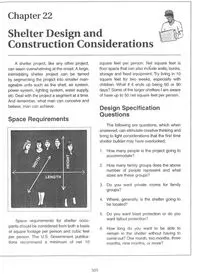
Space Requirements
LeneTH
Space requirements for sheller occu.
pants shouls be considered from both a basis,
of square fectage per person and cubic feat
per porson. The U.S. Government publica
tions iecommers @ minirur of net 10
‘square feet pee person. Net square feet is
floor space that can alsa ince walls, bunks,
storage and fixed equipment Ty ving in 10
square feet for wo weeks, especially with
chidron. What if t ends up being 60 or 30
cays? Some ofthe larger shotters lam aware
‘of have up to 50 net square fet per person.
Design Specification
Questions
The following ave questions, which when
‘answered, can atimulato creative thinking and
boing to Ight considerations thatthe frst time
seller bullder may have overlooked.
1, How many gecele is the project going to
coommerata?
2. Howr mary family groups does the above
umber of psorie represent and what
Sizes are these grcupa?
3. Do you wart private rooms for family
groups?
4. Where, generally, is the shelier going to
be Kecatec?
5. Do you want blast protection or do you!
cant fallout protocson?
How long co you want to be able to
remain in the sneter without having to
‘ome aut? One manth, ve months, roo
‘manths,niae ments, or more?
308
7. How much of a food supply do you need
to stocipie in of near the shelter? One
rmanth supply, two months, six months,
fone yess, or more?
rant a separate nie room inthe
8. Do you want to try to shield your sensitive
electric equipment from electromag.
netic pulse?
10, Be you intend on having communisation
equipment, fie. shorivave, ham, et)?
11. De you intend on having a decontarine-
tion ere?
12, Da you plan on having a crawhin or a
walein onty wey?
18, How doap ate the walls inthe area where
the shelters going ta be buit?
14, Da you want a pressurized water systom
‘with an electric woll purp or do you want
a hand oxmp or both?
15, Da you want hot water and lush tllots?
18, Da you want both a men's and a women's
‘athvaom, or ane bathroom?
47. Do you plan an having a water stonage
ator?
18. How big ofa cistarn, in terms of balloon
ceapacty, do you want ornoad?
+8, How long do you want to be able to run
your generators, (8. how long do you
‘want the fuol to last?
20. De you wan! lo have an extra generator
for back up?
21, Do you want to incorporate the ability to
fun on battery powar into the shatters
power system?
22, Do you want battery cower as an emor-
gency resene of as a primary operating
23, Howrlong do youwantto be able to run on
battory power without recharging the bat-
tras?
24.1 tho site for the shelter such that the
‘shelter can bo built into the sie or into
the top ofa slope?
25. Are you conoained about the security of
‘your shoto in the event ofan emergency
‘occupation?
26.00 you want 19 have an obsorvation
‘over inaorparates into yourshotter which
‘would entable you te have some contrel af
Ihe perimeter around tho shelter eta?
27.16 the shelter going to be connected to oF
part of any above ground structure?
‘You probably don't have the answers to
‘many of tiese questions but hopotully they
have caused you to consider somo important
aspects of, shatter buleing that you hada
‘thought of Before
Site Location
Considerations
Proximity to Target Areas
‘When stenlng on raid tracks, if you
‘otoerve an oncoming train, the logical thing is
fo get out ofthe way: I you believe in the pos-
sibility ofan oncoming ncear war or natural
saster, tno logical hing to do i to relocate
‘ut of any targotaroas or any potential wre
that could be drastcaly affected by esrth
shanges.f you Ive inthe of dominated
inner ey, what woul! bea bei ivestrent
buying bulet proct vests for your fai or
ima.ing 10 a beter neighborhood? nthe
Samo fashion, bulking = bine! sheltoe
botavse you Iho near @ knoe Tage ar69,
might not bo as smart 25 moving to nor
et area (perhaps a te a9 ten miles ewe)
and buidng a less expensive felout she.
{an you ace a locomotive coming down the
‘acs teward you, the mest eost-aectve
thing you can ois get ut ofthe way
In order to be elfective, shelters in target
‘areas must be blast hardened: but to wih-
Stand the direct effects of a nuclear weapon,
Evan you have a Bast sheter, your fist indi-
‘ation of a threat might be the flash of a
trike. At that point, tis too late fo rn to your
sheker.
tig my porsonal opinion that i you deter
mine that you need blast protection, you
should soriously consider relocating. Dis
tancing yourself from target areas and areas
of wuinorablty has both practical and finan:
cial advantages. is practical in the gene of
awiding the direct effects of a nuclear
\weapan and financial because bulking a fall
‘ou shelter Is lass expensive than building 2
blast shelton. Living clase to a target area
‘realy reduces your chance of survival and
greatly Inoroases the cost of a sheer.
“The best placa to relocate to isa remote
‘tea, at laast ten miles from any target area,
‘and prelerably, thity miles vay from any
‘areas af major papulation. It would be idest
if this area was in proximity to other tke
minded people,
‘Onea a decision is made on a general
location of a shelter there are certain tectore
Which shaulr) he considered for specific
locations
Available Water
You can't live long without water. You
should lnvestgata how doap the walls ars in
tha areas you are contemplating for a shear
and how many gallons por minuto thoy pro-
‘duce. Water capabilty is an important issuo,
Drlling a 600 ar B00 ft. well is exponsive, and
in tho event of well pump failure, is hard to
pull up and service the pump. It's impossible
to pump water with @ hand purnp from well
dospar than 250 feet
| would highly recommend having a well
for your shetter as water is very dificult to
slo18 over a long period of ime. This subject
Is covered extensively in the water chapter
‘earllar in this book.
Drainage
Drainage is very important. Consideration
should be given not only fora high water table
andits obvious complications. but also forthe
potential impact of unusual suface water
tunalf which could swamp the shette,
Depth of Bedrock
Itis wiso to dill or dig a tost hole to dotor-
min if thoro is any underlying bedrock that
would ebstruct the excavation nocessary to
accammadate the shelter. | know one shelter
project in partcular which spent consiserable
‘sums of money having to blast through unex-
pected bedkack
Tactical Problems
It ideal f the tonain around a potential
shelter ste oahancoe tho socurity ofthe shol-
ters parimotor. In othar words, it would be
bool lo lacato the shelter on a rately high
pint which would give its observation tower
‘unobstructed tactical view of the aren su
rpunding the shetter.
Access
Access is @ two-edged sword, Too easy
fan socess is not good because you dont
\want to be eonsitucing your shelter under
everyone's gaze and inspection. And you
dont want fo make it easy for somsone not
Invted to make their way fo your shelter, On
the other hand, you want i be atte to get to
iin the winter # needs be. It wort he much
{good having a shelter you can't get to in ims,
‘even if tis an ideal tactical location, Another
consideration relating 19 access le geting
equipment and material to te site dung the
‘onstruction phase.
Earthquake Considerations
Buried structures have the advantage of
being earth-integrated. In an earthquake. the
ground accelerates causing structures abour
Ihe ground to move back and forth in @ rock
ing motion. On the other hend, structures
buried in the earth are moved only slighty
‘and then in syn with the surrounding ground,
‘This can be compared tothe way a ship toss-
ces and roils in a storm on the waters surface
and s submarine below the surfaoe moves
stably within the sea.
You cbviously do nat want to build a shel
tor in close proximity to a known faul, but in
‘ganeral, a buriad shaller has the best char
of survhing en aaithquake, far beter thar
any typo of above ground structure, Never
theless, shaking ‘il cocur. Supplies and
‘equlpment on shelves, generators, and weter
snd fuel storage tanks should be properly
secured.
Other Shelter Building
Considerations
Cutting Into A Used Fuel Tank
DANGER
Extreme cautlon should be exercised
vehen cutting into a used fuel tank. Over tho
years, numerous people have been kiled by
‘explosions resulting fom trying to cut a tole
in a usod fuel tank. Tanks which contained
closal uot ara lose susceptible to explosion
than tanks which held gasoline. Old gasoline
tanks are extremely dangerous ta cut ints
Regardless itil is an old diesel tank or an old
‘gasoline tank, weal both kinds asi they were
gas tanks. You can never be sure exactly what
‘vas in the tank,
‘A fuol tank doos not need to have fue! in
the bottom of It to be dangerous. The fuel
‘vapors or fumnes, mized with ale will be ignt-
fed by a spark from a metal culling saw or
torch. The intensity of suctt an exciosion can
rately be survived.
There afb three ways fo prevent fuel tank
‘explosions when culng inte tank, The first
is to uso dry ioe, the eecond Is to use com-
pressed C02 and the third Is 1o use exhaust
‘off tho tall pipo ofa truck. The whole concept
is to displace the vapor fumes out of the tank
‘with C0, which I a heavy gas. Begin by mak-
ing sure the tanks standing upright nits at-
tural positon. Then, open one a the plumbing
220868 fings on the top of the tank
It using dry ce, put 20 bof the dry ice in
the tank for each 1000 gallons of tank eapac-
fy, Tho temperature has te be warm enough
to facitan the melting ofthe dy ice in order
to procuos the Cog gas. Writ unl tho dry loa
has melted complataly belore cutting into the
tank,
Ht using Cd, compressed gas, insert a
discharge tube from the tank of Cd into the
‘aco0ss hol inthe fuel tank nel slaty ot the
{995 iltho tank. Use 180-eu. fof compressad
(C0, gas for every 1000 gallons of tank capac
ity
When using the exhaust from a truck you
need a connecting pieoe of black fexiblo PVE
‘watortne slightly larger than the exhaust pine.
Slip this watering over the exhaust pipe and
ssocure it wih duet tape or a hase clamp 20
thal no exhaust leaks out, Put the ather ent
Into the access hole in the top ofthe fual tank,
Tum on the engine and let the truck idle
Check the end ofthe water ne to make eure
the exhaust is coming cut Dontt use a truck
‘wth eles in the muffler. The exhaust ean
tains CO gas which wil displace the gas
‘vapors out the top of the actass hole so be
‘sure not to tape this connection shut. truck
with a conventional 350 Cheyy engine needs
fa idle 10 minutes for avery 1000 gations of
tank capacity. Make sure be truck is tuned up
and not running rich oF having choke prob
Jems, You don’ want to be putting untamed
fuel and CO into tho tank. CO ean actually
‘combust. A diasol engine would be better to
use fortis application iit is avalable.
‘As an added precaution have someone
duct tape the cut behind the cutting torch to
prevent lr from entering the tank dung the
actual process of culting the hole. Ary ful
you findin the bottom ofthe tank, once you've
cut the hole, can be absarbes with sawdust.
shoveled into empty feed sucks and properiy
sisposes of
NOTICE
Unless you are knowiedigsable and expe-
rienced in this area, you should purchase a
tank which has already bean cut open by a
licensed fuel lank remover or purchase a new
tank. This information is not intanded to be
‘encouragement or advice from the author in
ragards to cutting into a tank, I yeu decide to
engage in such @ dangerous and unpre
sctable actity, you will awe to do it at your
‘own risk!
Waterproofing
When constructing sub-sarth homes and
Underground shetere which have snels oom
prised of porous materials, such as concrete
‘oF wood, meke sure not to skimp on the
Wwaterprocting. There is nothing much worse
than to backil and landscape en undat=
‘ground shelter and then discover sak, Tho
‘nly real solution is t0 call the backhco or
excavator back, uncover the shelter by
removing the dit, and re-do the watorproat
ay
For waterproofing concrete shelters, a
product called Para Soal is probably the best
‘commercial product on the market today.
Para Seals @ heavy mil PVC, material with
bentonite backing. It is a set-healing wator-
proofing system. If a hole is. punctured
through the PYG. and water scope in, the
bentonite swells up and stops the leak
Parascal is made by Paramaunt Technioal
Products, 2600 Paramount Drive, P.O. Bax
1042. Spoarish, SD 57788, (605) 642-4787
(oF (800} 858-5800. Another tsirly good prad-
luct is called ADF wihich is made by Te
Coatings, lozated in San Antonio, Texas
For ul tanks, the best material far water:
proofing is epoxy coal ter. You ean locate this
coating material by contacting the nearest
Underground tank manufacturer at by order:
ing through 2 commercial paint store,
For culver, a tar based foundation coat is
adequate sinca the shell is galvanized mate-
fia. Caution shoukd be taken to make sure
that the joints between sections and waidedt
intersection joins are property scaled 10 pre-
vent leaking.
‘The steel quonset strictures contain
many bok cannoctons an tend to leak if net
perly waterproofed Pulyuratiane foam
has been used succasstlly lo waterproof this
type at stature,
The newer generation af tkerglsss shol-
ters like the Subioc ES1D are considered 19
bbe watertight, but the old Theta modules have
atendeny to leak
Backfilling
Backliting is tre most eitcal constuction
phase of any structure system which alias on
fearth-arching for ts strustural strength, This
includes fuel tanks, cuNer,fiberaiass pods,
land steel quonect. The potental for sorious
problems with sotting and deforming due to
improper compaction should not be underes
timated! Gonoraly, the backfiing material
‘should be screened in such a manner that
‘nothing larger than a softballs placed within
‘wo feet of the surface of tho tank oF outer
LLaigor rocks, cue to the compaction pressure
of the matorial above, tend to gradually
migrato down onto the eurlace othe tank or
cuNn. This produces dents and rsoint loads
hich can potentially compromise the sttuc-
‘ural integrity ofthe system.
Backing the Shaker
Earth-Arching
Earth-arching is @ phenomena whereby
the earth covering a “uly buried” structure,
when subjoctod 19 an ovorprassura, acts es
‘one integral unk, absorbs the prossure and
8 pressure penetrates down into the earth,
the earth reduces and dlissipatas the pres.
sure. The effect is that “lly buriad” sinuo-
tures, without significant strength, only
receive a fraction ofthe intial pressure which
as applied tothe surface ofthe ground, ad
survive without collapse. The tom “tully
buried” means the structura in question, be i
a fiberglass dome, tank or culo, is covered
by at Isast 9 depth of carth which is equal to
of greater than the diameter of the stuoture
In other words, earth-arching wil nt work #
the shelter isnot buriod ata depth which pro-
vides an earth cover over the top ofthe shel-
terwtich is equal to or greater than the diam-
eter oF width ofthe tank, culvert or arch that
is covering.
Compaction
Anoter significant factor in relation to
cartvarching elfects is compacton. The
artharching effect will not function to its
capacity if tie earth cover over tho shokar i
not uniormly compacted to a percentage of
{99% Proctor. Compaction fs not only impor-
tant trom the standpoint of achieving the
‘The Reet of Poor Compaction
carth-atching atest to protect the shelter in
the event of an overpressure, but it's also
important in terms of keeping tha tank or oul
vort from deforming and deflecting ding the
scatting process.
A simple nay to test for ths 95% Proctor
ddansity is to jam your heal into compacted
earth and i barely Jeeves an imprint you
have approximately 95% Proctor dancly
Compaction can be thotoughly accom
plished with = wackor tamper appled fo each
8 to 12 inch layer of camth cover. The fit de
cf the bucket of a large excavator can bo
used as long as a repeated pounsing action
is applied.
‘The final agpoct of achieving the earth-
ferching effect is tho aggregate nature of the
sol iy and clay soiks wil not. even shen
property compacted, pracuce the earth-arche
ing effect. The overall material must not can
tain any more than’ 15% silly fines ar clay. On
the other earame, ifthe compacted back is
‘comprised of significant amounts of material
‘which islarge than 12 inches in damoter, the
earharching effect wil be comoromisad,
Both coatsa sand and gravel work wll and
facitato carth-zrching,
Landscaping
Considerations
Etforts should be mado to scrape of,
stockpile and reserve any lopsolln the aver
‘on top of and arcurs the sheltor ste. Be care-
ful that this el dos not get used for backfill
ing, bedding tips or other actvitos where
‘earth wit minimum rocks Is noaded. The top
sl ay not seem al hat valuable at the start
pf the project, butwen the bulk ofthe project
Is done and itis time lo landscape, the topsoil
Is extromely valuable. Not only should the sol
bbe soraped off areas whare excavations are
going to ocou, bul also areas where subsoil
from the excavation Is going to bo piled. The
topsoil under these piles usually gots dug
up and mixed in with the sub soll and thus
‘wasted during tne backfling operations.
The landscape should also make consid-
tration for security, Bushes, earth mounds
rani lenge racks should not be lacated on the
rounds iy ouch a way as to oreate conceal
iment and cover for uninvited guests and
intrnters,
Doors
Sheter enlyy doors and hatches have
three primary requirements: airightness,
security, and heal and overpressure resis:
tance, An arighl seal is the primary require
ment ct ary shelter door. This can be espe-
cially dfieut to achieve with a homemade
blast door. Doors built to resist heat, over
pressure and thwart security throats are by
their nature massive and dificult to get ar
Tight sesls 09, One solulion is to have a pri
mary outer door which provides heat, over-
pressure and security protection and a se-
‘onary innr marine doar which tealitetes an
‘ceoelent aitigh sl
Most shelters have dooss which saing
‘open to the auiside (in contrast to doors hat
‘swing inward). The reason for this is that the
door is easier to bulls that way. In the event of
‘an overpressure, the outside preceure push
'08 the door anto the door frame and the door
Is supported by the frame on its ante porph
fey. The disadvantage is that rubble rsuiting
fram a bist can prevent the door fram being
‘pened, and if the sheter doesnt have an
Unblocked atematve enleance, the occur
pants must be feed by rescue teas coming
from outside.
312
Doors opening to the inside allow ooou-
pants to oven them even when blockod by
‘accumulated nibble, These style doors aro
‘more clffcut fo construct because the aver-
pressure is carried by dogs or pins which
extend from the door into the door frame,
‘These dogs transfer the overpressure la the
door framo. Thoretora, inwardly opening
doors need ta bo emall.
“The best solution to being trapped inside
f cholo by rubble is to have an alternative
ntrancotext with a afferent profile, exposure
and olovaton. The Idea here ts thet it one
door isa herzontal surface walkin type, then
the other antrancelexit would be & vertical
hatch caming up tothe surface—ideally at a
higher elevation. The prablem of rubble Block-
ing a vertical type hatch can be teduced by
‘elevating the concrete reinforced hatch tube
(00 folowing pictures) several fest above the
round ive, arid have the hater pivot hor:
Zontally to open, as opposed to fipping open
vertically. One design which oeems effective
isthe jack pivot type (as shown on the follow
ing pagel which would allow occupants to it
the weight of any debris accumulated on top
ofthe batch
Door frames for exterior entry doors
should be structurally substantial. n the case
of a blast shetter, the door or hatch tere
should be constructed of steel roinforeed aon-
‘greta and have enough surface area and
mass to dlsperse the lore of ovorprescure
into the ground. This is enportant because #
‘the overpressure is not trenserred to the
‘ground, it wll bo tansfomed directly to the
cont tubo which will be either crushed ot dei:
ven into the sheer,
Doors should fe eutitted on the inside
weith af loast va chain binder arrangements
which would Ughtly secure the door against
the cfocts of nogative overpressure and
attempts by hostile individuals to make an
Unauthorized entry.
Anothor impartant aspect of daors are
‘seals. Usually these are mado of rubber
Fubber burns in case of intense surface fires,
Ideally, fhe-resistant her gaskets made of
kediar (which would retain intogrty at high
temperatures) should be used.
3
Phveting Heten Door
‘Yareal Entrance
Vertical Entry Exit
Looking Up From Ins Shelter
To protect the door from the effects of
large caliber firoarms and cutting terches,
steol doors should be lined internally with at
Toast 1 inch of steel reinforced concrete,
Entry Ways
when designing shelter entry ways, the
two factors whieh must be considered are
attonuation of radiation and ease of access.
The diamoter, length and number of turns in
fan entry way will determine how much put-
side radiation comes ito the ehetter through
the entrance wey. Most shelter doors do not
attenuate a significant amount ot reciation,
Shelter entrance way tunnels need to be con-
figured so that they attenuate radiation, both
gamma and neutron, and provide adequate
‘acoess and oscape,
Radiation attenuation is usualy scoom-
plished by extending the length of the
fentiance tunnel, incomparating tums in the
fontiance way tunnel. reducing the diameter
of tho onvance way tunnel creating a barrier
inside tho tunnel, of any combination of these
four
Neutron radiation is only a probiom in
proximity to "oroas affected by the blast.
Noulron radiation is nat attenuated as easily
90 Degree Turn on Culvert Entry Way
3H