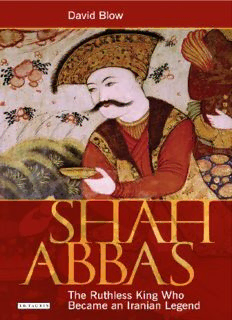
Table Of ContentIBT011 - Shah Abbas 3/2/09 17:30 Page i
i
IBT011 - Shah Abbas 3/2/09 17:30 Page ii
DAVID BLOW
David Blow studied History at Cambridge and Persian at SOAS,
was Assistant Director of the British Institute of Persian Studies in
Tehran 1968–9 and worked for the BBC Persian Service 1969–71,
broadcasting in Persian. He went on to work in publishing and for
the BBC World Service, where he was correspondent in Berlin and
Vienna. He is the Editor of Persia: Through Writers’ Eyes, a collec-
tion of mainly European writings about Iran.
‘This is a lively, well-written biography that is sure to keep the reader
engaged . . . strikes the right balance between the anecdotal and
the analytical’
Rudi Matthee, Professor of Middle Eastern History,
University of Delaware
‘The subject of Shah Abbas is fascinating and important. Moreover
the book will fill a very large gap, moving beyond an ordinary
biography to reflect recent scholarship.’
Gene Garthwaite, Jane and Raphael Bernstein Professor,
Dartmouth College
Praise for Persia: Through Writers’ Eyes:
‘lucid and well-informed . . . This is a worthwhile, enjoyable and
instructive book.’
David Morgan, Times Literary Supplement
ii
IBT011 - Shah Abbas 3/2/09 17:30 Page iii
Shah Abbas
DAVID BLOW
iii
IBT011 - Shah Abbas 3/2/09 17:30 Page iv
DAVID BLOW
For my wife, Laurence,
and my children,
John and Lucy
Published in 2009by I.B.Tauris & Co. Ltd
6 Salem Road, London W2 4BU
175 Fifth Avenue, New York NY 10010
www.ibtauris.com
Distributed in the United States and Canada Exclusively by Palgrave Macmillan
175 Fifth Avenue, New York NY 10010
Copyright © David Blow, 2009
The right of David Blow to be identified as the author of
this work has been asserted by the author in accordance with the
Copyright, Designs and Patent Act 1988.
All rights reserved. Except for brief quotations in a review, this book,
or any part thereof, may not be reproduced, stored in or introduced into a
retrieval system, or transmitted, in any form or by any means, electronic,
mechanical, photocopying, recording or otherwise, without the prior
written permission of the publisher.
ISBN: 978 1 84511 989 8
A full CIP record for this book is available from the British Library
A full CIP record is available from the Library of Congress
Library of Congress Catalog Card Number: available
Typeset in Sabon by Ellipsis Books Limited, Glasgow
Printed and bound in Great Britain by CPI Antony Rowe, Chippenham
iv
IBT011 - Shah Abbas 3/2/09 17:30 Page v
Shah Abbas
Contents
List of Illustrations vii
Preface ix
Introduction xi
1. Shah Abbas’s Inheritance: The Birth of a Shi’i State 1
2. A Turbulent Childhood and the Seizure of Power 15
3. Abbas Takes Control 31
4. The Recovery of Khurasan from the Uzbeks 47
5. English Adventurers at the Service of Shah Abbas 53
6. Maintaining the Offensive: Khurasan, the Persian
Gulf and a Challenge to the Ottomans 65
7. Abbas Expels the Ottomans 75
8. The Search for European Allies 85
9. Pressure on the Gulf, Mass Deportations
and the Murder of a Son 99
10. An Anglo-Iranian Victory: the Capture of Hormuz 113
11. Final Triumphs: the Capture of Qandahar and Baghdad 131
12. A Conflict of Envoys 137
vv
IBT011 - Shah Abbas 3/2/09 17:30 Page vi
SHAH ABBAS
13. The English Embassy and the Death of Abbas 143
14. Abbas, the Man and the King 155
15. The Court of Shah Abbas 165
16. The Throne and Mosque Alliance 181
17. The City that was Half the World 193
18. The Merchant King 209
19. Shah Abbas and the Arts 217
20. The Later Safavids 227
Conclusion 239
Notes 243
Select Bibliography 259
Index 269
vi
IBT011 - Shah Abbas 3/2/09 17:30 Page vii
List of Illustrations
Black and White Section (between pages 82 and 83)
1. Engraving of the first Safavid ruler, Shah Ismail I. German school, 1557. ©
The Trustees of the British Museum.
2. Engraving by Domenicus Custos of Shah Abbas I, praising him for his
v ictories over the Ottomans and comparing him to Cyrus the Great. Augsburg,
1602. © The Trustees of the British Museum.
3. Engraving of Anthony Sherley, possibly by Domenicus Custos, early
s eventeenth century. © National Portrait Gallery.
4. The Chahar Bagh Avenue in Isfahan. Engraving by the Dutch artist and
traveller, Cornelis de Bruin, who was in Isfahan from 1703 to 1704.
5. The shrine of Imam Riza in Mashhad. The dome over the tomb chamber
in the centre was decorated with gold tiles by Shah Abbas.
6. The Italian traveller, Pietro Della Valle, taken from ‘Viaggi’, his account of
his stay in Iran (1617–22) .
7. Ceremonial departure from Isfahan of Shah Sulaiman I and his grand vizier
for the Festival of Sacrifice (Eid-e Qurban) outside the city. Engraving by
Engelbert Kaempfer, who spent over four years in Iran (1683–88) during
the reign of Shah Sulaiman.
8. The interior of the dome of the Sheikh Lutfallah Mosque in Isfahan.
9. The Ali Qapu (‘Lofty Gate’), which was the main entrance to the palace
complex in Isfahan.
10. Shah Sultan Husain, the last ruler of Safavid Iran. Engraving by the Dutch
artist and traveller, Cornelis de Bruin.
11. Tradesmen’s tents in the Royal Square in Isfahan. Engraving by Cornelis de
Bruin.
vii
IBT011 - Shah Abbas 3/2/09 17:30 Page viii
SHAH ABBAS
Colour Section (between pages 178 and 179)
1. Shah Abbas receiving the Moghul ambassador, Khan Alam. Painting by the
Moghul artist Bishan Das, c.1619. Courtesy of Sotheby’s Picture Library.
2. Fritware tile panel, which originally covered the lower part of a wall, probably
in a palace in Isfahan. Period of Shah Abbas. © Victoria and Albert Museum,
London.
3. Shah Abbas with a gun. Contemporary Safavid painting from an eighteenth-
century Moghul Album. © Christie’s Images Ltd, 1995
4. Drawing of a calligrapher by Riza Abbasi, Isfahan, c.1600. The shah’s royal
seal is at the bottom right-hand corner.© The Trustees of the British Museum.
5. Meidan-e Shah (the Royal Square) in Isfahan, now renamed Meidan-e Imam.
The dome of the Sheikh Lutfallah Mosque is on the left and the portal
and minarets of the Royal Mosque, the Masjid-e Shah, now renamed the
Masjid-e Imam, can be seen at the far end of the square. Photograph taken
by the author in 1964.
6. The interior of the Royal Mosque in Isfahan. Photograph taken by the
author in 1964.
7. A sample of nastaliq script for collection in an album by the Iranian
calligrapher, Abd al-Rashid Daylami (d.1670). He emigrated to India, where
he held high office at the Moghul court, after his uncle, the calligrapher
Mir Imad Qazvini, was murdered on the orders of Shah Abbas. © The
Trustees of the British Museum.
8. Portrait of a European, probably by Riza Abbasi. Gouache heightened with
gold on paper. © Christie’s Images Ltd, 1995.
9. A falconer by Riza Abbasi, late sixteenth century. © The Trustees of the
British Museum.
10. Sir Robert Sherley (1581–1628) in Persian costume by Sir Anthony van Dyck
(1599–1641), Petworth House, The Egremont Collection (acquired in lieu
of tax by H.M.Treasury in 1957 and subsequently transferred to The National
Trust). © NTPL/Derrick E. Witty.
11. The Allahvirdi Khan Bridge over the Zayandeh River in Isfahan. The river
is virtually dry in the summer. Photograph taken by the author in 1964.
12. One of the pigeon towers outside Isfahan. The pigeon dung was used as
fertiliser. There were more than 3,500 such towers around the city in Safavid
times. Photograph taken by the author in 1964.
13. Shah Abbas portrayed on a late nineteenth-century ‘Mohtashem’ rug from
Kashan in central Iran. Courtesy of Sotheby’s Picture Library.
viii
IBT011 - Shah Abbas 3/2/09 17:30 Page ix
Shah Abbas
Preface
My interest in Shah Abbas began over forty years ago when, as a young
man just down from university, I spent the best part of a year in his capital
of Isfahan. Its population at that time, in the early 1960s, was barely what
it had been in Abbas’s day and considerably less than it became later in
the seventeenth century, when it is generally thought to have amounted to
about 600,000, which made it one of the most populous cities in the world.
It only reached this level again in the 1970s, although since then it has
greatly surpassed it. But despite many changes, it is still possible to walk
through the great central square Shah Abbas created and feel something of
his presence and of the world he lived in.
This book addresses the general reader about a key figure and a crucial
period in the history of Iran – a country of great importance in the world
then as now. It owes much to an immense amount of scholarly work that
has been done with increasing momentum over the past three or four
decades. This has enormously enlarged our understanding not only of the
reign of Shah Abbas, but of the whole Safavid period.
My main original Iranian source has been the Tarikh-e Alam-Ara-ye Abbasi,
or ‘The World-Adorning History of Shah Abbas’, which was written by his
official chronicler, Iskandar Beg Munshi (c.1560–c.1632), and covers the
whole of Abbas’s reign. Iskandar Beg was a chancery scribe, as the designation
munshi indicates, was often with Abbas, including when the shah was on
campaign, and was therefore an eyewitness of much that he recounts.
Despite its ‘official’ nature, his very full chronicle remains by far the most
important single Iranian source. Iskandar Beg also has one of the main
qualities of a genuine historian, in that he attempts to understand the causes
of events and why people acted as they did. Even those English-speakers
who are able to read Persian must be grateful to Professor Roger Savory for
making this great chronicle available in an English translation.
ix
Description:A ruthless autocrat who blinded and killed his own sons, but was revered as a hero by his own people. A brilliant warrior who restored his nation’s pride and territorial integrity by waging war on the foreign occupying forces, but chose an English knight to be his ambassador in the West. An ae