Table Of Content· SEPHER YETZIRAH
Translated from the Hebrew by
William Wynn Westcott
SEPHER YETZIRAH
THE BOOK OF FORMATION
WITH
THE FIFTY GATES OF INTELLIGENCE
&
THE THIRTY-TWO PATHS OF WISDOM
Translated from the Hebrew by
M.B., J.P.
WILLIAM WYNN WESTCOTT,
SUPREME MAGUS OF THE ROSICRUCIAN SOCIETY OF ENGLAND
FOURTH EDITION
EDITED AND REVISED,
WITH NOTES AND BIBLIOGRAPHY,
BY DARCY KUNTZ
HOLMES PUBUSHING GROUP
The Sepher Yetzirah: The Book of Formation. Copyright © 1996
by Darcy Kuntz. All rights reserved. No part of this book may
be reproduced or utilized in any form or by any means, electronic
or mechanical, including photocopying, recording or by any
information storage and retrieval system, without permission
in writing from Holmes Publishing Group except in the case of
brief quotations embodied in critical articles and reviews.
Golden Dawn Studies Series 3
First Edition, 1887
Second Revised Edition, 1893
Third Revised Edition, 1911
Fourth Revised Edition
1s t Printing, 1996
ISBN 1-55818-333-7
The front cover illustration 'The Fall' is by
Austin Osman Spare which was published
in Aleister Crowley's The Equinox, 1909.
FOR A COMPLETE LIST OF PUBLICATIONS,
PLEASE ADDRESS:
HOLMES PUBLISHING GROUP
POSTAL Box 623
EDMONDS, W A. 98020 USA
Contents
Page
Notes to the Fourth Edition.................................................... 7
Introduction to the Third Edition ........................................... 9
Preface to the Second Edition ................................................. 16
The Sepher Yetzirah
I. The Sephiroth, Numbers, Letters ................................ 17
I. The Twenty-two Letters .................. ............... ....... ...... 18
III. The Triad .................................................................... 19
IV. The Heptad with Supplement ..................................... 20
v. The Dodecad with Supplement ................................... 20
VI. Conclusion .................................................... "............ 21
The Fifty Gates of Intelligence .............................................. 23
The Thirty-two Paths of Wisdom ............... ............................ 25
Notes to the Sepher Yetzirah ........................ ......................... 28
Notes to the Thirty-two Paths ................................................ 35
The Hebrew Text of the Sepher Yetzirah ............................... 36
Bibliography........................................................................... 54
Illustrations
Page
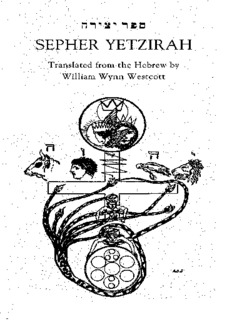
1. The Snake and upside down "Tn ................................. Half-title
Based on the cover of W.W. Westcott's, Numbers, 1890.
II. The Ten Sephiroth and Twenty Two Paths ........................... 6
From W.W. Westcott's, An Introduction to The Kabalah, 1910.
III. Theli: The Celestial Dragon ................................................ 32
From Rabbi Eliezer Rokeach's commentary on the Sepher Yetzirah,
Mantua, 1562.
KETHER
&N O----~-----...,;O CH
GEB~--~-~-~~-O
n-----+-~-___:::ONET
M
THE TEN SEPHIROTH AND TWENTY TWO PATHS
Notes to the Fourth Edition
THE three main books of the Kabbalistic esoteric philosophy are the Sepher
Yetzirah (Book of Formation), the Sepher Zohar (Book of Splendour) and the
Sepher Bahir (Book of Brilliance). Of these books the Sepher Yetzirah is consi<~ered
to be the oldest treatise and is believed to be a bridge between orthodox and
esoteric Kabbalah. The origins of the Sepher Yetzirah have been lost to the
antiquity of time, but a number of modem author's believe that the Sepher
Yetzirah was created by an oral (Mishnah) and written tradition. In the oral
tradition it is attributed to the Patriarch Abraham and it was written down by
Rabbi Akiba Ben Joseph who lived circa A.D. 120.
William Westcott wrote that the Sepher Yetzirah "explains a most curious
philosophical scheme of Creation, drawing a parallel between the origin of
the world, the sun, the planets, the elements, seasons, man and the twenty
two letters of the Hebrew alphabet; dividing them into a Triad, a Heptad,
and a Dodecad; three mother letters, A [Aleph), M [Mem), Sh [Shin] are
referred to primeval Air, Water and Fire; seven double letters are referred
to the planets and the seven fold division of time, etc.: and the twelve
simple letters are referred to the months, Zodiac signs and human organs.
Modern criticism tends to the conclusion that the existing ancient versions
were compiled about A.D. 200. The "Sepher Yetzirah" is mentioned in the
Talmuds, both of Jerusalem and of Babylon; it was written in the Neo
Hebraic language, like the Mishna." [An Introduction to the Kabalah, 1910.
p. 2-3.]
Westcott's translation of the Sepher Yetzirah was originally part of a
lecture he read before the Hermetic Society of London on 29 July 1886.
L
The title of his paper was 'The Sepher Yetzirah: A Rabbinical Treatise on
Creation.' This was the only paper Westcott read to the Society before it
fell into abeyance in 1887 with the death of Anna Kingsford.
The Hermetic Society was founded in 1885 by Anna Kingsford and
Edward Maitland. Both Kingsford and Maitland were members of the
Theosophical Society and become disenchanted by the Eastern aspects of
its teachings. The Hermetic Society was styled as a new Esoteric Church
based on Christian mysticism with the principal aim to study "The Greek
Mysteries and the Hermetic Gnosis and its allied schools, the Kabalistic,
Pythagorean, Platonic and Alexandrian."
7
Westcott's translation of the Sepher Yetzirah has been criticised as being
"in reality a paraphrase and fulfils few of the conditions required by
scholarship."2 Most commentaries of the Sepher Yetzirah tend to reveal more
about the author's own system than they do of the Sepher Yetzirah. As
Westcott had stated in his Introduction his translation was prepared for
members of the Theosophy Society, the Hermetic G.D. and the Rosicrucian
Society of England.
The first English edition of the Sepher Yetzirah was translated by Dr.
lsidor Kalisch and printed with the Hebrew text in 1877. Westcott offered·
his edition in 1887 which was translated into English from the Latin versions
of Pis toriu s and Postellus. His second edition (1893) and third edition (1911)
were translated from the Hebrew and collated with the Latin versions of
Rittangelius, Pistorius and Postellus. Westcott had corrected his English
translation and expanded the Notes from answers which he gave (verbally
and written) to members of the Theosophy Society and the Hermetic G.D.
A.E. Waite falsely believed that the second edition of the Sepher Yetzirah
was issued as part of the Collectanea Hermetica in 1893.3
The Sepher Yetzirah was a major Source Work for the Golden Dawn's
initiation ceremonies, diagrams and teachings. The 'Thirty-two Paths of
Wisdom' was used by the Golden Dawn to explain the twenty-two Major
Arcana and the twenty-two Paths (proper) connecting to the Sephiroth of
the Tree of Life.
This edition of the Sepher Yetzirah is primarily Westcott's third edition
and it has been collated with the second edition as footnotes. I have added
the Hebrew text of the Sepher Yetzirah from Kalisch's edition. His text has
the vowel pointing or Dagesh, but the oldest editions of the Sepher Yetzirah
did not have these vowel points.
Darcy Kuntz
( Frater D.E.U. )
Calgary, Canada, 1996.
Notes:
1. S.L. MacGregor Mathers read two papers to the Society. The first paper was
called 'The Qabalah' (3 June 1886) and the other was titled 'The Physical or Lower
Alchemy' (8 July 1886). A brief abstract of Mathers first lecture was printed in the
magazine Light (19 June 1886).
2. A.E. Waite's introduction to Knut Stenring's translation of The Book of Formation
(David McKay Co., 1923). p. 6.
3. Ibid. p. 6. Kaplan also repeated this error in his translation of the Sepher Yetzirah
(Samuel Weiser, 1990). p. 335.
8
Introduction to the Third Edition
THE "Sepher"Yetzirah," or "Book of Formation," is perhaps the oldest
Rabbinical treatise of Kabalistic philosophy which is still extant. The great
interest which has been evinced of late years in the Hebrew Kabalah, and
the modes of thought and doctrine allied to it, has induced me to translate
this tractate from the original Hebrew texts, and to collate with them the
Latin versions of me dire val authorities; and I have also published An
Introduction to the Kabalah which may be found useful to students.
Three important books of the "Zohar," or "Book of Splendour," which
is a great storehouse of Kabalistic teaching, have been translated into English
by S.L. MacGregor Mathers, I and the "Sepher Yetzirah" in an English
translation is almost a necessary companion to these abstruse disquisitions:
the two books indeed mutually explain each other.
The "Sepher Yetzirah," although this name means "The Book of
Formation," is not in any sense a narrative of Creation, or a substitute
Genesis, but is an ancient and instructive philosophical treatise upon one
aspect of the origin of the universe and mankind; an aspect at once archaic
and essentially Hebrew. The grouping of the processes of origin into an
arrangement, at once alphabetic and numeral, is one only to be found in
Semitic authors.
Attention must be called to the essential peculiarity of the Hebrew
language, the inextricable and necessary association of numbers and letters;
every letter suggesting a number, and every group of letters having a
numerical signification, as vital as its literal meaning.
The Kabalistic principles involved in the reversal of Hebrew letters,
and their substitution by others, on definite schemes, should also be studied
and borne in mind.
It is exactly on these principles that the "ground-work idea" 'of this
disquiSition rests; and these principles may be traced throughout the
Kabalistic tractates which have succeeded it in point of time and
development, many of which are associated together in one volume known
as the "Zohar," which is in the main concerned with the essential dignities
of the God-head, with the Emanations which have sprung therefrom, with
the doctrine of the Sephiroth, the ideals of Macroprosopus and
9
Microprosopus, and the doctrine of Re-incarnation.
The "Sepher Yetzirah," on the other hand, is mainly concerned with
our universe and with the Microcosm. The opinions of Hebrew Kabalistic
Rabbis and of modern mystics may be fitly introduced here.
The following interesting quotation is from Rabbi Moses Botarel, who
wrote his famous Commentary in 1409:-"It was Abraham our Father -
blessed be he - who wrote this book to condemn the doctrine of the sages
of his time, who were incredulous of the supreme dogma of the Unity. At
least, this was the opinion of Rabbi Saadiah - blessed be he - as written in
the first chapter of his book The Philosopher's Stone. These are his words:
The sages of Babylon attacked Abraham on account of his faith; for they
were all against him although themselves separable into three sects. The
First thought that the Universe was subject to the control of two opposing
forces, the one existing but to destroy the other, this is dualism; they held
that there was nothing in common between the author of evil and the
author of good. The Second sect admitted Three great Powers; two of them
as in the first case, and a third Power whose function was to decide between
the two others, a supreme arbitrator. The Third sect recognised no god
beside the Sun, in which it recognised the sole principle of existence."
Rabbi Judah Ha Levi (who flourished about 1120), in his critical
description of this treatise, wrote: "The Sepher Yetzirah teaches us the
existence of a Single Divine Power by sheWing us that in the bosom of
variety and multiplicity there is a Unity and Harmony, and that such
universal concord could only arise from the rule of a Supreme Unity."
According to Isaac Myer, in his Quabbalah (p. 159), the "Sepher Yetzirah"
was referred to in the writings of Ibn Gebirol of Cordova, commonly called
Avicebron, who died in A.D. 1070.
Eliphas Levi, the famous French Occultist, thus wrote of the "Sepher
Yetzirah," in his Histoire de la Magie, p. 54: "The Zohar is a Genesis of
illumination, the Sepher Jezirah is a ladder formed of truths. Therein are
explained the thirty-two absolute signs of sounds, numbers and letters: each
letter reproduces a number, an idea and a form; so that mathematics are capable
of application to ideas and to forms not less rigorously than to numbers, by
exact proportion and perfect correspondence. By the science of the Sepher
Jezirah the human spirit is fixed to truth, and in reason, and is able to take
account of the possible development of intelligence by the evolutions of
numbers. The Zohar represents absolute truth, and the Sepher Jezirah provides
the means by which we may seize, appropriate and make use of it."
Upon another page Eliphas Levi writes: "The Sepher Jezirah and the
Apocalypse are the masterpieces of Occultism; they contain more wisdom
than words; their expression is as figurative as poetry, and at the same time
it is as exact as mathematics."
10
Description:Yetzirah (Book of Formation), the Sepher Zohar (Book of Splendour) and Arcana and the twenty-two Paths (proper) connecting to the Sephiroth of.