Table Of ContentJ. Entomol. Soc. Brit. Columbia 110, December2013 35
SCIENTIFIC NOTE
Update on the establishment of birch leafminer parasitoids in
western Canada
Chris J.K. MacQuarrie\ Daryl J. Williams^, and David W. Langor^
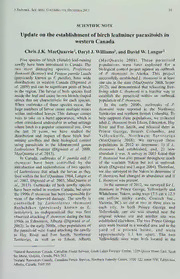
Five species of birch (Betula) leaf-mining (MacQuarrie 2008). These parasitoid
sawfly have been introduced to Canada. The populations were later exploited for a
two most damaging species, Profenusa biological control project against an outbreak
thomsoni (Konow) and Fenusa pumila Leach of P. thomsoni in Alaska. This project
(previously known as F pusilla), have wide successfully established L. thomsoni in at least
distributions in western Canada (Digweed et one site in the state (MacQuarrie 2008, Soper
al. 2009) and can be significant pests ofbirch 2012), and demonstrated that relocating free-
in the region. The larvae of both species feed living adult L. thomsoni is a feasible way to
inside the leaf and cause brown blotch-shaped establish the parasitoid within an outbreak
mines that are characteristic for each species. population ofP. thomsoni.
When outbreaks of these species occur, the In the early 2000s, outbreaks of P.
large numbers of larvae create multiple mines thomsoni were reported in the Northwest
within individual leaves. This damage causes Territories and northern British Columbia. To
trees to take on a burnt appearance, which is help suppress these populations, we collected
often considered undesirable in urban settings adult L. thomsoni from Edson, Edmonton, Hay
where birch is a popular ornamental tree. Over River and Fort Smith, and released them in
the last 20 years, we have studied the Prince George, British Columbia, and
distribution and impact of these birch leaf- Yellowknife, Northwest Territories
mining sawflies and their biological control (MacQuarrie 2008). We surveyed these
using parasitoids in the Ichneumonid genus populations in 2012 to determine: 1) if L.
Lathrolestes Foerster (Digweed et al. 2009, thomsoni had established; and, 2) how
A
MacQuarrie et al. 2013). abundant it was. survey in 2003 found that
In Canada, outbreaks of F pumila and P. P. thomsoni was also present throughout much
thomsoni have been controlled by the of the southern Yukon but not at outbreak
introduction and redistribution of two species levels (Digweed and Langor 2004). Therefore,
of Lathrolestes that attack the larvae as they we also surveyed in the Yukon to determine if
feed within the leaf(Quednau 1984, Langor et P. thomsoni had changed in abundance and if
al. 2002, Digweed et al. 2003, MacQuarrie et L. thomsoni was present.
al., 2013). Outbreaks of both sawfly species In the summer of2012, we surveyed for L.
have been noted in western Canada, but since thomsoni in Prince George, Yellowknife and
the 1990s P. thomsoni has been responsible for Whitehorse, Yukon, using traps (7.5 cm x 12.5
most of the observed damage. The sawfly is cm yellow sticky cards; Contech Inc.,
controlled by Lathrolestes thomsoni Victoria, BC) set out at two or three sites in
Reshchikov (previously known as L. each city. In both Prince George and
luteolator), an endoparasitoid that was first Yellowknife, one site was situated near the
observed attacking P. thomsoni during the late original release site and another site was
1990s in Edmonton, Alberta (Digweed et al. established elsewhere. The two Prince George
2003). In the early 2000s, other populations of sites were located in a wooded area and in the
the parasitoid were found attacking the sawfly yard of a private home, and were
in Hay River and Fort Smith, Northwest approximately 1.1 km apart. The two
Territories, as well as in Edson, Alberta Yellowknife sites were both located in the
'Natural Resources Canada, Canadian Forest Service, Great Lakes Forestry Centre, 1219 Queen Street East. Sault
Ste Marie, Ontario, Canada. P6A 2E5
^Natural Resources Canada, Canadian Forest Service, Northern Forestry Centre, 5320 122 street NW, Edmonton,
Alberta, Canada. T6H 3S5
J. Entomol. Soc. Brit. Columbia 110, December2013
yards of private homes and were all material on the traps was done by one of
approximately 2.5 km apart. In Whitehorse, the authors (D. J. Williams).
the sites were located in wooded areas near a We found L. thomsoni to be established in
major road (two sites) and along a walking Prince George, and established and abundant
trail (one site). These sites were approximately in Yellowknife (Table 1). Populations of the
0.5-3.0 km apart. sawfly at both release sites appear to be large
At each site, three birch trees were selected relative to the size of the parasitoid
by local volunteers, and a trap was hung at populations. Parasitism rates (percent of the
head height (approx. 2 m) in each tree. Traps total catch that was adult parasitoids) ranged
were placed in early or mid-June, depending from 11-17% in Yellowknife and 6-8% in
on the advancement of the season, and Prince George. In contrast, the R thomsoni
replaced weekly until early or mid-July, population in Whitehorse appeared to be
depending on the duration ofP. thomsoni adult small, and a parasitoid population was not
flight (Table 1). This study was intended for detected (Table 1).
detection and not for population assessment.
Volunteers were therefore allowed to carry out Our survey indicates L. thomsoni has
surveys according to their own local established in Prince George and Yellowknife.
conditions rather than according to a Suppression of either population was not
prescribed method. This meant the number of tested, but anecdotal evidence suggests that
traps hung in each city and at each site varied damage by P. thomsoni has been less evident
depending on how frequently the traps were in recent years (MacQuarrie et al. 2013).
changed. We report the total number of traps However, even when populations are large,
hung at each site over the trapping period the appearance of damage caused by P.
(Table 1). The volunteers returned the traps at thomsoni can vary from year to year
the end of the season, at which time we (MacQuarrie 2008), and a decrease in visible
examined the traps’ contents. Identification of damage may not indicate a sawfly population
Table 1
Summary of trap catches for adult Profenusa thomsoni (Konow) and adult Lathrolestes thomsoni
Reshchikov for three cities in 2012.
P. thomsoni L. thomsoni
Total
Days Site
period ’ traps Total Total
P^'P/^
adults adults
traps (n) traps (n)
Prince Georee. British Columbia
21 June- 4 July 13 1 20 60% (12) 82 15% (3) 7
2 20 75% (15) 63 20% (4) 4
Whitehorse. Yukon
8 June- 17 July 39 1 15 13% (2) 3 0% (0) 0
2 15 0% (0) 0 0% (0) 0
3 15 13% (2) 3 0% (0) 0
Yellowknife. Northwest Territories
4 June- 16 July 42 1 14 71% (10) 1931 57% (8) 236
2 24 54% (13) 862 38% (9) 177
J. Entomol. Soc. Brit. Columbia 110,December2013 37
experiencing suppression by the parasitoid. parasitism. Such estimates have been done for
Repeated observations of both populations, other P. thomsoni populations, but the work
including an assessment of parasitism rates, requires significant time, effort, and financial
would be necessary to confirm ifL. thomsoni resources to make an accurate assessment
is controlling P. thomsoni. (MacQuarrie 2008). These resources are hard
The population of P. thomsoni in to obtain for species, like P. thomsoni, that are
Whitehorse is small, and L. thomsoni does not considered minor, aesthetic pests. In contrast,
appear to be present. We suggest that sampling adult parasitoids, while a less precise
Whitehorse be monitored at regular intervals estimate than rearing, is a simple and
to assess the status of the P. thomsoni inexpensive way to determine the presence
population. Should an outbreak occur, the and relative abundance ofa parasitoid.
established L. thomsoni populations in We are optimistic that control ofthe sawfly
Yellowknife and Prince George could serve as will be achieved at Prince George and
sources of parasitoids for release in Yellowknife, based on the observation that L.
Whitehorse. thomsoni has persisted at both sites for at least
Determining the true impact ofL. thomsoni five years without any assistance or
on the dynamics of the Prince George and augmentation. This suggests that the L.
Yellowknife P. thomsoni populations requires thomsoni populations at these sites are
collecting and rearing large numbers of resilient and should be able to maintain their
leafminers to obtain an estimate ofthe percent presence into the future.
ACKNOWLEDGEMENTS
We thank S. Lindgren, University of their assistance in placing and monitoring
Northern British Columbia, Prince George; S. sticky traps; and R. Johns and three
Carriere and D. Taylor, Government of the anonymous reviewers for their comments on
Northwest Territories, Yellowknife; and B. an earlier version ofthis manuscript.
Godin, Environment Canada, Whitehorse, for
REFERENCES
Digweed, S. C., and D. W. Langor. 2004. Distributions ofleafrnining sawflies (Hymenoptera: Tenthredinidae) on
birch and alder in northwestern Canada. Can. Entomol. 136: 727-731.
Digweed, S. C., C. J. K. MacQuarrie, D. W. Langor, D. J, M. Williams, J. R. Spence, K. L. Nystrom, and L.
Morneau. 2009. Current status ofexotic birch-leafmining sawflies (Hymenoptera: Tenthredinidae) in Canada,
with keys to species. Can. Entomol. 141: 201-235.
Digweed, S. C., R. L. McQueen, J. R. Spence, and D. W. Langor. 2003, Biological control ofthe ambermarked
birch leafminer, Profenusa thomsoni (Hymenoptera: Tenthredinidae), in Alberta. Information Report NOR-
X-389, NRCan CFS, Northern Forestry Centre, Edmonton, AB.
Langor, D. W., S. C. Digweed, and J. R. Spence. 2002. Fenusa pusilla (Lepeltier), birch leafminer, and Profenusa
thomsoni (Konow) ambermarked birch leafminer (Hymenoptera: Tenthredinidae), pp. 123-127. In Mason,
RG., Huber, J.T. (eds.). Biological Control Programs in Canada, 1981-2000. CABI Publishing, Wellingford,
UK.
MacQuarrie, C. J. K, 2008. Distribution, Biological Control and Population dynamics of Profenusa thomsoni
(Konow) inAlaska. Ph.D. thesis. University ofAlberta, Edmonton, AB.
MacQuarrie, C. J. K., D. W. Langor, S. C. Digweed, and J. R. Spence. 2013. Fenusapumila Leach, birch leaf
miner, Profenusa thomsoni (Konow), Ambermarked birch leafminer (Hymenoptera: Tenthredinidae), pp. 175-
181. In Mason, P.G., Gillespie, D. (eds.). Biological Control Programmes in Canada 2001-2012. CABI
Publishing, Wellingford, UK.
Quednau, F. W. 1984. Fenusa pusilla (Lepeletier), birch leaf-miner (Hymenoptera: Tenthredinidae), pp. 291-294.
In Kelleher, J.S., Hulme, M.A. (eds.), Biological Control Programmes Against Insects and Weeds in Canada
1969-1980. Commonwealth Agricultural Bureaux, Famham Royal, Slough, UK.
Soper, A, 2012, Biological control of the ambermarked birch leafminer {Profenusa thomsoni) in Alaska. Ph.D.
thesis University ofMassachusetts, Amherst, MA.