Table Of Contentother RealCities sites
Newspaper Ads Online
Help
Contact Us
Site Index
Archives
Place an Ad
N
2
7
2
S
s
Back to Home > News >
Thursday, Jan 23, 2003
Local
Posted on Wed, Jan.
22, 2003
Honor guardsman is fired for blessings
Patrick Cubbage says he followed his training. A supervisor calls it a
breach.
By David O'Reilly
Inquirer Staff Writer
As a military
honor
guardsman,
Patrick Cubbage
had a simple
message to the
families of
deceased
veterans at
graveside
services.
"God bless you
and this family,
and God bless
the United States
of America," he
would say as he presented a folded flag to them.
Because of that, Cubbage was fired in October from his job at the
Brig. Gen. William C. Doyle Veterans Memorial Cemetery in
Burlington County, near McGuire Air Force Base.
He breached cemetery protocol, his supervisor said, by deviating
from the script.
"No family member ever objected," Cubbage, 54, a Vietnam combat
veteran, retired Philadelphia police officer, and former city bail
commissioner, said in a recent interview at his Northeast
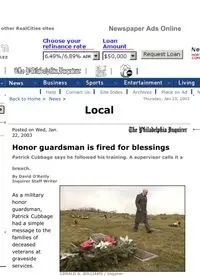
GERALD S. WILLIAMS / Inquirer
Patrick Cubbage, at the veterans cemetery in
Burlington County where he once worked, used to tell
mourners: "God bless you and this family, and God
bless the United States of America."
Philadelphia home.
"They were always very grateful - and sometimes very moved.
People would even grip my hand and say things like 'Thank you so
much.' "
Cubbage said he found the blessing in training literature he got when
he began working as a part-time guardsman at Doyle, making $16
an hour, in October 2001.
But Lt. Col. Roberta Niedt, spokeswoman for the New Jersey
Department of Military and Veterans Affairs, said Doyle - the state's
largest veterans cemetery - has a "standard phrase [for the flag
presentation] for each service."
Cubbage was dismissed not for the blessing, Niedt said, but for
departing from the standard presentation protocol.
Cubbage insisted, however, that he was operating within the rules
for honor guards. Opening a slender pamphlet that he said the
cemetery gave him when he started, he turned to a page topped by
the words Flag Presentation Protocol.
After Taps, it explains, the honor guard folds an American flag into a
triangle, and a guardsman then steps before the appropriate family
member.
Depending on the branch of service, the presenter next is to say
such words as: "This flag is presented on behalf of a grateful nation
and the United States Army as a token of appreciation for your loved
one's honorable and faithful service," and then to hand the flag to
the deceased's kin.
"If the next of kin has expressed a religious preference or belief," the
instructions continue, "add: 'God bless you and this family, and God
bless the United States of America.' "
"It doesn't say, 'You may add ...,' " Cubbage, an evangelical
Christian who attends Calvary Chapel in Northeast Philadelphia, said
as he tapped sternly at the pamphlet. "And I said it only if the family
had a chapel service or had clergy at the grave."
Although a part-time employee at Doyle, he said, he typically
worked from 25 to 35 hours a week, and he estimated that he
participated in about 2,000 burial ceremonies last year. "I probably
said the blessing 500 times."
But two of his fellow honor guardsmen complained in October, he
said, and on Oct. 16 Iven Dumas, the cemetery's honor guard
coordinator, ordered him to stop the blessings.
He said he protested, noting, "It's right in the manual." Dumas
PH
U
2
replied that the blessing could offend Jews and Muslims, he said, and
should be used only when next of kin notify the cemetery office that
they want a blessing.
"Jews and Muslims believe in God," Cubbage said he replied.
Dumas, he said, responded by handing him a copy of state
regulations prohibiting "harassment or hostile environments" in the
workplace.
Dumas declined to be interviewed and referred inquiries to Niedt's
office.
On Oct. 24, Joan L. Edwards, affirmative-action officer for the state
Department of Military and Veterans Affairs, wrote to Dumas to
clarify policy. Cubbage received a photocopy of the letter.
Government employees "must not engage in activities or expression
that a reasonable observer would interpret as government
endorsement ... of religion," she wrote.
Unless the next of kin expresses a religious preference "one way or
another," she continued, "then, the protocol would be to omit the
saying, 'God bless ...,' portion of the presentation. This is not
optional."
Cubbage said he reluctantly stopped saying the blessing - until Oct.
31. That day, he said, "this funeral procession pulls in for a burial,
and I see the 'fish' sign [a traditional symbol in Christianity] on the
back of one of the cars."
"So, I start a conversation with the driver, who turns out to belong
to Calvary Chapel. I asked him if the family would mind if I said the
blessing. He said, 'Oh, they're very religious. I'm sure they'd
welcome it.' "
The widow, who was in a wheelchair, bowed her head at the
blessing, Cubbage recalled.
But one of the other guardsmen "practically ran to the office" to
report him, he said.
He said Dumas called him into the office and demanded an
explanation. He said he explained that a family friend had assured
him they would welcome the blessing, but Dumas - citing Cubbage's
"disregard for stated policy" - fired him that day.
"I was in shock. I'm still in shock," he said.
"I was proud to serve the veterans who have served us," said
Cubbage, who in 2001 reenlisted in the New Jersey National Guard
just so that he could be the first enlisted man to salute his son,
Adam, when he became an Army officer.
Adam Cubbage is now a captain in the 108th Air Squadron - his
father's unit in the Vietnam War.
"I just don't get it," Patrick Cubbage said of his firing. "When you
give people that flag, you see them look into it and remember a
whole time in their loved one's life. So why in God's name did they
fire me? Because in God's name, they did fire me."
Contact staff writer David O'Reilly at 215-854-5723 or