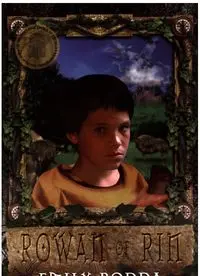
Table Of ContentRowan OF Rin
Seven hearts the journey make.
Seven ways the hearts will break ...
The witch Sheba’s prophecy is like a riddle. A
riddle Rowan must solve if he is to find out the
secret of the Mountain and save his home ...
To the sturdy villagers of Rin the boy Rowan is a
timid weakling. The most disappointing child
ever. Yet, incredibly, it is his help they need when
the stream that flows from the top of the Mountain
dries up. Without its water their precious bukshah
herds will die, and Rin will be doomed.
The six strongest villagers must brave the unknown
terrors of the Mountain to discover the answer to
the riddle. And Rowan, the unwanted seventh
member of the group, must go with them.
For Alex and Clem
LEXILE™ 710
Omnibus Books
52 Fullarton Road, Norwood SA 5067
an imprint of Scholastic Australia Pty Ltd (ABN 11 000 614 577)
PO Box 579, Gosford NSW 2250.
www.scholastic.com.au
Part of the Scholastic Group
Sydney • Auckland • New York • Toronto ■ London • Mexico City •
New Delhi • Hong Kong • Buenos Aires ■ Puerto Rico
First published in 1993.
Reprinted in 1993, 1994 (twice), 1995, 1996 (twice),
1997 (twice), 1998, 1999, 2000, 2001 (twice), 2002.
First published in this edition in 2003.
Reprinted in 2003 (three times).
Text copyright © Emily Rodda, 1993.
Cover artwork copyright © Barry Downard, 2003.
Map copyright © Omnibus Books, 2003.
All rights reserved. No part of this publication may be reproduced or
transmitted in any form or by any means, electronic or mechanical,
including photocopying, recording, storage in an information
retrieval system, or otherwise, without the prior written permission
of the publisher, unless specifically permitted under the
Australian Copyright Act 1968 as amended.
National Library of Australia Cataloguing-in-Publication entry
Rodda, Emily, 1948-
Rowan of Rin.
Rev. ed.
For children aged 9-12 years.
ISBN 1 86291 535 0.
1. Rowan (Fictitious character: Rodda)—Juvenile fiction.
2. Dragons—Juvenile fiction. 3. Riddles—Juvenile fiction.
4. Courage—Juvenile fiction. I. Title.
A823.3
Typeset in 14/16 pt Garamond 3 by Clinton Ellicott, Adelaide.
Printed in Australia by Griffin Press, Adelaide.
Contents
1
The Meeting
1
2
Sheba
11
3
The Heroes
22
4
Seeing is Believing
30
5
The Mountain
40
6
The Forest
51
7
Dreams
63
8
Flesh and Blood
74
9
Moving On
83
10
Endless Night
94
11
The Snare
105
12
Bravest Heart
115
13
The Answer
124
1 — The Meeting
ne morning the people of Rin woke to find
that the stream that flowed down the
Mountain and through their village had
slowed to a trickle. By nightfall even that small flow
had stopped. The mill wheel lay idle. There was no
water to turn its heavy blades. The bukshah
drinking pool on the other side of the village was
still. No bubbling stream was stirring it into life and
keeping it topped up to the brim.
There was no change on the second day, or the
third. By the fourth day the water in the pool was
thick and brown. The bukshah shook their heavy
heads and pawed the ground when they went to
drink in the morning and the evening.
After five days the pool was so shallow that even
little Annad, who was only five years old, could
touch the bottom with her hand without getting her
sleeve wet. And still the stream failed to flow.
On the evening of the sixth day the worried
people met in the market square to talk. “The
bukshah could not drink at all today,” said Lann, the
oldest person in the village, and once the greatest
fighter. “If we do not act soon, they will die.”
“Not Star,” whispered Annad to her brother, who
was the keeper of the bukshah. “Star will not die,
though, will she, Rowan? Because you will give Star
water from our well.”
“Bukshah cannot drink from our well, Annad,”
said Rowan. “It is not sweet enough for them. It
makes them ill. They can only drink the water that
flows down from the Mountain. It has always been
so. If the stream stays dry, Star will die like all the rest.”
Annad began to sob quietly. The children of Rin
were not supposed to cry, but Annad was very
young, and she loved Star. Rowan stared straight
ahead. His eyes were tearless, but his chest and
throat ached with sadness and fear. The sadness was
for Star, his friend and the strongest and gentlest of
all the bukshah. And for all the other great, humped
woolly beasts, each of which he knew by name. But
the fear was for himself. For himself and Annad and
their mother, and indeed for the whole village.
Rowan knew, as Annad did not, that without
the bukshah there would be no rich creamy milk
to drink, no cheese, curd and butter to eat. There
would be no thick grey wool for cloth. There would
be no help to plough the fields, or carry in the
harvest. There would be no broad backs to bear the
burdens on the long journeys down to the coast to
trade with the clever, silent Maris folk. The life of
Rin depended on the bukshah. Without them, the
village too would die.
Annad could not imagine the valley without the
village. But Rowan could. Reading the old stories in
the house of books, listening half-asleep to Timon
under the teaching tree, and, most of all, sitting on
the grass by the stream while the bukshah grazed
around him in the silence of the morning, he had
often imagined this place as the first settlers must
have seen it.
Hundreds of years ago they had climbed through
the hills, carrying the few things they owned on
their backs, looking for somewhere in this strange
land that they could claim as their own. They had
come from far away, across the sea. They had fought
a terrible enemy. On the coast they had heard,
from the wandering native people they called the
Travellers, of a place at the bottom of a forbidden
mountain in the high country far inland. They had
been tramping for many, many days in search of it.
They were very tired. Some had almost given up
hope. Then, one afternoon, they had topped a rise,
and looked down. There below them, nestled between
a towering mountain ahead and the hill on which
they stood, was a green, secret valley.
The people stared, speechless. They saw trees
loaded with small blue fruits, and fields of flowers
they did not recognise. They saw a stream, and a
pool, and a herd of strange grey beasts lifting their
heads to stare, horns shining in the sun. They saw
silence, stillness, and rich earth, and peace. The
people knew then that this was the place. This would
be their home. So they came down and mingled with
the big, gentle animals, who were tame and unafraid.
They called them the bukshah.
“The stream flows down from the Mountain,”
said Bronden, the furniture maker, her loud voice
breaking into Rowan’s thoughts. He watched her
stab the air with her stubby finger, pointing. “So the
problem must be up there, up there, something is
amiss. Something is stopping the flow.”
All eyes turned to the Mountain rising high above
the village, its tip shrouded as always in cloud.
“We must climb the Mountain and find out what
it is,” Bronden went on. “This is our only chance.
“No!” Neel the potter shook his head. “We cannot
climb the Mountain. Even the Travellers do not
venture there. Terrible dangers await anyone who
dares. And at the top—the Dragon.”
Bronden sneered at him. “You are talking like a
crazy Traveller yourself, Neel! There is no Dragon.
The Dragon is a story told to children to make them
behave. If there was a Dragon we would have seen it.
It would prey on the bukshah—and on us.”
“Perhaps it takes its prey elsewhere. We do not
know, Bronden.” Allun the baker’s light, pleasant
voice rose above the muttering of the crowd. “But if
you will excuse me for talking like a crazy Traveller—
remembering that my father was one, and it is only
to be expected—let me remind you of what we do
know.” His usually smiling face was grim as he
stared Bronden down. “We do know that we hear it
roar almost every morning and every night. And
that we see its fire in the cloud.”
Bronden rolled her eyes disdainfully, but Rowan
shivered. Tending the bukshah in the cold and dark
of winter mornings, and in the evenings when the
sun had slipped behind the Mountain, he had heard
the sound of the Dragon. He had seen its fire too, in
the sky above the cloud. The bukshah swayed and
grew restless at these times. The calves bellowed, and
the bigger beasts pawed the ground, flared their
nostrils and huddled together in fear. Even Star
moaned when the Dragon roared, and when he
stroked her neck to calm her, he would feel the
nerves jumping under her long, soft wool.
Suddenly he realised something. Something no
one else seemed to have thought of. He must speak.
Nervously he rose to his feet. The villagers stared
curiously at him. What could the boy Rowan, the
shy, timid herder of the bukshah, have to say?
“The Dragon has not roared since the stream dried
up,” said Rowan. “Not in the mornings, and not at
night.” He spoke as loudly as he could, but his voice
sounded small in the silence. He sank back to his place.
“Is this so?” Allun looked around the circle. “Is
the boy mistaken?”
“No, he is not,” said Bronden slowly. “I recall it
now. Indeed, there has been no sound from the
Mountain for days.” She lifted her head. “So I am
right. There is something amiss, high above us. I have
told you what we must do.”
“But we cannot do it,” insisted Neel, with dread.
“The Mountain is too steep, too dangerous. We
cannot climb it.”
“Has anyone ever tried?” enquired Allun.
“Yes!” said tall, straight-backed Marlie, the weaver
and dyer of cloth. “In times gone by, some people
did climb the Mountain, to look for new fruits to
plant in our orchard. But they never returned. After
that, the people of Rin heeded the warning, and left
the Mountain alone.”
“You see?” Neel burst out. “You see? If we climb
the Mountain, we will die.”
“But Neel,” boomed Bronden. “If we do not climb
the Mountain, we will die.”
“Bronden is right. We must make our choice,”
said Strong Jonn, who was the keeper of the orchard.
“We remain here and hope the stream begins running
again of its own accord, or we climb the Mountain
and try to remove whatever is stopping the water
from flowing down to us. Both ways are dangerous.
What is our decision? To go, or to stay?”
“We must go,” Marlie replied. “We cannot
simply stand by and let death slowly come to our
village. I vote to go.”
“And I,” shouted Bronden.
“I vote yes!” said Strong Jonn.
“I too,” added Allun lightly.
“Yes! We agree!” growled mighty Val the miller,
who had stood silently listening in the shadows,
shoulder to shoulder as always with Ellis, her twin
brother. Val and Ellis toiled together in the mill,
grinding the grain into flour, endlessly cleaning the
great stone building so that not a speck of dirt or
the tiniest spiderweb could be seen within its walls.
Jiller, Rowan’s mother, said that since childhood no
one had ever seen them apart.
“Yes!” “Yes!” “Yes!” One by one the villagers
stood up. Rowan looked around at the familiar faces,
now so serious and so stern. Maise, the keeper of the
books, was standing, with her son and daughter. So
were Timon the teacher, and Bree and Hanna from
the gardens. White-haired Lann leaned on her stick
beside them. And even fat, soft Solla, who made
sweet toffees and cakes and never could resist his own
cooking, had struggled to his feet. Then Rowan saw
Jiller rise slowly and join them. His heart thudding
with fear, he scrambled to his feet beside her.
Soon Neel the potter and four others were the
only ones still seated.
“So it is decided,” cried Bronden triumphantly.
“We will arm ourselves and set out at dawn.”
“Wait!” said Marlie. “We must not go without
consulting Sheba.”
“That mad old hag? That spinner of children’s
nightmares and curer of pains in the belly? What
has she got to do with this?”
“Sheba is old, Bronden, but she is not mad,” said
Marlie firmly. “As anyone who has been cured of
illness by her remedies will tell you. Sheba knows
more than herbs and spells. She understands the
Mountain as you and I never will. Sheba knows the
way up the Mountain. The secret way she was
taught by the Wise Woman before her. We must ask
Sheba to help us.”
“This is a good idea,” agreed Strong Jonn.
The people murmured. Many did not trust the
Wise Woman, Sheba. She lived alone beyond the
orchard, gathering herbs and other growing things
and selling the medicines, ointments and dyes she
made from them. She rarely spoke to anyone other
than those with whom she traded. And when she
did it was seldom pleasant. The children of Rin were
a hardy crew, like all of their race. But they were
afraid of Sheba, and called her not Wise Woman
but Witch.
“Oh, come! What harm can it do?” called Allun,
grinning. “If the old one can tell us anything, which
I doubt, then all the better. If she cannot, we have
lost nothing.”
“Travellers’ foolishness!” snapped Bronden. “This
is not a game, Allun the Baker. Why don’t you
“Enough!” cried old Lann. She glanced at Bronden,
who scowled. “We are going into the unknown,” she
said sternly. “And time is precious. We cannot
afford to miss a chance to speed our way. Who knows
Sheba best?”
“I know her,” said Strong Jonn. “She gathers a
herb that grows under the hoopberry trees in the
orchard.”
“I trade with her,” said Marlie. “Her purple and
blue dyes, in return for cloth.”
“Then you two can go and beg her favour,” sniffed
Bronden, “since you are so keen to do so.” She turned
her back on them.
“We will wait here for your return,” said Allun.
“Be speedy. There is much to plan.” He laughed.
“And take care not to insult her, now. Like Bronden,
she is not a woman to be trifled with.”
Strong Jonn looked around at the watching
villagers and pointed. Rowan jumped. Jonn’s finger
was pointing at him!
“Boy Rowan,” called Strong Jonn. “Little rabbit,
herder of the bukshah! Run and get two cheeses
from the coolhouse. The oldest, ripest, strongest
cheeses from the topmost shelf. And bring them to
us at Sheba’s hut. Sheba is very fond of good strong
cheese. The gift will sweeten her temper.”
Rowan stared, open-mouthed, and did not move.
He was terrified of Sheba. His mother nudged him.
“I will go,” piped up little Annad, beside him. “I am
not frightened.” Laughter rippled through the crowd.
“Go along, Rowan,” Jiller urged in a whisper. “Do
as you are bid. At once!”
Rowan scuttled away through the crowd.
“He is scared of his shadow, that boy,” he heard
Val the miller mutter to her brother, as he passed
them. “He will never be the man his father was.”
Ellis grunted agreement.
Rowan ran on, his cheeks burning with shame.