Table Of ContentRIGHTS BEYOND BORDERS
This page intentionally left blank
Rights beyond Borders
The Global Community and the Struggle over
Human Rights in China
ROSEMARY FOOT
OXPORD
UNIVERSITY PRESS
This book has been printed digitally and produced in a standard specification
in order to ensure its continuing availability
OXFORD
UNIVERSITY PRESS
Great Clarendon Street, Oxford OX2 6DP
Oxford University Press is a department of the University of Oxford.
It furthers the University's objective of excellence in research, scholarship,
and education by publishing worldwide in
Oxford New York
Auckland Bangkok Buenos Aires Cape Town Chennai
Dar es Salaam Delhi Hong Kong Istanbul Karachi Kolkata
Kuala Lumpur Madrid Melbourne Mexico City Mumbai Nairobi
Sao Paulo Shanghai Singapore Taipei Tokyo Toronto
with an associated company in Berlin
Oxford is a registered trade mark of Oxford University Press
in the UK and in certain other countries
Published in the United States
by Oxford University Press Inc., New York
© Rosemary Foot 2000
The moral rights of the author have been asserted
Database right Oxford University Press (maker)
Reprinted 2002
All rights reserved. No part of this publication may be reproduced,
stored in a retrieval system, or transmitted, in any form or by any means,
without the prior permission in writing of Oxford University Press,
or as expressly permitted by law, or under terms agreed with the appropriate
reprographics rights organization. Enquiries concerning reproduction
outside the scope of the above should be sent to the Rights Department,
Oxford University Press, at the address above
You must not circulate this book in any other binding or cover
and you must impose this same condition on any acquirer
ISBN 0-19-829775-0
ISBN 0-19-829776-9 (pbk)
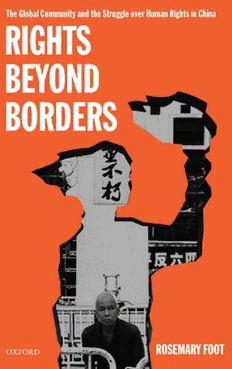
Jacket illustration: Tiananmen Anniversary. Photograph
taken by Anat Givon © Associated Press
Dick, Gail, and Tim
Acknowledgements
Writing a book is both a lonely and a collegial process. Those many soli-
tary hours at the computer terminal are balanced by interaction with
many inspiring individuals who are generous enough to share their time
and their thoughts, as well as to stand ready to ask the tough questions
that are sometimes too difficult to face or formulate when working alone.
There are many whom I would like to thank in this regard. Elena Jurado
proved to be invaluable as a research assistant. Her scholarly contribu-
tions and enthusiasm for the project made an enormous difference to its
rate of progress. Red Chan kindly helped with the translation of some
Chinese materials into English. During my stay at Princeton University,
among the graduate students, Phillip C. Saunders and Erica Strecker
Downs engaged in an exchange of ideas and relevant research papers. The
following either answered my questions, discussed the issues, provided
materials, or offered important perspectives: Philippe Van Amersfoort,
Philip Baker, George Black, Helen Brooks, Karen B. Brooks, Gregory
Chow, Steve Coffee, Danielle Dilley, Adele Dion, John Everard, Richard
Falk, Karen Fierke, Per Fischer, Jerry Fowler, Bennett Freeman, Charles
Goddard, Guy Goodwin-Gill, Jonathan Hecht, Lord Howe of Aberavon,
Jude Howell, Mike Jendrzejczyk, Sidney Jones, Stephanie Kleine-
Ahlbrandt, Arlette Laduguie, Beatrice Larouche, Woo Lee, Kerstin
Leitner, Tom Malinowski, David Malone, Susan O'Sullivan, Minxin Pei,
Nigel Rodley, Tony Saich, Susan Shirk, Markus Schmidt, Sun Shuyun,
Jeff Taylor, Caroline Wilson, Sophia Woodman, Rod Wye, and Phoebe
Yang. I am grateful to them all. Numerous colleagues and friends in
China were also of great help, but I have chosen not to name them.
Marc Williams of the University of New South Wales provided valu-
able comments on two of the chapters, and a period of respite (together
with an opportunity to see Sydney's incomparable millennium firework
display) during the last stages of writing. Colleagues and friends at
Oxford University have also been generous in discussing aspects of the
study at various crucial turning points. Dominic Byatt at Oxford University
Press was particularly encouraging when I took the proposal to him,
Amanda Watkins efficiently guided the manuscript through the editorial
process, and Hilary Walford proved to be keen-eyed and conscientious as
a copy editor. Avi Shlaim offered some of his worldly wisdom, which
Acknowledgements vii
helped me to take some important decisions at an early stage of the
project. Ngaire Woods has made suggestions and points that have set me
off on new periods of reflection. Karma Nabulsi has played a similar role,
and made several useful comments on an extended outline of the argu-
ment, one of which proved to be absolutely central to the shaping of the
research. Various anonymous reviewers for the Press also commented on
this outline argument, offering important perspectives that I might other-
wise have overlooked. Adam Roberts made several incisive comments on
a central chapter and Tim Kennedy helped to clarify the argument and
make it more accessible. Andrew Hurrell is deserving of especial thanks
for taking time out of his own busy schedule to cast his sharp eye over the
entire manuscript. All those familiar with Andrew and his work will
realize how beneficial that has been, although I must remain responsible
for all errors and lapses of judgement.
Funding for this project has come from two main sources: the British
Academy, which enabled me to make a research trip to China in the late
summer of 1999; and the remainder from Oxford University, via the
Social Studies Faculty board, and the Cyril Foster and Related Funds. I
am grateful to both institutions for their financial support.
I have dedicated this book to Dick and Gail Ullman and Tim Kennedy,
all three of whom helped to make the three months spent at the Center of
International Studies, Princeton University, in 1997 an exceptionally
productive period. I warmly thank the Center, and its Director, Professor
Michael Doyle, for inviting me to take part in its Visiting Fellowship
programme. To Dick, Gail, and Tim I would like to offer my profound
gratitude for providing the warmth of friendship and emotional support
so helpful in pushing this project forward.
Rosemary Foot
Oxford,
January 2000
This page intentionally left blank
Contents
Abbreviations X
1. Introduction 1
PART ONE: THE SETTING 27
2. The Evolution of the Global Human Rights Regime 29
3. The Global Consequences of China's Economic Reforms 60
PART TWO: THE PROCESS 81
4. The Generating of Attention, 1976-1989 83
5. Tiananmen and its Aftermath, June 1989-November 1991 113
6. The Shift to Multilateral Venues, 1992-1995 150
7. From Public Exposure to Private Dialogue, 1995-1998 190
8. Betting on the Long Term, 1998-1999 224
9. Conclusion: Rights beyond Borders? 251
Bibliography 274
Index 291