
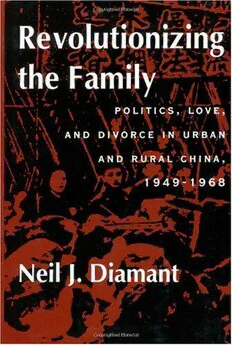
Download Revolutionizing the Family: Politics, Love, and Divorce in Urban and Rural China, 1949-1968 PDF Free - Full Version
Download Revolutionizing the Family: Politics, Love, and Divorce in Urban and Rural China, 1949-1968 by Neil J. Diamant in PDF format completely FREE. No registration required, no payment needed. Get instant access to this valuable resource on PDFdrive.to!
About Revolutionizing the Family: Politics, Love, and Divorce in Urban and Rural China, 1949-1968
In 1950, China's new Communist government enacted a Marriage Law to allow free choice in marriage and easier access to divorce. Prohibiting arranged marriages, concubinage, and bigamy, it was one of the most dramatic efforts ever by a state to change marital and family relationships. In this comprehensive study of the effects of that law, Neil J. Diamant draws on newly opened urban and rural archival sources to offer a detailed analysis of how the law was interpreted and implemented throughout the country. In sharp contrast to previous studies of the Marriage Law, which have argued that it had little effect in rural areas, Diamant argues that the law reshaped marriage and family relationships in significant--but often unintended--ways throughout the Maoist period. His evidence reveals a confused and often conflicted state apparatus, as well as cases of Chinese men and women taking advantage of the law to justify multiple sexual encounters, to marry for beauty, to demand expensive gifts for engagement, and to divorce on multiple occasions. Moreover, he finds, those who were best placed to use the law's more liberal provisions were not well-educated urbanites but rather illiterate peasant women who had never heard of sexual equality; and it was poor men, not women, who were those most betrayed by the peasant-based revolution.
Detailed Information
| Author: | Neil J. Diamant |
|---|---|
| Publication Year: | 2000 |
| ISBN: | 9780585390116 |
| Pages: | 460 |
| Language: | English |
| File Size: | 2.307 |
| Format: | |
| Price: | FREE |
Safe & Secure Download - No registration required
Why Choose PDFdrive for Your Free Revolutionizing the Family: Politics, Love, and Divorce in Urban and Rural China, 1949-1968 Download?
- 100% Free: No hidden fees or subscriptions required for one book every day.
- No Registration: Immediate access is available without creating accounts for one book every day.
- Safe and Secure: Clean downloads without malware or viruses
- Multiple Formats: PDF, MOBI, Mpub,... optimized for all devices
- Educational Resource: Supporting knowledge sharing and learning
Frequently Asked Questions
Is it really free to download Revolutionizing the Family: Politics, Love, and Divorce in Urban and Rural China, 1949-1968 PDF?
Yes, on https://PDFdrive.to you can download Revolutionizing the Family: Politics, Love, and Divorce in Urban and Rural China, 1949-1968 by Neil J. Diamant completely free. We don't require any payment, subscription, or registration to access this PDF file. For 3 books every day.
How can I read Revolutionizing the Family: Politics, Love, and Divorce in Urban and Rural China, 1949-1968 on my mobile device?
After downloading Revolutionizing the Family: Politics, Love, and Divorce in Urban and Rural China, 1949-1968 PDF, you can open it with any PDF reader app on your phone or tablet. We recommend using Adobe Acrobat Reader, Apple Books, or Google Play Books for the best reading experience.
Is this the full version of Revolutionizing the Family: Politics, Love, and Divorce in Urban and Rural China, 1949-1968?
Yes, this is the complete PDF version of Revolutionizing the Family: Politics, Love, and Divorce in Urban and Rural China, 1949-1968 by Neil J. Diamant. You will be able to read the entire content as in the printed version without missing any pages.
Is it legal to download Revolutionizing the Family: Politics, Love, and Divorce in Urban and Rural China, 1949-1968 PDF for free?
https://PDFdrive.to provides links to free educational resources available online. We do not store any files on our servers. Please be aware of copyright laws in your country before downloading.
The materials shared are intended for research, educational, and personal use in accordance with fair use principles.

