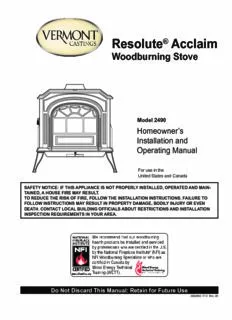
Table Of ContentResolute® Acclaim
Woodburning Stove
Model 2490
Homeowner’s
Installation and
Operating Manual
For use in the
United States and Canada
SAFeTy NoTice: iF ThiS AppliANce iS NoT pRopeRly iNSTAlleD, opeRATeD AND MAiN-
TAiNeD, A hoUSe FiRe MAy ReSUlT.
To ReDUce The RiSk oF FiRe, FolloW The iNSTAllATioN iNSTRUcTioNS. FAilURe To
FolloW iNSTRUcTio0N8S9 M3Ay ReSUlT iN pRopeRTy DAMAge, boDily iNjURy oR eveN
DeATh. coNTAcT locAl bUilDiNg oFFiciAlS AboUT ReSTRicTioNS AND iNSTAllATioN
Resolute Acclaim
iNSpecTioN ReqUiReMeNTS iN yoUR AReA.
Cover
Do Not Discard This Manual: Retain for Future Use
2000893 7/13 Rev. 28
Resolute® Acclaim Woodburning Stove
introduction
Thank you for choosing a Vermont Castings Resolute Acclaim.
Your stove is one of the finest available. It features high efficiency, non-catalytic performance, using space-age refractory
material and the precisely calibrated delivery of air to a concentrated charcoal bed to promote secondary combustion
in a controlled environment.
If treated properly and operated according to the guidelines in this manual it will provide years of safe, dependable, and
economical heating.
The Resolute Acclaim is listed by OMNI-Test Laboratories of Portland, Oregon. The test standards are ANSI/UL-1482
and 737 for the United States and ULC S627 for Canada.
The Resolute Acclaim is listed for burning wood. Do not burn other fuels.
The Resolute Acclaim is listed and approved for installation in mobile homes only in the United States and only with use
of Vermont Castings Mobile Home Installation Kit #3249.
The Vermont Castings Resolute Acclaim is in compliance with the standards set forth by the Federal Environmental
Protection Agency, 40 CFR Part 60.532(b)(2), as stated on the permanent label attached to each stove.
In addition to directions on installation and operation, this manual includes directions on maintenance and assembly.
We recommend that you hire a professional solid fuel stove installer to install your stove, or to advise you on the instal-
lation should you attempt to install it yourself.
Save These instructions.
Table of contents Accessories
Specifications .........................................3 Warming Shelf
#0064 Classic Black
Installation ..............................................4
#1385 Biscuit
Operation ..............................................17
#1395 Brown Majolica
Maintenance .........................................24 #1397 Bordeaux
Replacement Parts ...............................29 #0184 Rear Heat Shield
#0246 Bottom Heat Shield
#0133 Sparkscreen
#3255 Outside Air Adapter (for 3” ducting)
proposition 65 Warning: Fuels used in gas, woodburning
#3249 Mobile Home Kit - includes: Rear and Bottom
or oil fired appliances, and the products of combustion
Heat Shields, Outside Air Adapter, Ducting and Leg
of such fuels, contain chemicals known to the State
Clips
of California to cause cancer, birth defects and other
#0574 Stove Surface Thermometer
reproductive harm.
#3421 Gasket Kit
California Health & Safety Code Sec. 25249.6
#4360 Griddle Handle Kit
2 2000893
Resolute® Acclaim Woodburning Stove
Specifications
Resolute Acclaim Model 2490
Range of heat output ...................9,500-33,900 BTU/hr.* *Under specific conditions used during EPA emissions
EPA Emissions Rating ........................................3.4g/hr* testing.
Maximum heat output ..........................40,000 BTU/hr.** **This value can vary depending on how the unit is oper-
Area heated*** ...................Up to 1600 sq. ft. (148 sq m) ated, and the type and moisture content of the fuel used.
Fuel size/type .........................16” (410 mm) wood splits Figure shown is based on maximum fuel consumption
Fuel capacity .........................................30 lbs. (13.6 kg) obtained under laboratory conditions and on average
Loading .........................................................Front or top efficiencies.
Chimney connector.......................6” (152 mm) diameter ***These values are based on operation in building code-
Chimney flue size .......Min. 6” (152 mm) or 8” (203 mm) conforming homes under typical winter climate condi-
Flue exit position..........................Reversible, top or rear tions in New England. If your home is of non-standard
Primary air ...........................................................Manual construction (e.g., unusually well-insulated, not insulated,
Secondary air .......................................................Preset built underground, etc.) or if you live in a more severe or
Ash handling system ......................Removable ash pan more temperate climate, these figures may not apply.
Glass panel............................High-temperature ceramic Since so many variables affect performance, consult your
Weight ..................................................425 lbs. (192 kg) Vermont Castings' Authorized Dealer to determine realistic
Width (leg-to-leg) ......................................26” (660 mm) expectations for your home.
Depth (leg-to-leg) .....................................19” (480 mm)
Height to top of flue collar:
w/Regular legs ...................27¹⁄₂" (699 mm) top exit
.............................................25" (635 mm) rear exit
w/Short legs .......................25¹⁄₂" (648 mm) top exit
.............................................23" (584 mm) rear exit
12(cid:30)(cid:54)(cid:77)" DRAWINGS NOT TO SCALE
(324 mm)
19(cid:53)(cid:54)(cid:79)"
(495 mm)
23"
(584 mm)
25"
25(cid:53)(cid:54)(cid:79)" (635 mm)
(648 mm) 21(cid:53)(cid:54)(cid:79)"
(546 mm)
RESOLUTE
Acclaim
27(cid:53)(cid:54)(cid:79)" 21(cid:53)(cid:54)(cid:79)"
(546 mm)
(699 mm) (Reg. Legs)
25"
19(cid:53)(cid:54)(cid:79)"
(635 mm)
(495 mm)
(Short Legs)
6"
(152 mm)
19"
26"
(483 mm)
(660 mm)
Fig. 1 Resolute Acclaim dimensions.
2000893 0893 3
Resolute Acclaim
specifications
1/01
Resolute® Acclaim Woodburning Stove
installation
SAFeTy NoTice: iF yoUR ReSolUTe AcclAiM iS What kind of chimney to Use
NoT pRopeRly iNSTAlleD, opeRATeD AND MAiN-
Your Resolute Acclaim may be connected either to a sound
TAiNeD, A hoUSe FiRe MAy ReSUlT. FoR SAFeTy,
masonry chimney that meets local codes, to a relined ma-
FolloW All iNSTAllATioN, opeRATioN AND MAiN-
sonry chimney that meets local codes, or to an approved
TeNANce DiRecTioNS. coNTAcT locAl bUilDiNg
prefabricated metal chimney. Whatever kind you use, the
oFFiciAlS AboUT ReSTRicTioNS AND iNSTAllA-
chimney and chimney connector must be in good condition
TioN iNSpecTioN ReqUiReMeNTS iN yoUR AReA.
and kept clean.
Before you begin an installation, review your plans to see
that: If you use an existing masonry chimney, it must be inspect-
ed to ensure safe condition before the stove is installed.
• Your stove and chimney connector will be far enough
Your local professional chimney sweep, building inspector,
from combustible material to meet all clearance
or fire department official will be able to make the inspection
requirements.
or to direct you to someone who can.
• The floor protector is large enough and is constructed
The chimney should extend at least 3’ (914 mm) above the
properly to meet all requirements.
highest point where it passes through a roof, and at least
• You have all necessary permits from local authori- 2’ (610 mm) higher than any portion of a building within
ties. 10’ (3m). (Fig. 2)
Your local building official is the final authority for approv-
ing your installation as safe and determining that it meets 0 To 10'
local and state codes.
2' Min.
The metal label permanently attached to the back of every 3' 0 To 10'
Min.
Vermont Castings stove indicates that it has been tested to
2' Min.
3'
current UL and ULC standards, and gives the name of the
Min.
testing laboratory. Clearance and installation information is
also printed on the label. Local authorities generally will ac-
�
cept the label as evidence that, when the stove is installed
according to the information on the label and in this manual,
Reference Point
AC617
the installation meets codes and can be approved.
Fig. 2 The 2’-3’-10’ rule for chimneys.
Codes vary in different areas, however. Before starting
the installation, review your plans with the local building For proper draft and good performance, any chimney used
AC617
authority. Your local dealer can provide any additional with a Resolute AcclaimRL TsShKoCu8ld extend at least 16’ (5m)
information needed. above the flue collar of t2h/1e1 /s9t8ove.
For any unresolved questions about installation, refer
Masonry chimneys
to the National Fire Protection Association’s publication
ANSI/NFPA 211–1988 Standard for Chimneys, Fireplaces, An inspection of the chimney must confirm that it has a
Vents and Solid Fuel Burning Appliances. In Canada, the lining. Do not use an unlined chimney. The chimney also
equivalent publication is CSA CAN-B365, Installation Code should be examined for cracks, loose mortar, other signs
for Solid Fuel Burning Appliances and Equipment. These of deterioration, and blockage. Repair any defects before
standards are the basis for many national codes. They the chimney is used with your stove.
are nationally recognized and are accepted by most local
A prefabricated doube-wall
authorities. Your local dealer or your local building official
insulated chimney
may have a copy of these regulations.
iMpoRTANT: FAilURe To FolloW TheSe iNSTAllA-
TioN iNSTRUcTioNS MAy ReSUlT iN A DANgeRoUS
SiTUATioN, iNclUDiNg A chiMNey oR hoUSe FiRe.
FolloW All iNSTRUcTioNS exAcTly AND Do NoT
A tile-lined
AlloW MAkeShiFT coMpRoMiSeS To eNDANgeR
masonry
pRopeRTy AND peRSoNAl SAFeTy. chimney
ST241
Fig. 3 Standard chimney types.
4 2000893
ST241�
chimney types�
12/13/99 djt
Resolute® Acclaim Woodburning Stove
Unused openings in an existing masonry chimney must If possible, do not pass the chimney connector through a
be sealed with masonry to the thickness of the chimney combustible wall or ceiling. If passage through a combus-
wall, and the chimney liner should be repaired. Openings tible wall is unavoidable, refer to the recommendations
sealed with pie plates or wallpaper are a hazard and should in the section following on Wall Pass-Throughs. Do not
be sealed with mortar or refractory cement. In the event pass the connector through an attic, a closet or any similar
of a chimney fire, flames and smoke may be forced out of concealed space. The whole chimney connector should be
these unused thimbles. exposed and accessible for inspection and cleaning.
The chimney should be thoroughly cleaned before use. Install the chimney connector not less than 23” (584 mm)
from the ceiling. Keep it as short and direct as possible,
A newly-built masonry chimney must conform to the stan-
with no more than two (2) 90° turns. If possible, use 45°
dards of your local building code or, in the absence of a
elbows. Slope horizontal runs of connectors upward 1/4”
local code, to a recognized national code. Masonry chim-
per foot (20 mm per meter) going from the stove toward
neys must be lined, either with code-approved masonry or
the chimney. The recommended maximum length of a hori-
precast refractory tiles, stainless steel pipe, or a code-ap-
zontal run is 3’ (914 mm), and the total length of chimney
proved, “poured-in-place” liner. The chimney’s clean-out
connector should be no longer than 8’ (2.5 m).
door must seal tightly to help ensure a good draft.
In cathedral ceiling installations, extend the prefabricated
prefabricated chimneys
chimney downward to within 8’ (2.5 m) of the stove.
A prefabricated metal chimney must be one tested and SAFeTy NoTe: AlWAyS WeAR gloveS AND pRo-
listed for use with solid-fuel burning appliances to the TecTive eyeWeAR WheN DRilliNg, cUTTiNg oR
High-Temperature (H.T.) Chimney Standard UL-103-1985 joiNiNg SecTioNS oF chiMNey coNNecToR.
(2100°F.) for the United States, and High Temperature
(650°C) Standard ULC S-629 for Canada. Double-wall chimney connectors
Do NoT coNNecT ThiS UNiT To A chiMNey FlUe The listing for the Resolute Acclaim in the U.S. and Canada
SeRviNg ANoTheR AppliANce. includes use of double-wall chimney connectors that have
been tested and listed for use with solid-fuel burning ap-
chimney Size
pliances by a recognized testing laboratory.
A Resolute Acclaim is approved for venting into a masonry Information on assembling and installing double-wall con-
chimney with a flue size of 8” x 8” (203 x 203 mm), and into nectors is provided by the manufacturer of the double-wall
a round flue size of 8” (203 mm) or 6” (152 mm). pipe. Follow the manufacturer’s instructions exactly as
It may be vented into larger chimneys as well. However, you assemble the connector and attach it to the stove and
chimneys with liners larger than 8” x 12” (203 x 305 mm) chimney. Using chimneys and connectors from the same
may experience rapid cooling of smoke and reduction in manufacturer helps make the assembly and installation
draft, especially if they are located outside the home. These straightforward.
large chimneys may need to be insulated or to have their NoTe: For installations using double-wall connectors,
flues relined for proper stove performance. minimum clearances must conform to the listed clear-
Accessories to help make the connection between stain- ances in the clearance chart on page 12.
less steel chimney liners and your Resolute Acclaim are
Single-wall chimney connectors
available through your local dealer.
• Beginning at the flue collar of the stove, assemble the
chimney connector guidelines
chimney connector. Insert the first crimped end into the
A chimney connector is the double-wall or single-wall pipe stove’s flue collar, and keep each crimped end pointing
that connects the stove to the chimney. The chimney it- toward the stove. Using the holes in the flue collar as guides,
self is a masonry or prefabricated structure that encloses drill 1/8” (3mm) holes in the bottom of the first section of
the flue. Chimney connectors are used only to make the chimney connector and secure it to the flue collar with three
connection from the stove to the chimney. They are for (3) #10 x 1/2” sheet metal screws.
interior use only. • Secure each joint between sections of chimney con-
Double-wall connectors must be tested and listed for use nector, including telescoping joints, with at least three (3)
with solid-fuel burning appliances. Single-wall connectors sheet metal screws. The predrilled holes in the top of each
should be made of 24 gauge or heavier steel, and should section of chimney connector serve as guides when you
be 6” (152 mm) in diameter. Do not use galvanized chimney drill 1/8” (3 mm) holes in the bottom of the next section.
connector; it cannot withstand the high temperatures that
can be reached by smoke and exhaust gases, and may
release toxic fumes under high heat.
2000893 5
Resolute® Acclaim Woodburning Stove
• Secure the chimney con- snug and the joint between the thimble and the chimney
wall must be cemented firmly. (Fig. 5)
nector to the chimney. In-
A special piece called the “thimble sleeve,” slightly smaller
structions for various instal-
in diameter than standard connector and most thimbles,
lations follow.
will facilitate the removal of the chimney connector system
• Be sure the installed stove
for inspection and cleaning. Thimble sleeves should be
and chimney connector
available from your local dealer.
are correct distances from
nearby combustible mate-
rial.
NoTe: Special slip pipes Thimble Sleeve
and thimble sleeves that Flue
form telescoping joints be- Chimney Keep
Connector
tween sections of chimney Fig. 4 The crimped end of sleeve end
flush with
connector are available to the connector points toward flue tile
simplify installations. They the stoveS.T242�
Chimney connector�
often eliminate the need to 12/13/99 djt
cut individual connector sections. Consult your local dealer
about these special pieces.
Securing the Single-wall connector
ST243
to a prefabricated chimney
Fig. 5 The thimble, made of either ceramic or metal, must be
Follow the installation instructions of the chimney manufac- cemented securely in place.
turer exactly as you install the chimney. The manufacturer To install a thimble sleeve, slide it into the breech until it is
of the chimney will supply the accessories to support the flush with the inner flue wall. Do not extend it into the actual
chimney, either from the roof of the house, at the ceiling of flue passage, as this could interfere with the draft.
ST243�
the room where the stove is installed, or from an exterior
The thimble sleethvien bsleh ocuonldn epcrtoiotrnu� de 1-2” (25-50 mm) into
wall. 12/13/99 djt
the room. Use furnace cement and thin gasketing to seal
Special adapters are available from your local dealer to the sleeve in place in the thimble. Secure the chimney
make the connection between the prefabricated chimney connector to the outer end of the sleeve with sheet metal
and the chimney connector. The top of such adapters attach screws.
directly to the chimney or to the chimney’s ceiling support
package, while the bottom of the adapter is screwed to the
chimney connector.
Chimney
Flue Liner
These adapters are designed so the top end will fit outside
the inner wall of the chimney, and the bottom end will fit Elbow Flue Liner
inside the first section of chimney connector. When as-
sembled in this way, any soot or creosote falling from the
inner walls of the chimney will stay inside the chimney Slip Pipe
connector. Thimble
Standard
Securing the Single-wall connector Connector
to a Masonry chimney Flue Collar
Both freestanding masonry chimneys and fireplace masonry
chimneys may be used for installation of your Resolute
Acclaim.
Freestanding installations
If the chimney connector must pass through a combustible
wall to reach the chimney, follow the recommendations in
ST492
the Wall Pass-Through section that follows. The opening
Fig. 6 Chimney connection is a freestanding installation.
through the chimney wall to the flue (the “breech”) must
be lined with either a ceramic or metal cylinder, called
ST492
the “thimble”, which is securely cemented in place. Most Resolute Acclaim
chimney breeches incorporate thimbles, but the fit must be freestanding
installation
1/01
6 2000893
Resolute® Acclaim Woodburning Stove
Above A Fireplace
In this installation, the chimney connector rises from the
stove, turns ninety degrees, and goes back into the fireplace
chimney. (Fig. 7) The liner of the fireplace chimney should
extend at least to the point at which the chimney connector
enters the chimney. Follow all the guidelines for installing a
chimney connector into a freestanding masonry chimney,
and pay special attention to these additional points:
• If there is a combustible mantel or trim, check the stove Flexible Con-
nector
and chimney connector clearances. Use the necessary
combination of mantel, trim, and connector heat shields
to provide the required clearances.
Mantel Shield
• Double-check connector clearance from the ceiling.
• The fireplace damper must be closed and sealed to Fireplace
Adpator Kit
prevent room air from being drawn up the flue, reducing
the draft. However, it must be possible to reopen the
damper to inspect or clean the chimney.
RESAOLcUcTlEaim
Chimney Con-
nector Shields
*
ST245
Fig. 8 Chimney connector enters chimney through the fire-
* Check these place opening.
*
clearances
Wall pass-Throughs
ST245
Whenever possible, fidreepsilgance y our installation so the con-
Mantel nector does not pasfsle txh rcooungnhe ac tocormbustible wall. If you
are considering a w1a2ll /9p9ass-through in your installation,
Seal the
RESAOLcUcTlEaim Damper check with your building inspector before you begin. Also
check with the chimney connector manufacturer for any
specific requirements.
Accessories are available for use as wall pass-throughs.
If using one of these, make sure it has been tested and
ST244
listed for use as a wall pass-through.
Fig. 7 Chimney connector enters chimney above the fireplace.
U.S.: in the United States, the National Fire protection
Association (NFpA) has established guidelines for
Through A Fireplace
ST244 passing chimney connectors through combustible
Plymouth
If your fireplace opening height is at least 23” (584 mm)*, walls. Many building code inspectors follow these
fplc over mantel
you may install a Res1o2/l9u9te Acclaim through the opening guidelines when approving installations.
using a “positive connection” kit available from your local
The following illustration shows one NFPA-recommended
dealer. These kits provide a secure connection between
method. All combustible material in the wall is cut away
the stove flue collar and the chimney flue. (Fig. 8) If it is
a sufficient distance from the single-wall connector to
necessary to reverse the flue collar from the top exit to the
provide the required 12” (305 mm) clearance for the con-
rear exit position, follow the directions on Page 10.
nector. Any material used to close up the opening must be
Fireplace installations, whether connected to the flue above noncombustible.
or through the fireplace opening, have special clearance
Three other methods are also approved by the NFPA.
requirements to adjacent trim and the mantel. You’ll find
These are:
the required safe clearances for Resolute Acclaim fireplace
installations on Page 11. • Using a section of double-wall chimney with a 9” (229
mm) clearance to combustibles.
Floor protection requirements also apply to fireplace instal-
lations. Floor protection is discussed on Page 9.
2000893 7
Resolute® Acclaim Woodburning Stove
• Placing a chimney connector pipe inside a ventilated
18” (457 mm) clearance
thimble, which is then separated from combustibles by 6” all around the pipe
(152 mm) of fiberglass insulating material.
• Placing a chimney connector pipe inside a section of
9” (229 mm) diameter, solid-insulated, factory-built chim-
ney, with 2” (51 mm) of air space between the chimney
section and combustibles.
T T
Wall Stud
Flush
Mounted
Chimney Con-
nector
ST494a
T
Fig. 10 An approved wall pass-through for Canada.
12” (305mm) of
Noncombustible FloSoT4r9 p4rotection
Material
steel
A tremendous amount of heat radiates from the bottom
wall pass thru
plate of your Resolute Acclaim. The floor area directly
11/00
under and around the stove will require protection from
radiant heat as well as from stray sparks or embers that
Floor Pro-
may escape the firebox.
tection
ST493a
Heat protection is provided through the use of a Vermont
Fig. 9 An approved wall pass-through for the United States. Castings Bottom Heat Shield #0246. Spark and ember
protection must be provided by a floor protector constructed
canada: The canadian Standards Association has
with noncombustible material as specified.
established different guidelines. The illustration below
shows one method, in which all combustible material Most installations will require that the bottom heat shield be
in the wall is cut away to SpTro4v9i3dae the required 18” (457 attached. Only when the stove is placed on a completely
mm) clearance for the coBnrnicekc tpoars. s T thheru resulting space noncombustible surface such as unpainted concrete over
must remain empty. A flus1h1-/m00ounted sheet metal cover earth may it be used without the heat shield.
may be used on one side only. if covers must be used Even when the bottom heat shield is installed, you must
on both sides, each cover must be mounted on noncom- provide special protection to the floor beneath. For instal-
bustible spacers at least 1” (25 mm) clear of the wall. lations with the heat shield attached, use a noncombustible
your local dealer or your local building inspector can floor protector such as 1/4” non-asbestos mineral board or
provide details of other approved methods of passing equivalent, or 24 gauge sheet metal. The floor protector
a chimney connector through a combustible wall. may be covered with a noncombustible decorative material
In Canada, this type of installation must conform to CAN/ if desired. Do not obstruct the space under the heater.
CSA-B365, Installation Code for Solid Fuel Burning Appli- Protection requirements vary somewhat between the
ances and Equipment. United States and Canada as follows:
NoTe: Do not vent your Resolute Acclaim into a U.S. installations the floor protector is required under
factory-built (zero-clearance) fireplace under any the stove and must extend at least 16” from the front of
circumstances. The Resolute Acclaim has not been the stove (“C”, Fig. 11), and at least 6” from the sides and
specifically tested and listed for this type of installa- rear (“D” and “E”,Fig. 11). It must also extend under the
tion. These appliances and their chimneys are specifically chimney connector and 2” to either side (“F”,Fig. 11).
designed as a unit for use as fireplaces. It may void the
To meet these requirements, a floor protector must be at
listing or be hazardous to adapt them for any other use.
least 38” wide and 42” deep.
Do NoT coNNecT The ReSolUTe AcclAiM To ANy
in canada, a noncombustible floor protector is required
AiR DiSTRibUTioN DUcT oR SySTeM.
under the heater also. The floor protector must extend 18”
(457 mm) to the front (“C”, Fig. 11), and 8” (203 mm) from
the sides and rear (“D” and “E”, Fig. 11).
8 2000893
Resolute® Acclaim Woodburning Stove
F
Top exit Rear exit
RESOLUTE
Acclaim
E E
B
C D C D
A A Wood framing
requires protection
U.S. canada from radiant heat ST247a
A: 38” 42” (1067 mm)
B: 42” 46” (1168 mm) Fig. 12 Supporting timbers under fireplace hearth are consid-
C: 16” 18” (457 mm) ered to be combustible
D: 6” 8” (203 mm)
keep the Stove a Safe Distance From
E: 6” ST5800” � (203 mm)
F: 10” intr1ep0id” (254 mm) Surrounding Materials
floor protection ST500
11/10/00
Fig. 11 Required floor protector dimensions. Both a stove and its chimnSeyT c2o4n7nector radiate heat in all
directions when operating.R A esaafre e inxsitt afllloaotior nd rgerqmuires that
To meet these requirements, a floor protector must be at
adequate clearance be maintained between the stove and
least 42” (1067 mm) wide and 46” (1168 mm) deep. 12/14/99 djt
nearby combustible materials to ensure that such materials
Floor protection for Fireplace installation do not overheat.
Clearance is the distance between either your stove or
Do not assume that your fireplace hearth is completely
chimney connector, and nearby walls, floors, the ceiling,
noncombustible
and any other fixed combustible surface. Keep furnishings
Many fireplace hearths do not satisfy the “completely non-
and other combustible materials away from the stove as
combustible” requirement because the brick or concrete in
well. In general, a distance of 48” (1220 mm) must be
front of the fireplace opening is supported by heavy wood
maintained between the stove and moveable combustible
framing as in Figure 12. Because heat passes readily
items such as drying clothes, furniture, newspapers, fire-
through brick or concrete, it can easily pass through to
wood, etc. Keeping those clearance areas empty assures
the wood. As a result, such fireplace hearths can be a fire
that nearby surfaces and objects will not overheat.
hazard and are considered a combustible floor.
Safe Ways to Reduce clearances
For all fireplace installations, follow the floor protection
guidelines described above. Your stove has special clearance requirements that have
been established after careful research, and testing to UL
Keep in mind that many raised hearths will extend less than
and ULC standards.
the required clearance from the front of the heater when
it is installed. In such cases, sufficient floor protection as Clearance requirements have been established to meet
described above must be added in front of the hearth to most installation possibilities, and they involve the combi-
satisfy the minimum floor protector requirement from the nation of four basic variables:
front of the stove: 16” (410 mm) from the front in the United • When the stove has no listed heat shield mounted on
States and 18” (457 mm) from the front in Canada. it.
• When the stove has a listed heat shield mounted on
Hearth rugs do not satisfy the requirements for floor protec- it.
tion as they are not fire proof. • When the wall has no listed heat shield mounted on
it.
Fireplace installations also have special clearance require-
• When the wall has a listed heat shield mounted on it.
ments to the side walls, side decorative trim, and fireplace
In general, the greatest clearance is required when you
mantel. Refer to the information on fireplace and mantel
are placing a stove with no heat shield near a wall with no
trim shields in this section.
heat shield. The least clearance is required when both the
stove and the wall have heat shields. Reducing a stove
clearance may require a listed heat shield on the chimney
connector as well.
2000893 9
Resolute® Acclaim Woodburning Stove
Clearances may be reduced only by means approved by 2. Remove the flue collar and extension plate.
the regulatory authority, or in accordance with the clear- 3. Examine the exposed gasket; contact your Vermont
ances listed in this manual. Castings Authorized Dealer if the gasket needs to be
replaced.
Wall Shields
4. Position the extension plate and flue collar in the ap-
Wall shields should be constructed of 24 gauge or heavier propriate orientation, making sure the gasket remains in
sheet metal, or another noncombustible material such as place. The notched edge of the extension plate should
1/2” (13 mm) insulation board or common brick “laid on be next to the griddle.
flat,” with the 3¹⁄₂" (89 mm) side down. (Fig. 13) 5. Secure the extension plate and flue collar with the fas-
Shields must be spaced out from the combustible surface 1" teners removed in the first step. Run the bolts in only
(25 mm) on noncombustible spacers. The spacers should finger-tight. Adjust the fit of the extension plate and/or
not be directly behind the stove or chimney connector. flue collar if necessary. Tighten all four (4) fasteners,
but do not overtighten them. Test the action of the
griddle; make any needed adjustments by loosening
Air Flow
the hardware, repositioning the flue collar and extension
plate, retesting the griddle action, and retightening the
Screen hardware.
Wall Shield Fireplace installations
A fireplace installation requires special clearance between
Stud Wall
Framing the side of the stove and the right and left walls, the side
of the stove and the decorative side trim on the fireplace
face, and the top of the stove and the mantel.
Noncombustible
spacers and Shield Ventilated shields (noncombustible) installed on noncom-
fasteners
bustible spacers 1” (25 mm) away from the combustible
surface may be used to reduce clearances. (Fig. 14) A
Metal Spacer
Drywall mantel shield for the Resolute Acclaim must be at least 48”
(1219 mm) long, centered over the stove. Side trim shields
must extend the full length of the trim. (Fig. 15)
An unprotected mantel (“A”,Fig. 15) must have a minimum
clearance of 36” (914mm), measured from the stove’s top
Air Flow plate. With a ventilated shield the clearance may safely be
ST248
reduced to 30” (762 mm). Maximum depth of the mantel
Fig. 13 Approved wall shield construction. is 9” (229 mm).
Air must be able to flow between the wall and the shield. Unprotected top trim (B) protruding 1¹⁄₂" (38 mm) or less
ST248�
At least 50% of the bottom 1” (25 mm) of the shield should from the face of the fireplace must be a minimum of 28"
wall shield construction�
be open and the shield must be open at the top. (711 mm) from the stove's top surface. This clearance may
12/14/99 djt
not be reduced by shielding. If top trim protrudes more
When calculating clearance, always measure from the top
than 1¹⁄₂" (38 mm) the mantel clearances of 36" (915mm)
plate of the stove, or, from the chimney connector itself, to
unshielded and 30" (762 mm) shielded must be used.
the adjacent combustible surface. Do not measure from the
heat shields of the stove or connector to the combustible Side trim must have a minimum clearance of 8" (203 mm),
surface. measured from the stove's top side edge. In this case, venti-
lated shielding will not provide protection to allow clearance
Reversing the Flue collar
reduction.
Your Resolute Acclaim is shipped with the flue collar in the In addition, a fireplace installation must observe the floor
top exit position. Depending on your requirements, you protection guidelines discussed previously.
may wish to reverse the flue collar and extension plate to
The charts and sample installations on the following pages
the rear exit position. The only tool necessary is a 7/16”
list the clearances required for various installation configu-
wrench.
rations of the Resolute Acclaim.
To reverse the flue collar position:
1. Remove the four (4) fasteners that hold the collar and
extension plate. The fasteners are accessible by reach-
ing through the flue collar of the stove.
10 2000893
Description:3. Resolute® Acclaim Woodburning Stove. 2000893. RESOLUTE. Acclaim. 2556O". (648 mm). 2756O". (699 mm). 26". (660 mm). 6". (152 mm). 23".