Table Of ContentBegin Reading
Table of Contents
About the Author
Copyright Page
Thank you for buying this Henry Holt and Company ebook.
To receive special offers, bonus content, and info on new releases and other great reads, sign up for our
newsletters.
Or visit us online at
us.macmillan.com/newslettersignup
For email updates on the author, click here.
The author and publisher have provided this e-book to you for your personal use
only. You may not make this e-book publicly available in any way. Copyright
infringement is against the law. If you believe the copy of this e-book you
are reading infringes on the author’s copyright, please notify the publisher
at: us.macmillanusa.com/piracy.
INTRODUCTION
The First Shall Be First
The essays collected here scan over many diverse aspects of American life, but
they all aim to tell one essential story: This is what a society looks like when the
glue that holds it together starts to dissolve. This is the way ordinary citizens
react when they learn the structure beneath them is crumbling. This is the thrill
that pulses through the veins of the well-to-do when they discover there is no
longer any limit on their power to accumulate.
In headline terms, these essays cover the years of the Barack Obama
presidency and the populist explosion that marked its end. It was a time when
liberal hopes were sinking and the newly invigorated right was proceeding from
triumph to triumph. When I wrote the earliest installment in the collection,
Democrats still technically controlled both houses of Congress in addition to the
presidency; when I finished these essays, Donald Trump sat in the Oval Office
and Republicans had assumed a position of almost unprecedented power over
the nation’s political system.
For a few, these were times of great personal satisfaction. The effects of what
was called the Great Recession were receding, and affluence had returned to
smile once again on the tasteful and the fortunate. The lucky ones resumed their
fascinating inquiries into the art of the cocktail and the science of the grandiose
suburban home. For them, things transpired reassuringly as before.
But for the many, this was a period when reassurance was in short supply.
Ordinary Americans began to understand that, recovery or not, things would
probably never be the same in their town or neighborhood. For them, this was a
time of cascading collapse, with one trusted institution after another visibly
deteriorating.
It was a golden age of corruption. By this I do not mean that our top political
leaders were on the take—they weren’t—but rather that America’s guardian
class had been subverted or put to sleep. Human intellect no longer served the
interests of the public; it served money—or else it ceased to serve at all. That
was the theme of the era, whether the locale was Washington, D.C., or the
college your kids attended, or the city desk of your rapidly shrinking local
newspaper. No one was watching out for the interests of the people, and
increasingly the people could see that this was the case.
The financial crisis of 2008 engraved this pattern in the public mind. Every
trusted professional group touching the mortgage industry had turned out to be
corrupt: real estate appraisers had puffed the housing bubble, credit rating
agencies had puffed Wall Street’s trashy securities, and of course investment
bankers themselves had created the financial instruments that were designed to
destroy their clients. And then, as the larger economy spiraled earthward … as
millions around the world lost jobs and homes … the trusted professionals of the
federal government stepped in to ensure that their brother professionals on Wall
Street would suffer no ill effects. For the present generation, the bailout of the
crooks would stand as the ultimate demonstration of the worthlessness of
institutions, the nightmare knowledge that lurked behind every scam that was to
come.
What I describe in this volume is a vast panorama of such scams—a republic
of rip-offs. Bernie Sanders, the archetypal reform figure of our time, likes to say
that “the business model of Wall Street is fraud,” but in truth we could say that
about many of the designated protectors of our health and well-being.
Pharmaceutical companies, we learned, jack up prices for no reason other than
because they can, because it is their federally guaranteed right to do so. The
brain power of Silicon Valley, meanwhile, concentrates on the search for
ingenious ways to harvest private information and build monopolies so that it,
too, can gouge the world with impunity.
The university is the ultimate source of credentialed expertise—of the idea
that there are values beyond those of the market—and here, too, the rot and the
corruption were unmistakable. That the traditional professoriate was doomed
became obvious in these years, and also that the contemplative way of life was
circling the drain as well. But even as the intellectuals went down, the
universities themselves prospered in a remarkable and even unprecedented way,
growing and building and driving tuition prices skyward. As these developments
unfolded, legitimate higher ed was dogged by countless educational scams and
even fake-educational scams, operations that would sell anyone a realistic-
looking college degree for a modest sum.
In politics, of course, the scam and the fib are as old as the earth itself. Even
so, the past decade has been a time of extraordinary innovation in the field. The
rise of the super PAC and the Citizens United decision drew the most attention in
this regard, but what seems most striking in retrospect was the way the casual
dishonesty of politics started to spill over into everyday life.
The consolations of ideology became available to the millions, thanks to
Facebook and Twitter and the political entertainers on cable news. Millions of
Americans came to believe that everything was political and that therefore
everything was faked; that everyone was a false accuser so why not accuse
people falsely; that any complaint or objection could ultimately be confounded
by some clever meme; that they or their TV heroes had discovered the made-up
argument by which they could drown out that still small voice of reality. At
right-wing rallies, one began to notice a gleeful denial of things that were
obviously true.
Legitimate public defenders like newspapers were simply shutting down. And
as your local paper went silent, the reign of factuality seemed to crumble as well.
Among newspapers that survived, meanwhile, the resident professionals often
seemed to be in denial about what was happening. This was a “golden age of
journalism,” they chanted, and as their little world shrank and the public grew to
hate them more and more, the survivors came together in an ever tighter circle of
professional unanimity, missing the obvious but agreeing with one another on
the correct interpretation of an amazing variety of events.
Fake news flourished, of course. For every newspaper that withered away, an
opportunity opened up for somebody willing to imitate what had gone before.
Social media entrepreneurs prospered, as did home-grown propagandists and
online scam artists. It sometimes seemed as if everyone was search-engine-
optimizing something or making bogus documentaries or Photoshopping some
outrageous text onto some stock photo. The Internet teemed with collators of
tweets, makers of memes, content farms, traffickers in panic and stereotype, liars
for hire.
The representative figure of this new era was Andrew Breitbart, the master of
a homemade right-wing Web empire, who rose from obscurity to become the
bellowing scourge of the mainstream media: accusing promiscuously, denying
vociferously, always shouting, always rationalizing. For him, representation was
everything, reality was nothing, and politics became more and more an analogue
of pro wrestling. The pseudo-event was the only game in town.
*
The United States has always been friendly to quacks and mountebanks and false
accusers; that is an essential teaching of this country’s literature from the days of
Mark Twain to those of Lewis Lapham. Like pumpkin pie and the bald eagle, the
con game is so utterly American that it probably deserves its own series of
postage stamps. But something is different today. The quacks and the
mountebanks own the place, and everyone knows it. The con game is our
national pastime. Everyone either is in on it or has a plan for getting in on it
soon.
What has made corruption’s reign possible is no mystery. For most
Americans, the props of middle-class life—four years at college, for example—
are growing expensive and moving out of reach. At the same time, the rewards
showered upon society’s handful of winners have grown astronomically greater.
The result is exactly what our cynical ancestors would have expected: people
will do anything to be among the winners.
And as we serve money, we find that money always wants the same thing
from us: that it pushes everyone it beguiles in the same direction. Money never
seems to be interested in strengthening regulatory agencies, for example, but
always in subverting them, in making them miss the danger signs in coal mines
and in derivatives trading and in deep-sea oil wells. You can have a shot at
joining the one percent, money tells us, only if you are first committed to making
the one percent stronger, to defending their piles in some new and imaginative
way, to rationalizing and burnishing their glory, to exempting them from
regulation or taxation and bowing down as they pass.
What I am describing is not “sustainable,” as people in Washington like to
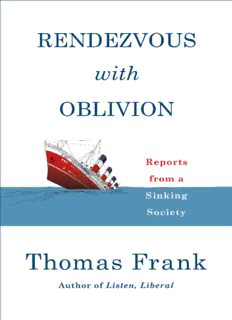
say. It has given us a rendezvous with oblivion, not with destiny. You can’t build
a civilization on rip-offs … on no-doc loans taken out in order to make scam
phone calls to senior citizens … on rolled-back odometers and fancy college
degrees that are worth less than they used to be and might well prove to be
worthless altogether … on the presidential aspirations of a con man who mimics
your way of talking but has no idea how to govern.
And so we come to Donald Trump, the very personification of this low,
dishonest age. Nearly every one of the trends described in this book culminates
with him. He is an Ivy League graduate who also went into business selling
degrees of his own. A dealer in tasteless palatial real estate. A one-man right-
wing propaganda bureau who didn’t seem to be able to distinguish between what
was true and what was false amid his constant tweetings and accusings. A
character from pro wrestling and reality TV. A true-believing adherent of
Breitbart’s doctrine that only media matters—indeed, a candidate whose 2016
campaign was run by the viceroy of Breitbart’s empire.
Trump was the most virulent fake populist of them all: a “blue-collar
billionaire,” as his admirers described him, a Republican who was carried to
victory by his lovable habit of inventing cruel nicknames for his opponents. The
legitimate media came together against him as a matter of course, tallying up his
falsehoods and insults and assuring their audience that he represented the end of
conservatism at long last. The country’s surviving newspapers endorsed his
Democratic opponent by an unprecedented margin.
For all that, there was still something real about Trump—or rather about the
suffering of the white working-class people who attended his rallies and who
made him their president during the crazy election of 2016. These were people
on the receiving end of the trends I’ve described; they were living in the world
dominated by the self-serving professionals who screwed things up and survived
to screw things up again. Despite what the Beltway types assured them, they
knew that the wars were inexcusable and the elites were corrupt and the trade
deals were bad. And what others saw as Trump’s falsehoods they saw as a form
of honesty, a plain-speaking directness that was refreshing in all its vulgarity.
They looked not to be saved by experts but rescued from them, and Trump’s
achievement was to make himself the vehicle of their hopes.
The results were disastrous, of course, and much of what I describe in the
book that follows are matters of grave import. You will notice, however, that I
describe them with a certain amount of levity. I do that because that’s the only
way to confront the issues of our time without sinking into debilitating gloom.
“We live in a land of abounding quackeries,” wrote H. L. Mencken once upon a
time, “and if we do not learn how to laugh we succumb to the melancholy
disease which afflicts the race of viewers-with-alarm.”
Description:From the acclaimed author of Listen, Liberal and What’s the Matter with Kansas, a scathing collection of his incisive commentary on our cruel times―perfect for this political moment What does a middle-class democracy look like when it comes apart? When, after forty years of economic triumph, Ame