Table Of ContentThis page intentionally left blank
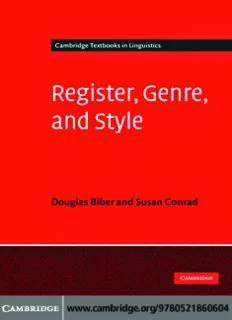
Register, Genre, and Style
This book describes the most important kinds of texts in English and
introduces the methodological techniques used to analyze them. Three
analytical approaches are introduced and compared, describing a wide
rangeoftextsfromtheperspectivesofregister,genre,andstyle.
Theprimaryfocusofthebookisontheanalysisofregisters.Part1intro-
ducesananalyticalframeworkforstudyingregisters,genreconventions,
and styles. Part 2 provides detailed descriptions of particular text vari-
eties in English, including spoken interpersonal varieties (conversation,
universityofficehours,serviceencounters),writtenvarieties(newspapers,
academicprose,fiction),andemergingelectronicvarieties(e-mail,inter-
netforums,textmessages).Finally,Part3introducesadvancedanalytical
approachesusingcorpora,anddiscussestheoreticalconcerns,suchasthe
placeofregisterstudiesinlinguistics,andpracticalapplicationsofregister
analysis.Eachchapterendswiththreetypesofactivities:reflectionand
reviewactivities,analysisactivities,andlargerprojectideas.
douglas biber isRegents’ProfessorofAppliedLinguisticsatNorth-
ern Arizona University. He has worked in Kenya and Somalia, and has
beenavisitingprofessoratseveraluniversities,includingtheUniversity
of Uppsala, University of Helsinki, University of Zurich, the Freiburg
InstituteofAdvancedStudies,andtheNorwegianAcademyofArtsand
Sciences.HispreviousbooksincludeVariationacrossSpeechandWrit-
ing,DimensionsofRegisterVariation,CorpusLinguistics,TheLongman
GrammarofSpokenandWrittenEnglish,andDiscourseontheMove.
susan conrad is Professor of Applied Linguistics at Portland State
University.ShehasworkedinSouthernAfricaandKorea,andconducted
workshopsondiscourseanalysisandcorpuslinguisticsinEurope,South
America,andThailand.HerpreviousbooksincludeCorpusLinguistics,
TheLongmanGrammarofSpokenandWrittenEnglish,andTheStudent
GrammarofSpokenandWrittenEnglish.
CAMBRIDGE TEXTBOOKS IN LINGUISTICS
Generaleditors:p. austin, j. bresnan, b. comrie, s. crain,
w. dressler, c. ewen, r. lass, d. lightfoot, k. rice,
i. roberts, s. romaine, n. v. smith
Register, Genre, and Style
Inthisseries:
r. a. hudsonSociolinguisticsSecondedition
a. j. elliotChildLanguage
p. h. matthewsSyntax
a. radfordTransformationalSyntax
l. bauerEnglishWord-Formation
s. c. levinsonPragmatics
g. brownandg. yuleDiscourseAnalysis
r. huddlestonIntroductiontotheGrammarofEnglish
r. lassPhonology
b. comrieTense
w. kleinSecondLanguageAcquisition
a. j. woods,p. fletcheranda. hughesStatisticsinLanguageStudies
d. a. cruseLexicalSemantics
a. radfordTransformationalGrammar
m. garmanPsycholinguistics
g. g. corbettGender
h. j. giegerichEnglishPhonology
r. cannFormalSemantics
j. laverPrinciplesofPhonetics
f. r. palmerGrammaticalRolesandRelations
m. a. jonesFoundationsofFrenchSyntax
a. radfordSyntacticTheoryandtheStructureofEnglish:AMinimalistApproach
r. d. van valin, jr,andr. j. lapollaSyntax:Structure,MeaningandFunction
a. durantiLinguisticAnthropology
a. cruttendenIntonationSecondedition
j. k. chambersandp. trudgillDialectologySecondedition
c. lyonsDefiniteness
r. kagerOptimalityTheory
j. a. holmAnIntroductiontoPidginsandCreoles
g. g. corbettNumber
c. j. ewenandh. van der hulstThePhonologicalStructureofWords
f. r. palmerMoodandModalitySecondedition
b. j. blakeCaseSecondedition
e. gussmanPhonology:AnalysisandTheory
m. yipTone
w. croftTypologyandUniversalsSecondedition
f. coulmasWritingSystems:AnIntroductiontotheirLinguisticAnalysis
p. j. hopperande. c. traugottGrammaticalizationSecondedition
l. whiteSecondLanguageAcquisitionandUniversalGrammar
i. plagWord-FormationinEnglish
w. croftanda. cruseCognitiveLinguistics
a. siewierskaPerson
a. radfordMinimalistSyntax:ExploringtheStructureofEnglish
d. bu¨ringBindingTheory
m. buttTheoriesofCase
n. hornstein,j. nun˜esandk. grohmannUnderstandingMinimalism
b. c. lustChildLanguage:AcquisitionandGrowth
g. g. corbettAgreement
j. c. l. ingramNeurolinguistics:AnIntroductiontoSpokenLanguageProcessingand
itsDisorders
j. clacksonIndo-EuropeanLinguistics:AnIntroduction
m. arielPragmaticsandGrammar
r. cann,r. kempsonande. gregoromichelakiSemantics:AnIntroduction
toMeaninginLanguage
y. matrasLanguageContact
d. biberands. conradRegister,Genre,andStyle
Register, Genre, and Style
DOUGLAS BIBER
NorthernArizonaUniversity
SUSAN CONRAD
PortlandStateUniversity
CAMBRIDGEUNIVERSITYPRESS
Cambridge, New York, Melbourne, Madrid, Cape Town, Singapore,
São Paulo, Delhi, Dubai, Tokyo
Cambridge University Press
The Edinburgh Building, Cambridge CB2 8RU, UK
Published in the United States of America by Cambridge University Press, New York
www.cambridge.org
Information on this title: www.cambridge.org/9780521860604
© Douglas Biber and Susan Conrad 2009
This publication is in copyright. Subject to statutory exception and to the
provision of relevant collective licensing agreements, no reproduction of any part
may take place without the written permission of Cambridge University Press.
First published in print format 2009
ISBN-13 978-0-511-65825-9 eBook (NetLibrary)
ISBN-13 978-0-521-86060-4 Hardback
ISBN-13 978-0-521-67789-9 Paperback
Cambridge University Press has no responsibility for the persistence or accuracy
of urls for external or third-party internet websites referred to in this publication,
and does not guarantee that any content on such websites is, or will remain,
accurate or appropriate.
Contents
Acknowledgements pageix
1 Registers,genres,andstyles:fundamental
varietiesoflanguage 1
1.1 Textvarietiesinyourdailylife 1
1.2 Texts,varieties,registers,anddialects 4
1.3 Registersandregisteranalysis:anoverview 6
1.4 Differentperspectivesontextvarieties:
register,genre,style 15
1.5 Register/genrevariationasalinguisticuniversal 23
1.6 Overviewofthebook 25
PartI Analyticalframework
2 Describingthesituationalcharacteristicsofregisters
andgenres 31
2.1 Introduction 31
2.2 Issuesintheidentificationofregistersandgenres 31
2.3 Aframeworkforsituationalanalysis 36
2.4 Applyingthesituationalanalyticalframeworkinaregisterstudy 47
3 Analyzinglinguisticfeaturesandtheirfunctions 50
3.1 Introduction 50
3.2 Fundamentalissuesforthelinguisticanalysisofregisters 51
3.3 Conductingquantitativeanalyses 58
3.4 Decidingonthelinguisticfeaturestoinvestigate 63
3.5 Functionalinterpretations 64
3.6 Textualconventions:thegenreperspective 69
3.7 Pervasivelinguisticfeaturesthatarenotdirectlyfunctional:the
styleperspective 71
3.8 Embeddedregistersandgenres 72
3.9 Ashortintroductiontocorpuslinguistics 73
3.10 Small-scaleversuslarge-scaleregisteranalyses 74
PartII Detaileddescriptionsofregisters,genres,andstyles
4 Interpersonalspokenregisters 85
4.1 Introduction 85
4.2 Conversation 86
vii
viii Contents
4.3 Universityofficehours 96
4.4 Serviceencounters 102
4.5 Conclusion 105
5 Writtenregisters,genres,andstyles 109
5.1 Introduction 109
5.2 Situationalcharacteristicsofnewspaperwritingandacademic
prose 110
5.3 Linguisticfeaturesinnewspaperwritingand
academicprose 114
5.4 Variationwithinthegeneralregisters 124
5.5 Morespecificsubregisters:researcharticlesections 129
5.6 Researcharticlesfromagenreperspective 131
5.7 Variationinfictionduetostyle 132
5.8 Conclusion 139
6 Historicalevolutionofregisters,genres,andstyles 143
6.1 Introduction 143
6.2 HistoricalchangeI:thefictionalnovel 144
6.3 HistoricalchangeII:thescientificresearcharticle 157
6.4 Historicalchangeinthepatternsofregistervariation 166
7 Registersandgenresinelectroniccommunication 177
7.1 Introduction:newtechnologyandnewregisters 177
7.2 Individuale-mailmessages 178
7.3 E-forumpostings 190
7.4 Textmessages 199
7.5 Chaptersummary 208
PartIII Largertheoreticalissues
8 Multidimensionalpatternsofregistervariation 215
8.1 Comparingmultipleregisters 215
8.2 Introductiontomultidimensionalanalysis 223
8.3 MDanalysisofuniversityspokenandwrittenregisters 226
8.4 Summaryandconclusion 245
9 Registerstudiesincontext 253
9.1 Registerstudiesinthebroadercontextoflinguistics 253
9.2 RegistervariationinlanguagesotherthanEnglish 256
9.3 Speechandwriting 260
9.4 Registervariationandsociolinguistics 264
9.5 Registerstudiesinthebroadercontextoftheworld 267
AppendixA Annotationofmajorregister/genrestudies
(byFedericaBarbieri) 271
AppendixB Activitytexts 296
References 315
Index 339
Description:This book describes the most important kinds of texts in English and introduces the methodological techniques used to analyse them. Three analytical approaches are introduced and compared, describing a wide range of texts from the perspectives of register, genre and style. The primary focus of the b