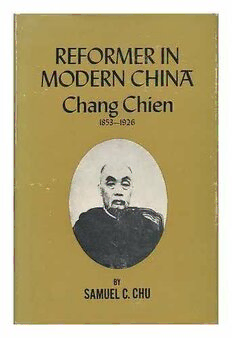
Table Of ContentReformer in Modern China
Chang Chien, 18J3-1926
Studies of the East Asian Institute
COLUMBIA UNIVERSITY
Chang Chien, 1853-1926
SAMUEL C. CHU
Reformer in Modern China
Chang Chien, iS;3-1926
COLUMBIA UNIVERSITY PRESS
New York and London, 1963
Samuel C. Chu is Associate Professor of History at
the University of Pittsburgh.
Copyright © 1958, 1965 Columbia University Press
Library of Congress Catalog Card Number : 65-10541
Printed in the United States of America
The East Asian Institute of Columbia University
THE EAST ASIAN INSTITUTE was established by Columbia University
in 1949 to prepare graduate students for careers dealing with East
Asia, and to aid research and publication on East Asia during the
modern period. The research program of the East Asian Institute
is conducted or directed by faculty members of the University, by
other scholars invited to participate in the program of the Institute,
and by candidates for the Certificate of the Institute or the degree
of Doctor of Philosophy. Some of the products of the research
program are published as Studies of the East Asian Institute. The
faculty of the Institute, without necessarily agreeing with the
conclusions reached in the Studies, hope with their publication to
perform a national service by increasing American understanding
of the peoples of East Asia, the development of their societies,
and their current problems.
The Faculty of the East Asian Institute are grateful to the
Rockefeller Foundation and the Ford Foundation for the financial
assistance which they have given to the program of research and
publication.
Dedicated in loving appreciation to my parents
Shih-Ming Chu and Grace Zia Chu
Foreword
VERY FEW scholarly biographies of Chinese leaders are available in
Western languages. Chang Chien, the subject of Professor Chu's
fascinating study, was a most unusual Chinese: a truly transitional
figure standing astride the late imperial era and the modern day.
Although eminently fitted for a distinguished official career, he
forsook officialdom to become a modern entrepreneur. Yet he was a
most unusual entrepreneur in devoting the profits from his successful
businesses to the modernization of his native community. With an
excellent traditional education, he devoted most of his talents to
the problems of bringing his country into the modern world.
Chang Chien's active career was almost equally divided between
the nineteenth and the twentieth centuries and between national
and local problems. He moved with equal ease among officials,
merchants, and scholars; in the "examination world" of imperial
days as in the world of assemblies and cabinets of the early repub
lican era. In his efforts to provide public primary schools, good
roads, or a modern hospital for his native district he acted in the best
traditions of the Chinese gentry. In struggling to cope with the
periodic flooding of the Huai River or to rationalize the national salt
administration he devoted himself to problems which have con
cerned public-spirited Chinese officials for centuries. In his efforts to
modernize Chinese education or to inaugurate a Chinese-owned
modern textile industry he was actuated by motives of recent-day
patriotism.
Chang Chien was, in short, the all-round Chinese scholar-leader,
characteristic of the best his culture produced, yet highly indivi
dualistic in his interests and style. A product of his age, he also
left his mark upon it through many pioneering enterprises.
Fortunately a great deal of primary information on Chang
Chien and his environment is available in Chinese. Professor Chu,
a graduate of the East Asian Institute and a Ph. D. in history at
Columbia, has used this material most effectively to present a well
FOREWORD
rounded, analytic biography of this man of many parts. Students of
China's modernization may draw from this study an appreciation
of the difficulties confronting a late Ch'ing entrepreneur. An
illuminating example is the unbelievable difficulties Chang Chien
encountered in accumulating the capital to start his first cotton-
spinning mill, despite his national reputation and excellent connec
tions with sponsoring officials. For another example, in the attempt
to create a modern local school system he had to start at the very
beginning—to establish China's first modern normal school.
Student's of traditional Chinese society should find the account of
Chang Chien's education, his encounters with the examination
system, and his apprenticeship as a personal secretary to a high
official very revealing.
This study, like those before it in the East Asian Institute Series,
was in large part done at Columbia University using the resources
of Columbia's East Asian Library.
C. MARTIN WILBUR
September, 1964 Professor of Chinese History
Columbia University