Table Of ContentHelen Hamlyn Centre for Design
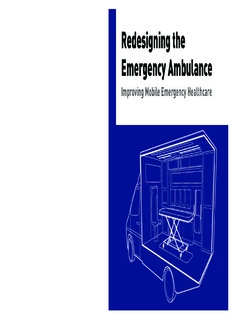
Redesigning the
Royal College of Art
Kensington Gore
London
SW7 2EU Emergency Ambulance
www.rca.ac.uk
www.hhc.rca.ac.uk
Improving Mobile Emergency Healthcare
RE covers.indd 1 06/09/2011 10:30
Helen Hamlyn Centre for Design, Royal College of Art Project Partners
Ed Matthews, Senior Research Fellow
Gianpaolo Fusari, Research Associate
Vehicle Design Department, Royal College of Art
Professor Dale Harrow, Director of Vehicle Design Department
Peter Stevens, Visiting Professor
Richard Winsor, Senior Tutor
Royal College of Art University of the West of England
University of the West of England, Bristol Helen Hamlyn Centre for Design and Vehicle Design Coldharbour Lane
Kensington Gore Bristol BS16 1QY
Dr Jonathan Benger, Professor of Emergency Medicine
London SW7 2EU www.uwe.ac.uk
London Ambulance Service www.rca.ac.uk
Dixie Dean, Emergency Care Practitioner www.hhc.rca.ac.uk London Ambulance Service NHS Trust
220 Waterloo Road
Imperial College Healthcare NHS Trust Imperial College Healthcare NHS Trust London SE1 8SD
Professor the Lord Ara Darzi of Denham, Professor of Surgery The Bays, South Wharf Road www.londonambulance.nhs.uk
Dr Dominic King, Clinical Lecturer in Surgery St Mary’s Hospital
London W2 1NY NHS London
Design: www.imperial.nhs.uk 105 Victoria Street
Gianpaolo Fusari London SW1E 6QT
www.london.nhs.uk
Photography:
Petr Krejci, Tim Saunders and Gianpaolo Fusari
Printing:
Redlin Printing Ltd
www.redlin.co.uk helen hamlyn
Redesigning the Emergency Ambulance
centre for design
© 2011
Helen Hamlyn Centre for Design, Royal College of Art
ISBN 978-1-907342-45-5
British Library Catalogue-in-Publication Data: a catalogue record for
this book is available from the British Library. All rights reserved.
Imperial College Healthcare
No part of this book may be reproduced, stored in a retrieval system
or transmitted in any form or by any means, electronic, mechanical, NHS Trust
photocopying, recording or otherwise, without the prior consent of the
publishers
Published by
Helen Hamlyn Centre for Design
Royal College of Art
Kensington Gore
London SW7 2EU London
www.hhc.rca.ac.uk
RE covers.indd 2 06/09/2011 10:30
Redesigning the
Emergency
Ambulance
A report from the Helen Hamlyn Centre for Design and the
Department of Vehicle Design at the Royal College of Art
in association with the London Ambulance Service,
Imperial College Healthcare NHS Trust and the
University of the West of England, Bristol.
Contents
Forewords by Lord Darzi and Lady Hamlyn 3
Executive Summary 5
The Need for Change 7
Evidence Base 9
The Design Brief 11
The Design Process 15
Testing the Design 17
Scenario Testing - Round One 18
Design Issues 23
Design Changes 24
Scenario Testing - Round Two 27
Scenario Testing - Round Three 30
Next Steps 34
Further Reading 36
REDESIGNING THE EMERGENCY AMBULANCE 3
Contents Foreword
The interior of a present-day ambulance looks in many One of my most fervent wishes in supporting the Helen
ways much as it did when I first started working in the Hamlyn Centre for Design at the Royal College of Art has
NHS over two decades ago. How we practise pre-hospital been to direct the practical application of design thinking
and emergency care has, however, changed significantly. towards projects and activities that address important
Paramedics and ambulance staff now have the skills and social challenges in a serious, creative and engaging way.
technology to better manage the complex needs of For many years now I have been interested in the redesign
patients and treat them where possible in the community of the current frontline ambulance.
rather than at hospital. In London, we have networks of The Helen Hamlyn Centre for Design has assembled
centres that specialise in the care of trauma, stroke and a dedicated design research team in partnership with the
cardiac patients. This means that patients may have to Vehicle Design Department at the Royal College of Art,
travel further in ambulances to ensure they receive better the University of the West of England, Bristol, Imperial
care. It is therefore essential that we provide an College Healthcare NHS Trust and the London Ambulance
ambulance environment that is more in keeping with the Service to design a new interior for the current emergency
times and facilitates excellent care rather than hinders it. ambulance.
Funding from the innovation fund at NHS London has Research has shown that there are many problems with
given us the support to approach ambulance redesign the present vehicle, which have a negative impact on both
from a unique multidisciplinary perspective. The design patients and ambulance crews. The project team has spent
team has done a tremendous job in developing solutions the past 18 months in consultation with frontline clinicians,
to the problems that ambulance staff face with the patients and healthcare providers in order to provide a
current environment in which they work. I would like to better, more hygienic and workable interior. It has been
thank the project team for their hard work and also the noted that ambulance crews suffer from badly designed
members of the steering group for their support. Staff vehicles and equipment, which is surely unacceptable given
from London Ambulance Service have been central to the the life-threatening situations they regularly face.
design process, and we hope this work will facilitate the I am personally very involved and excited about this
development of an ambulance that is fit for purpose for project and have wanted to see this happen for a long
them and their patients. I would also like to thank Lady time, having had first-hand experiences myself of the
Hamlyn for her continuing support of such an deficiencies in many of the ambulances now being used.
important and innovative stream of work. I am especially pleased that this is a co-design project
involving patients who use this service and ambulance
Lord Ara Darzi of Denham
crews who work on the vehicles on a daily basis. It is vital
that we engage these groups in the design process so
that we provide a vehicle that is fit for purpose in the 21st
century.
Helen Hamlyn
4
REDESIGNING THE EMERGENCY AMBULANCE 5
Executive Summary
This report describes design and development work that
has been supported by the Innovation Fund of NHS London
and the Helen Hamlyn Trust to redesign the interior of the
modern emergency ambulance.
The current interior has emerged piecemeal from Eight key design innovations emerged from the
a 20th century ambulance that was required to do little first round of evaluation, which were further modified
more than convey patients to the nearest hospital. Yet the and developed during two further iterations. Evidence
21st century ambulance service provides both definitive collected to date, and the final evaluations performed in
treatment of urgent care conditions at scene and the May 2011, clearly indicate that the new design improves
emergency treatment and transport of seriously ill and safety and the patient experience, while enhancing the
injured patients to the centre best suited to their needs. clinical and cost-effectiveness of care. This will yield
By taking a fresh look at the ambulance interior, we have significant benefits to patients, staff and the NHS as
addressed both of these modern requirements, improving a whole.
patient care and safety alongside enhanced healthcare This project has created a new and innovative
efficiency. ambulance interior, in response to evidence collected
The project has built on existing evidence and previous through three research projects since 2005. The purpose-
work to address ten improvement areas. It used a process built mobile demonstrator will be used to showcase the
of co-design, in which designers from the Helen Hamlyn project throughout the UK, to build confidence among
Centre for Design worked closely with clinicians from manufacturers and the wider NHS, with the ultimate aim
London Ambulance Service and patient representatives, of progressing to frontline clinical testing and successful
through an iterative process of design, evaluation and implementation into modern emergency care.
modification. During three cycles of testing, ideas were
proposed, developed and evaluated. These ideas were
then implemented, refined or discarded.
6
REDESIGNING THE EMERGENCY AMBULANCE 7
The Need for Change
In June 2008 Lord Darzi’s report ‘High quality care for all:
NHS Next Stage Review’ outlined plans to create
specialised heart, stroke and trauma units. The report also
recommended utilising alternative care pathways similar
to those provided in community settings, such as urgent
care centres and community health teams.
An important and integral component of this that in order to improve quality, efficiency and
community-based approach was an improved mobile cost-effectiveness, they need to change. In recent years
healthcare system provided by ambulance services, this understanding has led to the introduction of a wider
moving away from the traditional approach of range of different, often smaller and less expensive
transportation to hospital, in favour of a ‘treat-at- responder vehicles to treat and refer patients where they
scene-and-refer’ model of healthcare. are (for example at home, school or work). However, the
figures cited above suggest that these changes alone
The need for change within the Ambulance Service have not achieved the ambitions set out in the Darzi
The Information Centre for Health & Social Care review.
reported that in 2009/10 there were a total of 7.87 million In order to effect real change and improvements in
ambulance 999 calls. Approximately 40% did not require care, the ambulance service must be able to bring more
treatment in an A&E department, so over three million of the skills and facilities of the hospital to the patient.
patients were transported unnecessarily to hospitals in This will in turn better enable ambulance staff to deal
the UK as a result of the lack of alternative methods and/ with those urgent care problems that do not necessarily
or pathways for treatment. This figure alone illustrates require a trip to hospital, thereby providing the patient
that an approach aimed at significantly increasing the with the ‘right treatment in the right place at the right
proportion of healthcare treatments delivered in the time’. However, to be successful, these changes in vehicle
community, rather than in hospital, could subsequently design and treatment approach will also require better
improve the quality and effectiveness of care, while training, in particular increasing the diagnostic skills and
delivering considerable cost savings – and reducing the knowledge of ambulance clinicians to enable them to
pressure on emergency services within the NHS. treat and discharge patients on-scene. Again, ambulance
Ambulance services across the UK have recognised services in the UK have recognised this need and have
responded in part by introducing Emergency Care
8
Practitioner and more recently the ‘Advanced Paramedic’ changes has lagged behind the strategic ambitions of
or ‘Paramedic Practitioner’ roles. Government, the NHS and ambulance services. The
In parallel, centralisation of specialist heart attack, introduction of First Responders, using a range of
stroke and trauma services has improved outcomes for vehicles, has helped to manage response times and
those who are treated in these hospitals, but placed an thereby improved efficiency to some extent, but has not
additional burden on ambulance services to transport as yet led to significant improvements in the quality or
and provide emergency care to critically ill and injured cost-effectiveness of ambulance service provision. This is
patients over longer distances in safety. Thus the current compounded by the fact that ambulance staff do not
ambulance is now called upon both to perform better in always have the environment and equipment to provide
these critical roles and to provide effective treatment at- optimum care according to patient need.
scene to patients with urgent care needs. It was originally
designed for neither of these tasks.
Real solutions to generate real change
To address the challenges outlined above, it is necessary
Challenges to change
to design a 21st century mobile treatment space, which is
These alternative approaches to the delivery of urgent
truly ‘fit for purpose’ and therefore capable of delivering
healthcare have presented significant challenges to
the ‘right treatment, in the right place, at the right time’.
ambulance services in terms of the types of vehicles
Since 2005, the Helen Hamlyn Centre for Design and
required, and the need for additional staff training and
the Vehicle Design Department at the Royal College of Art
operational structures. In 2005 the Government report
has been working collaboratively with other institutions,
‘Taking Healthcare to the Patient’ outlined the case for
increasing the range of services available; it described including the London Ambulance Service and the
some potential delivery models for these services and University of the West of England, to improve ambulance
also some of the changes required in funding structures design. This report describes an innovative approach to
and governance. An important aspect of the proposals the design and development of the emergency
was the recommendation that a national approach ambulance, building on previous successes to produce an
be taken to the procurement of ambulances. It also ambulance interior that provides better treatment to all
recognised that, within such an approach, there would patients, matched to their specific healthcare needs, and
be a need to develop delivery models that could provide improves efficiency by transporting only those that
an effective mix of vehicles, ranging from emergency require hospital care to the centre best suited to their
treatment to urgent services care, and patient transport condition.
within the community.
However, the design and development of the
equipment and vehicles necessary to support these
Description:deficiencies in many of the ambulances now being used. I am especially pleased .. In the new design there is no need to use a personal bag inside the vehicle, because .. The images shown here reflect the development of the