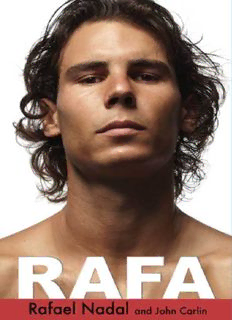
Table Of ContentRAFA
RAFAEL NADAL
and John Carlin
Contents
Cast of Characters
CHAPTER 1 - THE SILENCE OF THE CENTRE COURT
“Clark Kent and Superman”
CHAPTER 2 - THE DYNAMIC DUO
Uncle Toni
CHAPTER 3 - THE FOOTBALL STAR THAT NEVER WAS
The Clan
CHAPTER 4 - HUMMINGBIRD
Highly Strung
Photo Section 1
CHAPTER 5 - FEAR OF WINNING
Mallorcans
CHAPTER 6 - “AN INVASION OF THE PUREST JOY”
The Longest Day
CHAPTER 7 - MIND OVER MATTER
Murder on the Orient Express
Photo Section 2
CHAPTER 8 - PARADISE LOST
Rafa’s Women
CHAPTER 9 - ON TOP OF THE WORLD
Manacor
Career Highlights
Acknowledgments
About the Authors
Copyright
CAST OF CHARACTERS
The Family
Rafael Nadal: tennis player
Sebastián Nadal: his father
Ana María Parera: his mother
Maribel Nadal: his sister
Toni Nadal: his uncle and coach
Rafael Nadal: his uncle
Miguel Ángel Nadal: his uncle, and former professional
football player
Marilén Nadal: his aunt and godmother
Don Rafael Nadal: his paternal grandfather
Pedro Parera: his maternal grandfather
Juan Parera: his uncle and godfather
The Team
Carlos Costa: his agent
Rafael Maymó (“Titín”): his physical therapist
Benito Pérez Barbadillo: his communications chief
Joan Forcades: his physical trainer
Francis Roig: his second coach
Jordi Robert (“Tuts”): his Nike handler and close friend
Ángel Ruiz Cotorro: his doctor
Jofre Porta: a coach when he was young
The Friends
María Francisca Perelló: his girlfriend
Carlos Moyá: former world number one tennis player
Toméu Salva: childhood tennis-playing friend
Miguel Ángel Munar: his oldest friend
CHAPTER 1
THE SILENCE OF THE CENTRE COURT
T
he Silence, that’s what strikes you when you play on Wimbledon’s Centre
Court. You bounce the ball soundlessly up and down on the soft turf; you toss it
up to serve; you hit it and you hear the echo of your own shot. And of every shot
after that. Clack, clack; clack, clack. The trimmed grass, the rich history, the
ancient stadium, the players dressed in white, the respectful crowds, the
venerable tradition—not a billboard advertisement in view—all combine to
enclose and cushion you from the outside world. The feeling suits me; the
cathedral hush of the Centre Court is good for my game. Because what I battle
hardest to do in a tennis match is to quiet the voices in my head, to shut
everything out of my mind but the contest itself and concentrate every atom of
my being on the point I am playing. If I made a mistake on a previous point,
forget it; should a thought of victory suggest itself, crush it.
The silence of the Centre Court is broken when a point’s done, if it’s been a
good point—because the Wimbledon crowds can tell the difference—by a shock
of noise; applause, cheers, people shouting your name. I hear them, but as if
from some place far off. I don’t register that there are fifteen thousand people
hunched around the arena, tracking every move my opponent and I make. I am
so focused I have no sense at all, as I do now reflecting back on the Wimbledon
final of 2008 against Roger Federer, the biggest match of my life, that there are
millions watching me around the world.
I had always dreamt of playing here at Wimbledon. My uncle Toni, who has
been my coach all my life, had drummed into me from an early age that this was
the biggest tournament of them all. By the time I was fourteen, I was sharing
with my friends the fantasy that I’d play here one day and win. So far, though,
I’d played and lost, both times against Federer—in the final here the year before,
and the year before that. The defeat in 2006 had not been so hard. I went out
onto the court that time just pleased and grateful that, having just turned twenty,
I’d made it that far. Federer beat me pretty easily, more easily than if I’d gone
out with more belief. But my defeat in 2007, which went to five sets, left me
utterly destroyed. I knew I could have done better, that it was not my ability or
the quality of my game that had failed me, but my head. And I wept after that
loss. I cried incessantly for half an hour in the dressing room. Tears of
disappointment and self-recrimination. Losing always hurts, but it hurts much
more when you had your chance and threw it away. I had beaten myself as much
as Federer had beaten me; I had let myself down and I hated that. I had flagged
mentally, I had allowed myself to get distracted; I had veered from my game
plan. So stupid, so unnecessary. So obviously, so exactly what you must not do
in a big game.
My uncle Toni, the toughest of tennis coaches, is usually the last person in the
world to offer me consolation; he criticizes me even when I win. It is a measure
of what a wreck I must have been that he abandoned the habit of a lifetime and
told me there was no reason to cry, that there would be more Wimbledons and
more Wimbledon finals. I told him he didn’t understand, that this had probably
been my last time here, my last chance to win it. I am very, very keenly aware of
how short the life of a professional athlete is, and I cannot bear the thought of
squandering an opportunity that might never come again. I know I won’t be
happy when my career is over, and I want to make the best of it while it lasts.
Every single moment counts—that’s why I’ve always trained very hard—but
some moments count for more than others, and I had let a big one pass in 2007.
I’d missed an opportunity that might never come again; just two or three points
here or there, had I been more focused, would have made all the difference.
Because victory in tennis turns on the tiniest of margins. I’d lost the last and fifth
set 6–2 against Federer, but had I just been a little more clearheaded when I was
4–2 or even 5–2 down, had I seized my four chances to break his serve early on
in the set (instead of seizing up, as I did), or had I played as if this were the first
set and not the last, I could have won it.
There was nothing Toni could do to ease my grief. Yet he turned out, in the
end, to be right. Another chance had come my way. Here I was again, just one
year later. I was determined now that I’d learn the lesson from that defeat twelve
months earlier, that whatever else gave way this time, my head would not. The
best sign that my head was in the right place now was the conviction, for all the
nerves, that I would win.
At dinner with family and friends and team members the night before, at the
house we rent when I play at Wimbledon, across the road from the All England
Club, mention of the match had been off-limits. I didn’t expressly prohibit them
from raising the subject, but they all understood well enough that, whatever else
I might have been talking about, I was already beginning to play the match in a
space inside my head that, from here on in until the start of play, should remain
mine alone. I cooked, as I do most nights during the Wimbledon fortnight. I
enjoy it, and my family thinks it’s good for me. Something else to help settle my
mind. That night I grilled some fish and served some pasta with shrimps. After
dinner I played darts with my uncles Toni and Rafael, as if this were just another
evening at home in Manacor, the town on the Spanish island of Mallorca where I
have always lived. I won. Rafael claimed later that he’d let me win, so I’d be in a
better frame of mind for the final, but I don’t believe him. It’s important for me
to win, at everything. I have no sense of humor about losing.
At a quarter to one I went to bed, but I couldn’t sleep. The subject we had
chosen not to talk about was the only one on my mind. I watched films on TV
and only dozed off at four in the morning. At nine I was up. It would have been
better to have slept a few hours more, but I felt fresh, and Rafael Maymó, my
physical therapist, who is always in attendance, said it made no difference—that
the excitement and the adrenaline would carry me through, however long the
game went on.
For breakfast I had my usual. Some cereal, orange juice, a milk chocolate
drink—never coffee—and my favorite from home, bread sprinkled with salt and
olive oil. I’d woken up feeling good. Tennis is so much about how you feel on
the day. When you get up in the morning, any ordinary morning, sometimes you
feel bright and healthy and strong; other days you feel muggy and fragile. That
day I felt as alert and nimble and full of energy as I ever had.
It was in that mood that at ten thirty I crossed the road for my final training
session at Wimbledon’s Court 17, close to the Centre Court. Before I started
hitting, I lay down on a bench, as I always do, and Rafael Maymó—who I
nickname “Titín”—bent and stretched my knees, massaged my legs, my
shoulder, and then gave special attention to my feet. (My left foot is the most
vulnerable part of my body, where it hurts most often, most painfully.) The idea
is to wake up the muscles and reduce the possibility of injuries. Usually I’d hit
balls for an hour in the warm-up before a big match, but this time, because it was
drizzling, I left it after twenty-five minutes. I started gently, as always, and
gradually increased the pace until I ended up running and hitting with the same
intensity as in a match. I trained with more nerves than usual that morning, but
also with greater concentration. Toni was there and so was Titín, and my agent,
Carlos Costa, a former professional tennis player, who was there to warm up
with me. I was more quiet than usual. We all were. No jokes. No smiles. When
we wrapped up, I could tell, just from a glance, that Toni was not too happy, that
he felt I hadn’t been hitting the ball as cleanly as I might have. He looked
reproachful—I’ve known that look all my life—and worried. He was right that I
hadn’t been at my sharpest just then, but I knew something that he didn’t, and
never could, enormously important as he had been in the whole of my tennis
career: physically I felt in perfect shape, save for a pain on the sole of my left
foot that I’d have to have treated before I went on court, and inside I bore the
single-minded conviction that I had it in me to win. Tennis against a rival with
whom you’re evenly matched, or whom you have a chance of beating, is all
about raising your game when it’s needed. A champion plays at his best not in
the opening rounds of a tournament but in the semifinals and finals against the
best opponents, and a great tennis champion plays at his best in a Grand Slam
final. I had my fears—I was in a constant battle to contain my nerves—but I
fought them down, and the one thought that occupied my brain was that today
I’d rise to the occasion.
I was physically fit and in good form. I had played very well a month earlier
at the French Open, where I’d beaten Federer in the final, and I’d played some
incredible games here on grass. The two last times we’d met here at Wimbledon
he’d gone in as the favorite. This year I still felt I wasn’t the favorite. But there
was a difference. I didn’t think that Federer was the favorite to win either. I put
my chances at fifty-fifty.
I also knew that, most probably, the balance of poorly chosen or poorly struck
shots would stand at close to fifty-fifty between us by the time it was all over.
That is in the nature of tennis, especially with two players as familiar with each
other’s game as Federer and I are. You might think that after the millions and
millions of balls I’ve hit, I’d have the basic shots of tennis sown up, that reliably
hitting a true, smooth, clean shot every time would be a piece of cake. But it
isn’t. Not just because every day you wake up feeling differently, but because
every shot is different; every single one. From the moment the ball is in motion,
it comes at you at an infinitesimal number of angles and speeds; with more
topspin, or backspin, or flatter, or higher. The differences might be minute,
microscopic, but so are the variations your body makes—shoulders, elbow,
wrists, hips, ankles, knees—in every shot. And there are so many other factors—
the weather, the surface, the rival. No ball arrives the same as another; no shot is
identical. So every time you line up to hit a shot, you have to make a split-
second judgment as to the trajectory and speed of the ball and then make a split-
second decision as to how, how hard, and where you must try and hit the shot
back. And you have to do that over and over, often fifty times in a game, fifteen
times in twenty seconds, in continual bursts more than two, three, four hours,
and all the time you’re running hard and your nerves are taut; it’s when your
coordination is right and the tempo is smooth that the good sensations come, that
you are better able to manage the biological and mental feat of striking the ball
cleanly in the middle of the racket and aiming it true, at speed and under
immense mental pressure, time after time. And of one thing I have no doubt: the
more you train, the better your feeling. Tennis is, more than most sports, a sport
of the mind; it is the player who has those good sensations on the most days,
who manages to isolate himself best from his fears and from the ups and downs
in morale a match inevitably brings, who ends up being world number one. This
was the goal I had set myself during my three patient years as number two to
Federer, and which I knew I would be very close to reaching if I won this
Wimbledon final.
When the match itself would actually begin was another question. I looked up
and saw patches of blue in the sky. But it was mostly overcast, with thick, dark
clouds glowering on the horizon. The game was due to start in three hours, but
there was every chance it might be delayed or interrupted. I didn’t let that worry
me. My mind was going to be clear and focused this time, whatever happened.
No distractions. I was not going to allow any room for a repeat of my failure of
concentration in 2007.
We left Court 17 at about eleven-thirty and went to the locker room, the one at
the All England Club that’s reserved for the top seeds. It’s not very big, maybe a
quarter of the size of a tennis court. But the tradition of the place is what gives it
its grandeur. The wood panels, the green and purple colors of Wimbledon on the
walls, the carpeted floor, the knowledge that so many greats—Laver, Borg,
McEnroe, Connors, Sampras—have been there. Usually it’s busy in there, but
now that there were just the two of us left in the tournament, I was alone.
Federer hadn’t showed up yet. I had a shower, changed, and went up a couple of
flights of stairs to have lunch in the players’ dining room. Again, it was
unusually quiet, but this suited me. I was withdrawing deeper into myself,
isolating myself from my surroundings, settling into the routines—the inflexible
routines—I have before each match and that continue right up to the start of play.
I ate what I always eat. Pasta—no sauce, nothing that could possibly cause
indigestion—with olive oil and salt, and a straight, simple piece of fish. To
drink: water. Toni and Titín were at the table with me. Toni was brooding. But
that’s nothing new. Titín was placid. He is the person in whose company I spend
the most time and he’s always placid. Again, we spoke little. I think Toni might
have grumbled about the weather, but I said nothing. Even when I’m not playing
a tournament, I listen more than I talk.
At one o’clock, with an hour to go before the start of play, we went back down
to the locker room. An unusual thing about tennis is that even in the biggest
tournaments you share a locker room with your opponent. Federer was already
in there, sitting on the wooden bench where he always sits, when I came in after
lunch. Because we’re used to it, there was no awkwardness. None that I felt,
anyway. In a little while we were going to do everything we possibly could to
crush each other in the biggest match of the year, but we’re friends as well as
Description:What makes a champion What does it take to be the best in the world at your sport? Rafael Nadal, one of the greatest players in the history of tennis, has the answers. In his memoir, written with award-winning journalist John Carlin, he reveals the secrets of his game and shares the inspiring person