
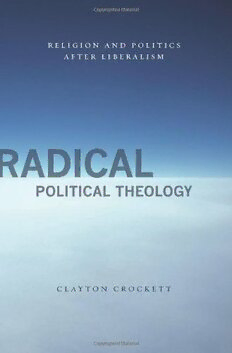
Download Radical Political Theology: Religion and Politics After Liberalism PDF Free - Full Version
Download Radical Political Theology: Religion and Politics After Liberalism by Clayton Crockett in PDF format completely FREE. No registration required, no payment needed. Get instant access to this valuable resource on PDFdrive.to!
About Radical Political Theology: Religion and Politics After Liberalism
In the 1960s, the strict opposition between the religious and the secular began to break down, blurring the distinction between political philosophy and political theology. This collapse contributed to the decline of modern liberalism, which supported a neutral, value-free space for capitalism. It also deeply unsettled political, religious, and philosophical realms, forced to confront the conceptual stakes of a return to religion.Gamely intervening in a contest that defies simple resolutions, Clayton Crockett conceives of the postmodern convergence of the secular and the religious as a basis for emancipatory political thought. Engaging themes of sovereignty, democracy, potentiality, law, and event from a religious and political point of view, Crockett articulates a theological vision that responds to our contemporary world and its theo-political realities. Specifically, he claims we should think about God and the state in terms of potentiality rather than sovereign power. Deploying new concepts, such as Slavoj ?i?ek's idea of parallax and Catherine Malabou's notion of plasticity, his argument engages with debates over the nature and status of religion, ideology, and messianism. Tangling with the work of Derrida, Deleuze, Spinoza, Antonio Negri, Giorgio Agamben, Alain Badiou, John D. Caputo, and Catherine Keller, Crockett concludes with a reconsideration of democracy as a form of political thought and religious practice, underscoring its ties to modern liberal capitalism while also envisioning a more authentic democracy unconstrained by those ties.
Detailed Information
| Author: | Clayton Crockett |
|---|---|
| Publication Year: | 2011 |
| ISBN: | 9780231149822 |
| Pages: | 215 |
| Language: | English |
| File Size: | 12.17 |
| Format: | |
| Price: | FREE |
Safe & Secure Download - No registration required
Why Choose PDFdrive for Your Free Radical Political Theology: Religion and Politics After Liberalism Download?
- 100% Free: No hidden fees or subscriptions required for one book every day.
- No Registration: Immediate access is available without creating accounts for one book every day.
- Safe and Secure: Clean downloads without malware or viruses
- Multiple Formats: PDF, MOBI, Mpub,... optimized for all devices
- Educational Resource: Supporting knowledge sharing and learning
Frequently Asked Questions
Is it really free to download Radical Political Theology: Religion and Politics After Liberalism PDF?
Yes, on https://PDFdrive.to you can download Radical Political Theology: Religion and Politics After Liberalism by Clayton Crockett completely free. We don't require any payment, subscription, or registration to access this PDF file. For 3 books every day.
How can I read Radical Political Theology: Religion and Politics After Liberalism on my mobile device?
After downloading Radical Political Theology: Religion and Politics After Liberalism PDF, you can open it with any PDF reader app on your phone or tablet. We recommend using Adobe Acrobat Reader, Apple Books, or Google Play Books for the best reading experience.
Is this the full version of Radical Political Theology: Religion and Politics After Liberalism?
Yes, this is the complete PDF version of Radical Political Theology: Religion and Politics After Liberalism by Clayton Crockett. You will be able to read the entire content as in the printed version without missing any pages.
Is it legal to download Radical Political Theology: Religion and Politics After Liberalism PDF for free?
https://PDFdrive.to provides links to free educational resources available online. We do not store any files on our servers. Please be aware of copyright laws in your country before downloading.
The materials shared are intended for research, educational, and personal use in accordance with fair use principles.

