
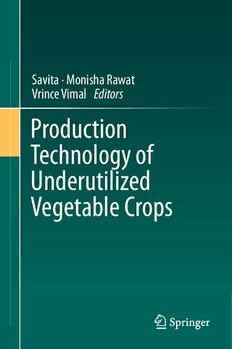
Download Production Technology of Underutilized Vegetable Crops PDF Free - Full Version
Download Production Technology of Underutilized Vegetable Crops by Savita, Monisha Rawat, Vrince Vimal in PDF format completely FREE. No registration required, no payment needed. Get instant access to this valuable resource on PDFdrive.to!
About Production Technology of Underutilized Vegetable Crops
This volume discusses the nutraceutical importance, production technologies, management and cultivation practices of underutilized vegetables, which can be described as those vegetable crops which are neither grown commercially on a large scale nor traded widely. While much of the crops addressed in the book are cultivated, traded and consumed at the local level, there are over 60 species of minor vegetables with high growth and yield potentials that are not cultivated to a large extent for greater populations. This work highlights the production technologies needed to grow these vegetables on a larger scale and under various adverse soil and climatic conditions, and their nutritional and medical benefits to assist with food security, health and poverty alleviation in rural areas. Production of underutilized vegetables is low, due to the unavailability of planting material, lack of awareness about the nutritional and medicinal importance among the farmers and inadequate information on the production techniques of these crops. In this context, there is an urgent need to take up a program on genetic resources exploration, management, utilization, and improvement of underutilized vegetable crops to ensure food and nutritional security. Readers will learn about these technologies and practices, while also learning about the unique properties and benefits of these underutilized vegetables. The book will be useful for academicians and researchers focusing on vegetable production and breeding, as well as farmers and sustainability scientists looking for underexplored sources of nutrition to benefit large rural populations.
Detailed Information
| Author: | Savita, Monisha Rawat, Vrince Vimal |
|---|---|
| Publication Year: | 2023 |
| ISBN: | 9783031153846 |
| Pages: | 389 |
| Language: | English |
| File Size: | 14.511 |
| Format: | |
| Price: | FREE |
Safe & Secure Download - No registration required
Why Choose PDFdrive for Your Free Production Technology of Underutilized Vegetable Crops Download?
- 100% Free: No hidden fees or subscriptions required for one book every day.
- No Registration: Immediate access is available without creating accounts for one book every day.
- Safe and Secure: Clean downloads without malware or viruses
- Multiple Formats: PDF, MOBI, Mpub,... optimized for all devices
- Educational Resource: Supporting knowledge sharing and learning
Frequently Asked Questions
Is it really free to download Production Technology of Underutilized Vegetable Crops PDF?
Yes, on https://PDFdrive.to you can download Production Technology of Underutilized Vegetable Crops by Savita, Monisha Rawat, Vrince Vimal completely free. We don't require any payment, subscription, or registration to access this PDF file. For 3 books every day.
How can I read Production Technology of Underutilized Vegetable Crops on my mobile device?
After downloading Production Technology of Underutilized Vegetable Crops PDF, you can open it with any PDF reader app on your phone or tablet. We recommend using Adobe Acrobat Reader, Apple Books, or Google Play Books for the best reading experience.
Is this the full version of Production Technology of Underutilized Vegetable Crops?
Yes, this is the complete PDF version of Production Technology of Underutilized Vegetable Crops by Savita, Monisha Rawat, Vrince Vimal. You will be able to read the entire content as in the printed version without missing any pages.
Is it legal to download Production Technology of Underutilized Vegetable Crops PDF for free?
https://PDFdrive.to provides links to free educational resources available online. We do not store any files on our servers. Please be aware of copyright laws in your country before downloading.
The materials shared are intended for research, educational, and personal use in accordance with fair use principles.

