
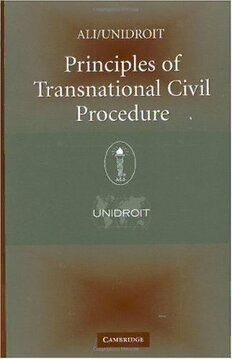
Download Principles of Transnational Civil Procedure PDF Free - Full Version
Download Principles of Transnational Civil Procedure by American Law Institute, UNIDROIT in PDF format completely FREE. No registration required, no payment needed. Get instant access to this valuable resource on PDFdrive.to!
About Principles of Transnational Civil Procedure
The ALI (American Law Institute) and UNIDROIT (the International Institute for the Unification of Private Law) are preeminent organizations working together toward the clarification and advancement of the procedural rules of law. Recognizing the need for a “universal” set of procedures that would transcend national jurisdictional rules and facilitate the resolution of disputes arising from transnational commercial transactions, Principles of Transnational Civil Procedure was launched to create a set of procedural rules and principles that would be adopted globally. This work strives to reduce uncertainty for parties that must litigate in unfamiliar surroundings and to promote fairness in judicial proceedings. As recognized standards of civil justice, Principles of Transnational Civil Procedure can be used in judicial proceedings as well as in arbitration. The result is a work that significantly contributes to the promotion of a universal rule of procedural law. The American Law Institute was organized in 1923 following a study conducted by a group of prominent American judges, lawyers, and law professors. Their recommendation that a lawyers' organization be formed to improve the law and its administration led to the creation of The American Law Institute. UNIDROIT was founded in 1926 as a specialized agency of the League of Nations. It exists as an independent intergovernmental organization on the basis of a multilateral agreement, the UNIDROIT Statute. Its purpose is to study needs and methods for modernizing, harmonizing, and coordinating private laws between states and groups of states and to prepare legislative texts for consideration by governments.
Detailed Information
| Author: | American Law Institute, UNIDROIT |
|---|---|
| Publication Year: | 2005 |
| ISBN: | 9780511137587 |
| Pages: | 478 |
| Language: | English |
| File Size: | 1.83 |
| Format: | |
| Price: | FREE |
Safe & Secure Download - No registration required
Why Choose PDFdrive for Your Free Principles of Transnational Civil Procedure Download?
- 100% Free: No hidden fees or subscriptions required for one book every day.
- No Registration: Immediate access is available without creating accounts for one book every day.
- Safe and Secure: Clean downloads without malware or viruses
- Multiple Formats: PDF, MOBI, Mpub,... optimized for all devices
- Educational Resource: Supporting knowledge sharing and learning
Frequently Asked Questions
Is it really free to download Principles of Transnational Civil Procedure PDF?
Yes, on https://PDFdrive.to you can download Principles of Transnational Civil Procedure by American Law Institute, UNIDROIT completely free. We don't require any payment, subscription, or registration to access this PDF file. For 3 books every day.
How can I read Principles of Transnational Civil Procedure on my mobile device?
After downloading Principles of Transnational Civil Procedure PDF, you can open it with any PDF reader app on your phone or tablet. We recommend using Adobe Acrobat Reader, Apple Books, or Google Play Books for the best reading experience.
Is this the full version of Principles of Transnational Civil Procedure?
Yes, this is the complete PDF version of Principles of Transnational Civil Procedure by American Law Institute, UNIDROIT. You will be able to read the entire content as in the printed version without missing any pages.
Is it legal to download Principles of Transnational Civil Procedure PDF for free?
https://PDFdrive.to provides links to free educational resources available online. We do not store any files on our servers. Please be aware of copyright laws in your country before downloading.
The materials shared are intended for research, educational, and personal use in accordance with fair use principles.

