Table Of ContentJulie Miller
Daytona State College
Molly O’Neill
Daytona State College
Nancy Hyde
Professor Emeritus
Broward College
PREALGEBRA
Published by McGraw-Hill, a business unit of The McGraw-Hill Companies, Inc., 1221 Avenue of the Americas, New York, NY 10020. Copyright © 2011
by The McGraw-Hill Companies, Inc. All rights reserved. No part of this publication may be reproduced or distributed in any form or by any means, or
stored in a database or retrieval system, without the prior written consent of The McGraw-Hill Companies, Inc., including, but not limited to, in any
network or other electronic storage or transmission, or broadcast for distance learning.
Some ancillaries, including electronic and print components, may not be available to customers outside the United States.
This book is printed on acid-free paper.
1 2 3 4 5 6 7 8 9 0 DOW/DOW 1 0 9 8 7 6 5 4 3 2 1 0
ISBN 978–0–07–338431–3
MHID 0–07–338431–3
ISBN 978–0–07–723893–3 (Annotated Instructor’s Edition)
MHID 0–07–723893–1
Editorial Director: Stewart K. Mattson
Executive Editor: David Millage
Director of Development: Kristine Tibbetts
Senior Developmental Editor: Emilie J. Berglund
Marketing Manager: Victoria Anderson
Lead Project Manager: Peggy J. Selle
Senior Production Supervisor: Sherry L. Kane
Lead Media Project Manager: Stacy A. Patch
Senior Designer: Laurie B. Janssen
Cover Illustration: Imagineering Media Services, Inc.
Lead Photo Research Coordinator: Carrie K. Burger
Supplement Producer: Mary Jane Lampe
Compositor: Aptara®, Inc.
Typeface: 10/12 Times Ten Roman
Printer: R. R. Donnelley Willard, OH
All credits appearing on page or at the end of the book are considered to be an extension of the copyright page.
Library of Congress Cataloging-in-Publication Data
Miller, Julie, 1962-
Prealgebra / Julie Miller, Molly O’Neill, Nancy Hyde.—1st ed.
p. cm.
Includes index.
ISBN 978–0–07–338431–3—ISBN 0–07–338431–3 (hard copy : alk. paper)
I. Mathematics—Textbooks. I. O’Neill, Molly, 1953 II. Hyde, Nancy. III. Title.
QA39.3.M56 2011
510—dc22
2009022051
www.mhhe.com
Letter from the Authors
Dear Colleagues,
We originally embarked on this textbook project because we were seeing a lack of student
success in our developmental math sequence. In short, we were not getting the results we
wanted from our students with the materials and textbooks that we were using at the time.
The primary goal of our project was to create teaching and learning materials that would get
better results.
At Daytona State College, our students were instrumental in helping us develop the clarity of
writing; the step-by-step examples; and the pedagogical elements, such as Avoiding Mistakes,
Concept Connections, and Problem Recognition Exercises, found in our textbooks. They also
helped us create the content for the McGraw-Hill video exercises that accompany this text.
Using our text with a course redesign at Daytona State College, our student success rates in
developmental courses have improved by 20% since 2006 (for further information, see The
Daytona Beach News Journal, December 18, 2006). We think you will agree that these are the
kinds of results we are all striving for in developmental mathematics courses.
This project has been a true collaboration with our Board of Advisors and colleagues in
developmental mathematics around the country. We are sincerely humbled by those of
you who adopted the first edition and the over 400 colleagues around the country who
partnered with us providing valuable feedback and suggestions through reviews, symposia,
focus groups, and being on our Board of Advisors. You partnered with us to create
materials that will help students get better results. For that we are immeasurably grateful.
As an author team, we have an ongoing commitment to provide the best possible text
materials for instructors and students. With your continued help and suggestions we will
continue the quest to help all of our students get better results.
Sincerely,
Julie Miller Molly O’Neill Nancy Hyde
[email protected] [email protected] [email protected]
iii
About the Authors
Julie Miller Julie Miller has been on the faculty in the School of Mathematics at Daytona State
College for 20 years, where she has taught developmental and upper-level courses.
Prior to her work at DSC, she worked as a software engineer
for General Electric in the area of flight and radar simulation.
Julie earned a bachelor of science in applied mathematics from
Union College in Schenectady, New York, and a master of sci-
ence in mathematics from the University of Florida. In a ddition
to this textbook, she has authored several course supplements for
college algebra, trigonometry, and precalculus, as well as several
short works of fiction and nonfiction for young readers.
“My father is a medical researcher, and I got hooked on math
and science when I was young and would visit his laboratory.
I can remember using graph paper to plot data points for his
experiiments andd ddoing simple calculations. He would then tell me what the peaks
and features in the graph meant in the context of his experiment. I think that appli-
cations and hands-on experience made math come alive for me and I’d like to see
math come alive for my students.”
—Julie Miller
Molly O’Neill Molly O’Neill is also from Daytona State College, where she has taught for 22 years
in the School of Mathematics. She has taught a variety of courses from developmen-
tal mathematics to calculus. Before she came to Florida, Molly
taught as an adjunct instructor at the University of Michigan–
Dearborn, Eastern Michigan University, Wayne State Univer-
sity, and Oakland Community College. Molly earned a bachelor
of science in mathematics and a master of arts and teaching from
Western Michigan University in Kalamazoo, Michigan. Besides
this textbook, she has authored several course supplements for
college algebra, trigonometry, and precalculus and has reviewed
texts for developmental mathematics.
“I differ from many of my colleagues in that math was not
always easy for me. But in seventh grade I had a teacher who
taught me that if I follow the rules of mathematics, even I could
solve math problems. Once I understood this, I enjoyed math to
tthhe poiintt off chhoosiing it for my career. I now have the greatest job because I get to
do math every day and I have the opportunity to influence my students just as I
was influenced. Authoring these texts has given me another avenue to reach even
more students.”
—Molly O’Neill
iv
Nancy Hyde served as a full-time faculty member of the Mathematics Depart- Nancy Hyde
ment at Broward College for 24 years. During this time she taught the full spec-
trum of courses from developmental math through differential
equations. She received a bachelor of science degree in math
education from Florida State University and a master’s degree in
math education from Florida Atlantic University. She has con-
ducted workshops and seminars for both students and teachers
on the use of technology in the classroom. In addition to this
textbook, she has authored a graphing calculator supplement for
College Algebra.
“I grew up in Brevard County, Florida, with my father work-
ing at Cape Canaveral. I was always excited by mathematics and
physics in relation to the space program. As I studied higher lev-
els of mathematics I became more intrigued by its ab stract natuurree aanndd iinnffiinniittee
possibilities. It is enjoyable and r ewarding to convey this perspective to students
while helping them to understand mathematics.”
—Nancy Hyde
D
edication
To Susan and Jim Conway
—Julie Miller
To my father, Richard
—Molly O’Neill
To the “Group,” Chris, Jim, Kathy,
and Dennis
—Nancy Hyde
v
Get Better Results
with Miller/O’Neill/Hyde
About the Cover
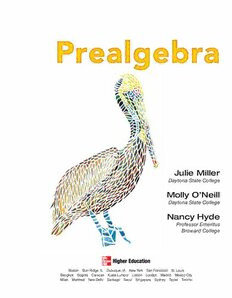
A mosaic is made up of pieces placed together to create a unified whole. Similarly, a prealgebra course
provides an array of topics that together create a solid mathematical foundation for the developmental
mathematics student.
The Miller/O’Neill/Hyde developmental mathematics series helps students see the whole picture
through better pedagogy and supplemental materials. In this Prealgebra textbook, Julie Miller, Molly O’Neill,
and Nancy Hyde focused their efforts on guiding students successfully through core topics, building
mathematical proficiency, and getting better results!
“We originally embarked on this textbook project because we were seeing a
lack of student success in courses beyond our developmental sequence. We
wanted to build a better bridge between developmental algebra and higher
level math courses. Our goal has been to develop pedagogical features to
help students achieve better results in mathematics.”
—Julie Miller, Molly O’Neill, Nancy Hyde
vi
Get Better Results
How Will Miller/O’Neill/Hyde Help Your Students
Get Better Results?
Better Clarity, Quality, and Accuracy
Julie Miller, Molly O’Neill, and Nancy Hyde know what students need to be successful in mathematics.
Better results come from clarity in their exposition, quality ooff
step-by-step worked examples, and accuracy of their “I would describe it as an excellent text
exercises sets; but it takes more than just great authors to written by teachers! It has easy to understand
build a textbook series to help students achieve success in explanations for students. The examples are
mathematics. Our authors worked with a strong mathematiccaall good and the mathematics is solid. The students
team of instructors from around the country to ensure that tthhee should fi nd it “easy to read.”
clarity, quality, and accuracy you expect from —Teresa Hasenauer, Indian River State College
the Miller/O’Neill/Hyde series was included in this edition.
Better Exercise Sets!
Comprehensive sets of exercises are available for every student level. Julie Miller, Molly O’Neill, and Nancy Hyde
worked with a national board of advisors from across the country to offer the appropriate depth and breadth of
exercises for your students. Problem Recognition Exercises were created to improve student performance
while testing.
Our practice exercise sets help students progress from skill development to conceptual understanding. Student
tested and instructor approved, the Miller/O’Neill/Hyyddee
exercise sets will help your student get better resulttss.. “ Extremely interesting and effective practice exercises.
I love the study skills component that reminds
▶ Problem Recognition Exercises
students of essential habits that will help students
▶ Skill Practice Exercises
achieve success. Review is a great reinforcement
▶ Study Skills Exercises technique for recently mastered skills. The exercises
▶ Mixed Exercises are innovative and there are plenty of relevant
▶ Expanding Your Skills Exercises applications from several fi elds and disciplines.”
—Corinna Goehring, Jackson State Community College
Better Step-By-Step Pedagogy!
Prealgebra provides enhanced step-by-step learning tools to help students get better results.
▶ Worked Examples provide an “easy-to-understand”
“ MOH seems to look into the heads of students
approach, clearly guiding each student through a
and see what mistakes they make and then
step-by-step approach to master each practice
exercise for better comprehension. help the students to avoid them—not only do
the Avoiding Mistakes help with this, but the
▶ TIPs offer students extra cautious direction to help immpprroovvee
TIPs along the way also help.”
understanding through hints and further insight.
—Linda Schott, Ozark Technical Community College
▶ Avoiding Mistakes boxes alert students to common eerrrroorrss
and provide practical ways to avoid them. Both of thessee
learning aids will help students get better results by showing how to work through a problem using a clearly
defined step-by-step methodology that has been class tested and student approved.
vii
Formula for Student Success
Step-by-Step Worked Examples
▶ Do you get the feeling that there is a disconnection between your students’ class work and homework?
▶ Do your students have trouble finding worked examples that match the practice exercises?
▶ Do you prefer that your students see examples in the textbook that match the ones you use in class?
Miller/O’Neill/Hyde’s Worked Examples offer a clear, concise methodology that replicates the
mathematical processes used in the authors’ classroom lectures!
“I really like the visuals you use on the worked
problems; there is just so much more help for
students. I wouldn’t be very worried about a
student who missed a class and had to catch
Skill Practice Example 8 Using a Linear EEqqqqqqqqquuuuaauttpiioo nnb yiinn raae aCCdoonninssguumm aeenrrd AA fpppoppplllliioccwaattiiinoonng the text.”
10.D.J.signs up for a new credit —Terry Kidd, Salt Lake Community College
Joanne has a cellular phone plan in wwwwwwwhhhhhiiiicccchhhh sssshhhheeee
card that earns travelmiles
pays $39.95 per month for 450 minooff aaiiiirr ttiiiimmee..
with a certain airline.She
initially earns 15,000 travel Additional minutes beyond 450 are cchhaarrggeedd aatt
miles by signing up for the a rate of $0.40 per minute.If Joanne’ss bbiillll ccoommeess
new card.Then for each dollar to $87.95, how many minutes didd sshhee uussee
spent she earns 2.5 travel beyond 450 min?
miles.If at the end of one year
she has 38,500 travel miles,
howmany dollars did she
cchhaarrggggee oonn tthhee ccrreeddiitt ccaarrdd?? SSolution:
“ The Worked Examples are very easy Step 1: Read the
problem.
for the students to follow with great
LLet xrepresent the number of minutes beyond 450. Step 2: Label the
step-by-step detailed explanations.
variable.
Miller/O’Neill/Hyde excels with their TThen 0.40xrepresents the cost for xadditional minutes.
Worked Examples.” Monthly Cost of Total Step 3: Write an
⫹ ⫽
—Kelli Hammer, Broward College aa fee b aadditional minutesb acostb equation in
words.
39.95 ⫹ 0.40x ⫽ 87.95 Step 4: Write a
mathematical
equation.
39.95⫹0.40x⫽87.95 Step 5: Solve the
eeqquuaattiioonn..
39.95⫺39.955⫹⫹00..4400xx⫽⫽8877..9955⫺⫺3399..9955 SSSSSuuuubbttrraacctt 3399..9955..
0000...44440000xxxx⫽⫽⫽44448888...00000000
“00T ..44h00xxe au4488th..00o00rs do a great job of explaining
⫽⫽ DDiivviiddee bbyy 00..4400..
00t..h44e00ir th00in..44k00ing as they work from step to step
in txxh⫽⫽e 11e22x00amples. This helps to demystify
Answer Joanne talked for 120 min bbbbeeeyyyootnnhdde 44p5500ro mmciienn..ss of mathematics. The “avoiding
10.D.J.charged $9400. mistakes” also help to reduce common
student misconceptions.”
—Nicole Lloyd, Lansing Community College
To ensure that the classroom experience also matches the examples in the text and the practice exercises, we
have included references to even-numbered exercises to be used as Classroom Examples. These exercises are
highlighted in the Practice Exercises at the end of each section.
viii
Get Better Results
Better Learning Tools
Chapter Openers
Chapter 7
Tired of students not being prepared? The In this chapter, we present the concept of percent. Percents are used to measure the number of
parts per hundred of some whole amount. As a consumer, it is important to have a working
Miller/O’Neill/Hyde Chapter Openers help knowledge of percents.
students get better results through engaging Are You Prepared?
To prepare for your work with percents, take a minute to review multiplying and dividing by a
Puzzles and Games that introduce the chapter
power of 10. Also practice solving equations and proportions. Work the problems on the left.
c ncepts and ask “Are You Prepared ding to the number of digits to the left and
right of the decim .
f you need help, eview Sections 5.3, 5.4, and 3.4.
0.582 100 2. 0.002 100 S. ___• ______
4. 318 0.01 F. ______• ______
“I really like the puzzle idea! I like for the chapter op5e.n0.e5r to 6. Solve. 34 x P. ____________•
be an activity instead of just reading. That way, st7u.dSoelvne.t s 36 8. Solve. 01.630x 11060.2 O. • ___
40 100 I. ______•
don’t even realize they are preparing themselves for the
E. • _________
concepts ahead and it is not nearly as boring.”
H. ______• ___
—Jacqui Fields, Wake Technical Community College U. • ______
s bakery was called ___ ___ ___ ___ ___ ___ ___ ___ ___.
1 2 3 4 5 2 6 7 8
TIP and Avoiding Mistakes Boxes
TIP and Avoiding Mistakes boxes have been created based on the authors’ classroom experiences—they have also
been integrated into the Worked Examples. These pedagogical tools will help students get better results by learning
how to work through a problem using a clearly defined step-by-step methodology.
Example 1 Adding and Subtracting Like Fractions Avoiding Mistakes Boxes:
Add.Write the answer as a fraction or whole number. Avoiding Mistakes boxes are integrated throughout
a. 1⫹5 b. 2 ⫹ 1 ⫺13 the textbook to alert students to common errors and
4 4 15 15 15
Avoiding Mistakes how to avoid them.
Solution: Notice that when adding fractions,
.
a. 1⫹5⫽1⫹5 Add the numerators. We add only umerators.
4 4 4
6
⫽ .
4
“ The MOH text does a better job of pointing out the
3
⫽ Simplify to lowest terms. common mistakes students make.”
2 —Kaye Black, Bluegrass Community & Technical College
TIP Boxes
TIP: Example 1(a) can also be solved by using a percent proportion.
Teaching tips are usually revealed only in the
5.5 x
classroom. Not an more xes r What is 5.5% of 20,000?
100 20,000
students helpfu ts and extra direction to help 1 2120,0002 100x
improve understanding and further insight. 110,000 100x
110,000 100x
Divide both sides by 100.
“ I think that one of the best features of 100 100
this chapter (and probably will continue 1100 x The sales tax is $1100.
throughout the text) is the TIP section.”
—Ena Salter, Manatee Community College
ix
Better Exercise Sets! Better Practice! Better Results!
▶ Do your students have trouble with problem solving?
▶ Do you want to help students overcome math anxiety?
▶ Do you want to help your students improve performance on math assessments?
Problem Recognition Exercises
Problem Recognition Exercises present a collection of problems that look similar to a student upon first glance, but are
actually quite different in the manner of their individual solutions. Students sharpen critical thinking skills and better
develop their “solution recall” to help them distinguish the method needed to solve an exercise—an essential skill in
developmental mathematics.
Problem Recognition Exercises, tested in
“I like how this author doesn’t title all the sections within this PRE.
a developmental mathematics classroom,
I believe that would be important during testing-anxiety situations.
were created to improve student performance
How many times do our students say they did not know what to
while testing.
do and (are) not sure what they were being asked?”
—Christine Baade, San Juan College
on Exercises
Operations on Fractions versus Solving Proportions
For Exercises 1–6,identify the problem as a proportion or as a product of fractions.Then solve the
proportion or multiply the fractions.
x 15 1 15 2 3 2 y
1. a. b. ⴢ 2. a. ⴢ b.
4 8 4 8 5 10 5 10
2 3 2 n m 6 3 6
3. a. b. 4. a. b.
7 14 7 14 5 15 5 15
48 16 48 16 10 28 10 28
5. a. b. ⴢ 6. a. ⴢ b.
p 3 8 3 7 5 7 t
For Exercises 7–10,solve the proportion or perform the indicated operation on fractions.
3 6 3 6 3 6 3 6
7. a. b. c. d. ⴢ
7 z 7 35 7 35 7 35
4 20 4 20 4 20 4 20
8. a. b. c.
5 3 v 3 5 3 3
14 10 14 x 14 10 14
9. a. ⴢ b. c. d.
5 7 5 7 5 7
“T hese are brilliant! I often do
11 11 66 11 66 11 66
10. a. b. c. suc h things in class to get
y 3 11 3 11 3 11
across a point, and I haven’t
seen them in a text before.”
“T his book does a much better job of pairing similar problems for
—Russell Penner, Mohawk Valley
students to be able to practice recognizing different exercises— Community College
and as an instructor, I can use these exercises as part of a review
and lecture about the need to understand a problem versus just
memorizing a process.”
—Vicki Lucido, St. Louis Community College–Florissant Valley
x