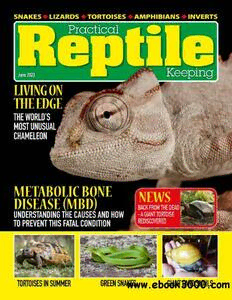
Table Of ContentSNAKES◆LIZARDS ◆TORTOISES ◆AMPHIBIANS ◆INVERTS
Practical
Keeping
June 2022
LIVING ON
THE EDGE
THE WORLD’S
MOST UNUSUAL
CHAMELEON
METABOLIC BONE
NEWS
DISEASE (MBD)
BACK FROM THE DEAD
UNDERSTANDING THE CAUSES AND HOW - A GIANT TORTOISE
TO PREVENT THIS FATAL CONDITION REDISCOVERED
TORTOISES IN SUMMER GREEN SNAKES GIANT LAND SNAILS
Contents
June 2022
m e
We lco
Features experience of keeping exotics, being especially suitable
It was rather a case of shell-shock for a family 18 A FLIGHT OF FANCY – flying lizards are one of the for younger owners with limited space and funds
available. Such animals can be intrinsically interesting
living in the English town of Knebworth in most unusual and captivating of all reptiles. They have
and although not cuddly, giant land snails represent
Hertfordshire last month, when they were also gained a reputation for being exceedingly difficult
beautiful symbols of the natural world. This is a guide
reunited with their beloved tortoise, Twin. He was found by three Network Rail to keep, let alone breed in vivarium surroundings. as to what you need to know about looking after them.
Here’s how to do so successfully.
workers - John Keeley, Matt Cooke and Tony Russell - who were carrying out 64 ATTRACTING AMPHIBIANS TO YOUR GARDEN
railway inspections along the East Coast Main Line, when they spotted Twin 30 MY FAVOURITE THINGS ABOUT BREDL’S – many people enjoy attracting wild birds to their
PYTHON – discover the appeal of these Australian
walking alongside the track. gardens, and now there’s an increasing trend to do the
pythons.
The trio couldn’t believe their eyes, but sprung into action to rescue the same for our native amphibians. Also this is a great
wandering tortoise. They then decided to take her to a nearby vet to see if she was 36 THE AMAZING ANDERSON’S SALAMANDER time of year to make the necessary changes in your
microchipped and to get her checked over. Although she was given a clean bill of – expert advice on how to keep and breed these garden!
relatives of the axolotl, which also originate from
health, the vet did not find a microchip and so it wasn’t possible to locate her Mexico and were only recognised by science less than Regulars
owners. 40 years ago.
Unsure of what do to next, they then decided to look after Twin overnight and 40 THE ROUGH AND THE SMOOTH: AMERICAN 4 NEWS AND VIEWS – featuring stories that include a
continue the search. The following day, John visited shops and cafés in Knebworth GREEN SNAKES AND THEIR CARE – the insectivorous stunning new species of snake from South America, a
to see if anyone had lost a tortoise. Although this didn’t bring any joy, a café owner dietary habits of these snakes have not made them previously unknown mountainfrog from Australia, why
agreed to post about the tortoise on their easy to keep, but with greater insights, they are now certain turtles cannot find their way to the ocean as
Facebook page to help spread the word. being bred more frequently. They also have much to easily after hatching as others, how one of Nature’s
The power of social media proved fruitful, offer as vivarium subjects, especially if you like snakes most iconic events is under threat and more, including
with Lizzie Jeanes spotting the post and but would prefer not to feed them on rodents. new crocodilian discoveries from Africa, and starting
contacting John to claim Twin. After eight 46 TORTOISES IN SUMMER – what you need to with the remarkable account of how a species of giant
consider at this time of year. tortoise believed to be extinct for over a century has
months apart, Twin was reunited with Lizzie
48 BROKEN-DOWN BONES – understanding been rediscovered.
and her two children Charlie, 10, and Connie,
metabolic bone disease (MBD). This by far the most 24 OUT OF AFRICA – a chameleon which rewrites
8, as well as with another tortoise named
commonly encountered clinical illness seen in pet the rule book! In his regular column this month, having
Joey, who Twin has lived with since 1952.
lizards. It can also affect tortoises and turtles although headed west from his home in Botswana into
Lizzie said: “I was absolutely elated when I
it is less frequently seen in snakes. MBD can result in neighbouring Namibia, Paul Donovan encounters one
heard that Twin had been found. When she physical deformity, stunted growth and premature of the most unusual chameleons in the world.
went missing, we searched high and low for death. Discover its causes, and how can it be prevented.
her, but we’d given up hope as she’d been 54 DON’T STAY BLINKERED! – it’s strange how some 38 SUBSCRIPTION
missing for eight months. I can’t thank the species are always rather overlooked, but here two sets OFFER – AND
Twin is pleased to be back
team enough for reuniting us once more with with long-time companion Joey. of enthusiasts make the case that chuckwallas deserve BACK ISSUES.
Twin, who has been in our family for 70 years. Photo courtesy Network Rail & Lizzie Jeanes. to be more popular. Every single one
We’re all so delighted!” 57 VIVARIUM SAFETY – new products of all types for
is now available
David Alderton reptile-keepers are being launched regularly, ensuring to buy online!
that the hobby has never been better-served, thanks to
the choice of equipment now on offer. Unfortunately,
David Alderton, Editor. Email: [email protected]
although the vast majority of the available products do
exactly what they claim, there can be issues in a few 32 Q & A – addressing the problems that you want
✥ David has extensive practical experience with this group of creatures, going back over 40 years. He has written answered.
cases. Also, here are some practical safety tips too, if
and broadcast widely about their care and biology. you’re buying or are given secondhand equipment. 34 REPTILE FOCUS – a stunning portrayal of a
Main cover image of a Namaqua chameleon (Chamaeleo namaquensis). Photo courtesy reptiles4all/www.shutterstock.com 60 SHELL CASE: KEEPING GIANT LAND SNAILS species in close-up.
– invertebrates represent many people’s first 66 HOW TO CONTACT US.
New!
THE AMAZING ANIMALS PODCAST SERIES
If you like animals, don’t miss out on this new free series of podcasts, which
you can listen to now on many platforms, including Spotify, Audible, Amazon, Google and more!
Akara Heart is in conversation with
award-winning animal author David
Alderton, discussing the many
ways in which animals have directly
influenced our lives.
The first episode of this series -
The tortoise that went to sea - is
available now. Further titles will be
following soon.
You can check the Amazing Animals Podcast Series out directly via these links to
Spotify <https://spoti.fi/3l4LUxC> and Amazon <https://amzn.to/3r6Y7G8> or on other popular podcast sites.
News & Views
Featuring stories that include a stunning new species of snake from South America, a previously unknown mountainfrog from Australia, why certain
turtles cannot find their way to the ocean as easily after hatching as others, how one of Nature’s most iconic events is under threat and more,
including new crocodilian discoveries from Africa while starting here with the remarkable account of how a species of giant tortoise believed to be extinct
for over a century has been rediscovered. Compiled by G. Valentine.
Giant Galápagos tortoise species believed extinct still survives!
A
giant tortoise belonging to a
Galápagos species long believed
extinct has been discovered alive.
This individual, named Fernanda
after her Fernandina Island home, is the
first of her species identified in more
than a century.
The history of this species
The Fernandina Island Galápagos giant
tortoise (Chelonoidis phantasticus,
which literally means “fantastic giant
tortoise”) was previously known only
from a single specimen, collected in
1906. The recent discovery of a female
tortoise living on Fernandina Island
provided the opportunity to determine
if the species lives on.
By sequencing the genomes of both
the living individual and the museum
specimen, and comparing them to the Fernanda, the only
other 13 species of Galápagos giant known living “For many years it was thought that Galápagos island to another during
tortoises, Princeton University’s Stephen individual of her kind, the original specimen collected in 1906 hurricanes or other major storms. There
Gaughran confirmed that the two whose existence has had been transplanted to the island, as are also historical records of seafarers
known Fernandina tortoises are just been confirmed it was the only one of its kind,” explains moving the tortoises between islands.
by genetic studies.
members of the same species, Peter Grant, an emeritus professor of
Photo courtesy of the
genetically distinct from all others. ecology and evolutionary biology, also Genetics reveals the
Galápagos Conservancy.
from Princeton University, who has unexpected truth
spent more than 40 years studying “Like many people, my initial suspicion
evolution in the Galápagos islands. “It was that this was not a native tortoise of
now seems to be one of a very few that Fernandina Island,” admits Gaughran.
were alive a century ago.” But to determine Fernanda’s species
definitively, he sequenced her complete
Doubts over her origins genome and compared it to the
When Fernanda was discovered, many genome he was able to recover from
ecologists doubted that she was the specimen collected in 1906. He also
actually a genuine Fernandina Island compared those two genomes to
tortoise. She lacks the striking samples from the other 13 species of
saddleback flaring of the male historical Galápagos tortoises — three individuals
specimen, although scientists from each of the 12 living species, and
speculated that her obviously stunted one individual of the extinct C.
growth may have distorted her features. abingdonii form.
Tortoises cannot actively swim from “We saw — honestly, to my surprise
Fernandina Island is on the westerly side of the Galápagos archipelago,
with the larger island of Isabela lying to the east. one island to another, but they do float, — that Fernanda was very similar to the
Photo courtesy TonelloPhotography/www.shutterstock.com and they can be carried from one one that they found on that island more
4 | Practical Reptile Keeping
Both marine iguanas (Amblyrhynchus cristatus) and
sea turtles can be found along the coast of
Fernandina Island, but the landscape of this volcanic
island is harsh, with prominent outcrops of lava.
Photo courtesy Danita Delimont/www.shutterstock.com molecular research. What a cool
discovery!”
A long-standing mystery
Since 1906, scant but compelling
evidence has hinted that giant tortoises
might still live on Fernandina Island, an
active volcano on the western edge of
the Galápagos Archipelago that is
reputed to be the largest pristine island
on Earth.
The single specimen of the species C.
phantasticus — “the fantastic giant
tortoise” — was collected by explorer
Rollo Beck during a 1906 expedition.
The description of “fantastic” refers not
to the variety of the species, but the
extraordinary shape of the male’s shell.
This shows extreme flaring along the
outer edge and conspicuous saddle-
backing at the front. Saddle-backing is
unique to Galápagos tortoises, and this
is displayed more evidently in this
species than any other.
Since its 1906 discovery, the survival
DNA sequencing
than 100 years ago, and both of those or Neanderthal,” he said. “Genetics is has enabled the DNA of the Fernandina tortoise has remained
were very different from all of the other genetics, for the most part. It’s in the profiles of species to an open question for biologists. In 1964,
islands’ tortoises,” explains Gaughran. interpretation where it matters what be analysed, 18 scats (droppings) attributable to
“The finding of one specimen still kind of creature the DNA comes from.” highlighting both tortoises were reported on the western
alive today gives hope, and also opens At Princeton University, Gaughran is similarities and also slopes of the island. Scats and a possible
up new questions, as many mysteries working with ecologists Andrea Graham differences, enabling visual observation from an aircraft were
relationships to be
still remain,” adds his colleague Adalgisa and Bridgett vonHoldt to unravel reported during the early 2000s, and
carefully unravelled.
Caccone. “Are there more tortoises on pinniped (seal and walrus) evolution. another possible tortoise scat was seen
Photo courtesy angellodeco/
Fernandina that can be brought back “Stephen solves conservation mysteries, www.shutterstock.com during 2014.
into captivity to start a breeding in species ranging from tortoises to
programme? How did tortoises colonise pinnipeds, with the deft and careful
Fernandina, and what is their application of genetic and bioinformatic
evolutionary relationship to the other tools,” explains Andrea Graham, who is a
giant Galápagos tortoises? This research professor of ecology and evolutionary
also highlights the importance of using biology.
museum collections to understand the “He has such a curiosity for
past.” discovering the messages and codes
tucked away in ancient remains,” adds
The value of museum her colleague, vonHoldt. “Stephen has
specimens been collecting specimens from several
Museum specimens are a challenge to hundred years old to a few thousand,
analyse genetically, but Gaugran has and these really hold the keys for
been focused on this area for years, understanding the history of when and
developing a tool to compare DNA from how genomes changed over time. It is
ancient specimens to modern samples. not surprising to me that he also led the
His tool is flexible enough to work on effort to unravel the mystery of
many species. “The software doesn’t Fernanda, the fantastic ghost tortoise
care if it’s a seal or a tortoise or human that has been rediscovered through
JUNE 2022 | 5
News & Views
Fernandina’s ecology
The island has remained largely
unexplored, due to extensive lava fields
blocking access to the island’s interior.
“Fernandina is the highest of the
Galápagos islands, geologically young,
and is mainly a huge pile of jagged
blocks of brown lava; Rosemary and I
once climbed to the top,” says Grant,
referring to his wife and research partner
Rosemary Grant, an emeritus senior
research biologist at Princeton
University in New Jersey.
“At lower elevations, the vegetation
occurs in island-like clumps in a sea of
recently congealed lava. Fernanda was
found in one of these, and there is
evidence that a few relatives may exist in
others.”
Scientists estimate that Fernanda is
well over 50 years old, but she is small, For more than a
possibly because the limited vegetation century, the the South American mainland some scientists debate whether these
stunted her growth. Encouragingly, Fernandina westwards. Because they cannot swim, should be considered species or
recent tracks and scat of at least two or Island Galápagos giant the tortoises bred only with others on subspecies, the Princeton-Yale team
three other tortoises were found during tortoise (Chelonoidis their own islands, resulting in rapid concluded that they are different
other recent expeditions to the island. phantasticus) was evolution — following the pattern of enough, with thousands of distinctive
known only from this
the better-known Galápagos finches. genetic markers, to be considered
Tortoises of the Galápagos single specimen, Today, there are 14 different species separate species.
collected in 1906.
Two or three million years ago, a storm of giant Galápagos tortoises, all Diversification of Galápagos tortoises
Photo courtesy of the
carried one or more giant tortoises from California Academy of Sciences. descended from a single ancestor. While reveals a continuum of shell shapes,
with the easternmost islands’ animals
showing rounder, domed shells, and the
westernmost island — Fernandina
— home to the species with the most
dramatic saddle-backing. The domed
tortoises live in more humid, higher
elevation ecosystems, while their
saddle-backed cousins inhabit drier,
lower elevation environments. All 14 are
listed on the IUCN Red List as either
vulnerable, endangered, critically
endangered or extinct.
The tortoise populations were
decimated by European seafarers who
hunted them for food, having
discovered that they could keep
tortoises alive on their ships with
minimal effort, as the reptiles could
survive with little food or water. “They
were a great source of fresh meat for the
sailors, but it meant that many of the
Freshwater pools of water and vegetation amid the larva rocks on Fernandina Island
ensure that giant tortoises were able to colonise this fairly barren island successfully. species were severely overhunted,”
explains Gaughran.
6 | Practical Reptile Keeping
“The genetic work provides intriguing Galápagos tortoises National Park Tortoise Center, a rescue guarantee that there is a male still living
hints of a mixing of genes with members with rounded, domed and breeding facility, where experts are on the island today, as it could have died
of another population,” says Peter Grant. shells are found on seeing what they can do to keep her in the interim.
“It would be fascinating if confirmed by islands where food is species alive. “The discovery informs us
more plentiful, as here
future detective work on the genome. about rare species that may persist in Further information
on Santa Cruz.
Another thought-provoking finding is isolated places for a long time,” said
Photo courtesy Shawn Evelyn L. Jensen, Stephen J.
the nearest relatives of the Fernandina Goldberg/www.shutterstock. Grant. “This information is important for Gaughran, Nicole A. Fusco, Nikos
species are not on the nearest very large com conservation. It spurs biologists to
Poulakakis, Washington Tapia,
island (Isabela) but on another search harder for the last few individuals
Christian Sevilla, Jeffreys Málaga,
(Española) far away on the other side of of a population to bring them back from
Carol Mariani, James P. Gibbs,
Isabela. The question of how the the brink of extinction.”
Adalgisa Caccone. The Galápagos
ancestors reached Fernandina is It is just possible that if Fernanda had
giant tortoise Chelonoidis
therefore unclear.” mated previously, she could still lay
phantasticus is not extinct.
fertile eggs. Tortoises are able to store
Communications Biology, 2022; 5 (1)
Hope for the future viable sperm for a number of years. If
DOI: 10.1038/s42003-022-03483-w
Fernanda is now at the Galápagos this happened though, there is no
JUNE 2022 | 7
News & Views
Beautiful new snake found in Paraguay
A
beautiful non-venomous snake,
previously unknown to science,
has been discovered in the South
American country of Paraguay
and described by researchers of the
Paraguayan NGO Para La Tierra with the
collaboration of Guyra Paraguay and the
Instituto de Investigación Biológica del
Paraguay. It belongs to the genus
Phalotris, which features 15 semi-
subterranean species distributed in
central South America. This group of
snakes is noted for their striking
colouration, displaying red, black, and
yellow patterns.
Jean-Paul Brouard, who first made
the discovery, came across an individual
of the new species by chance while
digging a hole at Rancho Laguna
Blanca. It was decided to name the
snake officially as Phalotris shawnella, in
honour of two children – Shawn Ariel
Smith Fernández and Ella Bethany
Atkinson – who were born in the same
year as the Fundación Para La Tierra The newly-discovered species of snake.
(2008) was established. They inspired Photo courtesy Jean-Paul Brouard.
The dart-like shape of the snake’s head is a clue to its semi-underground lifestyle, helping it to
burrow more easily. Photo courtesy Jean-Paul Brouard. The two areas in Paraguay where the species has been discovered.
Map courtesy P. Smith, J.-P. Brouard and P. Cacciali.
8 | Practical Reptile Keeping
The colour and patterning of this new snake provides some camouflage in its natural habitat, as
seen here.
by its red head in combination with a of Laguna Blanca, an area declared as an
yellow collar, a black lateral band and Important Area for the Conservation of
orange ventral scales with irregular Amphibians and Reptiles.
black spots. Only known from three “This demonstrates once again the
individuals, it is endemic to the Cerrado need to protect the natural
forests of the department of San Pedro environment in this region of Paraguay,”
in east Paraguay. Its known distribution say the researchers. “Laguna Blanca was
consists of two spots with sandy soils in designated as a Nature Reserve for a
that department – Colonia Volendam period of five years, but currently has no
and Laguna Blanca – which are 90 km protection at all. The preservation of this
(56ml) apart. site should be considered a national
priority for conservation.”
the founders of this non-governmental There is a distinct Protection needed
organisation (NGO) to work for the whitish band across The extreme rarity of the species led the Further information
conservation of Paraguayan wildlife, in the back of the head. authors to consider it as “Endangered”,
Smith P, Brouard J-P, Cacciali P (2022)
Photo courtesy Jean-Paul
the hope that their children can inherit Brouard. according to the conservation A new species of Phalotris
a better world. categories of the International Union for
(Serpentes, Colubridae,
Conservation of Nature (IUCN), which
Elapomorphini) from Paraguay.
Limited range means it is in imminent danger of
Zoosystematics and Evolution 98(1):
The new Phalotris snake is particularly extinction in the absence of measures
77-85. https://doi.org/10.3897/
attractive and can be distinguished for its protection. This snake can only be
zse.98.61064
from other related species in its genus found in the famous tourist destination
JUNE 2022 | 9
News & Views
New mountainfrog species found
Researchers from Australia’s Southern Cross Appearance and lifestyle
University have helped to discover a new Knowles’ mountainfrog varies in colour and
species of mountainfrog, now known to pattern and is confined to upland rainforests
science as Knowles’ mountainfrog (Philoria in this region. The frog breeds in spring and
knowlesi). It lives in the rainforest area along the early summer, in small bogs, seepages and
border between New South Wales and banks of headwater streams. During the
Queensland, and conservationists are working mating season, the males create a small
to protect its habitat. breeding chamber in wet areas and tadpoles
develop entirely within this chamber.
How the discovery occurred Dr David Newell from Southern Cross
Since 2006, researchers have been gathering University said the frog’s only known habitat, The latest addition to the mountain frog group.
and analysing DNA from mountainfrog the Gondwana Rainforest of Australia World Photo courtesy Dr. David Newell.
populations at Mount Barney National Park and Heritage Area, represented one of the most
Levers Plateau in northern New South Wales, diverse ecosystems in Australia. “The Harry Hines explains that under the
within the Gondwana Rainforests of Australia rainforests of Queensland’s Mount Barney Queensland Bushfire Recovery Program, led
World Heritage Area, as they suspected a National Park and the adjacent Mount by DES, it was found that the mountainfrogs
previously undiscovered species was living Nothofagus National Park in New South Wales had survived the fires and were persisting at
there. have special significance in the evolution of sites burnt during the bushfires.
The research team includes Ecologists from Australia’s native species and this is why they “Not only that, but the increased survey
the Department of Environment and Science are enshrined as part of the Gondwana effort resulted in the discovery of additional
(DES) and researchers from Southern Cross Rainforest of Australia World Heritage Area,” populations of the new species,” he adds.
University, the University of Newcastle, CSIRO Dr Newell explains. “Researchers were also able to gather the only
and the South Australian Museum. “This new species of frog belongs to a systematic data on calling phenology, which
DES Senior Conservation Office Harry Hines lineage only found in upland rainforest will support the design of future surveying
said DES staff carried out targeted surveys for communities. There are currently seven and acoustic monitoring of the species.”
the species in the Mount Barney area, collecting known species of mountainfrog, six of which The new species is nevertheless already
specimens and genetic samples and recording are found only in the Gondwana rainforest now classified as endangered, and DES is
the frog’s mating calls. area. Most are confined to the very working to protect its habitat as part of
“Over the past 16 years, we have gathered headwaters of mountain streams and a key ongoing national park management.
DNA samples and determined these threat to their survival is climate change. As Professor Michael Mahony from Newcastle
populations are actually genetically distinct, these habitats warm, these frogs literally will University explains the new species was
and warrant being regarded as a new species,” have nowhere else to go,” he adds. named in honour of prominent Australian
he says. environmentalist Ross Knowles, reflecting his
A lucky escape outstanding contributions to the science in
Following the Black Summer bushfires of terms of Australian frogs and their
2019-2020, the Australian Government conservation.
allocated $200 million (£112 million) to a
Bushfire Wildlife and Habitat Recovery
Further information
Package, prioritising the most fire-impacted
Michael J Mahony, Harry B. Hines, Terry
threatened locations and species – such as
Bertozzi, Stephen V Mahony, David A
mountainfrogs – to receive funding for
Newell, John B Clarke, Stephen C.
recovery actions. For the fire-impacted areas
Donnellan A new species of Philoria
in southern Queensland, the Australian
(Anura: Limnodynastidae) from the
Government provided the Queensland
uplands of the Gondwana Rainforests
Government with $3.85 million (£2.2 million)
World Heritage Area of eastern
for recovery projects, including the
Australia DOI: 10.11646/
Dr David Newell has revealed these frogs live in a very Gondwana Rainforests of Australia World
ZOOTAXA.5104.2.3
restricted area, as far as is known. Photo courtesy Dr. Newell. Heritage Area and this mountainfrog.
10 | Practical Reptile Keeping