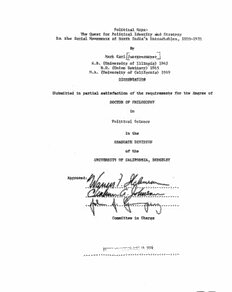
Table Of ContentPolitical Hope:
The Quest for Political Identity and Strategy
in the Social Movements of North India's Untouchables, 1900-1970
By
Mark Karl~uergensmeyer]
A.B. (University of Illinpis) 1962
B.D. (Union Seminary) 1965
M.A. (University of California) 1969
DISSERTATION
Submitted in partial satisfaction of the requirements for the degree of
DOCTOR OF PHILOSOPHY
in
Political Science
in the
GRADUATE DIVISION
of the
UNIVERSITY OF CALIFORNIA, BERKELEY
Approved:
Committee in Charge
••••••••••••••••••••••••••••••••••••••••••
c
3o
1-~_
I ~ 7J
@ COPYRIGHT 1974
Mark Juergensmeyer
'
iii
ABSTRACT:
POLITICAL HOPE: SQIEDULED CASTE MOVEMENTS IN THE PUNJAB
Mark Juergensmeyer
The focus of this study is on the Ad Dharm movement -- a
revolutionary religion of the Punjab Scheduled Castes (Untouchables)
which rose to prominence from 1925 to 1935, and was restored, in a
somewhat different incarnation, in 1970. In a larger sense, how
ever, this study examines the social and political situation of the
Punjab Scheduled Castes in this century, as a wa_y of understanding
"the politics of the poor," and the way in which social movements
are useful in strategies for change.
There are three main sections. Following a review of the liter
ature on social movements and on Scheduled Castes, the first main
section analyzes the social contexts, in two chapters. The first
chapter looks at the social ecology of the Punjab, and locates
the Scheduled Castes among the dominant Sikh, Muslim, and Hindu
religious COIIIIDWlities; the unique social characteristics of the
Scheduled Caste coaaunity are examined to determine those elements
of class consciousness and political identity which become the bases
for social movements. The second chapter looks at the social context
of the movements from a grassroots' perspective; utilizing the
anthropologists' method of field research and the sociologists'
sample survey, six local Scheduled Caste coaaunities (in three
villages, a town, and two sections of a city) are studied in depth,
to understand the role which social movements play in the lives of
ordinary people.
The second main section of the study contains, in four chapters,
a description of the historical development of the Ad Dharm movement,
based on old records and interviews. A biographical sketch is given
of Mangoo Ram, the Ad Dharm leader who had been associated with the
Ghadar revolutionary party in California. The analysis of the Ad
l)harm movement includes the origins and early leadership, the ideol
ogy, organization and social vision, and an account of the external
relations -- how the Ad Dharm responded to other social forces,
and attempted to affect change. The Ad Dharm' s relationship with
the Arya Sauj, the Congress, the British, and the Unionist Party
iv
s
a re discussed; so, also, are the movementJ relationships with
other Scheduled Caste movements -- Ambedkar' s Scheduled Caste
Federation and neo-Buddhism, mass movement Christianity, the
Sweeper movements -- and the appeals of the Radhasoami sect, and
the urban middle class. The study analyzes the Ad Dharm's demise,
and the cooptation of Scheduled Caste leadership into modern party
politics. The recent revival of Ad Dharm, in 1970, supported by
Scheduled Caste immigrants to Great Britain, is placed in the
context of the new social and political forces in the Punjab post
Independence; the study of the new Ad !harm was enhanced by field
research in England.
The third main section of the study is devoted to analysis
and evaluation, in two chapters. The first chapter attempts to
set forth a theoretical framework for analyzing and comparing the
political utility of social movements, using the rubrics of "poli
tical identity" and "strategy." Concepts from social philosophy
are borrowed to develop -a political "construction of reality" of
the poor. The framework of analysis, which is intended to be
generally applicable to the politics of the poor, is then applied,
in the last chJpter of the study, to the various Scheduled Caste
movements in the Punjab. Following the comparative evaluation of
the movements, aheomparison is also made between the effects of
government policy and thoeof social movements; the study concludes
that the unique contribution of social movements is their social
vision.
The study includes maps, tables, and the statistical results
of the study's survey. Among the appendices are included an exten
sive description of Punjab religious sects, and an English transla
tion of a 1931 report of the Ad Dharm movement.
V
ACKNOWLEDGEMENTS
My interest in studying social movements as vessels of politi
cal change began while I was a graduate student at Berkeley. The
provocative seminars of Warren Ilchman, Chalmers Johnson, and John
Gumperz were most helpful; happily, those three influential professors
later agreed to serve as the dissertation committee for this study.
Ideas develop through discussion and critique; and for that,
I am grateful to my colleagues, Lonnie Hicks, Manoranjan Mohanty,
Emily Hodges Datta, Patrick O'Donnell and Richard Busacca. The
richness of their ideas has immeasurably benefitted my own.
I first became concerned about the situation of the Scheduled
Castes (Untouchables) while teaching at Punjab University, India,
from 1965 to 1967, under the auspices of the Presbyterian Frontier
Intern program, and the World Student Chtistian Federation. Again,
when I returned to do field research on the social movemeats of the
Punjab Scheduled Castes in 1970-71, the support and stimulation of
the academic community of Punjab University, Chandigarh, made the
st:udy possible. I am especially grateful to Prof. S.B. Rangnekar,
head of the Economics Department, who arranged for my housing, and
served with warmth and insight as my academic field advisor. Prof.
Vic tor d I Souza, head of the Sociology Department, helped me to design
the sample survey; and I am fondly indebted to my Panjabi language
tutors, Mr. Devinder Singh and Mr. Mohinder Singh, both of the
Panj abi. Department, for their friendship and assistance. Prof. and
Mrs. Eric Banerji, and Prof. Manoranjan Mohanty and Ms. Lata
Mohanty, of Delhi University, provided intellectull stimulus and
the comforts of home.
In each of the local field studies, certain individuals pro
vi.ded hospitality, made arrangements, and too~ a major role in the
study i. tself. In "Nalla, 11 it was Mohinder Singh; in "Bimla, 11 it
was Guprit Singh Dhillon; in 11Allahpind, 11 it was Principal Ram Singh,
Prof. Paul Love, and Chaplain Maqbul Caleli, all of Baring College,
Bata1a; in Jandiala, it was Santokh Singh Sangha, Avtar Singh Nahar,
and Roy Bonney; in Valmiki Gate, Jullundur, it was Hari Kishan Nahar;
and i.n Boota Mandi, it was Manohar Mahay. Their kindness will long
be remembered.
vi
\
Certain other people played key roles in my historical
I
studies of the Ad Dharm and the other social movements. I am
especially grateful to Baba Mangoo Ram, now at Garhshankar, !:hri
Mangu Ram 'Jaspal,' of Birmingham, U.K., ~ri L.R. Balley of
Jullundur, Shri Bhagwan Das of New Delhi, and Rev. Ernest Campbell
of New Delhi. I appreciated their warm hospitality, as well as
their interest in my study.
The Center for Souch and Southeast Asia Studies al the Univer
sity of California, Berkeley, has provided the necessary services
to complete the research and typing of the manuecript. I am especially
grateful for the hours of patient labor and professional skill
provided by Patrick Peel, Clinton ~eeler, Surjit Singh Guraya, and
Mary Barrett. A trip to South Asia, on behalf of the Center, allowed
me to return to the Punjab in 1973, to update my field research.
Prof. Eugene F. Ir.chick, Chairman of the Center, has been under
standing and tolerant of my neglect of Center duties in the last
hectic weeks of completing this dissertation. My work at the Center
has been made more pleasant through the cheerful presence of Ms.
Dora Austin-Doughty, Ms. Joan Platt, and Ms. Janet Hampton.
Warren Ilchman, as dissertation advisor and former Center
Chairman, has provided the intellectual challenge for this study;
as a colleague and friend, he has been gracious in his counsel, and
wise in his insight. I have learned much through the critical
perception of Sucheng Chan; she has provided for me a model of
discipline and purposeful scholarship, which impelled me to give this
study more care and concern than it might have had. To her, and
to our little friend, Ms. Brandenburg, with whom we share a home,
I a1 so owe a deep appreciation for the fullness and the <tunl .¢,
our time together.
vii
TABLE OF CONTENTS
Abstract iii
Acknowledgements
V
Table of Contents vii
INTRODUCTION 1
A political study of social movements 1
Untouchable movements in the Punjab 3
The scholarly contexts of this study 8
Context A: studies of social movements 8
Context B: studies of Untouchables 18
1) case studies 19
2) studies of government policy 21
3) studies of social mobility 23
PART ONE: THE CONTEXT 37
CHAPTER I. 'llle Contexts for Political Action: the
Social Ecology of the Pun1ab 38
lbe context of religious rivalry 39
The context of caste: the preponderance of
Jats, and the Punjab circularity of caste 51
Punjab Scheduled Castes: the question of
inherent unity 59
a) the multiplicity of Scheduled Castes 61
b) the limits of Hindu culture 70
c) pollution and poverty: the comnon fea
tures of lower caste life 76
A caste identity beneath a caste label 79
The political coherence of the Scheduled
Castes 90
SUD1Dary 94
CHAPTER II. The Grassroots: the Punjab Scheduled
Castes in Six Local Settings 102
Village Nalla: Scheduled Castes in traditional
roles 105
Village Bimla: a perversion of the tradition 110
Village Allahpind: vestiges of social change 118
Jandiala Town: the political shape of social
change 123
Note: the Scheduled Castes of Jullundur City 130
Valmiki Gate, Jullundur: the traditional city 134
Boots Mandi, Jullundur: the progressive city 144
Suamary: the local contexts of social movements 152
PART '1WO: THE MOVEMENTS 155
CHAPTER III. Mangoo Ram and the Origins of a Revolu
tionary Religion 157
The bhakti mystique of Ravi Das 160
viii
The crystallization of consciousness 167
a) the political forces 168
b) the new leaders 174
c) the new beginnings 179
Mangoo Ram: from Fresno to revolutionary
religion 187
CHAPrER IV. Poetry and Politics: the Visionary
World of Ad Dharm 208
The concept of "qaum" 209
"Adi": myth of origins 213
Red turbans and "soham" 218
The modern virtues 224
The organizational reality 227
a) events 228
b) publications 234
c) social composition 237
d) organization 246
CHAPTER V. Ad Dharm in Motion: Points of Challenge
and Change 267
Establishing an identity, 1926-1929: factions
within, and Aryas from without 268
Securing an identity, 1929-1931: the great
census 276
Reaching out, 1931-1935: appeals for govern
ment action 282
The bold assertion, 1935-1940: Achutistan
and elections 295
The prudent assertion, 1940-1946: Ambedkar
and Unionist coalitions 299
The undoing of Ad Dharm 306
CHAPTER VI. Ad Dharm Anew: Scheduled Caste Politics
of the 1970's 325
Punjabi Suba: the new cOlllllunalism 326
Scheduled Caste politics, post-Independence 330
a) Republican Party 331
b) Christian politics 334
c) Congress 337
d) Communists 341
e) the other parties 343
The search for Scheduled Caste identity, 1970 346
a) the great middle class 350
b) Radhasoami 352
c) JD1Dary: preface to a new movement 355
f11
The new Mangoo Ram 357
Ravi Das in Wolverhampton 360
ix
Ad Dharm anew 371
a) conferences and the renewal of the
"qatDD" 375
b) strategy and the elections of 1971 379
Ad Dharm in the future of the Punjab Scheduled
Castes 386
PART TIIREE: mE ANALYSIS 406
CHAPTER VII. Politics of the Poor: the Search for an
Analytical Model 407
The neglect of the poor in political analysis 410
The group in politics -- a conceptual frame-
work 415
a) "group politics" in social science 415
b} a different kind of social analysis 423
c) an alternative model of group politics 429
Political identity of the poor 435
Strategies of the poor 441
a) the role of individuals in political
strategy 459
b) enmoacy 463
The political utility of social movements 463
CHAPTER VIII. Testing the Model: Evaluating the
Punjab Scheduled Caste Movements as Strategies 477
Evaluating the movements 483
a) Christianity 483
b) Ad Dharm 486
c) Ambedkar movements 492
d) Radhasoami 495
e) the Sweeper movements 498
f) Hindu/Sikh reform movements 501
g) nationalist movements 502
h) CoUdilunist movements 507
i) the middle class 511
Scheduled Caste strategies: the balance sheet 512
a) solidarity 513
b} aligmnent 518
c) competition 523
d) confrontation 528
e) separatism 530
f) doing the alternative 534
The movements and the government: the value
of group politics versus system politics 539
Political hope: the visionary politics of
social movements 548
The future of visionary politics 557
X
APPENDICES 567
A. Questionnaire Form 567
B. Answers to Selected Questions, Comparing Scheduled
Caste with Upper Caste Responses 578
C. Survey Questions Relating to Radhasoami (Beas), with
Percentage Response 581
D. Form for Village Information 583
E. Punjab Religiou-s Sects 586
F. Report of the Ad Dharm Mandal, 1926-!931 597
G. Magowll, District Hoshiarpur in the Ad Dharm School :
Huge Public Meeting 633
INTERVIEWS 635
A. Interviews, 1970-71 635
B. Interviewa, 1972-74 640
BIBLIOGRAPHY
642
A. Social Movanents and Political Change 642
B. India: Social and Political Change 649
C. Scheduled Castes 656
D. Punjab History, Politics and Society 661
E. Scheduled Caste Social Movements 667
F. Miscellaneous 676