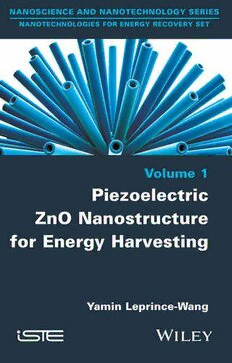
Table Of Content9781848217188-Case.qxp_Layout 1 25/02/2015 11:41 Page 1
NANOSCIENCE AND NANOTECHNOLOGY SERIES
NANOTECHNOLOGIES FOR ENERGY RECOVERY SET
1
Coordinated by Pascal Maigné NANOTECHNOLOGIES FOR ENERGY RECOVERY SET
In the past decade, zinc oxide (ZnO) has become increasingly attractive Y
a
as a II-VI semiconductor within the international scientific community m
in
due to its numerous unique and beneficial properties. With extensive L
e
applications in electronics, phonics, acoustics, energy and sensing, ZnO p
r
is being used extensively in nanostructure applications to create in
c
e
materials with high bio-compatibility and piezoelectric traits at low -W
costs. a
n
g
This book focuses on ZnO as a nanostructure with promising
applications in energy harvesting. In the first half of the book, its
different forms are explored, including its most applied forms as a
nanowire, and different low cost fabrication methods are discussed. P
i
e
The author then dedicates the main body of the book to ZnO z
o
nanostructure-based piezoelectric nanogenerators, emphasizing the
e
advantages of the materials’ intrinsic properties. This technology has le
potential applications for converting mechanical movement energy, c
t
r
vibration energy, and hydraulic energy (from ambient sources) into i
c
electric energy for self-powered micro- and nanosystems.
Z
n
Results within these applications are presented, highlighting the recent O Volume 1
progress in nanopiezotronics as well as introducing the remaining
N
issues to be tackled in device fabrication. a
n
o Piezoelectric
s
t
r
u
c
t ZnO Nanostructure
u
r
e
Yamin Leprince-Wang is Full Professor at the University of Paris-Est fo
Marne-la-Vallée, France, where she is also Head of the Materials Science r for Energy Harvesting
E
& Engineering Master’s degree course. Her main research interest n
consists of synthesis and characterization of 1D and 2D oxide e
r
nanomaterials such as TiO2, -Bi2O3, ZnO and their applications in g
y
energy and environment fieldsδ, such as nanogenerators of electricity,
H
solar cells, and gas sensors. a
r
v
e
s
t
i
n
g
Yamin Leprince-Wang
Z(7ib8e8-CBHBII(
www.iste.co.uk
Piezoelectric ZnO Nanostructure for Energy Harvesting
Nanotechnologies for Energy Recovery Set
coordinated by
Pascal Maigné
Volume 1
Piezoelectric ZnO
Nanostructure for
Energy Harvesting
Yamin Leprince-Wang
First published 2015 in Great Britain and the United States by ISTE Ltd and John Wiley & Sons, Inc.
Apart from any fair dealing for the purposes of research or private study, or criticism or review, as
permitted under the Copyright, Designs and Patents Act 1988, this publication may only be reproduced,
stored or transmitted, in any form or by any means, with the prior permission in writing of the publishers,
or in the case of reprographic reproduction in accordance with the terms and licenses issued by the
CLA. Enquiries concerning reproduction outside these terms should be sent to the publishers at the
undermentioned address:
ISTE Ltd John Wiley & Sons, Inc.
27-37 St George’s Road 111 River Street
London SW19 4EU Hoboken, NJ 07030
UK USA
www.iste.co.uk www.wiley.com
© ISTE Ltd 2015
The rights of Yamin Leprince-Wang to be identified as the author of this work have been asserted by her
in accordance with the Copyright, Designs and Patents Act 1988.
Library of Congress Control Number: 2015931475
British Library Cataloguing-in-Publication Data
A CIP record for this book is available from the British Library
ISBN 978-1-84821-718-8
Contents
PREFACE . . . . . . . . . . . . . . . . . . . . . . . . . . . . . . . . . . . . . . ix
ACKNOWLEDGEMENTS . . . . . . . . . . . . . . . . . . . . . . . . . . . . . xi
INTRODUCTION . . . . . . . . . . . . . . . . . . . . . . . . . . . . . . . . . . xiii
CHAPTER 1. PROPERTIES OF ZNO . . . . . . . . . . . . . . . . . . . . . . 1
1.1. Crystal structure of ZnO . . . . . . . . . . . . . . . . . . . . . . . . 1
1.2. Electrical properties of ZnO and
Schottky junction ZnO/Au . . . . . . . . . . . . . . . . . . . . . . . . . 3
1.3. Optical properties of ZnO . . . . . . . . . . . . . . . . . . . . . . . 14
1.4. Piezoelectricity of ZnO . . . . . . . . . . . . . . . . . . . . . . . . 16
CHAPTER 2. ZNO NANOSTRUCTURE SYNTHESIS. . . . . . . . . . . . . . 21
2.1. Electrochemical deposition for
ZnO nanostructure . . . . . . . . . . . . . . . . . . . . . . . . . . . . . . 22
2.1.1. Electrodeposition of
monocrystalline ZnO nanowires
and nanorods via template method . . . . . . . . . . . . . . . . . . . 24
2.1.2. ZnO nanowire array growth
via electrochemical road . . . . . . . . . . . . . . . . . . . . . . . . . 29
2.2. Hydrothermal method for ZnO
nanowire array grow . . . . . . . . . . . . . . . . . . . . . . . . . . . . . 31
vi Piezoelectric ZnO Nanostructure for Energy Harvesting
2.3. Comparative discussion on ZnO
nanowire arrays obtained via
electrodeposition and hydrothermal method . . . . . . . . . . . . . . . 33
2.4. Influence of main parameters of
hydrothermal method on ZnO nanowire
growth morphology . . . . . . . . . . . . . . . . . . . . . . . . . . . . . 36
2.4.1. Effect of the growth method . . . . . . . . . . . . . . . . . . . 36
2.4.2. Effect of the growth solution pH value . . . . . . . . . . . . . 38
2.4.3. Effect of the growth temperature . . . . . . . . . . . . . . . . 40
2.4.4. Effect of the growth time . . . . . . . . . . . . . . . . . . . . . 41
2.5. Electrospinning method for ZnO
micro/nanofiber synthesis . . . . . . . . . . . . . . . . . . . . . . . . . . 44
CHAPTER 3. MODELING AND
SIMULATION OF ZNO-NANOWIRE-
BASED ENERGY HARVESTING . . . . . . . . . . . . . . . . . . . . . . . . . 49
3.1. Nanowire in bending mode . . . . . . . . . . . . . . . . . . . . . . 51
3.1.1. Influence of the nanowire length . . . . . . . . . . . . . . . . 54
3.1.2. Influence of the nanowire diameter . . . . . . . . . . . . . . . 55
3.1.3. Influence of the aspect ratio . . . . . . . . . . . . . . . . . . . 56
3.2. Nanowire in compression mode . . . . . . . . . . . . . . . . . . . 57
3.2.1. Influence of the nanowire length . . . . . . . . . . . . . . . . 58
3.2.2. Influence of the nanowire diameter . . . . . . . . . . . . . . . 59
3.2.3. Influence of the aspect ratio . . . . . . . . . . . . . . . . . . . 59
3.3. Nanowire arrays in static
and vibrational responses . . . . . . . . . . . . . . . . . . . . . . . . . . 61
3.3.1. Nanowire arrays in static
and compressive responses . . . . . . . . . . . . . . . . . . . . . . . . 61
3.3.2. Nanowire arrays in
periodic vibrational response . . . . . . . . . . . . . . . . . . . . . . 62
CHAPTER 4. ZNO-NANOWIRE- BASED
NANOGENERATORS: PRINCIPLE, CHARACTERIZATION
AND DEVICE FABRICATION . . . . . . . . . . . . . . . . . . . . . . . . . . 65
4.1. Working principle of
nanogenerators . . . . . . . . . . . . . . . . . . . . . . . . . . . . . . . . 67
Contents vii
4.2. ZnO-nanowire-based energy
harvesting device fabrication . . . . . . . . . . . . . . . . . . . . . . . . 75
4.3. ZnO-nanowire-based energy
harvesting device characterization . . . . . . . . . . . . . . . . . . . . . 81
4.4. ZnO-nanostructure-based
hybrid nanogenerators . . . . . . . . . . . . . . . . . . . . . . . . . . . . 96
CONCLUSION . . . . . . . . . . . . . . . . . . . . . . . . . . . . . . . . . . . 105
BIBLIOGRAPHY . . . . . . . . . . . . . . . . . . . . . . . . . . . . . . . . . . 109
INDEX. . . . . . . . . . . . . . . . . . . . . . . . . . . . . . . . . . . . . . . . 121