
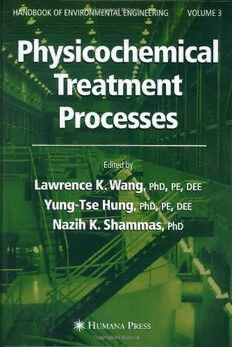
Download Physicochemical Treatment Processes: Volume 3 (Handbook of Environmental Engineering) PDF Free - Full Version
Download Physicochemical Treatment Processes: Volume 3 (Handbook of Environmental Engineering) by Lawrence K. Wang, Yung-Tse Hung, Nazih K. Shammas in PDF format completely FREE. No registration required, no payment needed. Get instant access to this valuable resource on PDFdrive.to!
About Physicochemical Treatment Processes: Volume 3 (Handbook of Environmental Engineering)
A critical survey of both the principles and practices involved in water pollution control, potable water treatment, water reuse, and sludge treatment. The authors discuss the performance, potential, and limitations of each major physicochemical treatment process in detail-including the physical and chemical theory behind it, the applications, the design procedures, examples, references, and cost data-as a basis for intelligent planning and realization of treatment systems. Among the processes covered are screening, comminution, flow equalization, neutralization, mixing, coagulation, flocculation, chemical precipitation, oxidation, recarbonization, softening, halogenation, and disinfection. Additional chapters discuss ozonation, electrolysis, sedimentation, dissolved air flotation, gravity filtration, granular activated carbon adsorption, and sludge treatment. The emphasis throughout is on developing the necessary engineering from fundamental principles of chemistry, physics, and mathematics. Two companion volumes, Air Pollution Control Engineering, Volume 1, and Advanced Air and Noise Pollution Control, Volume 2, survey the basic air pollution control technique and the use of multiple techniques to deal with air, thermal, and noise pollution.
Detailed Information
| Author: | Lawrence K. Wang, Yung-Tse Hung, Nazih K. Shammas |
|---|---|
| Publication Year: | 2005 |
| ISBN: | 9781592598205 |
| Pages: | 731 |
| Language: | English |
| File Size: | 7.192 |
| Format: | |
| Price: | FREE |
Safe & Secure Download - No registration required
Why Choose PDFdrive for Your Free Physicochemical Treatment Processes: Volume 3 (Handbook of Environmental Engineering) Download?
- 100% Free: No hidden fees or subscriptions required for one book every day.
- No Registration: Immediate access is available without creating accounts for one book every day.
- Safe and Secure: Clean downloads without malware or viruses
- Multiple Formats: PDF, MOBI, Mpub,... optimized for all devices
- Educational Resource: Supporting knowledge sharing and learning
Frequently Asked Questions
Is it really free to download Physicochemical Treatment Processes: Volume 3 (Handbook of Environmental Engineering) PDF?
Yes, on https://PDFdrive.to you can download Physicochemical Treatment Processes: Volume 3 (Handbook of Environmental Engineering) by Lawrence K. Wang, Yung-Tse Hung, Nazih K. Shammas completely free. We don't require any payment, subscription, or registration to access this PDF file. For 3 books every day.
How can I read Physicochemical Treatment Processes: Volume 3 (Handbook of Environmental Engineering) on my mobile device?
After downloading Physicochemical Treatment Processes: Volume 3 (Handbook of Environmental Engineering) PDF, you can open it with any PDF reader app on your phone or tablet. We recommend using Adobe Acrobat Reader, Apple Books, or Google Play Books for the best reading experience.
Is this the full version of Physicochemical Treatment Processes: Volume 3 (Handbook of Environmental Engineering)?
Yes, this is the complete PDF version of Physicochemical Treatment Processes: Volume 3 (Handbook of Environmental Engineering) by Lawrence K. Wang, Yung-Tse Hung, Nazih K. Shammas. You will be able to read the entire content as in the printed version without missing any pages.
Is it legal to download Physicochemical Treatment Processes: Volume 3 (Handbook of Environmental Engineering) PDF for free?
https://PDFdrive.to provides links to free educational resources available online. We do not store any files on our servers. Please be aware of copyright laws in your country before downloading.
The materials shared are intended for research, educational, and personal use in accordance with fair use principles.

