Table Of ContentNew Trends in T ranslation S tudies
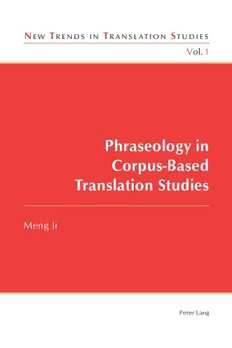
Vol.1
Phraseology in
Corpus-Based
Translation Studies
Meng Ji
Peter Lang
New Trends in T ranslation S tudies
Translations of Cervantes’ Don Quijote (1605) take pride of place among
foreign literature in China. Despite the contrasts between the two cultures
and the passage of four centuries the adventures and misadventures of
the Castilian hero have always been popular with Chinese readers.
In this book a corpus-based stylistic study is used to explore two con-
temporary Mandarin Chinese translations of Don Quijote: those by Yang
Jiang (1978) and Liu Jingsheng (1995). Utilising a micro-structural perspec-
tive this study suggests explanations for the surprising popularity of Don
Quijote in China.
Meng Ji has a PhD from Imperial College London (2009) within the area of
corpus-based translation studies focused on the study of phraseology in literary
translations into Chinese. She is presently developing an interdisciplinary
approach to corpus-based translation studies by integrating methodologies
from disciplines including textual statistics, quantitative sociolinguistics and
computational stylometry.
ISBN 978-3-03911-550-1
www.peterlang.com
Phraseology in Corpus-Based
Translation Studies
New Trends in Translation Studies
Volume 1
Series Editor:
Dr Jorge Díaz Cintas
Advisory Board:
Professor Susan Bassnett McGuire
Professor Frederic Chaume
Professor Aline Remael
PETER LANG
Oxford • Bern • Berlin • Bruxelles • Frankfurt am Main • New York • Wien
Phraseology in
Corpus-Based
Translation Studies
Meng Ji
PETER LANG
Oxford • Bern • Berlin • Bruxelles • Frankfurt am Main • New York • Wien
Bibliographic information published by Die Deutsche Nationalbibliothek.
Die Deutsche Nationalbibliothek lists this publication in the Deutsche National-
bibliografie; detailed bibliographic data is available on the Internet at
http://dnb.d-nb.de.
A catalogue record for this book is available from the British Library.
Library of Congress Cataloging-in-Publication Data:
Ji, Meng, 1982-
Phraseology in corpus-based translation studies / Meng Ji.
p. cm. -- (New trends in translation studies ; vol 1)
Includes bibliographical references and index.
1. Cervantes Saavedra, Miguel de, 1547-1616--Appreciation--China. 2.
Cervantes Saavedra, Miguel de, 1547-1616--Criticism and interpretation.
3. Cervantes Saavedra, Miguel de, 1547-1616. Don Quixote--Translations
into Chinese. 4. Corpora (Linguistics) 5. Translating and
interpreting. I. Title.
PQ6349.C6J52 2010
495.1‘802--dc22
2010007058
ISSN 1664-249X
ISBN 978-3-0353-0014-7
© Peter Lang AG, International Academic Publishers, Bern 2010
Hochfeldstrasse 32, CH-3012 Bern, Switzerland
[email protected], www.peterlang.com, www.peterlang.net
All rights reserved.
All parts of this publication are protected by copyright.
Any utilisation outside the strict limits of the copyright law, without
the permission of the publisher, is forbidden and liable to prosecution.
This applies in particular to reproductions, translations, microfilming,
and storage and processing in electronic retrieval systems.
Printed in Germany
Table of Contents
List of Tables and Diagrams ix
List of Abbreviations xi
Acknowledgements xiii
Introduction xv
Chapter 1
Construction of a Parallel Corpus of Don Quijote (Part I) 1
1.1. Corpus construction in Translation Studies 2
1.2. Selection of corpus texts 7
1.3. Segmentation of Chinese texts 12
1.4. Parallel text alignment 32
1.5. Conclusion 43
Chapter 2
Corpus Data Retrieval and Classification 45
2.1. Problem-oriented annotation 45
2.2. Automatic extraction of four-character expressions 49
2.3. Classification of Chinese four-character expressions 55
2.4. Redefining Chinese idioms 58
2.5. Classification of figurative idioms and archaic idioms 67
2.6. Conclusion 75
vi
Chapter 3
General Phraseological Patterns in Yang’s Translation 79
3.1. Quantifying style in corpus-based Translation Studies 79
3.2. Sampling 82
3.3. Time factor in the use of idioms in contemporary Chinese 85
3.4. Yang’s phraseological preference for morpho-syntactically
patterned phrases 92
3.5. Conclusion 106
Chapter 4
General Phraseological Patterns in Liu’s Translation 111
4.1. Liu’s phraseological preference for figurative idioms 111
4.2. Cognate metaphors 113
4.3. Non-cognate metaphors 116
4.4. Other figurative speeches in the source text 127
4.5. Liu’s phraseological preference for archaic idioms 135
4.6. Conclusion 140
Chapter 5
Use of Figurative/Archaic Idioms in the Two Translations 143
5.1. Use of figurative idioms in the two Chinese translations 143
5.2. Use of archaic idioms in the two translations 154
5.3. Conclusion 171
Chapter 6
Quantitative Exploration of Stylistic Variation in Liu’s Translation 173
6.1. A context-motivated theory for style shifting in literary translation 173
6.2. Statistical method applied 177
6.3. Variable reduction and pattern recognition 182
6.4. Conclusion 198
vii
Chapter 7
Conclusion 201
7.1. Summary 201
7.2. Balancing of manual and automatic textual analysis 203
7.3. Systematicity and replicability of the processing of
textual information 206
7.4. Construction of theoretical models to elicit the nature of
literary translation 211
Appendix I
A Complete Situational Framework for Register Studies 215
References 219
Index 229