Table Of ContentAppendices DRAFT
1 Review protocol
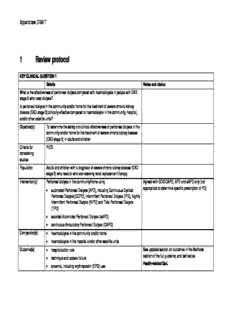
KEY CLINICAL QUESTION 1
Details Notes and status
What is the effectiveness of peritoneal dialysis compared with haemodialysis in people with CKD
stage 5 who need dialysis?
Is peritoneal dialysis in the community and/or home for the treatment of severe chronic kidney
disease (CKD stage 5) clinically effective compared to haemodialysis in the community, hospital,
and/or other satellite units?
Objective(s) To determine the safety and clinical effectiveness of peritoneal dialysis in the
community and/or home for the treatment of severe chronic kidney disease
(CKD stage 5) in adults and children
Criteria for PICO
considering
studies
Population Adults and children with a diagnosis of severe chronic kidney disease (CKD
stage 5) who need or who are receiving renal replacement therapy.
Intervention(s) Peritoneal dialysis in the community/home using Agreed with GDG CAPD, APD and aAPD only (not
• automated Peritoneal Dialysis (APD), including Continuous Cyclical appropriate to determine specific prescription of PD)
Peritoneal Dialysis (CCPD), Intermittent Peritoneal Dialysis (IPD), Nightly
Intermittent Peritoneal Dialysis (NIPD) and Tidal Peritoneal Dialysis
(TPD)
• assisted Automated Peritoneal Dialysis (aAPD)
• continuous Ambulatory Peritoneal Dialysis (CAPD).
Comparator(s) • haemodialysis in the community and/or home
• haemodialysis in the hospital and/or other satellite units
Outcome(s) • hospitalisation rate See updated section on outcomes in the Methods
section of the full guideline, and defined as
• technique and access failure
Health-related QoL
• anaemia, including erythropoietin (EPO) use
Appendices DRAFT
• adverse effects of dialysis, for example infections Patient involvement and satisfaction
• mortality Mortality (where reported, also deaths in first 3
• health related quality of life months)
• resource use and costs Preservation of renal function
Technique failure or switch
Resource use and costs inc hospitalisation
Adverse events
Adequacy rates
Staff attitude
Nutritional status
Anaemia
How to be As per the Guidelines Manual. No additional databases are required Due to paucity of data, undertook additional search to
searched Date restriction: identify relevant registry data related to any of the
interventions (including HD) and agreed outcomes.
Systematic reviews – 2004 onwards
RCTs – no date restrictions
Language restriction: English language
Study design: systematic reviews and RCTs
Review strategy GRADE profiles
Appendices DRAFT
KEY CLINICAL QUESTION 2
Details Notes and status
What is the effectiveness of different modes of peritoneal dialysis (CAPD, APD, aAPD) in people with CKD Agreed with GDG CAPD, APD and aAPD
stage 5 who need dialysis? only (not appropriate to determine specific
What is the clinical effectiveness of the different types of peritoneal dialysis (Automated Peritoneal Dialysis prescription of PD)
[APD], Continuous Cyclical Peritoneal Dialysis [CCPD], Intermittent Peritoneal Dialysis [IPD], Nightly
Intermittent Peritoneal Dialysis [NIPD], Tidal Peritoneal Dialysis [TPD], assisted Automated Peritoneal
Dialysis [aAPD] and Continuous Ambulatory Dialysis [CAPD]) compared to each other?
Objective(s) To determine the safety and clinical effectiveness of the different types of peritoneal
dialysis for the treatment of severe chronic kidney disease (CKD stage 5) in adults
and children.
Criteria for PICO
considering studies
Population Adults and children with a diagnosis of severe chronic kidney disease (CKD stage 5)
who need or who are receiving renal replacement therapy.
Intervention(s) Peritoneal dialysis in the community/home using Agreed with GDG CAPD, APD and aAPD
• automated Peritoneal Dialysis (APD), including Continuous Cyclical Peritoneal only (not appropriate to determine specific
prescription of PD)
Dialysis (CCPD), Intermittent Peritoneal Dialysis (IPD), Nightly Intermittent
Peritoneal Dialysis (NIPD) and Tidal Peritoneal Dialysis (TPD)
• assisted Automated Peritoneal Dialysis (aAPD)
• continuous Ambulatory Peritoneal dialysis (CAPD)
Comparator(s) Any of the above
Outcome(s) • hospitalisation rate See updated section on outcomes in the
Methods section of the full guideline
• technique and access failure
• anaemia, including erythropoietin (EPO) use
• adverse effects of dialysis, for example infections
• mortality
• health related quality of life
Appendices DRAFT
How to be searched As per the Guidelines Manual. No additional databases are required Due to paucity of data, undertook additional
Date restriction: search to identify relevant registry data
related to any of the interventions (including
Systematic reviews – 2004 onwards
HD) and agreed outcomes.
RCTs – no date restrictions
Language restriction: English language
Study design: systematic reviews and RCTs.
Review strategy GRADE profiles
Appendices DRAFT
KEY CLINICAL QUESTION 3
Details Notes and status
When is it appropriate to switch people either to or from peritoneal dialysis to avoid complications due to renal
replacement therapies?
Objective(s) To avoid adverse effects of peritoneal dialysis in the treatment of severe chronic
kidney disease (CKD stage 5) in adults and children
Criteria for considering PICO
studies
Population Adults and children with a diagnosis of severe chronic kidney disease (CKD stage 5)
who need or who are receiving renal replacement therapy.
Intervention(s) Any type of intervention e.g. kidney transplant, haemodialysis
Comparator(s) Any comparators considered
Outcome(s) • hospitalisation rate See updated section on outcomes in the
Methods section of the full guideline
• failure of treatment
• technique and access failure
• anaemia, including erythropoietin (EPO) use
• adverse effects of dialysis, for example infections
• mortality
How to be searched To use trials in question 1 and question 2
To look up other guidelines identified in the scope
Review strategy GRADE profiles
Appendices DRAFT
KEY CLINICAL QUESTION 4a
Details Notes and status
What is the effectiveness of interventions to improve decision making in people/ carers of patients undergoing
or considering undergoing peritoneal dialysis in the community and/or home?
Objective(s) To determine the information and support needs for patients and carers
Criteria for PICO
considering studies
Population Adults and children with a diagnosis of severe chronic kidney disease (CKD stage 5)
who need or who are receiving renal replacement therapy.
Intervention(s) Peritoneal dialysis in the community/home using Considered studies with PD alone, but not
• automated peritoneal dialysis (APD), including continuous cyclical peritoneal with HD alone unless general CKD and
dialysis population
dialysis (CCPD), intermittent peritoneal dialysis (IPD), nightly intermittent peritoneal
dialysis (NIPD) and tidal peritoneal dialysis (TPD)
• assisted automated peritoneal dialysis (aAPD) and Agreed with GDG CAPD, APD and aAPD
only (not appropriate to determine specific
• continuous ambulatory peritoneal dialysis (CAPD)
prescription of PD)
Haemodialysis in the community and/or home and haemodialysis in the hospital
Comparator(s) RCTs of interventions to improve decision making
Outcome(s) Patient satisfaction and patient experience See updated section on outcomes in the
Methods section of the full guideline
How to be searched As per the Guidelines Manual. No additional databases are required
Date restriction: None
Language restriction: English language
Study design: systematic reviews and RCTs
Review strategy GRADE profiles
Appendices DRAFT
KEY CLINICAL QUESTION 4b
Details Notes and status
What are the information and support needs of people/ carers of patients undergoing or considering Revised to cover the following:
undergoing peritoneal dialysis in the community and/or home? What are the barriers and facilitators for peritoneal
dialysis use for
• adults with CKD stage 5 who need dialysis?
• children with CKD stage 5 who need dialysis?
• carers of people with CKD stage 5 who need
dialysis?
• healthcare professionals who support patients
and carers deciding on the modality of dialysis
(peritoneal dialysis or haemodialysis)?
Objective(s) To determine the information and support needs for patients and carers based
on qualitative evidence
Criteria for PICO
considering studies
Population Adults and children with a diagnosis of severe chronic kidney disease (CKD
stage 5) who need or who are receiving renal replacement therapy.
Intervention(s) Peritoneal dialysis in the community/home using Considered studies with PD alone, but not with HD
• automated peritoneal dialysis (APD), including continuous cyclical alone unless general CKD and dialysis population
peritoneal dialysis (CCPD), intermittent peritoneal dialysis (IPD), nightly
intermittent peritoneal dialysis (NIPD) and tidal peritoneal dialysis (TPD) Agreed with GDG CAPD, APD and aAPD only (not
• assisted automated peritoneal dialysis (aAPD) and appropriate to determine specific prescription of PD)
• continuous ambulatory peritoneal dialysis (CAPD).
Haemodialysis in the community and/or home and haemodialysis in the hospital
Comparator(s) None
Outcome(s) Patient satisfaction and patient experience
7
Appendices DRAFT
How to be As per the Guidelines Manual. No additional databases are required. Healthtalk online not used as good evidence base in
searched Date restriction: None published literature
Language restriction: English language
Study design: qualitative studies, healthtalkonline.org
Review strategy Meta-thematic analysis Used structured GRADE approach rather than a true
thematic analysis
8
Appendices DRAFT
2 Evidence tables
NOTE: the questions are presented in the order as in the full guideline rather than as in the review protocol.
2.1 Barriers and facilitators to decision making
2.1.1 Review question on information and support needs (review question 4b)
What are the barriers and facilitators for peritoneal dialysis use for
• adults with CKD stage 5 who need dialysis?
• children with CKD stage 5 who need dialysis?
• carers of people with CKD stage 5 who need dialysis?
• healthcare professionals who support patients and carers deciding on the modality of dialysis (peritoneal dialysis or
haemodialysis)?
9
Appendices DRAFT
6,190
Retrieved from
searches and GDG
EXC
168
Based on title and
Ordered full text
abstract
13 EXC
Included full text See EXC studies for
(overall) reasons
Systematic review(s) related to adult and carer views
Study Aim Study inc/exc Databases Study quality Results Author conclusions or Comment
ID criteria searched assessment recommendations
Morton To synthesise the Included qualitative • Medline, Assessed reporting 18 studies were included, of which 15 Authors recommend ‘formal Very high
2010a views of patients studies if PsycINFO, using the COREQ described specific preferences for dialysis incorporation of peers’, giving quality with
and carers in • using CINAHL, framework modality. information at stage 4 disease, great level of
decision making interviews, EmBase, Studies were not Overall, themes identified were the use of ‘formal care detail.
rtreegaatrmdeinngt for foobcsuesr vgartoiounpss ,t o saobcsitaral cwtos,r k ewxecigluhdteedd oorn the • confronting mortality pdaiatlhywsiasy [s… […] to] ffoarc hiliotamtee Uthseemda tic
CKD, and to explore social science basis of reporting o choosing life or death provision of treatments more analysis to
determine which patient/carer journals, quality. o being a burden aligned with their preferences’. generate
ftahcotsoer sd iencfilsuieonncse preferences or EconLit o living in limbo results.
dialysis • Hand-
10
Description:dialysis for the treatment of severe chronic kidney disease (CKD stage 5) in adults . Study design: qualitative studies, healthtalkonline.org Systematic review(s) related to adult and carer views weighing alternatives o . analysis. Lee 2008. To explore patient views, that is experiences with diff