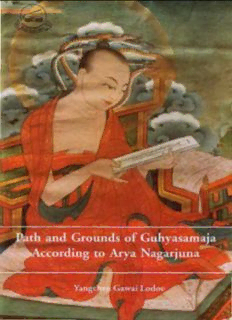
Table Of ContentPaths and Grounds of
Guhyasamaja
According to Arya Nagarjuna
(With Commentary by Geshe Losang Tsephel)
Master Yangchen Gawai Lodoe
Translated
by
Tenzin Dorjee
(co-translator on root text Jeremy Russell)
Edited by
David Ross Komito and Andrew Fagan
LIBRARY OF TIBETAN WORKS AND ARCHIVES
Copyright 1995: Library of Tibetan Works and Archives, Dharamsala
First published in 1995
Reprinted: 2000,2004
ALL RIGHTS RESERVED
No part of this publication may be reproduced, stored in a retrieval
system, or transmitted in any form or by any means, electronic, me
chanical, photo-copying, recording or otherwise, without the prior
permssion of the bearers of copyright.
ISBN: 81-85102-94-5
Published by the Library of Tibetan Works and Archives, Dharamsala,
H. P. (India) and printed at Indraprastha Press (CBT), 4 Bahadurshah
Zafar Marg, New Delhi 110002.
Dedication
Even though the self and others
Equally wish for happiness but not suffering;
Since others are more important
May altruism to establish all in happiness
Spread universally in the hearts
Of all sentient beings pervading space.
His Holiness the Dalai Lama of Tibet, the 1989 Nobel Laureate.
I dedicate this humble yet significant book to all of my great spiritual
masters, above all to His Holiness the Dalai Lama, who have shown me
infinite loving kindness and care and transmitted priceless teachings.
May they live for ages to come and may all mother sentient beings
always come under their compassionate care and enlightened guid
ance.
Acknowledgement
I have been helped by many people in presenting this book to the
empowered minds and the receptive eyes. I am grateful to them all but
my special thanks are due to: my kind masters Venerable Geshe
Lobsang Tsephel for his commentary; Venerable Geshe Sonam Rinchen
(especially for his valuable teachings at the Library for twelve years
while I served as his translator) and Venerable Geshe Dawa for their
helpful clarifications; my translation colleague Jeremy Russell and his
wife Philippa Russell for their class notes; Dr. Andrew Fagan for his
editorial help even during his busy schedule at the Delek Hospital, and
my old friend Professor David Komito for re-editing the complete
manuscript even during his Yamantaka retreat in Dharamsala; Mr.
Gyatsho Tshering, our director, for his trust, friendship and inspiration
during my twelve years' service in the Translation Bureau of the
Library of Tibetan Works and Archives, and to my colleagues Tenzin
Choedon, Tsering Norzom and Pasang Chozom for their help in
preliminary typing.
Publisher's Note
In many Tantras and works of highly realised masters, Guhyasamaja is
described as 'the supreme and king of all Tantras'. Thus we are extremely
pleased to publish this edition of The Paths and Grounds of Guhyasamaja
According to Arya Nagarjuna. Guhyasamaja is studied and practised in
all the traditions of Tibetan Buddhism, with the Gelugpa tradition
placing particular emphasis upon it. It is an essential part of Highest
Yoga Tantra, and studying it undoubtedly facilitates understanding of
other Tantras of the same class.
The text presented here is selected from Yangchen Gala's Paths and
Grounds ofTantra. Yangchen Galo was a saint-scholar in 18th century
Tibet who belonged to the Gelugpa tradition. The commentary is
provided by Venerable Geshe Lobsang Tsephel who presented this text
in Buddhist philosophy classes at the Library of Tibetan Works and
Archives in Dharamsala, in 1986. Mr Tenzin Dorjee Lotsawa was his
accomplished translator and subsequently devoted himself to produc
ing the wor~ in book form, with the assistance of Jeremy Russell. We
are grateful to Geshe Lobsang Tsephel, and to the translator and
editors, for their dedicated efforts to make the Guhyasamaja Tantra
accessible to serious practitioners of Tibetan Buddhist Tantra.
It should be noted that Tantra is a swift but risky path to enlighten
~ent. It is extremely profound, is codified in a special terminology, and
IS dependent upon the explanation, advice and personal guidance of a
qualified teacher. We therefore strongly advise that only practitioners
who ~ave received the Guhyasamaja Empowerment or an empower
ment mto another Highest Yoga Tantra should make use of this book.
It is our sincere hope that this work will be of inestimable benefit to
students of Highest Yoga Tantra and, through them, will contribute to
the welfare of all sentient beings.
Gyatsho Tshering
Director
April, 1995
Geshey Losang Tsephel
Contents
Dedication iii
Acknowledgements iv
Forward v
Introduction xi
pART ONE: AN INTRODUCTORY AND PRELIMINARY DISCOURSE
1 A Structure of the Paths in Buddhism 3
2 The Three Principle Paths 5
3 The Title and the Lineage 7
4 Salutation 8
5 An Expression of Worship 8
6 Rarity of the Highest Yoga Tantra 9
7 A Pledge of Composition 10
8 Explaining the Presentation of the Paths and grounds of
Highest Mantra 10
9 General Explanation of the Mode of Progression on the Paths 10
10 Empowerment is the Entrance into Mystical Tantric Practice 11
11 The Three Lower Tantras, Two Stages and the Perfection
Vehicle 13
12 The Need of Highest Yoga Tantra for Enlightenment 15
pART TWO: THE GENERATION STAGE
1 Specific Explanation of the Mode of Progression on the
Two Stages of Highest (Yoga Tantra) 19
2 Definition 19
3 Death and Dying 21
4 An Intermediate State (Bardo) 23
5 A Rebirth 25
viii The Paths and Grounds of Guhyasamaja
6. Generating the Body Mandala and Taking the Truth Body
in the Path 26
7 Taking the Complete Enjoyment Body in the Path 30
8 Taking the Emanation Body in the Path 32
9 Generating the Body into the Residence Mandala 33
10 Territorial Boundaries of the Deities and their Source Syllables 34
11 The Four Female Consorts Arise from the Pure Elements of
OmB~ ~
12 Inviting and Dissolving the Wisdom Beings 39
13 Divisions 41
14 The Coarse and the Subtle Yo gas 42
15 The Supreme Conqueror of the Mandala 42
16 Etymological Explanation 45
17 The Criteria of Having Completed the Generation Stage 46
18 The Beginner's Level 46
19 The Slight Dawning of Wisdom 46
20 Slight Control over Wisdom 47
21 Perfect Control over Wisdom 47
22 The Criteria for the Stability in and the Completion of the
Coarse and the Subtle Levels of the Generation Stage 48
23 The Union of Calm Abiding and Special Insight 48
24 The Mode of Transference from the Generation Stage to the
Completion Stage 49
PART THREE: THE CoMPLETION STAGE
1 The Mode of Progression on the Completion Stage 51
2 Definition 51
3 Divisions 51
4 Etymological Explanation 52
5 Isolated Body 52
6 The Mode of Transference from a Lower Level to a Higher
Level 53
7 Isolated Speech 54
8 The Mode of Transference from Isolated Body to Isolated
Speech 54
9 Etymological Explanation of the Isolated Speech 54
10 The Three Types of Vitality and Exertion 55
11 Isola ted Mind 56