Table Of ContentD.RabounskiandL.Borissova
PARTICLESHERE
ANDBEYONDTHEMIRROR
SVENSKAFYSIKARKIVET•2008
Dmitri Rabounski and Larissa Borissova
Particles Here
and Beyond the Mirror
Second edition, revised and expanded by new chapters
Andra upplagan, reviderad och utvidgad med nya kapitel
Particlar h¨ar
och bakom spegeln
Swedish physics archive
2008
Svenska fysikarkivet
Svenska fysikarkivet (that means the Swedish physics archive) is a publisher regis-
teredwiththeRoyalNationalLibraryofSweden(Kungligabiblioteket),Stockholm.
Postaladdressforcorrespondence:
Svenskafysikarkivet,N¨asbydalsv¨agen4/11,18331T¨aby,Sweden
EditedbyIndranuSuhendro
Copyright(cid:176)c DmitriRabounskiandLarissaBorissova,2001,2008
Copyright(cid:176)c TypesettinganddesignbyDmitriRabounski,2008
Copyright(cid:176)c PublicationbySvenskafysikarkivet,2008
Copyright Agreement: — All rights reserved. The Authors do hereby grantSven-
ska fysikarkivet non-exclusive, worldwide, royalty-free license to publish and dis-
tributethisbookinaccordancewiththeBudapestOpenInitiative: thismeansthat
electronic copying, print copying and distribution of this book for non-commercial,
academicorindividualusecanbemadebyanyuserwithoutpermissionorcharge.
Anypartofthisbookbeingcitedorusedhowsoeverinotherpublicationsmustac-
knowledge this publication. No part of this book may be reproduced in any form
whatsoever (including storage in any media) for commercial use without the prior
permissionofthecopyrightholder. Requestsforpermissiontoreproduceanypartof
thisbookforcommercialusemustbeaddressedtotheAuthors. TheAuthorsretain
their rights to use this book as a whole or any part of it in any other publications
and in any way they see fit. This Copyright Agreement shall remain valid even if
the Authors transfer copyright of the book to another party. The Authors hereby
agreetoindemnifyandholdharmlessSvenskafysikarkivetforanythirdpartyclaims
whatsoeverandhowsoevermadeagainstSvenskafysikarkivetconcerningauthorship
orpublicationofthebook.
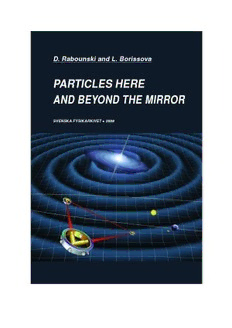
Cover image: the three LISA spacecraft placed in orbits that form a triangular
formation with center 20◦ behind the Earth and side length 5 million km. This
imageisacourtesyofNASA/JPL-Caltech. Thisimageisapublicdomainproduct;
see http://www.jpl.nasa.gov/images/policy/index.cfm for details. We are thankful
toNASA,JetPropulsionLaboratory,andCaltechfortheimage.
ThisbookwastypesetusingteTEXtypesettingsystemandKile,aTEX/LATEXeditor
fortheKDEdesktop. PoweredbyUbuntuLinux.
SignedtoprintonJuly06,2008.
ISBN: 978-91-85917-03-7
Printed in Jakarta, Indonesia
Contents
Foreword to the 2nd edition.........................................5
Chapter 1 Three Kinds of Particles According to Pseudo-
Riemannian Space
§1.1 Problem statement.........................................7
§1.2 Chronometrically invariant (observable) quantities.........12
§1.3 Mass-bearing particles and massless particles..............24
§1.4 Fully degenerate space-time. Zero-particles................29
§1.5 An extended space for particles of all three kinds..........31
§1.6 Equations of motion: general considerations...............35
§1.7 Equations of motion in the extended space.................37
§1.8 Equations of motion in the strictly non-degenerate space...40
§1.9 A particular case: equations of geodesic lines..............43
§1.10 A particular case: Newton’s laws..........................45
§1.11 Analysisoftheequations: theultimatetransitionsbetween
the basic space and zero-space.............................48
§1.12 Analysis of the equations: asymmetry of the space and
the world beyond the mirror...............................51
§1.13 The physical conditions characterizing the direct and re-
verse flow of time..........................................54
§1.14 Basic introduction into the mirror world...................57
§1.15 Who is a superluminal observer?...........................61
§1.16 Gravitational collapse in different regions of space.........62
Chapter 2 Motion of Particles as a Result of Motion of
Space Itself
§2.1 Problem statement........................................65
§2.2 Equations of motion and Killing’s equations...............68
§2.3 Conclusions...............................................72
4 Contents
Chapter 3 Deviation of World-Lines. Detecting Gravita-
tional Waves
§3.1 Gravitational wave detectors...............................73
§3.2 A brief history of the measurements.......................74
§3.3 Weber’s approach and criticism thereof....................75
§3.4 The main equations.......................................77
§3.5 Exact solution for a free-mass detector.....................79
§3.6 Exact solution for a solid-body detector....................82
§3.7 Conclusions...............................................86
Chapter 4 InstantDisplacementWorld-Lines. Teleporting
Particles
§4.1 Trajectories for instant displacement. Zero-space: the way
for non-quantum teleportation of photons..................87
§4.2 The geometric structure of zero-space......................92
§4.3 Zero-space as home space for virtual particles. Geometric
interpretation of the Feynman diagrams...................95
Conclusions.......................................................102
Epilogue..........................................................107
Appendix A Notations of tensor algebra and analysis............108
Appendix B A thesis presented at the 2008 APS April Meeting..111
Bibliography......................................................112
Foreword to the 2nd Edition
The background behind this book is as follows. In 1991 we initiated a
study to find out what kinds of particles may theoretically inhabit the
space-time of the General Theory of Relativity. As the instrument, we
equipped ourselves with the mathematical apparatus of chronometric
invariants (physically observable quantities) developed in the 1940’s by
Abraham Zelmanov.
The study was completed to reveal that aside for mass-bearing and
massless (light-like) particles, those of the third kind may also exist.
Theirtrajectoriesliebeyondtheregularregioninspace-time. Forareg-
ular observer the trajectories are of zero four-dimensional length and
zero three-dimensional observable length. Besides, along the trajecto-
ries the interval of observable time is also zero. Mathematically, this
means that such particles inhabit a space-time with fully degenerate
metric (fully degenerate space-time). We have therefore called such
a space “zero-space” and such particles — “zero-particles”.
Foraregularobservertheirmotioninzero-spaceisinstantaneous,so
zero-particlesdorealizelong-rangeaction. Throughpossibleinteraction
with our-world’s mass-bearing or massless particles, zero-particles may
instantaneously transmit signals to any point in our three-dimensional
space (a phenomenon we may call “non-quantum teleportation”).
Consideringzero-particlesintheframesofthewave-particleduality,
wehaveobtainedthatforaregularobservertheyarestandingwavesand
the whole zero-space is filled with a system of standing light-like waves
(zero-particles), i.e. standing light-holograms. This result corresponds
to the known “stopped light experiment” (Harvard, USA, 2001).
Using the mathematical method of physically observable quantities,
wehavealsoshowedthattwoseparateregionsininhomogeneousspace-
time may exist, where the physically observable (proper) time flows
into the future and into the past, while such a duality is not found in
a homogeneous space-time. These regions are referred to as our world
and the mirror world respectively; they are separated by a space-time
membrane wherein observable time stops.
All the above results are derived exclusively from the application
of Zelmanov’s mathematical apparatus of physically observable quanti-
ties. Of course, these are not the final results which we could extract
6 Foreword
from the theme, using Zelmanov’s mathematical method. It is possi-
ble that further studies in this direction will give more theoretical and
experimental results.
Now we present these results into your consideration. The second
edition of this book is amended by new theoretical results and also two
new chapters: a chapter on the theory of gravitational wave detectors
and a chapter concerning virtual particles and non-quantum teleporta-
tion in the framework of the General Theory of Relativity.
In conclusion we would like to express belated thanks and sincere
gratitude to Dr. Abraham Zelmanov (1913–1987) and Prof. Kyril Sta-
nyukovich (1916–1989), teachers of ours, for countless hours of friendly
conversations. We are also grateful to Kyril Dombrovski whose talks
andfriendlydiscussionsgreatlyinfluencedouroutlooks. Alsowehighly
appreciate assistance from the side of our colleague Indranu Suhendro,
whose editing has made this book much more accessible to a reader.
May 15, 2008 Dmitri Rabounski and Larissa Borissova
Chapter 1 Three Kinds of Particles
According to
Pseudo-Riemannian Space
§1.1 Problem statement
Themaingoalofthetheoryofmotionofparticlesistodefinethethree-
dimensional (spatial) coordinates of a particle at any given moment of
time. Inordertodothis,oneshouldbeawareofthreethings. First,one
shouldknowinwhatsortofspace-timetheeventstakeaplace. Thatis,
one should know the geometric structure of space and time, just as one
should know the conditions of a road to be able to drive on it. Second,
one should know the physical properties of the moving particle. Third,
knowledge of the equations of motion of particles of a certain kind is
necessary.
Thefirstproblemactuallyleadstothechoiceofaspacefromamong
the spaces known in mathematics, in order to represent just the right
geometryforspaceandtimewhichbestfitsthegeometricrepresentation
of the observed world.
Theviewoftheworldasaspace-timecontinuumtakesitsoriginfrom
the historical speech Raum und Zeit by Hermann Minkowski, which he
gave on September 21, 1908, in K¨oln, Germany, at the 80th Assembly
oftheSocietyofGermanNaturalScientistsandPhysicians(DieGesell-
schaft Deutscher Naturforscher und A¨rzte). There he introduced the
notion“space-time”intophysics, andpresentedageometricinterpreta-
tionoftheprincipleofinvarianceofthevelocityoflightandofLorentz’
transformations.
Afewyearslater, in1912, MarcelGrossmann, inhisprivateconver-
sationwithAlbertEinstein,aclosefriendofhim,proposedRiemannian
geometry as the geometry of the observed world. Later Einstein came
to the idea that became the corner-stone of his General Theory of Rel-
ativity: that was the “geometric concept of the world”, according to
whichthegeometricstructureofspace-timedeterminesallpropertiesof
theUniverse. ThusEinstein’sGeneralTheoryofRelativity,finalizedby
8 Chapter 1 Kinds of Particles in the Pseudo-Riemannian Space
him in 1915, is the first geometric theory of space-time and of motion
of particles since the dawn of the contemporary science.
Consideration of the problem in detail led Einstein to the fact that
the only way to represent space-time in the way that fits the existing
experimental data is given by a four-dimensional pseudo-Riemannian
space with the sign-alternating Minkowski signature (+−−−) or (−+++)
(one time axis and three spatial axes). This is a particular case of the
family of Riemannian spaces, i.e. spaces where geometry is Rieman-
nian(thesquareofdistanceds2 betweeninfinitelyclosepointsissetup
by metric ds2=g dxαdxβ=inv). In a Riemannian space coordinate
αβ
axes can be of any kind. Four-dimensional pseudo-Riemannian space
is different on the account of the fact that there is a principal differ-
ence between the three-dimensional space, perceived as space, from the
fourth axis — time. From the mathematical viewpoint this looks as
follows: three spatial axes are real, while the time axis is imaginary
(or vice versa), and choice of such conditions is arbitrary.
A particular case of a flat, uniform, and isotropic four-dimensional
pseudo-Riemannian space is referred to as Minkowski’s space. This is
the basic space-time of the Special Theory of Relativity — the ab-
stractedcase,whichisfreeofgravitationalfields,rotation,deformation,
and curvature. In the general case the real pseudo-Riemannian space
is curved, non-uniform and anisotropic. This is the basic space-time
of the General Theory of Relativity, where we meet both gravitational
field, rotation, deformation, and curvature.
So, theGeneralTheoryofRelativityisbuiltonviewoftheworldas
a four-dimensional space-time, where any and all objects possess not a
three-dimensionalvolumealone, buttheir“longitude”intime. Thatis,
any physical body, including ours, is a really existing four-dimensional
instance with the shape of a cylinder elongated in time (cylinder of
events of this body), created by perplexion of other cylinders at the
moment of its “birth” and split into many other ones at the moment of
its“death”. Forexample,forahumanthe“timelength”istheduration
of their life from conception till death.
Very soon after Eddington in 1919 gave the first proof that Sun
rays are curved by its gravitational field, many researchers faced strong
obstacles in fitting together calculations made in the framework of the
General Theory of Relativity with existing results of observations and
experiments. Successful experiments verifying the General Theory of
Relativity during the last 80 years have explicitly shown that the four-
dimensional pseudo-Riemannian space is the basic space-time of the
observed world (as far as the up-to-date measurement precision al-
1.1 Problem statement 9
lows us to judge). And if the inevitable evolution of human civiliza-
tion and thought, and of experimental technology, shows that the four-
dimensionalpseudo-Riemannianspacecannolongerexplaintheresults
of new experiments, this will mean nothing other than the need to
assume a more general space, which will include the four-dimensional
pseudo-Riemannian space as a particular case.
Thisbookwillfocusonthemotionofparticlesbasedonthegeomet-
ric concept of the world-structure: we will assume that the geometry of
our space-time determined all properties of the observed world. There-
fore, contrary to other researchers, we are not going to constrain the
geometry of the space-time by any limitations and we will solve our
problems the way the space-time geometry requires them to be solved.
Hence, any particle in the space-time corresponds to its own world-
line, which sets up the three-dimensional (spatial) coordinates of this
particle at any given moment of time. Subsequently, our goal to de-
termine possible kinds of particles evolves into considering all allowable
types of trajectories of motion in the four-dimensional space-time.
Generally speaking, referring to the equations of motion of free par-
ticlesinametricspace(space-time)oneactuallyreferstotheequations
of geodesic lines,whicharethefour-dimensionalequationsoftheworld-
trajectory of a free particle∗
d2xα dxµdxν
+Γα =0, (1.1)
dρ2 µν dρ dρ
whereΓα areChristoffel’ssymbolsofthe2ndkindandρisaparameter
µν
of derivation along to the geodesic line.
From the geometric viewpoint the equations of geodesic lines are
equations of parallel transfer in the sense of Levi-Civita [1] of the four-
dimensional kinematic vector
dxα
Qα= , (1.2)
dρ
namely — the following equations
DQα dQα dxν
= +Γα Qµ =0, (1.3)
dρ dρ µν dρ
where DQα=dQα+Γα Qµdxν is the absolute differential of the kine-
µν
matic vector Qα transferred in parallel to itself and tangential to the
trajectory of transfer (a geodesic line).
∗Here and so forth space-time indices are Greek, for instance α,β,=0,1,2,3,
whilespatialindices—Roman,forinstancei,k=1,2,3.