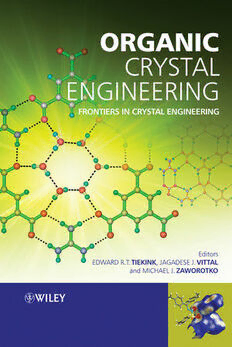
Table Of ContentOrganic Crystal Engineering
Organi c C ryst al Engi neeri ng : Front i ers i n Cryst al E ngi neeri ng Edited by E. R.T. Tieki nk, J. Vittal and M. Zaworotko
© 2010 John Wi l ey & Sons, L t d. ISBN: 978-0-470-31990-1
Organic Crystal
Engineering
Frontiers in Crystal Engineering
Editors
EDWARD R.T. TIEKINK
School of Materials Science and Engineering, Nanyang
Technological University, Singapore
JAGADESE VITTAL
Department of Chemistry, National University of Singapore,
Singapore
MICHAEL ZAWOROTKO
Department of Chemistry, University of South Florida, USA
A John Wiley and Sons, Ltd., Publication
Thiseditionfirstpublished2010
©2010JohnWiley&Sons,Ltd.
Registeredoffice
JohnWiley&SonsLtd,TheAtrium,SouthernGate,Chichester,WestSussexPO198SQ,UnitedKingdom
Fordetailsofourglobaleditorialoffices,forcustomerservicesandforinformationabouthowtoapplyforpermissionto
reusethecopyrightmaterialinthisbookpleaseseeourwebsiteatwww.wiley.com.
TherightoftheauthortobeidentifiedastheauthorofthisworkhasbeenassertedinaccordancewiththeCopyright,
DesignsandPatentsAct1988.
Allrightsreserved.Nopartofthispublicationmaybereproduced,storedinaretrievalsystem,ortransmitted,inanyform
orbyanymeans,electronic,mechanical,photocopying,recordingorotherwise,exceptaspermittedbytheUKCopyright,
DesignsandPatentsAct1988,withoutthepriorpermissionofthepublisher.
Wileyalsopublishesitsbooksinavarietyofelectronicformats. Somecontentthatappearsinprintmaynotbeavailablein
electronicbooks.
Designationsusedbycompaniestodistinguishtheirproductsareoftenclaimedastrademarks. Allbrandnamesandproduct
namesusedinthisbookaretradenames,servicemarks,trademarksorregisteredtrademarksoftheirrespectiveowners. The
publisherisnotassociatedwithanyproductorvendormentionedinthisbook. Thispublicationisdesignedtoprovide
accurateandauthoritativeinformationinregardtothesubjectmattercovered.Itissoldontheunderstandingthatthe
publisherisnotengagedinrenderingprofessionalservices. Ifprofessionaladviceorotherexpertassistanceisrequired,the
servicesofacompetentprofessionalshouldbesought.
Thepublisherandtheauthormakenorepresentationsorwarrantieswithrespecttotheaccuracyorcompletenessofthe
contentsofthisworkandspecificallydisclaimallwarranties,includingwithoutlimitationanyimpliedwarrantiesoffitness
foraparticularpurpose. Thisworkissoldwiththeunderstandingthatthepublisherisnotengagedinrenderingprofessional
services. Theadviceandstrategiescontainedhereinmaynotbesuitableforeverysituation. Inviewofongoingresearch,
equipmentmodifications,changesingovernmentalregulations,andtheconstantflowofinformationrelatingtotheuseof
experimentalreagents,equipment,anddevices,thereaderisurgedtoreviewandevaluatetheinformationprovidedinthe
packageinsertorinstructionsforeachchemical,pieceofequipment,reagent,ordevicefor,amongotherthings,anychanges
intheinstructionsorindicationofusageandforaddedwarningsandprecautions. ThefactthatanorganizationorWebsiteis
referredtointhisworkasacitationand/orapotentialsourceoffurtherinformationdoesnotmeanthattheauthororthe
publisherendorsestheinformationtheorganizationorWebsitemayprovideorrecommendationsitmaymake. Further,
readersshouldbeawarethatInternetWebsiteslistedinthisworkmayhavechangedordisappearedbetweenwhenthiswork
waswrittenandwhenitisread. Nowarrantymaybecreatedorextendedbyanypromotionalstatementsforthiswork.
Neitherthepublishernortheauthorshallbeliableforanydamagesarisingherefrom.
LibraryofCongressCataloging-in-PublicationData
Organiccrystalengineering: frontiersincrystalengineering/editors,EdwardTiekink,JagadeseVittal,MichaelZaworotko.
p. cm.
Includesbibliographicalreferencesandindex.
ISBN978-0-470-31990-1(cloth)
1. Molecularcrystals–Research.2. Organicsolidstatechemistry. 3. Crystalgrowth. I.Tiekink,EdwardR.T.II.Vittal,
JagadeseJ.III.Zaworotko,Michael.
QD921.O652010
548–dc22
2009052144
AcataloguerecordforthisbookisavailablefromtheBritishLibrary.
ISBN978-0-470-31990-1
Typesetin10/12ptTimes-RomanbyLaserwordsPrivateLimited,Chennai,India
PrintedandboundinGreatBritainbyCPIAntonyRowe,Chippenham,Wiltshire
Dedication
Fumio Toda, a pioneer in organic crystal engineering
Contents
List of Contributors xiii
Preface xv
1. The Role of the Cambridge Structural Database in Crystal Engineering 1
AndrewD.Bond
1.1 Introduction 1
1.2 Organisation and Management of Crystallographic Information 2
1.2.1 Validation of New Crystal Structures: Mogul 3
1.2.2 Validation of Structural Discoveries: What is New and What
is Not? 5
1.3 Organisation of Crystallographic Information for Crystal Engineering 6
1.3.1 IsoStar 6
1.3.2 CSDContact 8
1.3.3 CSDSymmetry 10
1.4 New Tools for Database Research 13
1.4.1 A General Tool for 3-D Searches of the CSD: 3DSEARCH 13
1.4.2 Ad hoc Software 17
1.5 Search for Functional Group Exchanges: GRX 18
1.6 Search for Solvated and Unsolvated Structures: Solvates 20
1.6.1 Tools to Examine Structural Similarity 22
1.7 Clustering and Classifying CSD Search Results: dSNAP 23
1.8 The PXRD Profile as a Structural Descriptor 25
1.8.1 IsoQuest 26
1.8.2 Self-organising maps 28
1.8.3 Discrimination of polymorphs and redeterminations 30
1.9 Identifying Supramolecular Constructs: XPac 32
1.10 Concluding Remarks: The Future Role of Crystallographic Databases 36
References 38
2. Computational Crystal Structure Prediction: Towards In Silico Solid
Form Screening 43
GraemeM.Day
2.1 Introduction 43
2.2 Methods used to Predict Crystal Structures 45
2.2.1 Search Methods 46
viii Contents
2.2.2 Evaluating the Computer-generated Crystal Structures 47
2.3 Current Capabilities of Crystal Structure Prediction 48
2.3.1 The Blind Tests 48
2.3.2 Further Assessments of Crystal Structure Prediction 52
2.3.3 Flexible Molecules 57
2.4 Exploration of Crystal Forms. A Case Study: Carbamazepine 58
2.4.1 PolymorphismandtheInfluenceofSmallMolecularChanges
on Packing 59
2.4.2 Solvate and Co-crystal Formation 61
2.4.3 Computational Solid Form Screening? 63
2.5 Summary 64
Acknowledgements 64
References 64
3. Multi-component Pharmaceutical Crystalline Phases: Engineering for
Performance 67
Matthew L.Peterson,EdwinA.Collier,MagaliB.Hickey,HectorGuzman
andO¨rnAlmarsson
3.1 Introduction 67
3.2 Exploring Crystal Form Diversity 68
3.3 High-throughput Experimentation 72
3.4 Examples of ‘Form and Formulation’ 75
3.4.1 Indinavir sulfate ethanolate – a case of a salt hydrate/solvate 75
3.4.2 Norfloxacin – polymorphs, solvates, salts, complexes and
co-crystals 77
3.5 AMG517 and Celecoxib – ‘Spring and Parachute’ Approach 78
3.5.1 β-Lactam antibiotics and hydrates – the importance of
crystallinity 82
3.6 Carbamazepine – Stabilization Against a Hydrate 83
3.7 Theophylline:Phenobarbital – Two is Better Than One 87
3.8 Delaviridine Mesylate – Material Misbehaviour 90
3.9 Summary and Outlook 91
References 93
4. Complex Formation of Surfactants with Aromatic Compounds and
their Pharmaceutical Applications 101
YujiOhashi,KeijuSawadaandNahokoIimura
4.1 Introduction 101
4.2 Structures of the Complexes Formed Between Surfactants and
Aromatic Compounds 103
4.2.1 Crystal structure of I (CTAB–p-hydroxybenzoic acid) 103
4.2.2 Crystal structure of II (CTAB–m-cyanophenol) 105
4.2.3 Crystal structure of III (CTAB–p-cresol) 105
4.2.4 Crystal structure of IV (CTAB–hydroquinone) 106
4.2.5 Crystal structure of V (CTAB–o-iodophenol) 107
Contents ix
4.2.6 Crystal structure of VI (MTAB–o-iodophenol) 107
4.2.7 Crystal structures of VII (LTAB–o-iodophenol) and VIII
(DTAB–o-iodophenol) 107
4.2.8 Crystal structure of IX (DTAB–p-hydroxybenzoic acid) 108
4.3 Complex Formation of Aromatic Compounds Containing an Hetero
Ring 109
4.3.1 Crystal structures of X (CTAB–acridine), XI (CTAB–
phenoxazine) and XII (CTAB–phenothiazine) 109
4.3.2 Crystal structures of XIII (CTAB–dibenzofuran) and XIV
(CTAB–carbazole) 109
4.4 Complex Formation of Biphenyl with Cationic Surfactants 110
4.5 Complex Formation of Odd-Number Surfactants with Biphenyl 112
4.6 Common Packing Mode in the Complexes 114
4.7 Complex Formation by Grinding in a Mortar 117
4.8 C-H...π interactions 122
4.9 ComplexFormationofAnionicSurfactantswithAromaticCompounds 125
4.10 Increased Solubility of Insoluble Drugs 127
4.11 Enhanced Thermal Stability of Perfumes 130
4.12 Complex Formation with Surfactants other than Quaternary Alkylam-
monium Salts 134
4.13 Hydroquinone Complexes 136
4.14 Application to Whitening Agents 142
Acknowledgements 147
References 147
5. Hydrogen Bonding and Molecular Packing in Multi-functional Crystal
Structures 151
AshwiniNangia
5.1 Introduction 151
5.2 Hydrogen Bonding in Ureas and Amides 154
5.3 Pyridyl Ureas and Amides 156
5.4 Nitrophenyl Ureas and Amides 160
5.5 Molecular Conformation and Hydrogen Bonding 166
5.6 Supramolecular HSAB Interactions 182
5.7 gem-Alkynols 184
5.8 Conclusions 186
Acknowledgements 187
References 187
6. Persistence of N–H...S Hydrogen Bonding in Thiocarbamide Structures 191
EdwardR.T.Tiekink
6.1 Introduction 191
6.2 Supramolecular Aggregation Patterns in the Thiocarbamides 194
6.2.1 Cyclic thiocarbamides – five-membered rings 194
6.2.2 Cyclic thiocarbamides – six-membered rings 196
x Contents
6.2.3 Acyclic thiocarbamides – E configuration 196
6.2.4 Acyclic thiocarbamides – Z configuration 201
6.2.5 Co-crystals containing thiocarbamides 206
6.3 Conclusions 206
References 211
7. Crystal Engineering with Molecules Containing Amide and Pyridine
Functionalities 215
KumarBiradhaandLalitRajput
7.1 Introduction 215
7.2 Primary Amides Containing a Pyridine Moiety 217
7.2.1 Amides directly linked to a pyridine moiety 218
7.2.2 Primary amide and pyridine linked by spacer units 220
7.3 Co-crystals with Primary Amidopyridines 220
7.3.1 Combination of amides for co-crystallization 223
7.4 Secondary Amides Containing a Pyridine Moiety 224
7.4.1 Monoamide and monopyridine derivatives 224
7.5 Bis-Amidopyridine Derivatives 225
7.5.1 C-Terminal bis-amidopyridines 227
7.5.2 N-Terminal bis-amidopyridines (reverse amides) 229
7.6 Two-componentStructuresContainingSecondaryAmidesandPyridine
Derivatives 231
7.7 Triamidopyridine Derivatives 232
7.7.1 2-Pyridyl based systems 232
7.7.2 3-Pyridyl and 4-pyridyl based systems 233
7.8 Conclusions 234
Acknowledgements 236
References 236
8. Urea/Thiourea-Anion Host Lattices, Stabilization of Labile Species, and
Designed Construction of Rosette Ribbon and Layers 239
ThomasC.W.Mak,Chi-KeungLam,JieHan,QiLiandFengXue
8.1 Introduction 239
8.2 Inclusion Compounds with Urea/Thiourea-Anion Host Lattices 241
8.2.1 Isostructurality Based on Interchangeability of Supramolecu-
lar Synthons 241
8.2.2 Carbonate and Oxalate as Prolific Hydrogen-Bond Acceptors 243
8.2.3 Hydrogen-Bonded Networks Constructed with
5-Nitrobarbiturate 247
8.2.4 Generation and Trapping of Labile Anions 257
8.3 StabilizationofCyclicOxocarbonDianionsbyHydrogenBondingwith
Urea/Thiourea 265
8.3.1 Cyclic Oxocarbon Acids 265
8.3.2 Trapping Cyclic Oxocarbon Dianions in the Crystalline State 265
Contents xi
8.3.3 Charge-localized and -delocalized Valence Tautomeric Forms
of Cyclic Oxocarbon Dianions 278
8.4 Supramolecular Assembly Based on the Rosette Motif 289
8.4.1 Anionic Rosette Ribbon Built of Guanidinium and Hydrogen
Carbonate Dimer 289
8.4.2 Anionic Rosette Networks Assembled with Guanidinium and
C -symmetric Oxo-anion Building Blocks 293
3
8.4.3 Anionic Rosette Layers Formed by Guanidinium andNon-C
3
Molecular Building Blocks 301
8.5 Conclusion and Outlook 306
Acknowledgements 307
References 307
Index 313
List of Contributors
O¨rn Almarsson, Alkermes Inc., 88 Sidney Street, Cambridge, MA 02139, USA
Kumar Biradha, Department of Chemistry, Indian Institute of Technology, Kharagpur-
721302, India
Andrew D. Bond, University of Southern Denmark, Department of Physics and Chem-
istry, Campusvej 55, 5230 Odense M, Denmark
Edwin A. Collier, TransForm Pharmaceutical Inc., a Johnson and Johnson Company,
29 Hartwell Avenue, Lexington, MA 02421, USA
Graeme M. Day, Department of Chemistry, University of Cambridge, Lensfield Road,
Cambridge CB2 1EW, UK
Hector Guzman, Alkermes Inc., 88 Sidney Street, Cambridge, MA 02139, USA
Jie Han, Department of Chemistry and Center of Novel Functional Molecules, The
ChineseUniversityofHongKong,Shatin, NewTerritories, HongKongSAR,PRChina
Magali B. Hickey, TransForm Pharmaceutical Inc., a Johnson and Johnson Company,
29 Hartwell Avenue, Lexington, MA 02421, USA
Nahoko Iimura, Department of Pharmaceutics, Niigata University of Pharmacy and
Applied Life Sciences, 265-1, Higashijima, Niigata 956-8603, Japan
Chi-Keung Lam, Department of Chemistry and Centerof NovelFunctional Molecules,
The Chinese University of Hong Kong, Shatin, New Territories, Hong Kong SAR, PR
China
QiLi,DepartmentofChemistryandCenterofNovelFunctionalMolecules,TheChinese
University of Hong Kong, Shatin, New Territories, Hong Kong SAR, PR China
Thomas C. W. Mak, Department of Chemistry and Center of Novel Functional
Molecules, The ChineseUniversity ofHong Kong, Shatin, New Territories, Hong Kong
SAR, PR China