Table Of ContentColdType
{
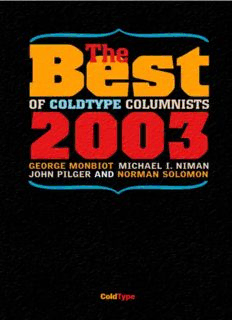
Best
The
OF COLDTYPE COLUMNISTS
2003
GEORGE MONBIOT, MICHAEL I. NIMAN
{JOHN PILGER AND NORMAN SOLOMON
Edited & designed by Tony Sutton
ColdType
WRITING WORTH READING FROM AROUND THE WORLD
wwwwww..ccoollddttyyppee..nneett
January 2004
ColdType columnists: left to right, from
top) George Monbiot, Michael I. Niman,
John Pilger and Norman Solomon
THE AUTHORS
Each month, ColdType reprints commentary and opinion from four of
the world’s top columnists: George Monbiot (LLoonnddoonn CCaalllliinngg) of the
London Guardian; Michael I. Niman ((GGeettttiinngg AA GGrriipp)), professor of
Journalism and Media Studies in the Communication Department at
Buffalo State College; John Pilger ((WWoorrddss AAggaaiinnsstt WWaarr)), who writes for
many newspapers and magazine including Britain’s New Statesman,
Daily Mirror and Independent; and Norman Solomon ((MMeeddiiaa BBeeaatt)),
executive director of the Institute for Public Accuracy, whose columns
appear in newspapers across North America.
This e-book contains one column from each month of 2003 from each of these
writers (10 from Niman), selected by ColdTypeeditor Tony Sutton. N.B. English
and American spellings reflect the origin of the articles.
You can read these columnists and much more at
hhttttpp::////wwwwww..ccoollddttyyppee..nneett
January
THE BEST OF COLDTYPE
GEORGE MONBIOT/ JANUARY 9
The time for
talking is over
T
HE REST OF EUROPE MUST BE WONDERING
whether Britain has gone into hibernation.At the end of
this month our Prime Minister is likely to announce the
decision he made months ago,that Britain will follow the
US into Iraq.If so,then two or three weeks later,the war
will begin.Unless the UN inspectors find something before January 27,
this will be a war without even the flimsiest of pretexts:an unprovoked
attack whose purpose is to enhance the wealth and power of an
American kleptocracy.Far from promoting peace,it could be the first in
a series of imperial wars.The gravest global crisis since the end of the
Cold War is three weeks away,and most of us seem to be asking why
someone else doesn’t do something about it.
It is not often that the people of these islands have an opportunity
to change the course of world events.Bush knows that the Americans’
approval of his war depends,in part,upon its credibility overseas:opin-
ion polls have shown that many of those who would support an inter-
national attack would withdraw that support if they perceived that the
US was acting alone.An international attack,in this case,means an
attack supported by Britain.If Blair pulled out,Bush could be forced to
think again.Blair will pull out only if he perceives that the political cost
of sticking with Bush is greater than the cost of deserting him.Bush’s
war, in other words, depends upon our indifference. As Gramsci
remarked,“what comes to pass does so not so much because a few
people want it to happen,as because the mass of citizens abdicate their
responsibility and let things be”.
There are several reasons why most British people do not seem pre-
pared to act. New military technology has removed the need for a
PAGE 2
JANUARY 2003
draft,so the otherwise unengaged young men who might have become
the core of the resistance movement are left to blast imaginary enemies
on their Gameboys.The economy is still growing,so underlying resent-
ment towards the government is muted;yet we perceive our jobs and
prospects to be insecure, so we are reluctant to expose ourselves to
trouble.
It also seems that many people who might have contested this war
simply can’t believe it’s happening.If,paradoxically,we were facing a
real threat from a real enemy, the debate would have seemed more
urgent. But if Blair had told us that we had to go to war to stop
Saruman of Isengard from sending his orcs against the good people of
Rohan,it would scarcely seem less plausible than the threat of Saddam
of Iraq dropping bombs on America.
These factors may explain our feebleness.They don’t excuse it.It is
true that our chances of stopping this war are slight:both men appear
determined to proceed, with or without evidence or cause. But to
imagine that protest is useless if it doesn’t lead to an immediate cessa-
tion is to misunderstand its purpose and power.Even if we cannot stop
the attack upon Iraq, we must ensure that it becomes so politically
costly that there will never be another like it.And this means that the
usual demos will no longer suffice.
There have, so far, been many well-organised and determined
protests, and several more are planned over the next six weeks. On
January 18,demonstrators will seek to blockade the armed forces’ joint
headquarters at Northwood, in North London. Three days later,
there’ll be a mass lobby of parliament;at 6pm on the day the war is
announced, protesters will gather in almost every town centre in
Britain.On February 15,there’ll be a massive rally in London.These
actions are critically important,as they’ll demonstrate the level of pub-
lic opposition.But they’re unlikely,by themselves,to provoke one of
Blair’s famous sweats.We must raise the temperature.
The Campaign for Nuclear Disarmament has already tried one bold
and unprecedented measure: seeking to persuade the courts to rule
PAGE 3
THE BEST OF COLDTYPE
that attacking Iraq without a new UN resolution would be illegal.But
on December 17th,the judges decided that they do not have the power
to interpret the existing resolution. It seems that we now have few
options but to launch a massive,though non-violent,campaign of dis-
ruption.
CND and the Stop the War Coalition have suggested an hour’s stop-
page on the day after the war begins.Many activists are now talking
about building on this,and seeking to provoke wider strike action,or
even a general strike.
This is,of course,difficult and dangerous.Some general strikes have
been effective,forcing the tsar to agree to a constitution and a legisla-
tive assembly in 1905,for example,reversing the Kapp Putsch in Berlin
in 1920,and overthrowing the Khuri regime in Lebanon in 1952.Others
have been counter-productive, in some cases disastrous. When the
French general strike was broken in 1920,the labour movement all but
collapsed.Mussolini used the announcement of a general strike in 1922
to represent himself as the only man capable of restoring order; he
seized power,with the king’s blessing,after the fascists had routed the
strikers and burnt down the Socialist Party headquarters.If we call for
a strike and almost everyone goes to work,Blair will see this as a sign
that he can do as he pleases.
But this is the scale on which we should be thinking.If we cannot
mobilise the workforce,there are still plenty of means of concentrating
politicians’ minds.We could,for example,consider blocking the roads
down which Blair and his key ministers must travel to meet their
appointments,disrupting the speeches they make and blockading the
most important public buildings.Hundreds of us are likely to be arrest-
ed,but that,as the Vietnam protesters found,serves only to generate
public interest. Non-violence, however, is critical: nothing did more
harm to the anti-war movement in the late 1960s than the Days of
Rage organised in Chicago by the Weathermen.
But peaceful,well-focused and widespread nuisance,even if it irri-
tates other members of the public,forces the issue to the front of peo-
PAGE 4
JANUARY 2003
ple’s minds,and ensures that no one can contemplate the war without
also contemplating the opposition to the war.We must oblige people
to recognise that something unprecedented in recent times is taking
place,that Bush,assisted by Blair’s moral slipstreaming,is seeking to
summon a war from a largely peaceful world.We will fail unless we
stage a political drama commensurate with the scale of the threat.
All this will,of course,be costly.But there comes a point at which
political commitment is meaningless unless you are prepared to act on
it.According to the latest opinion poll,some 42% of British people –
against the 38% who support it – want to stop this war. But if our
action is confined to shaking our heads at the television set,Blair might
as well have a universal mandate.Are you out there? Or are you wait-
ing for someone else to act on your behalf?
PAGE 5
THE BEST OF COLDTYPE
MICHAEL I. NIMAN/ JANUARY 9
What Bush would
rather you didn’t know
W
hen Iraq presented its weapons declaration to the
United Nations last month,the Bush administration
immediately attacked the report as being incom-
plete,hinting that producing a partial report might
be a justification to unleash upon that nation the
most lethal killing machine history has known.
The Bush folks were indeed telling the truth.The report distributed
by the United Nations was missing key pieces of information about
Iraq’s weapons programs.That’s because the United States removed
over 8,000 pages of information from the 11,800 page report, before
passing it on.
The missing pages incriminated 24 U.S.based corporations and the
successive Reagan and Bush-Daddy administrations in connection
with illegally supplying Saddam Hussein’s Iraqi government with myr-
iad weapons of mass destruction and the training to use them.
According to the report,Eastman Kodak (which seems not to have
fundamentally changed since collaborating with the Nazis in WWII),
Dupont, Honeywell, Rockwell, Sperry, Hewlett-Packard and Bechtel
were among the American companies aiding the Iraqi weapons pro-
gram leading up to the invasion of Kuwait.
The report also reiterated information previously documented by
Senator Byrd,and before that,reported in a host of Alternative news-
papers and magazines and radio shows around the world, detailing
how the U.S.Government directly supplied weapons of mass destruc-
tion to Saddam Hussein – weapons he then used against his own peo-
ple while the U.S.resupplied his arsenal.
PAGE 6
Description:renewed blitz of network talk shows. and then let the devil take the hindmost. The US urgently required a new approach, and it deployed two.