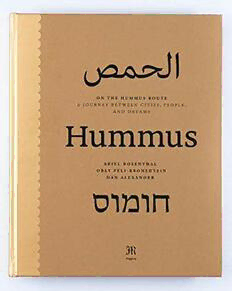
Table Of Contentصمحلا
Hummus
סומוח
صمحلا
ON THE HUMMUS ROUTE
A JOURNEY BETWEEN CITIES, PEOPLE,
AND DREAMS
Hummus
ARIEL ROSENTHAL
ORLY PELI-BRONSHTEIN
DAN ALEXANDER
סומוח
صمحلا Ariel Rosenthal
Hummus Orly Peli-Bronshtein
סומוח Dan Alexander
M A N Y T H A N K S TO O U R G LO B A L T E A M
O F C O N T R I B U TO R S F O R S H A R I N G T H E I R
LOV E O F H U M M U S
authors anonymous elia kahvedjian avi s. ravitzki
Ariel Rosenthal Photographer; Damascus Late founder of the Photo Elia photo shop Artist; Périgord
Orly Peli-Bronshtein and legendary photographer; Jerusalem
Dan Alexander mohammed asad claudia roden
Photographer; Gaza joudie kalla Food researcher, cultural anthropologist,
initiator and vision Chef, food consultant, and author; London and author; London
Ariel Rosenthal nof atamna-ismaeel
Chef, food festival director; Kafr Qara arin abu-hamid kurdi nimrod saunders
concept, chief editor, and design Chef and restaurateur; Acre Photographer; Givatayim
Dan Alexander
yosef baballah
Chef and restaurateur; Umm al-Fahm david loftus hind tahboub
recipes and culinary editor Photographer; London Chef; Paris
Orly Peli-Bronshtein
dr. on barak
Historian, lecturer, and author; Tel Aviv felix lupa sami tamimi
graphic design and art direction Photographer; Tel Aviv Chef, restaurateur, and author; London
Dan Alexander & Co.
felipe romero beltrán itzik luzon brandon tauszik
studio director Photographer; Bogotá Restaurateur; Jaffa Photographer and filmmaker; California
Maya Shitrit Shwartz
josh berer farouk mardam-bey mousa tawfiq
english translation Calligrapher and craftsman; Historian, food researcher, author, and Journalist and researcher; Paris and Gaza
Nomi Abeliovich Washington D.C. publisher; Paris
english text editor yaron brener karim mostafa
Gabriella Gershenson Photographer; Tel Aviv Photographer; Beirut
special thanks to charles constantine mohammad orfali
Karim Haidar, Hind Tahboub, Adeena Sussman, Photographer; Paris and Beirut Syrian chef, restaurateur, and culinary
Linda Mady, Iris Gelbart expert; Dubai
dr. yahya diwer, md
Doctor and photographer; Alexandria eilon paz
Photographer; New York
prof. liora gvion
Sociologist, lecturer, and author; Tel Aviv shai peri
Photographer; Kiryat Ono
magica
karim haidar
Chef, restaurateur, and founder of the anna-marie ravitzki
Academy of Arab Cuisine; Paris Philosopher, poet, and artist;
Périgord and Paris
Celebratory first edition, 2019
Printed in the Middle East
• Both the metric and USCS measurements are included in
© All rights reserved. No part of this publication may be reproduced, the recipes, for your onvenience. When following a recipe,
stored in a retrieval system, or transmitted in any form or by any we recommend working with one of these systems only.
means, electronic, mechanical, photocopying, or otherwise, without • All spoon measurements are level, unless stated otherwise.
the prior permission of the authors. A teaspoon is 5 millimeters and a tablespoon is 15 millimeters.
• For hummus dip or falafel, we recommend first referring to
www.hummusroute.com the step-by-step recipes on pages 178-9 and 184-5.
Hummus
TA B L E O F C O N T E N T S
JAFFA
MEMORIES FROM MY MOTHER’S KITCHEN by Joudie Kalla ........ 115
HUMMUS BIL SHATTA Hummus with Hot Peppers by Joudie Kalla ............ 117
MSABAHA Swimming Chickpeas. ............................................. 118
MESHULASH Triple Hummus à la Abu Hassan ................................. 120
SARDINE FALAFEL. .................................................... 122
A PALESTINIAN, A LEBANESE, AND AN ISRAELI WALK INTO WHITE FAVA BEAN HUMMUS by Itzik Luzon. .......................... 123
A BAR by Dan Alexander ....................................................... 13 PITA POCKETS ......................................................... 124
DEFINITION: CICER, THE ORIGIN OF CHICKPEA .............. 17 A BRIEF HISTORY OF HUMMUS by Orly Peli-Bronshtein. ............... 129
CHICKPEAS ACROSS THE GLOBE .................................... 19 THE TALE OF MULLAH NASREDDIN AND HIS COAT .......... 139
CAIRO TEL AVIV
THE WANDERING KITCHEN by Claudia Roden ........................... 33 HUMMUS AND ME – IT’S PERSONAL by Ariel Rosenthal ............. 167
THE ROLLING FALAFEL BALL by Dr. On Barak .......................... 43 COOKED CHICKPEAS FOR HUMMUS by Ariel Rosenthal .............. 176
TA’AMIYA Fava Bean Falafel by Claudia Roden. ................................... 48 COOKED CHICKPEAS FOR SALADS AND STEWS by Ariel Rosenthal 176
KOSHARY Chickpeas, Lentils, and Rice with Spicy Tomato Sauce . .................... 50 HUMMUS HAKOSEM by Ariel Rosenthal ................................... 178
FERAKH BEL HUMMUS Chicken and Chickpea Casserole by Claudia Roden ....... 52 HARISSA HAKOSEM by Ariel Rosenthal. ................................... 180
HALABESSA Tomato-Chickpea Soup. ........................................... 54 FRIED EGGPLANT HAKOSEM by Ariel Rosenthal. ....................... 182
DUKKAH CRACKERS. .................................................... 56 FALAFEL HAKOSEM by Ariel Rosenthal. ................................... 184
MOROCCAN FISH HAKOSEM by Ariel Rosenthal ........................ 186
RICE WITH CARAMELIZED ONIONS HAKOSEM by Ariel Rosenthal . 188
GAZ A PICKLED CARROTS AND CABBAGE by Ariel Rosenthal ................ 190
A POOR MAN’S KEBAB by Mousa Tawfiq ................................... 75
CHICKPEA TO COOK a Poem by Rumi. ..................................... 81 JERUSALEM
HUMMUS BI TAHINE Hummus with Tahini.................................. 82
ONION-STUFFED FALAFEL. ........................................... 84 CHICKPEAS OF THE GODS .......................................... 219
DILL FALAFEL. ........................................................... 86 MY CURIOSITY FOR FOOD by Sami Tamimi ............................ 221
CHICKPEA CONFIT. ..................................................... 87 THE SWEETEST CHICKPEA OF ALL Kdaameh. ...................... 223
KASHK SOUP WITH CHICKPEAS AND RICE. ....................... 89 TELL ME HOW YOU EAT YOUR HUMMUS, AND I WILL TELL
CHICKPEA AND VEAL CASSEROLE WITH SHATTA PEPPERS ... 90 YOU WHO YOU ARE by Prof. Liora Gvion. ................................. 225
MAFTOUL Palestinian Couscous. ............................................... 91 A HUMMUS NARRATIVE by Hind Tahboub. .............................. 231
ANGELS IN GAZA by Anna-Marie Ravitzki. ................................... 93 CHICKPEAS FOR THE FIRST-BORN. ............................... 233
Table of Contents Hummus
ARBES Salt-and-Pepper Chickpeas. ............................................. 237 BEIRUT
LABLABI Spicy Chickpeas. ................................................... 238
QEDREH KHALILIYEH The Hebronite Pot by Hind Tahboub ................. 239 HUMMUS WITHOUT BORDERS by Karim Haidar. ...................... 349
LAMB-STUFFED FALAFEL. ........................................... 240 CHICKPEAS CAN CHANGE THE WORLD. ......................... 353
BAJIA Yemenite Falafel. ...................................................... 242 HUMMUS WITH SQUID INK AND BOTTARGA by Karim Haidar ..... 354
ROASTED SQUASH WITH TAHINI YOGURT, FRIED CHICKPEAS, FATTET HUMMUS Crispy Pita Layered with Chickpeas, Yogurt, and Tahini ........ 355
AND GREEN CHILE SALSA by Sami Tamimi. ............................ 244 BEANS FIT FOR A KING. ............................................. 357
QUDSIYEH Hummus with Ful Medames and Chickpeas by Hind Tahboub. ........... 245 FATAYER Chickpea and Wild Spinach Pies. ..................................... 358
HAMIN SHPONDRA Overnight Short-Rib, Potato, and Chickpea Casserole. ....... 246 MAGHMOUR Vegetarian Moussaka. .......................................... 359
SHULBATA Bulgur Pilaf with Chickpeas ....................................... 360
BALILA Garlic-Cumin Chickpeas .............................................. 361
NAZ ARETH HUMMUS BEIRUTI. .................................................... 362
THE PREGNANT CHICKPEA ......................................... 269
THE JOY OF GROWING CHICKPEAS by Nof Atamna-Ismaeel. .......... 271 DAMASCUS
MIRACLE WATER Aquafaba .............................................. 275
FALAFEL B’AJIN Vegetarian Lahmajun. ..................................... 276 FRIED CHICKPEAS WITH BAHARAT. .............................. 376
FRESH ZA’ATAR FALAFEL. ........................................... 277 THE ONLY IMPORTANT QUESTION TO ASK by Farouk Mardam-Bey .. 383
WARM GALILEAN HUMMUS. ......................................... 279 HUMMUS HAS ITS MEMORIES by Mohammad Orfali. ................... 385
CHOPPED VEGETABLE SALAD ...................................... 280 A THOUSAND–YEAR–OLD HANGOVER CURE. ................... 389
TAHINI SAUCE ......................................................... 281 BURGHOL BI DFINE Chickpea, Bulgur, and Carrot Stew by Farouk Mardam-Bey ..... 390
BAQDONSIYA Green Tahini. ............................................... 281 HUMMUS BIL LAHMEH Hummus with Buttered Lamb by Mohammad Orfali ...... 391
FALAFEL SHAMI Green Falafel Patties with Baharat Spice ...................... 392
FRIED CHICKPEA SAMBUSAS ....................................... 393
ACRE YAKHNI Lamb and Chickpea Stew. ............................................ 394
MAHSHI SIYAMI Zucchini Stuffed with Rice and Chickpeas .................... 395
AN ANCIENT SHOPPING LIST. ..................................... 305 KIBBEH HEMO Stuffed Semolina Dumplings in Chickpea Soup .................. 396
THE HUMMUS HARVEST ............................................. 311 THE GOLDEN CHICKPEA ............................................ 401
HUMMUS ALAKAWI by Yosef Baballah ..................................... 312
FALAFEL ALAKAWI by Yosef Baballah. ..................................... 313
HUMMUS EL ABED by Arin Abu-Hamid Kurdi. .............................. 314
MAKHLUTA Hummus with Ful Medames, Chickpeas, and Olive Oil . ............... 316
SAJ PITA ................................................................. 318
MNAZZALEH Eggplant, Bell Pepper, and Chickpea Stew ......................... 319
Hummus
A PA L E S T I N I A N , A L E B A N E S E ,
A N D A N I S R A E L I WA L K I N TO A B A R
Dan Alexander
A Palestinian, a Lebanese, and an Israeli walk into a bar… this is not the
beginning of a joke; this is the story of how Ariel and I met Hind, a Palestinian
chef, and Karim, a French chef originally from Lebanon, in a Parisian bar that
is a renowned institution overlooking the Louvre Museum. We were excited and
tense, each of us burdened with a baggage of sorts mostly made up of prejudice.
It was a blind date between cultures and, as blind dates go, the initial chatter,
broken language, insecurities, and all other patterns of reality were but simple
attempts to break the ice between us, right there and then around our table at
39 rue de l'Amiral de Coligny, not far from the Mona Lisa and all that stands
for French elegance and restraint.
We waited for our second round of martinis. Suddenly, Ariel presented a
gift – a tub of tahini that he brought especially from Nazareth. In an instance
the restraint we may have felt, our wobbly words, and all of the alcohol fumes
around us simply evaporated into thin air in the very presence of this soulful
tub. Then, in a flash and without any warning, things heated up Middle Eastern
style with our tempers soaring up for the real battle: What is the right amount
of tahini for making hummus. Karim cried “Almost none!” Ariel jumped back
“In large amounts, always!” and words turned to shouts really quickly.
But the Mona Lisa fluttered her eyelids to remind us where we all were, so we
just burst out laughing, realizing that in this one blazing moment shared by us
passionate, happy people joined by one common identity, a real romance had
just sparked, because, in the end of it all, it is all about humanity. Since then we
have met many times, for precious moments of partners that travel on a utopian
journey, filled with friendships, recipes, and dreams.
This magical joint journey of ours follows the Hummus Route, an imaginary
route that I envisioned in my mind’s eye between places, people, and dreams,
across the hummus capitals of the Middle East, from Cairo all the way up to
13
Preface Hummus
Damascus, via Gaza, Jaffa, Tel Aviv, Jerusalem, Nazareth, Acre, and Beirut. It On our part, the blessing that this chickpea of pure gold has bestowed on us, is
is a road of revelation that runs in a landscape of yearning, sesame seeds, joy, the very privilege of enriching our lives with magical moments of gold, when our
pain, thoughts, tears, and laughter, orbiting around the rediscovery of one of hearts beat together as one. Within the folds of this book, we too have sprinkled
the world’s most ancient raw materials, which goes far beyond borders and into many golden grains to be discovered by each of our readers, hoping to enrich
the realms of diverse cultures in the history of mankind. their life with dreams and flavors forever.
With the story of the chickpea we can find the story of us all, from the tables of I wish the warmest thank you to Orly and Ariel, and all those travelers who
kings, sultans, secret alleyways in age-old marketplaces, and ancient manuscripts, shared this journey with us into a new future. Our eyes have been opened
to the food stalls of bustling streets and hushed high-end restaurants. On this as our hearts have embraced and recognized that in the end of it all, it is all
journey, we raised our heads from the pita pocket and the plate, to find ourselves about humanity.
eager to travel on this old-new road, between these cities, as we shared our
dreams, lots of hummus and falafel, and one bright new world for all, because
this appetite, the tastes, and these huge amounts of tahini culminate into the
unity of a virtue, the talking and listening of a dialogue, because in the end of
Dan Alexander is an international award-winning designer and thought leader, the founder
it all, it is all about humanity.
and creative director of Dan Alexander & Co., an innovation, design, and branding lab
headquartered in Paris. Dan collaborates with opinion leaders and creatives worldwide,
We also discovered that hummus is a culture in its own right, opening up a space to intercept technology, philosophy, and design. His publication Seafoodpedia won the
that constantly seeks an identity, and our journey uncovered glorious culinary prestigious Gourmand International Cookbook Award. He lives and works in Paris and in
the Périgord region in the South of France.
traditions of past and present. Hummus has reinvented itself over and over again,
always asking to be rediscovered, in every moment, anew. While the chickpea
retains its identity, it offers us a fresh and unfamiliar tradition of a whole new
social order.
For us, a definition of an identity was unveiled, which relies on the past but
faces the future with a big smile, because chickpeas dissolve any fixed concept by
telling us that hummus is made with love, or not made at all. And this river of
time flowing through our journey, has engulfed us into this space of a void, in an
infinite dialogue of flavors and the endeared closeness of friendships. Because, in
the end, it is all about humanity, and food can only bring hearts closer together.
In our wanderings, we came across one particularly beautiful legend. It tells of
a gold-hearted sultan who treated the entire village to a royal feast, once every
year. Among the countless beverages and dishes set before his guests, he served
a rice and lamb stew speckled with chickpeas. Inside this dish, the sultan would
hide one chickpea made of pure gold. The guest that found this lucky grain in
their serving was crowned the winner, and lavishly rewarded with riches and
treasures for life.
14 15
Hummus
D E F I N I T I O N :
C I C E R , T H E O R I G I N O F C H I C K P E A
c h i c k p e a
A somewhat spherical, irregular-shaped pea-like seed of a legume plant (pulse)
native to the Mediterranean region. It has a buff color, firm texture, and nutty
flavor. It is used in Mediterranean and Middle Eastern cuisines in soups, stews,
and salads, and can be roasted and eaten as a snack. Chickpea, or cicer in Latin, is
also known as cece (ceci in plural), garbanzo bean, and bengal gram. This ancient
pulse was domesticated 7,000 years ago, and is the basic ingredient for hummus
and falafel dishes.
Origin of the name: Early eighteenth century (earlier as chiche-pease), from late
Middle English chiche (from Old French chiche, cice, from Latin cicer).
h u m m u s
This word, also spelled humus, houmous, and houmus, is both Arabic and Hebrew
for chickpea. It is also the name of the thick Middle Eastern purée made of mashed
chickpeas, tahini (sesame paste), olive oil, garlic, lemon juice, and other spices, used
as a sandwich filling, spread, or dip.
g a r b a n z o
The origin of this name for chickpea, also called a garbanzo bean, is from mid-
eighteenth-century Spanish – originally from Basque garbantzu, meaning dry (gartau)
Cicer Sativum, also known as and seed (antzu), and garavance, from the edible plant calavance.
Cicer Arietinum, or chickpea.
c i c e r a r i e t i n u m
Hortus Romanus Juxta Systema
Tournefortianum Paulo Strictius
The chickpea plant species, of the pea family Fabaceae. Cicer was the classical Latin
Distributus, by Giorgio Bonelli
name for chickpea, and arietinum means ram’s head, in reference to the pea’s shape.
(1772-1793). The New York Public
Library, Digital Collections This Latin name is taken from the Cicero family’s common crop, and the cognomen
of the Roman statesman and orator Marcus Tullius Cicero, as recorded by Pliny.
Columella was the first author to use the word arietinum in reference to the seed.
Researchers claim the word cicer derives from the Semitic kikar, which means round.
17
Hummus
C H I C K P E A S AC RO S S T H E G LO B E
a m h a r i c h i n d i
ሽምብራ / Shimbra चना / Chana
a r a b i c i ta l i a n
صمحلا / Hummus, Hhimmass, Cece
Malana, Alhams
(Ancient Arabic: Hallaru, Himmis) j a pa n e s e
ヒヨコマメ / Hiyokomame
c h i n e s e
鹰嘴豆 / Ying Zui Dou, m a l ay
Ji Tou Dou Katjang Arab, Katjang Kuda
e n g l i s h p o r t u g u e s e
Bengal Gram, Chickpea, Grão, Grão de Bico, Gravanço
Garbanzo Bean
r u s s i a n
f r e n c h нут / Noot
Pois Chiche
s pa n i s h
g e r m a n Garbanzo
Kichererbse
s w e d i s h
h e b r e w Kikärt
סומוח / Hummus
(Ancient Hebrew: הצמח / Himtza) t u r k i s h
Nochut
19