Table Of ContentRadiological Protection
2010
www.nea.fr
O
ccupational Radiological
Protection Principles and Criteria for O
ccupational Radiological
Designing New Nuclear Power Plants
Protection Principles and Criteria
Global demand for electricity continues to grow and numerous new nuclear power
O for Designing New Nuclear Power
plants (NPPs) are being planned or constructed in NEA member countries. Most of cc
u
these new NPPs will be of the third generation, and will be designed for as long as p
a Plants
80 years of operation. The successful design, construction and operation of these tio
n
plants will depend broadly on appropriately implementing the lessons from experience a
accumulated to date. l R
a
d
io
This case study introduces a policy and technical framework that may be used lo
g
when formulating technical assistance and guidance for senior managers of NPPs, ic
a
designers, manufacturers, contractors and authorities responsible for regulating l P
r
occupational radiation exposure. It is aimed in particular at assisting design and license o
t
e
assessments of new NPPs. Although not targeting the needs of countries introducing c
t
nuclear power for the first time, this case study can also provide valuable input on io
n
occupational radiological protection issues for the implementation of new nuclear P
r
energy programmes. in
c
ip
le
s
a
n
d
C
r
it
e
r
ia
fo
r
D
e
s
ig
n
in
g
N
e
w
N
u
c
le
a
r
P
OECD Nuclear Energy Agency ISBN 978-92-64-99142-2 o
w
Le Seine Saint-Germain – 12, boulevard des Îles -:HSTCQE=^^VYWW: e
r
F-92130 Issy-les-Moulineaux, France P
Tel.: +33 (0)1 4524 1015 – Fax: +33 (0)1 4524 1110 la
n
E-mail: [email protected] – Internet: www.nea.fr ts N U C L E A R E N E R G Y A G E N C Y
Radiological Protection ISBN 978-92-64-99142-2
Occupational Radiological Protection
Principles and Criteria for Designing
New Nuclear Power Plants
© OECD 2010
NEA No. 6975
NUCLEAR ENERGY AGENCY
ORGANISATION FOR ECONOMIC CO-OPERATION AND DEVELOPMENT
ORGANISATION FOR ECONOMIC CO‐OPERATION AND DEVELOPMENT
The OECD is a unique forum where the governments of 33 democracies work together to address
the economic, social and environmental challenges of globalisation. The OECD is also at the forefront
of efforts to understand and to help governments respond to new developments and concerns, such as
corporate governance, the information economy and the challenges of an ageing population. The
Organisation provides a setting where governments can compare policy experiences, seek answers to
common problems, identify good practice and work to co-ordinate domestic and international policies.
The OECD member countries are: Australia, Austria, Belgium, Canada, Chile, the Czech Republic,
Denmark, Finland, France, Germany, Greece, Hungary, Iceland, Ireland, Israel, Italy, Japan, Korea,
Luxembourg, Mexico, the Netherlands, New Zealand, Norway, Poland, Portugal, the Slovak Republic,
Slovenia, Spain, Sweden, Switzerland, Turkey, the United Kingdom and the United States. The
European Commission takes part in the work of the OECD.
OECD Publishing disseminates widely the results of the Organisation’s statistics gathering and
research on economic, social and environmental issues, as well as the conventions, guidelines and
standards agreed by its members.
This work is published on the responsibility of the Secretary-General of the OECD.
The opinions expressed and arguments employed herein do not necessarily reflect the official views of the Organisation
or of the governments of its member countries.
NUCLEAR ENERGY AGENCY
The OECD Nuclear Energy Agency (NEA) was established on 1st February 1958 under the name of
the OEEC European Nuclear Energy Agency. It received its present designation on 20th April 1972, when
Japan became its first non-European full member. NEA membership today consists of 28 OECD
member countries: Australia, Austria, Belgium, Canada, the Czech Republic, Denmark, Finland, France,
Germany, Greece, Hungary, Iceland, Ireland, Italy, Japan, Korea, Luxembourg, Mexico, the Netherlands,
Norway, Portugal, the Slovak Republic, Spain, Sweden, Switzerland, Turkey, the United Kingdom and
the United States. The European Commission also takes part in the work of the Agency.
The mission of the NEA is:
– to assist its member countries in maintaining and further developing, through international
co-operation, the scientific, technological and legal bases required for a safe,
environmentally friendly and economical use of nuclear energy for peaceful purposes, as
well as
– to provide authoritative assessments and to forge common understandings on key issues, as
input to government decisions on nuclear energy policy and to broader OECD policy
analyses in areas such as energy and sustainable development.
Specific areas of competence of the NEA include safety and regulation of nuclear activities,
radioactive waste management, radiological protection, nuclear science, economic and technical
analyses of the nuclear fuel cycle, nuclear law and liability, and public information.
The NEA Data Bank provides nuclear data and computer program services for participating
countries. In these and related tasks, the NEA works in close collaboration with the International
Atomic Energy Agency in Vienna, with which it has a Co-operation Agreement, as well as with other
international organisations in the nuclear field.
Corrigenda to OECD publications may be found online at: www.oecd.org/publishing/corrigenda.
© OECD 2010
You can copy, download or print OECD content for your own use, and you can include excerpts from OECD publications,
databases and multimedia products in your own documents, presentations, blogs, websites and teaching materials,
provided that suitable acknowledgment of OECD as source and copyright owner is given. All requests for public or
commercial use and translation rights should be submitted to [email protected]. Requests for permission to photocopy
portions of this material for public or commercial use shall be addressed directly to the Copyright Clearance Center (CCC) at
[email protected] or the Centre français d'exploitation du droit de copie (CFC) [email protected].
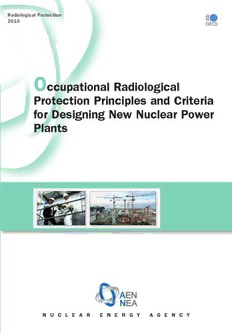
Cover photos: Maintenance (NEI, United States); Flamanville 3 (EDF Médiathèque, Alexis Morin, France).
FOREWORD
FOREWORD
The NEA has long been addressing the radiological protection of occupationally
exposed workers. For example, in 1992, the NEA launched the International
System on Occupational Exposure (ISOE) as a joint programme for technical
information exchange, with the objective to provide a forum for radiological
protection professionals from utilities and regulatory authorities to discuss and
co-ordinate international co-operative undertakings for the radiological
protection of nuclear power plant workers. This ongoing operational programme
has proved successful in helping radiological protection experts at utilities and
regulatory authorities to better manage occupational exposures at nuclear power
plants. However, in accordance with its statute as a relatively independent
technical exchange programme, ISOE does not address policy issues that might
be of relevance to its membership or that could benefit from members’
experience.
Given the interest of the NEA Committee on Radiation Protection and Public
Health (CRPPH) in such policy issues, it agreed in 2006 to create an ad hoc Expert
Group on Occupational Exposure (EGOE) to broadly explore policy and regulatory
issues that could be usefully addressed by the CRPPH across many sectors, with a
focus on the nuclear power industry, and to report back on possible follow-up.
Additionally, recognising the significant operational experience residing within
the ISOE programme and the potential benefits to both the CRPPH and ISOE of
collaborative discussions in the area of occupational radiological protection
policy, the NEA Secretariat was instructed to co-ordinate with the ISOE
programme on its possible involvement in the EGOE. The ISOE Steering Group
accepted the invitation to participate in the EGOE exercise.
The EGOE was tasked with identifying issues that could be usefully explored
by the CRPPH. Possible areas that were considered include:
• Policy issues in occupational radiological protection identified by the
Expert Group on the CRPPH Collective Opinion (for example, holistic
approaches to risk management, maintenance and promotion of
safety culture, issues related to decommissioning), or in the report of
the ISOE Working Group on Operational Radiological Protection.
• Current experience in stakeholder involvement in occupational
radiological protection, and its role in the management of
occupational exposures.
• Policy, regulatory and operational lessons that can be drawn from a
review of the regulatory assessment of “ALARA” (as low as reasonably
achievable) programmes.
OCCUPATIONAL RADIOLOGICAL PROTECTION PRINCIPLES AND CRITERIA
FOR DESIGNING NEW NUCLEAR POWER PLANTS – © OECD/NEA 2010 3
FOREWORD
• The application of dose constraints in regulations and the impact on
operational programmes.
• How the work of other CRPPH groups or initiatives contribute to the
regulation and protection of occupationally exposed workers, for
example in the areas of proposed International Commission on
Radiological Protection (ICRP) environmental protection guidance,
stakeholder involvement or best available technology.
• Issues concerning the implementation of the new ICRP recom-
mendations.
• How ISOE operational experience can support the review and
development of international guidance and advice for occupational
radiological protection, such as the International Basic Safety
Standards, or for new nuclear build.
• How the CRPPH can support the work under the International Action
Plan for Occupational Radiation Exposure in a complementary and co-
ordinated manner.
As a result of the EGOE’s initial investigations and discussions, three areas
were selected for the development of detailed case studies. The proposals,
which were presented to and approved by the CRPPH in 2007, were:
1. Occupational radiological protection principles and criteria for
designing new nuclear power plants (initial title: Criteria for new build).
2. ICRP implementation (working title: ICRP implementation – focus on
“dose constraints”).
3. Radiological protection policy and operational issues.
It was advised that these three case studies should be addressed in a step-
by-step approach to best manage the workload. Following this recommendation,
the Group prepared the present Case study No. 1, which was approved by the
CRPPH in 2009.
OCCUPATIONAL RADIOLOGICAL PROTECTION PRINCIPLES AND CRITERIA
4 FOR DESIGNING NEW NUCLEAR POWER PLANTS – © OECD/NEA 2010
TABLE OF CONTENTS
Table of contents
Foreword .................................................................................................................... 3
List of acronyms ........................................................................................................ 7
Executive summary .................................................................................................. 9
Introduction and scope ............................................................................................ 15
1. Occupational radiological protection principles at the design stage
of nuclear power plants ................................................................................... 21
1.1. International guidance ............................................................................. 21
1.2 Occupational radiological protection philosophy at the design stage 23
1.3 National guidance and role of regulatory authorities .......................... 24
1.4 Role of designers and operators .............................................................. 27
2. Lessons learnt, knowledge management, education and training ............ 29
2.1 Lessons learnt from feed-back experience analysis ............................ 29
2.2 Knowledge management ......................................................................... 37
2.3 Radiological protection education and training ................................... 38
3. Integrating occupational radiological protection criteria
during the design process ................................................................................ 41
3.1 Organisation to integrate occupational radiological protection
criteria in the design process .................................................................. 41
3.2 Occupational radiological protection criteria at the design stage ...... 45
3.3 Use of emerging technologies ................................................................. 51
3.4 Use of design standardisation: examples of existing approaches ..... 52
3.5 Occupational radiological protection considerations
in the design of the EPR. ........................................................................... 53
4. Evaluation and integration of occupational radiological protection cost
in the design process ........................................................................................ 55
4.1 Identification of investment cost related to
occupational radiological protection ...................................................... 55
4.2 Some life-cycle cost-benefit questions .................................................. 56
5. Conclusions ....................................................................................................... 61
References.................................................................................................................. 63
OCCUPATIONAL RADIOLOGICAL PROTECTION PRINCIPLES AND CRITERIA
FOR DESIGNING NEW NUCLEAR POWER PLANTS – © OECD/NEA 2010 5
TABLE OF CONTENTS
Appendices
1. ALARA design check-list .................................................................................. 65
2. ALARA engineering design principles ............................................................ 73
3. Application of ALARA to facility system design ........................................... 87
4. Application for construction and/or operating licenses
for nuclear power plants – design aspects related to ORP .......................... 101
5. Optimisation of occupational radiological protection in the design
of the new European pressurised reactor (EPR) ............................................ 105
6. CRPPH Expert Group on Occupational Exposure (EGOE) .............................. 109
List of figures
1a. Dose trend for own personnel in power generating NPPs in Europe:
Mean annual dose from 10 European countries ........................................... 34
1b. Dose trend for outside workers in Europe: Mean annual dose
from 10 European countries ............................................................................ 34
2. Average annual collective dose trends for all PWRs and
advanced PWRs ................................................................................................. 35
3. Average annual collective dose trends for BWRs ......................................... 35
4. Average annual collective doses per job in all 11 German PWRs and
in the 3 youngest KONVOI-PWR (averaged over 2001-2006) ....................... 36
OCCUPATIONAL RADIOLOGICAL PROTECTION PRINCIPLES AND CRITERIA
6 FOR DESIGNING NEW NUCLEAR POWER PLANTS – © OECD/NEA 2010
LIST OF ACRONYMS
List of acronyms
ABWR Advanced boiling water reactor
AGR Advanced gas cooled reactor
ALARA As low as reasonably achievable
ALARP As low as reasonably practicable
ANSI American National Standards Institute document
ARAN Asia Region ALARA Network
ASME American Society of Mechanical Engineers
BEG British Energy Group
BOP Balance of plant
BWR Boiling water reactor
CANDU Canadian light-water reactor
CETRAD Co-ordination Action on Education and Training in Radiological
protection and Radioactive Waste Management
CNS Convention on Nuclear Safety
CUW Reactor Water Clean-up Pump
DOE Department of Energy
DP Differential pressure
DPCs Ducts, Pipes, Cables, and Conduits
EAN European ALARA Network
EDF Électricité de France
ENETRAP European Network on Education and Training in Radiological
protection
EPR European Pressurised Reactor (sometimes called the Evolutionary
Power Reactor)
ESOREX European Study on Occupational Radiation Exposure
EUTERP European Platform on Training and Education in Radiological
protection
FSAR Final Safety Analysis Report
HEPA High-Efficiency Particulate Air
HVAC Heating, Ventilation and Air-conditioning
IAEA International Atomic Energy Agency
ICRP International Commission for Radiological Protection
IEC International Electrotechnical Commission
ILO International Labor Organization
IRM In-core radiation monitors
IRP International Radiological protection Association
ISOE Information System on Occupational Exposure
MSIV Main Steam Isolation Valve
NCRP National Council on Radiological protection and Measurement
NPP Nuclear Power Plant
OCCUPATIONAL RADIOLOGICAL PROTECTION PRINCIPLES AND CRITERIA
FOR DESIGNING NEW NUCLEAR POWER PLANTS – © OECD/NEA 2010 7
LIST OF ACRONYMS
NRC Nuclear Regulatory Commission
NSSS Nuclear Steam Supply System
OECD Organization for Economic Co-operation and Development
ORP Occupational Radiological protection
PWR Pressurized Water Reactor
RCA Radiation Control Area
RECAN Regional European and Central Asian ALARA Network
RHR Residual Heat Removal
RPM Radiological protection Manager
SRV Safety Relief Valve
SSC Structures, Systems and Components
TIP Transversing In-core Probes
TMI Three Mile Island
VVER Water-cooled Water-Moderated Power Reactor (Russian version of
the PWR)
WENRA Western European Nuclear Regulators’ Association
OCCUPATIONAL RADIOLOGICAL PROTECTION PRINCIPLES AND CRITERIA
8 FOR DESIGNING NEW NUCLEAR POWER PLANTS – © OECD/NEA 2010