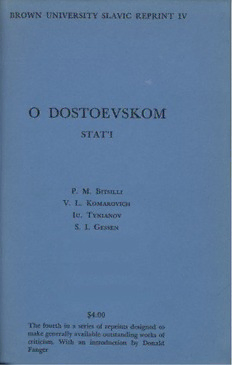
Table Of ContentBROWN UNIVERSITY SLAVIC REPRINT IV
O DOSTOEVSKOM
STAT’I
P. M. BlTSILLI
V. L. Komarovich
lu. Tynianov
S. I. Gessen
Introduction by Donald Fanger
/ «
Providence, Rhode Island
Brown University Press
1966
Copyright © 1966 by Brown University
All rights reserved
Library of Congress Catalog Card Number: 66-23779
CONTENTS
INTRODUCTION ѴІІ
BIBLIOGRAPHICAL NOTE ІХ
K VOPROSU O VNUTRENNEI FORME ROMANA
dostoevskogo P. M. Bitsilli 1
iunost’ dostoevskogo V. L. Komarovich 73
“mirovaia garmoniia” dostoevskogo
V. L. Komarovich 117
DOSTOEVSKII I GOGOL’: K TEORRI PARODII
Iu. Tynianov 151
TRAGEDIA DOBRA V “bRAT’IAKH KARAMAZOVYKH”
dostoevskogo S. I. Gessen 197
INTRODUCTION
This volume represents a new departure for the Brown University
Slavic Reprint Series, whose purpose remains to make generally
available, again or for the first time, some of the best works of Russian
criticism—works that too often are to be found only in a handful of
large libraries. Until now, this rescue operation has been confined
to critical monographs; but the gratifying spread of such reprinting
projects, here and in Europe, seems by now to promise that the great
majority of the most valuable books will gradually be restored to
currency. This heartening development, however, has so far left one
great field untouched. For if few libraries outside Russia can be
expected to contain all of the best books on a given writer, how much
truer this must be of uncollected critical articles. The library that has
Russkaia Mysl’ may not have Byloe; the library that has Sovremen-
nyia Zapiski may not have the Godishnik of Sofia University, or the
short-lived A tenei. And yet the student of any single writer or prob
lem is likely to find that he needs all of these or some similar spec
trum of sources very difficult of access.
It is to supply this need that the Slavic Reprint Series turns with
this issue to the reprinting of shorter works—essays and articles—on a
series of important writers and themes. The rationale for such a turn
—service to students and scholars of Russian literature—explains
why these collections may, on occasion, differ in composition from
comparable anthologies in English. Our chief criteria are excellence
and rarity; stringently applied, they tend to produce miscellanies
in the strictest sense. Articles, however excellent, will be ineligible
for inclusion if they are available in print elsewhere; topics, however
important, will go unrepresented if only work of less than the highest
quality is available to represent them—or if work of a higher quality
on some other topic is available to take precedence. In the case at
hand five studies illuminate five important aspects of Dostoevsky’s
work. The longest of them and the most general is Bitsilli’s brilliant
attempt to characterize what he calls the “inner form’’ of Dostoev
sky’s novels, to define, via the indices of language and structure, the
essential nature of the Dostoevskian novel. The approach, though
more disciplined, is not unlike Leontiev’s to Tolstoy; and a similar
sensitivity to fictional art combines with deep erudition to produce-
in the discussions of Dostoevsky’s lexicon, characterization, dramat-
icism, grotesquerie—a view that adjusts and synthesizes a number of
hitherto partial insights with striking originality.
Introduction
Vlll
Komarovich’s two pieces, by contrast, straddle biography and
creative work by treating the vexed problem of Dostoevsky’s early
enthusiasm for utopian socialism and its continuing reflection in
his work, long after the experience of Siberia had led him to re
nounce most of its basic assumptions. The first essay is unexcelled
in its re-creation of the atmosphere of the 1840’s in Russian utopian
circles; it shows concretely the nature of a faith only feebly suggested
by the usual summary phrases, and it throws a good deal of light in
passing on the question of Dostoevsky’s relations with Belinsky.
“Dostoevsky’s ‘Universal Harmony’ ’’ follows the fate of these ideas
as they are treated in the later works and contains, among much
else of value, perhaps the best discussion in Russian of the polemic
relation of Notes from Underground to Chernyshevsky’s novel What
Is To Be Done?
Tynianov’s classic study pursues a more strictly literary aim. In
vestigating Dostoevsky’s early use of Gogolian techniques, he comes
up not only with a definitive statement of the younger writer’s
relation to the then dominant influence in Russian literature but
a suggestive theory of parody as well, whose possible applications
to other such cases still remain to be explored. Finally, Gessen's
article on The Brothers Karamazov represents a metaphysical ap
proach that has come to seem out of date and—in view of its fre
quent abuse—rightly suspect. There would seem, nevertheless, to be
no possibility of interpreting any of the major works without con
fronting the philosophic questions with which they deal, and Ges
sen's meticulous analysis does this squarely and with rare success.
From these brief remarks it will be clear that, though the shape
of this collection has been dictated in part by factors that precede
editorial judgment, it is in at least equal part the product of an
editorial judgment that is, of necessity, highly personal and so
eminently disputable. Without seeking to minimize my responsibility
in this regard, I have sought to make its exercise as enlightened as
possible by consulting numerous colleagues in this country and in
England, and their generous advice is here gratefully acknowledged.
Donald Fanger
Stanford University
BIBLIOGRAPHICAL NOTE
The essays in this volume have been reproduced from the follow
ing sources:
Bitsilli, Petr Mikhailovich. “K voprosu o vnutrennei forme romana
Dostoevskogo.” Sofia Universitet. Istorikofilologicheski fakultet.
Godishnik, XLII (1945/46), 1-71.
Komarovich, Vasilii Leonidovich. “Iunost’ Dostoevskogo.” Byloe,
XXVIII (1924), 3-43.
-------. ” ‘Mirovaia garmoniia’ Dostoevskogo.” Atenei, I—II (1924),
112-42.
Tynianov, Iurii Nikolaevich. Dostoevskii i Gogol’: K teorii parodii.
(Petrograd) Izd. OPOIAZ, 1921. (Reprinted in his Arkhaisty i nova-
tory [Leningrad, 1929]).
Gessen, Sergei Iosifovich. “Tragediia dobra v Brat’iakh Karama-
zovykh Dostoevskogo.” Sovremennyia zapiski, XXV (1928), 308-38.