Table Of ContentMISCELLANEOUS NOTES
8 8 7 8 8 lid u i« i3 14 i& iH n ns is aio su ata 313 at«
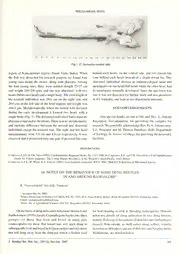
Fig.1: C. hemiodonventral side
region of Kanyakumari region (Tamil Nadu, India). When behind each head), on the ventral side, and two dorsal fins
the fish was dissected for research purpose we found four (one behind each head) instead of a single dorsal fin. This
young ones inside the uterus, along with placenta. Among abnormal individual showed an underdeveloped snout and
the four young ones, three were normal (length 25-27 cm mouthpartsononehead(lefthead) while theotherhead,had
and weight 150-200 gm), and one was abnormal, with two its mouthparts normally developed. Since the specimen was
heads(bifurcatedhead)andasinglebody.Thetotal lengthof rare it wasnot dissected forfurtherstudy and waspreserved
the teratoid individual was 20.6 cm on the right side and in 4% formalin, and kept in ourdepartment museum.
20.0 cm on the left side ofthe head regions and weight was
ACKNOWLEDGEMENTS
104.3 gm. Morphologically when the neural fold deviated
during the early development it formed two heads with a
singlebody (Fig. 1). The deformed individual hadaseparate Ourspecial thanks are due to Mr. and Mrs. L. Antony
placentaconnectedtotheuterus.Therewasnomorphometric Rayappan, Srivaikundam, for providing the samples for
and meristic difference between the normal and abnormal research.WegratefullyacknowledgeRev.Fr.A.Antonysamy,
individual except the teratoid trait. The right and left head S.J., Principal and M. Thomas Punithan, HoD, Department
measurements were 5.5 cm and 4.8 cm respectively. It was ofZoology,St.Xavier’sCollege,forprovidingthenecessary
observed that itpossessedonly one pairofpectoral fins (one facilities.
REFERENCES
Compagno,L.J.V.&V.H.Niem(1998):Carcharhinidae.RequiemSharks.Pp. 1312-1360.In:Carpenter,K.E.andV.H.Niem(Eds:):FAOIdentification
GuideforFisherypurposes. TheLivingMarine Resourcesofthe WesternCentral Pacific. FAO, Rome.
Compagno,L.J.V.,W. White& S. Fowler (2003): Carcharhinushemiodon.IUCN2004. 2004IUCNRed ListofThreatenedSpecies.
NOTES ON THE BEHAVIOUR OF SOME DUNG BEETLES
18.
AND AROUND BANGALORE
IN 1
K. Veenakumari2 and GK. Veeresh3
1AcceptedMay04,2005
2ProjectDirectorateofBiologicalControl,P.B.No. 2491.H.A.FarmHebbal,BellaryRoad.Bengaluru560024, Karnataka,India.
Email: [email protected]
3Unive sityofAgriculturalSciences,G.K.V.K. Bengaluru560065, Karnataka,India.
OnthebasisofdungutilizationbehaviourHeinrichand for both feeding as well as breeding (telecoprids). Hitherto
Bartholomew(1979)classifyCoprophagousbeetlesintothree unknown details of dung utilization in two dung buriers,
groups: (i) those that feed and breed in dung pats namelyHeliocoprisbucephalus(Fabricius)andOnthophagus
(endocoprids) (ii) those that tunnel into soil, pack dung to duporti Boucomont, as well astwo dung rollers, namely
subsequentlyfeedandbreedinit(paracoprids)and(iii)those Scarabaeus(Khepher)sanctus(Fabricius)andSisyphushirtus
that roll dung away from the dung pat which is further used Weidemann, are detailedbelow.
J. Bombay Nat. Hist. Soc., 104 (3), Sep-Dec 2007 361
MISCELLANEOUS NOTES
Table 1: Duration anddimensionsofthe immature stagesof Onthophagusduporti
Developmental time (days) Egg Larva Pupa Total
Allindividuals 3.48±0.48 12.59±1.23 4.36±1.48 20.48±1.65
n=20 n=15 n=15 n=9
Dimensions (mm) Egg stage 1 Egg stage II 1 instar III instar Pupa Cocoon Brood ball
Allindividuals* L-2.4±0.1 L-2.5±0 6.0±0.9 13.1±1.5 L-7.7±0.9 L-9.1±0.6 L-23.0±2.1
n=15 n=7 n=15 n=18 n=14 n=16 n=2
B-1 0±0 B-1.5±0 B-4.7±0.3 B-7.2±0.7 B-14.2±5.3
n=15 n=7 n=14 n=16 n=12
*L= Length, B = Breadth
Onthophagusduporti tothat in H. dilloni(Kingston and Coe 1977).The male was
Adultsarefoundthroughouttheyear.Theyarethemost found in the upper part ofthe tunnel while the female was
abundantScarabaeinae indung patsandarefound ingreater confined to the lower part of the tunnel. The tunnel was
numbers along the margins of dung pats and in the straightwithnodeviationsforadistanceof20cmafterwhich
rhizosphere. As many as 255 adults were found in a single itwasoblique,endinginachamber.Thebroodburrowswere
cow dung pat in November. deeper than the food burrows. Kingston and Coe (1977)
This species nests at depths of8-10 cm by fashioning worked on the nesting behaviourofH. dilloni in Kenyaand
several cylindrical brood masses in each of which a single suggestedthatthebroodchamber’sdepthvariedtoavoidboth
egg is laid. The eggs are cream to yellow, cylindrical and extremeclimaticconditionsaswellaspredators.Twotothree
fixedbythepointedendtotheeggcell.Theeggsincreasein adults of the kleptoparasite Onthophagus turbagus Walker
size and change to spheroids towards completion of the were found in halfa dozen brood balls. The different brood
incubationperiod(Table 1).Onhatching,thelarvaenotonly chamberparameters are mentioned in theTable 2.
resemble but also behave and nest in a manner identical to Whendisturbed,theadultsproducedaloud,screeching
O. gazella and O. rectecornutus (Veenakumari and Veeresh noise by rubbing their hind coxae against their abdomens.
1996). As Onthophagus is a very large genus similar Table2:Broodballandburrowdimensionsofsomedungbeetles
observations have been made on other species in the genus
(Horgan 2001; Hunteretal. 1996; Lee and Peng 1982). Scarabaeus Sisyphus Heliocopris
The durations taken for completing different sanctus hirtus bucephalus
developmental stages and measurements of these stages,
Diameterofdung 4.09±1.23 0.95±0.15 -
includingcocoon andbrood mass, are presented inTable 1. ball (cm) n=5 n=7
Heliocoprisbucephalus (Fabricius) Weight ofthefood 45.23±22.94 0.136±0.006 186.5±18.45
Both cow and elephant droppings attract adults of ball/mass (g) n=5 n=7 n=3
H. bucephalus. They make shallow food burrows and Dryweightofsoil 79.9 - 1014±36.32
excavated n=1 n=3
provision with less dung when compared to brood burrows (g)
whicharemuchdeeperandprovisionedwith largerquantities Time taken to bury 25 - -
ofdung(2,029g).Afterexcavatingdungpatsthebeetlesdig adung ball (minutes)n=1
andexcavatesoilwiththeirclypeusandforelegstoconstruct Depth of brood 16±1 - 90
foodandbroodburrows. Malesandfemalesdigindependent cell (cm) n=3
food burrows and provision them with food. Burrows from Weightofthe brood 105 - 2029
which food is exhausted are abandoned and fresh burrows ball/mass (g) n=1
constructed and provisioned with food. On the other hand Diameteroffood - - 4.9±0.22
brood burrows were constructed collectively by both males burrowentrance n=4
and females. A large amount of soil (1,014 g ± 36.32, n=3) (cm)
was alsoexcavatedwhileconstructing these broodburrows. Depth offood 28±12.88
Bisexualcooperationwasexhibitedbythesebeetles, similar burrow (cm) n=5
362 1 Bombay Nat. Hist. Soc., 104 (3), Sep-Dec 2007
MISCELLANEOUS NOTES
whichisprobablyananti-predatormechanism(Arrow 1931; S. catenatus not only help the female in rolling dung balls
Narendran andJoseph 1978). but also take an active part in nesting thus proving bisexual
cooperation. He labels this as ‘mate guarding’ to ward off
Scarabaeus Khepher sanctus (Fabricius) intrusion by conspecific males.
( )
Adults of S. (K.) sanctus emerged from the soil in
June-July with the first monsoon showers. Guided by Sisyphushirtus Weidemann
olfactionthey flew anddroppedashortdistancefromeither These beetles too emerged in July with the first
sheep or cow dung. Walking up to the dung with raised monsoon showers and were attractedto both sheep andcow
antennae each beetle cut out a circular mass ofdung using dung. The detached mass of dung was fashioned into a
its clypeus and forelegs, and fashioned a spheroid. Once spheroidbycompactionagainstthebody.Thedimensionsof
fashioned, theball wasrolledaway from the dungpat inthe the dung ball are mentioned in Table 2.
directionofthewindbypushing with the forelegswhile the Balls were rolled by beetles either singly or in pairs.
beetle walked behind the ball on its hind legs. In 1963, When a single beetle rolled aball, it pushed the ball with its
Matthews divided the whole process of ball making into hind legs while it stood on its fore legs in a head-stand
different phases, namely ‘cutting phase’, ‘shaping phase’, position. When rolling in pairs the female pushed with its
‘rollingphase’and ‘buryingphase’. Whilerolling,thebeetle hind legs from behind while the male stood on its hind legs
pausedrepeatedly toshapetheballandto inspect the soil to in front of the ball and pulled with its forelegs. The balls
findasuitablespotforburyingit.Havingdugdeepthebeetle wererolledonvariedterrainandovernumerousobstacles.A
emerged from the pit, pushed the ball in and disappeared pairofbeetles was noticed attempting to roll aball up a 700
beneath the ball to continue digging and slowly sank the slope. Thebeetlestumbleddowntheslopemanytimesalong
ball into the soil. In one instance it took 25 minutes for a withtheballbeforethey finallyabandoneditandflew away.
beetle to bury a brood ball and in the process 79.9 g ofsoil Rolling overobstacles has been observed in various species
wasexcavated.Thedimensionsofbroodballsarementioned (Fabre 1897; Hingston 1923; Halffter and Matthews 1966).
inTable2.Whenthesebeetlesweredisturbedtheyproduced Similarly, as observed by Puzanova-Malysheva (1956) in
a screeching noise. Scarabaeus sacer, S. hirtus too, at times, abandoned a ball
The presence of small soil mounds indicated the that it was rolling, flew back to the dung pat, fashioned a
presence of these beetles in the soil. On removing such larger ball and began rolling it in the same direction as the
mounds a hole marking the entrance to a tunnel was seen. ball it had abandoned.
Tracingthisrevealedmatingpairsofbeetlesalongwithdung After inspecting and rejecting a number of places, a
masses. In some instances, additional males were present placewouldfinallybeselectedandtheballburied.Whilethe
nearby indicating male competition for a mate. Males were female sat on the ball, guarding itthe male dug a pit with its
also noticed to fight each other forpossession ofdung balls fore tibiae and clypeus. The male then pushed the ball in,
rightfromball makingtorolling,whichcontinuedevenafter went below the ball and continueddigging till it completely
burying. This resulted in dung balls being abandoned near disappeared in the soil. The female thenentered the soil and
dungpats.Legs,elytraandotherbodypartslostinsuchbattles mated.
were found in the vicinity of these dung balls, which once The main purpose ofrolling the dung ball away from
abandoned were utilized by dipterans and by Onthophagus the pat might beto attract the opposite sex formating and to
ramosus(Weidemann). Similarcombats have been reported ensure adequate provisioning offood for the couple during
for Scarabaeus, Gymnopleurus and Sisyphus (Halffter and coitus. Rolling the ball away from the dung pat and burying
Matthews 1966). In 50 per cent of the instances observed it in the soil might reduce desiccation, and thus help in
individualsofOnthophagussp. werefound in thedungballs maintaining the proper consistency of dung. Heymons and
fashioned for food by S. sanclus, indicating intraspecific Lengerken(1929) inferthatrollingreducesmoisturecontent
competition forfood. andachievesproperconsistencyaspreferredbyScarabaeus.
Bisexual cooperation was observed in this species of It also reduces competition with dung buriers at the food
Scarabaeus also. Sato (1998) reported that the males of source (Halffterand Matthews 1966).
REFERENCES
Arrow, G.J. (1931): The FaunaofBritish IndiaincludingCeylon and Fabre,J.H.(1897):SouvenirsEntomologiquesVol.V.Paris.Translation
Burma, Coleoptera: Lamellicornia. Ill (Coprinae). Taylor and byde Mattos,AT. Lonson,296. pp
Francis,London,428 pp. Halffter, G. & E.G. Matthews (1966): The natural history of dung
J. Bombay Nat. Hist. Soc., 104 (3), Sep-Dec 2007 363
MISCELLANEOUS NOTES
beetles of the subfamily Scarabaeinae. Folia ent. Mex. 12-14: 243-263.
1-312. Lee, J.M. & Y.S. Peng (1982): Influence of manure availability and
Heinrich,B. &G.A. Bartholomew(1979): TheecologyoftheAfrican nestingdensityontheprogenysizeofOnthophagusgazella.Emir.
dungbeetles. Sclent.Amer. 241: 118-127. Ent. 11(1): 38-41.
*Heymons, R. & H. Lengerken (1929): Biologishe Untersuchungen Narendran,T.C.&K.J.Joseph(1978):Mechanismsofsoundproduction
on coprophagen Lamellicomein. I. Nahrungaerwerb and in Reliocoprisbucephalus(Coleoptera: Scarabaeinae). Entomon.
Fortpflanzungsbiologie der Gattung Scarabaeus Linnaeus. A. 3: 297-299.
Morh. Okol. Tiere. 14: 531-613. Puzanova-Malysheva, E.V. (1956): Povedenie zhuka Skarabeya -
Hingston, R.W.G. (1923): A Naturalist in Hindustan. H.F. and ScarabaeussacerL.(Coleoptera;Scarabaeidae).TrudyYses.Ent.
G.Witherby,London, 292pp. Obehch. 45: 51-71.
Horgan, F.G. (2001): Burial ofbovine dung by coprophagous beetles Sato, H. (1998): Maleparticipation innestbuildinginthedungbeetle
(Coleoptera: Scarabaeidae) from horse and cow grazing sites in Scarabaeus catenatus (Coleoptera: Scarabaeidae): mating effort
El Salvador. EuropeanJ. SoilBiol. 37(2): 103-111. versuspaternaleffort.J. InsectBehav. 11(6): 833-843.
Hunter, J.S., G.T. Fincher & D.C. Sheppard (1996): Observations on Veenakumari, K. & G.K. Veeresh (1996): Some aspects of the
the life history of Onthophagus depressus (Coleoptera: reproductive biology of Onthophagus gazella (F.) and
Scarabaeidae).J. Entmol. Sci. 31(1): 63-71. Onthophagus rectecornutus Lansb. (Coleoptera: Scarabaeidae).
Kingston, T.J. & M. Coe (1977): The biology ofa giant dung-beetle J. BombayNat. Hist. Soc. 93(2): 222-256.
(Heliocoprisdilloni) (Coleoptera: Scarabaeidae).J. Zool 181(2): *original notseen
19. PROTEIN PROFILE OF HAEMOLYMPH FROMAPIS SPECIES1
NeelimaR. Kumar2-3and LalitaNegi2-4
'AcceptedJune07, 2004
departmentofZoology, PunjabUniversity,Chandigarh 160014, India.
-’Email: [email protected]
4Email: [email protected]
Molecular or biochemical considerations are High hills workerbees ofApiscerana were collected
comparatively new tools in honeybee systematics. Though from Kinnaur, Himachal Pradesh (2,500 m above msl), and
thesehavebeenextensivelyusedinthecaseofApismellifera ofthe plains from the botanical garden, Punjab University,
m
(Mestriner 1969;MestrinerandContel 1972;Sylvester 1986; Chandigarh(320 above msl).Apismellifera workerswere
Leeetal. 1989; Sheppard and Berlocher 1989), notmuch is taken from the maintained apiary and Apis clorsata from
known about the molecular and biochemical systematic naturalnestingsitesfromthePunjabUniversitycampus.The
aspects of the Asian honeybee species. It is necessary to haemolymphofworkerhoneybeeswas sucked with an auto
integratemorphometric,biologicalandbehaviouraldatawith pipette,bypinchingoffbetweentwoadjacenttergitesofthe
molecular studies for valid identification of races or abdomen ofthe bee. It was then diluted with sample buffer
geographic ecotypes in case ofhoneybees. Keeping this in in the ratio of 1:1. Forprotein profiling, standard technique
view, studies on biochemical characterizations ofhoneybee ofSDS-PAGE (Laemmli 1970) was employed.
species and populations were carried out. Duringthepresentstudies,nineproteinfractionswere
Table 1: Proteinfractionsin haemolymphofApisspecies
Standard A. ceranaofhigh hills A. ceranaofplains A. mellifera A. dorsata
Sr. No. Mol. Wt. Rf. Values Mol. Wt. Rf. Values Mol. Wt. Rf. Values Mol. Wt. Rf. Values Mol. Wt. Rf. Values
(kD) (kD) (kD) (kD) (kD)
1. 480 0.2765 480 0.2765 4400 0.04255 210 0.36 250 0.34
2. 67 0.48 300 0.3101 3000 0.085 41.9 0.53 67 0.48
3. 45 0.51 96 0.4468 2000 0.1276 45 0.51 45 0.51
4. 24 0.5951 67 0.48 1650 0.1489 24 0.5951 24 0.5951
5. 18 0.6170 45 0.51 1050 0.17 - - - -
6. - - 29 0.57 400 0.29 - - - -
7. - - - - 67 0.48 - - - -
8. - - - - 45 0.51 - - - -
9. - - - - 41.9 0.53 - - - -
364 J. Bombay Nat. Hist. Soc., 104 (3), Sep-Dec 2007