Table Of ContentNew Perspectives on the History of
Gender and Empire
i
ii
New Perspectives on the History of
Gender and Empire
Comparative and Global Approaches
Edited by Ulrike Lindner and D ö rte Lerp
iii
BLOOMSBURY A CADEMIC
Bloomsbury Publishing Plc
50 Bedford Square, London, WC 1B 3 DP , UK
1385 Broadway, New York, NY 10018 , USA
BLOOMSBURY , BLOOMSBURY A CADEMIC and the Diana logo are trademarks
of Bloomsbury Publishing Plc
First published in Great Britain 2018
Copyright © Ulrike Lindner, D ö rte Lerp and Contributors, 2018
For legal purposes the Acknowledgements on p. xii constitute an extension of this
copyright page.
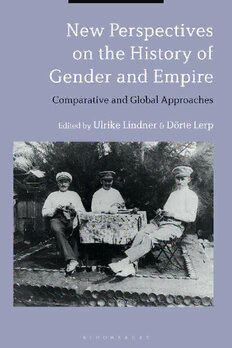
Cover image: Soldaten der Schutztruppe beim Stricken, 1910. (© bpk)
All rights reserved. No part of this publication may be reproduced or transmitted
in any form or by any means, electronic or mechanical, including photocopying,
recording, or any information storage or retrieval system, without prior permission
in writing from the publishers.
Bloomsbury Publishing Plc does not have any control over, or responsibility for, any
third- party websites referred to or in this book. All internet addresses given in this
book were correct at the time of going to press. The author and publisher regret
any inconvenience caused if addresses have changed or sites have ceased to
exist, but can accept no responsibility for any such changes.
A catalogue record for this book is available from the British Library.
A catalog record for this book is available from the Library of Congress.
ISBN : HB : 978-1-3500-5631-2
e PDF : 978-1-3500-5632-9
eBook: 978-1-3500-5633-6
Typeset by Refi neCatch Limited, Bungay, Suffolk
To fi nd out more about our authors and books visit www.bloomsbury.com
and sign up for our newsletters .
iv
Contents
List of Illustrations vii
List of Contributors viii
Acknowledgements xii
1 Introduction: Gendered Imperial Formations
Ulrike Lindner and D ö rte Lerp 1
Part I Regulating Marriages and Demarcating Empire
2 Mixed Marriages in the Fascist Aegean and the Domestic
Foundations of Imperial Sovereignty
Alexis Rappas 31
3 In the Forge of Empire: Legal Order, Colonists, and Marriage
in the Nineteenth- century Northern Black Sea Steppe
Julia Malitska 59
Part II Intimate Relationships and Imperial Encounters
4 Interpreting an Execution in German East Africa. Race, Gender,
and Memory
Bettina Brockmeyer 87
5 Colonial Self- positioning. Approaching the Snapshots of an
American Woman in the Philippines (1900–1902)
Silvan Niedermeier 115
6 Male Same-Sex Conduct and Masculinity in Colonial
German Southwest Africa
Jan Severin 149
v
vi Contents
Part III Indigenous Servants and Colonial Homes
7 Domestic Servant Debates and the Fault Lines of Empire
in Early Twentieth-Century South Africa and New Zealand
Elizabeth Dillenburg 179
8 Being at Home: Intersections of Race, Class, and Gender in
Settler Colonial Australia
Eva Bischoff 209
Part IV Education and Schooling
9 Women and Education Reform in Colonial India: Trans-
regional and Intersectional Perspectives
Jana Tschurenev 241
10 Missionary Encounters: Female Boarding Schools in
Nineteenth-Century Travancore
Divya Kannan 269
Index 295
Illustrations
1.1 German soldiers in Southwest Africa, ca. 1910. Courtesy bpk –
Bildagentur f ü r Kunst, Kultur und Geschichte. 1
3.1 Anna Catharina Neumeier and Johann Michael Becker’s marriage
certifi cate, Josephstal colony, issued by the pastor Carl Biller on
February 5, 1801. Courtesy State Archive of Odesa Oblast. 71
5.1 Eastman Kodak advertisement, 1901. Courtesy George Eastman
Museum. 123
5.2 Photo album of Mary Denison Th omas, Filipino boy, 1900.
Courtesy of the Department of Special Collections, Stanford
University Libraries. 129
5.3 Photo album of Mary Denison Th omas, Filipino boy, 1900.
Courtesy of the Department of Special Collections, Stanford
University Libraries. 130
5.4 Photo album of Mary Denison Th omas, Filipino girl, 1900.
Courtesy of the Department of Special Collections, Stanford
University Libraries. 131
5.5 Photo album of Mary Denison Th omas, Mary Denison
Th omas, 1900. Courtesy of the Department of Special
Collections, Stanford University Libraries. 135
5.6 Photo album of Mary Denison Th omas, Mary Denison Th omas
in a boat, 1900. Courtesy of the Department of Special
Collections, Stanford University Libraries. 137
5.7 Photo album of Mary Denison Th omas, Mary Denison Th omas
on a horse, 1900. Courtesy of the Department of Special
Collections, Stanford University Libraries. 138
5.8 Photo album of Mary Denison Th omas, Mary Denison Th omas
on a horse, 1900. Courtesy of the Department of Special
Collections, Stanford University Libraries. 139
vii
Contributors
Eva Bischoff teaches International History at Trier University. Her research
interests include colonial and imperial history, postcolonial theory, and gender/
queer studies. She received her PhD from the Ludwig-Maximilians University
in Munich. Her thesis was published as a monograph in 2011, entitled:
Kannibale-Werden. Eine postkoloniale Geschichte deutscher M än nlichkeit um
1900 (transcript). She recently concluded a book project investigating the
history of a group of Quaker families and their roles in the process of settler
imperialism in early nineteenth- century Australia.
Bettina Brockmeyer is a historian and currently postdoctoral fellow at
the Collaborative Research Center “Practices of Comparison” at Bielefeld
University. Her research interests include gender history, colonialism,
biographical writing, and history of medicine and the body. She is the author
of Selbstverst ä ndnisse. Dialoge ü ber K ö rper und Gemü t im frü hen 19. Jahrhundert
(2009). She co- edited the Journal InterDisciplines (2016) on “Race, Gender,
and Questions of Belonging.” In her current book project she is working on
colonial biographies in an entangled Tanzanian-German-British history.
Elizabeth Dillenburg is a doctoral candidate in history at the University of
Minnesota ( USA ). She received her BA and MA from Marquette University
(Wisconsin, USA ). She is completing her dissertation, entitled “Constructing
‘the Girlhood of Our Empire’: Education, Emigration, and Girls’ Imperial
Networks in Britain, South Africa, and New Zealand, c. 1880–1910.” Her
research focuses on gender, childhood history, migration, historical memory,
and sports history. Her publications include Th e Cricket Pitch as a Battlefi eld:
Th e Historical Roots and Contemporary Contexts of the 1960s Protests against
Apartheid Cricket (2012). She worked as the editorial assistant for Gender &
History from 2014–2016 and has been the assistant editor of the Austrian
History Yearbook since 2016.
viii
Contributors ix
Divya Kannan is currently Assistant Professor, Department of History, at
Miranda House, University of Delhi. Her research interests include histories of
education, childhood, gender, and colonialism, with a particular focus on
South India. She is currently involved in researching a history of popular
science education, schooling, and oral narratives in twentieth- century Kerala.
D ö rte Lerp is working as a postdoctoral scholar at the University of Cologne.
Her research focuses on German and European colonial history, global tourism
history, and postcolonial memorial culture. She is author of Imperiale
Grenzr ä ume. Bev ö lkerungspolitiken in Deutsch-S üd westafrika und den ös tlichen
Provinzen Preu ß ens 1884–1914 (2016) and published an article on the “Colonial
Gender Order” in the German Historical Museum’s catalogue G erman Colonial
History. Fragments Past and Present (2016) as well as a chapter on German
colonial women’s schools in Witzenhausen and Bad Weilbach (2009). She is
currently exploring the history of wildlife tourism in Eastern Africa in the
second half of the twentieth century.
Ulrike Lindner is Professor of Modern History at the University of Cologne.
Her research interests lie in imperial, colonial, and global history. She has
worked on the comparative history of European empires in Africa and has also
addressed postcolonial approaches, questions of colonial labor, and issues of
gender and colonialism. Her publications include K oloniale Begegnungen:
Gro ß britannien und Deutschland als Imperialm ä chte in Afrika 1880–1914
(2011), H ybrid Cultures, Nervous States. Germany and Great Britain in a (Post)
colonial World (co- edited with Maren Mö hring et al., 2010); Bonded Labour.
Global and Comparative Perspectives (18th–21st Century) (co- edited with
Sabine Damir-Geilsdorf et al., 2016); “Transcending Gender Roles, Crossing
Racial and Political Boundaries: Agnes Hill in German South West Africa,”
Journal of Imperial and Commonwealth History (2016).
Julia Malitska received her PhD in History from S ö dert ö rn University (Sweden)
in 2017. She is the author of the book N egotiating Imperial Rule: Colonists and
Marriage in the Nineteenth- century Black Sea Steppe (2017). Her current research
interests cover the history of medicine, animal welfare and consumption in
Eastern and Central Europe during nineteenth- twentieth centuries.