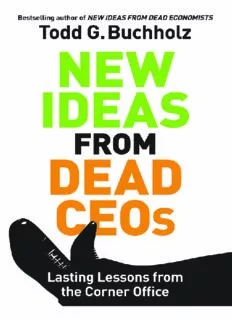
Table Of ContentNEW
IDEAS
FROM
DEAD
CEOs
Lasting Lessons from
the Corner Office
Todd Buchholz
To the millions of men and women who wake up to the
blare of an alarm, hug their children tight, and then go off
to make CEOs look good
Contents
Introduction: Late-Night Obsessions v
1 A. P. Giannini:
Bank of America—The Gladiator of Banking 1
2 Thomas Watson Sr. and Jr.:
IBM—A Tale of Two Watsons 27
2 1⁄2 Mary Kay Ash and Estée Lauder:
The Most Beautiful Balance Sheets 65
3 Mary Kay Ash:
The Billion Dollar Coffee Klatsch 69
4 Estée Lauder:
Even the Rich Like Freebies 85
5 David Sarnoff:
RCA—The Road to 30 Rock 103
6 Ray Kroc:
McDonald’s—King of the Road 139
7 Akio Morita:
iv CONTENTS
Sony—The Sound of the People 169
8 Walt Disney:
Disney—The Imagination Machine 205
9 Sam Walton:
Wal-Mart—A Penny Saved Is a Billion Earned 241
Conclusion: No Roads Ahead 267
Acknowledgments 269
Notes 271
Index 287
About the Author
Other Books by Todd BuchholZ
Credits
Cover
CoPyright
About the Publisher
Introduction
Late-Night Obsessions
I
t is midnight during a blistering August night in New York City, 1949:
Estée Lauder stands in front of a stove in a backroom kitchen with no
air-conditioning, scalding her hands while stirring, struggling to get a pot
of cream to congeal into a valuable cosmetic. A few blocks uptown,
Thomas Watson Jr. collapses onto his bed, only to be summoned by his
domineering father, who complains that the punch card machines are
jamming up, and customers are dumping IBM. In Princeton, New Jersey,
the prince of broadcasting, David Sarnoff, rolls up his sleeves and carries
midnight coffee to his RCA scientists, who are battling to beat CBS in
the race to create color television. In Tokyo, Akio Morita is crawling on
his hands and knees, brushing magnetized goo onto a tape, using the
bristles of a badger’s belly.All this in one night.All this brought us televi-
sion, DVDs, computers, and a youthful complexion.
Nobody accomplishes great things alone. Each year on the anniver-
sary of his father’s death, Thomas Watson Jr. would follow a ritual. He
would sit at home quietly, take stock of IBM’s latest accomplishments,
and say aloud,“That’s another year I’ve made it alone.” Not really. Thomas
Jr. was building on the obsession of his father. And we as consumers do
the same.
vi INTRODUCTION
These days it is common to hear about a rich businessman who be-
gan by “tinkering in his garage.” I do not believe it.The marketplace is
too fierce for tinkerers, too unforgiving for dilettantes.That businessman
either lied about the tinkering or is lying about his bank account.Tennes-
see Williams was wrong.We do not depend on the kindness of strangers.
We are free riders on the obsessions of others.
Today, our headlines blare about corporate theft, overcompensation,
and underperformance. Before CEOs were known for bullying and
cheating, they were known for pushing their companies to the pinnacle
through their intellect, creativity, and judgment. The CEOs featured in
this book were not candidates for sainthood. Many of them knew “God”
only as a prefix to “damn it.” But they were devoted to their businesses,
not just to their egos, personal bank accounts, and yachts.Amadeo P. Gi-
annini, who brought banking to the dockworkers in San Francisco and to
people across the world through the Bank of America, swore that he
would never become a millionaire. He once came perilously close and
immediately wrote a charitable check for $509,000.
Are you CEO material? First, a simple test. Then a more complex
test. If you had a newspaper route as a kid and turned it into a business by
hiring others to help, you might be a CEO inside. If you simply tossed
the papers from your Schwinn as a solitary chore and then ran off to
school, you’re probably a worker bee. Sam Walton made $4,000 a year
with his paper route—at a time when that could buy a brand-new
Schwinn and a couple of Cadillacs, too. Not that Sam would spring for a
shiny brand-name set of wheels.That is part of it, too.The great CEOs
understood that they were working for tomorrow. They often had to
scrimp. Mary Kay Ash saved the first dollar she made selling pots and
pans. Last year I visited Mary Kay’s office in Dallas, which is still preserved
like a pink room at Versailles. But the Renoir is a fake.Yes, Mary Kay
bought a gold-plated toilet seat, but she did so to motivate her future sales
executives, not to glorify her personal movements.
What is my more complex test for a great, visionary CEO? I have
concluded that the subjects of this book were united by falling into the
“upper tail” of three separate bell-curve distributions: First, passion or
drive. Second, talent.Third, luck.All three are necessary.The bankruptcy
courts are filled with brilliant, talented people who were just not willing
INTRODUCTION vii
to sweat past midnight or just not lucky enough to meet the right part-
ner. Likewise, I am sure there are fortunate, hard-driving people experi-
menting in their garages, but without a clue as to what they are doing.
There are no stupid people in this book—though if I someday decide to
write New Ideas from Dead Politicians, there may be room.
This book blends the lives and the business challenges of the featured
CEOs in order to expose their strengths and the circumstances they had
to overcome. Luck seems like an odd subject for a book about busi-
ness lessons. I am not talking about the good fortune of winning a Las
Vegas jackpot. I am discussing the circumstances, good and bad, that slap
us across the face or push us forward like the tailwinds on a cross-country
flight. In 1906, David Sarnoff strode into the lobby of a downtown office
building and knocked on the wrong door. Bad luck? The “right” door
might have led him to a career writing obituaries for the NewYork Herald.
By knocking on the “wrong” door, Sarnoff met Guglielmo Marconi and
led America into the age of radio and television.
We do not get to choose our parents, our century, or the legal system
we do business in. Six-year-old Amadeo Giannini watched a laborer
shoot his father to death at the family farm.Walt Disney wept as his first
cartoon success was ripped from his hands because of a contract he did
not understand. Nine-year-old David Sarnoff showed up on the docks
from Russia without knowing any English, after a childhood of utter iso-
lation.The CEOs here navigated a century marked by two world wars,
the Great Depression, and a globalized economy that shredded depend-
able business traditions.We will see how they coped and how they led.
In this book, I am not trying merely to summarize biographies. I have
chosen these CEOs by deploying several criteria. First, they had to be in-
novators, not just outstanding managers. It is better to make yourself obsolete
than to wait and let your competitors do it for you. These CEOs did not wait.
They pushed hard. Second, the CEOs had to be interesting to me. I am
sure there is a wonderful CEO who led the charge to turn dung into red
bricks, but we can leave him for a sequel. The CEOs discussed in this
book teach us about the forces that made the twentieth century so uplift-
ing in its technology and brutal in its politics.Thomas Watson Jr. piloted
military missions over dangerous skies. Mary Kay Ash figured out how to
empower women when most businesspeople imagined them only sitting
viii INTRODUCTION
at home, worrying how to rid their husband’s shirts of that stubborn
“ring around the collar.” Third, and most important, I chose to focus on
CEOs who teach us lessons that we can apply today, either as managers or
as investors, trying to figure out which companies may be worthy of our
portfolios.Therefore, you will encounter Dell, Krispy Kreme,AOL–Time
Warner, and Airbus, companies that emerged long after these CEOs had
passed from the scene. Ray Kroc from McDonald’s would have saved
Krispy Kreme from its meltdown. Sam Walton would have applauded
Carnival Cruise Lines.We will see why.
As you plunge forward, you may notice a social theme that also unites
these outstanding CEOs. They believed in progress, in a century that
would give more freedom and more choices to more people.They were
convinced that the huddled masses would indeed breathe free. They
would bet on the people. Giannini lent to those who looked torn and
tattered. J. P. Morgan would have sneered. Kroc contended that a work-
ing man could launch a successful franchise. Disney imagined a park
that would invite the lowliest laborer to spend time with his children.
Mary Kay insisted that working-class women could have skin as soft as
any Hollywood starlet’s. The CEOs in this book placed the right bet.
They bet on progress and that a rising tide would lift all boats. In this
book, the century literally starts on a boat, with David Sarnoff crushed
into steerage along with hundreds of desperate souls. By the end of the
century,Ted Arison from Carnival Cruise Lines built luxury cruise ships
to carry the children and grandchildren of those immigrants on tropical
vacations.
Of course, each of these CEOs failed at some point. Faced with bank-
ruptcy and defections, they could have succumb to psychological depres-
sion or the siren call of politicians offering class warfare.They each heard
nos, the tsk-tsks of friends, and a schadenfreude chorus scoffing at their
failure. But they pushed on, energized by passion, ego, money, and the
promise of glory.You cannot build a successful business or economy on
the kindness of strangers.These CEOs relied on more dependable, more
human drives. Drives that took them on fascinating rides.
Come find out.
Description:New Ideas from Dead CEOs uncovers the secrets of success of great CEOs by giving readers an intimate look at their professional and personal lives. Why did Ray Kroc's plan for McDonald's thrive when many burger joints failed? And how, decades later, did Krispy Kreme fail to heed Kroc's hard-won less