Table Of Content791.43
Ww4
1983-
REVUE DE THÉORIE DE L'IMAGE ET DU SON
A JOURNAL OF THEORY ON IMAGE AND SOUND
New Discourses of African Cinema
Nouveaux discours du cinéma africain
IRIS No. 18, Spring 1995
Iris est une revue de théorie de l'image et du son, bilingue francais-anglais, qui paraît
deux fois l'an. Depuis 1983, /ris consacre chaque numéro à un sujet particulier de la
théorie et de l'histoire du cinéma. ris depuis 1989 paraît au printemps aux Etats-Unis
et à l'automne en France.
Iris is a biannual publication that presents current scholarship in film theory and the
relation of image to sound. Begun in 1983, Jris devotes each issue to a different aspect
of film theory or history. Since 1989, the Spring issue is published in the United States
and the Fall issue in France.
Fondateurs/Founders: Jacques Aumont, Jean-Paul Simon, Marc Vernet.
Comité de direction/Editors: Dominique Bliiher, Claire Dupré la Tour, Anne Goliot-
Lété, Margrit Trôhler (France), Rick Altman, Dudley Andrew, Lauren Rabinovitz
(USA)
Comité de rédaction/Editorial Board: Jacques Aumont (Université de Paris ID),
Raymond Bellour (CNRS), Janet Bergstrom (UCLA), Francesco Casetti (Universita di
Trento), Donald Crafton (University of Wisconsin at Madison), André Gaudreault
(Université de Montréal), Miriam Hansen (University of Chicago), Susan Hayward
(Birmingham University), Frank Kessler (Katholieke Universiteit Nijmegen),
Christian Metz} (EHESS), Dana Polan (University of Pittsburgh), David N. Rodowick
(University of Rochester), Jean-Paul Simon, Maureen Turim (University of Florida),
Marc Vernet (Délégué Général de la Bibliothèque de l'Image).
iris (France):
iris (USA):
Institute for Cinema and Culture 41 Avenue Gambetta
162 Communication Studies Bldg. 75020 Paris
University of Iowa France
Iowa City, IA 52242
e-mail: iris @uiowa.edu
World Wide Web: Attp://www.arcade.uiowa.edu/film/
no —
Secrétaire de rédaction/Editorial Associates: Scott Benjamin (Iowa City).
À PARAITRE / FORTHCOMING (1995-6):
- Cinéma, souvenir, film / Memory in Cinema and Films
- On the Notion of Genre in the Cinema / Sur la notion de genre au cinéma
- European Precursors of Film Noir / Précurseurs européens du film noir
- Le bonimenteur au cinéma / The Lecturer in Cinema
©IRIS
Directeur de la Publication (France) : Jean-Paul Simon
Printed by the University of lowa Printing Department, Coralville, IA
ISSN: 0751-7033
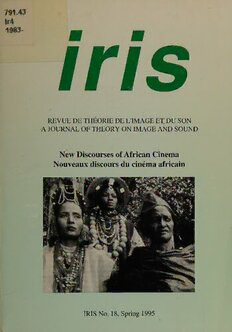
Cover: Hyénes (Hyenas, Senegal, 1992)
RE Nien! Pe ag ol
Ing
laa —
SOMMAIRE/TABLE OF CONTENTS IRIS N° 18
NEW DISCOURSES OF AFRICAN CINEMA
NOUVEAUX DISCOURS DU CINEMA AFRICAIN
Introduction
DENSA Ee TE Bec RO RE A ae PaCS A 3
Articles
Brian Goldfarb
A Pedagogical Cinema: Development Theory, Colonialism,
Ben sta ELi neration African Fini. in reine 7
Jude Akudinobi
Tradition/Modernity and the Discourse of African Cinema .........:cscsseeseeseereees 25
Michel Serceau
Le cinéma d’ Afrique noire francophone face au
modèle occidental : la rançon du refus .............ccssesceteseeeseeeees teen mnt 39
Bruno Tackels
COTE WC TAS Od RS OR RS LA it TERRE ST, ARC SOS EE 47
Keyan Tomaselli and Maureen Eke
mecondary Orality in South African Film... steve 61
Onookome Okome
Cinema and Social Change in Nigeria: the Political Imperative 71
N. Frank Ukadike
The Other Voices of Documentary: Allah Tantou and
Afrique, je te plumerai "ss... 81
Richard Porton
Hyenas: Between Anti-Colonialism and the Critique of Modernity 95
LR. Rayfield
Hyènes : comment trouver le message? ........sssesereeseeesseesseesstseseseneeeesenenenens 105
Dudley Andrew
Falaises sacrées et espaces COMMUNS 113
Philip Gentile
In the Midst of Secrets: Souleymane Cissé's Yeelen 125
Sheila Petty
Miseria: Towards an African Feminist Framework of Analysis ............::000+ 137
Ken Harrow
Camp de Thiaroye: Who’s That Hiding in Those Tanks, and
How Come We Can’t See Their Faces? .............sssceccsssssessssssscssseneesesessevsesseonees 147
Comptes-rendus / Book reviews
Eric Porter, Sheila Petty, Lee Freeman, Frank Kessler,
Scott Curtis, N. Frank Ukadike ss... 153
N. Frank Ukadike
New Discourses of African Cinema?
Nouveaux discours du cinéma africain ?
Why study African cinema? Why is it necessary now? Who should champion the
explication of the film images of Africa for a balanced assessment of the way things are,
offer a lucid [reinterpretation of the media images of this most misrepresented
continent in the world? What is it that needs to be addressed concerning the ongoing
debate about the adequacy of current critical methodologies for dealing with what
cinema has become in Africa?
Since my attendance at the Society for Cinema Studies conference held in Toronto,
Ontario, February 11-14, 1993, these questions reverberated in my mind. Usually in
such an intellectual forum, young scholars are eager to meet with colleagues and big
names in the field, and having the opportunity to be introduced to senior colleagues and
the “big wigs” of the profession can be rather intriguing. However, my experience was
not quite so. It happened that a Canadian friend at the conference introduced me, as the
author of a forthcoming book, Black African Cinema, to one of America’s foremost
scholars, a “big wig” in the field. This scholar gave me a chilling response when he
asked, “After Manthia Diawara’s book (out only a few months) is there anything else
to be written or said about African cinema?” My Canadian friend, herself working on
two books on African cinema and television, was astounded. I left with the dilemma of
how best to perform the herculean task of speaking on the African experience — how to
dispel these outmoded and untenable myths which permeate the interpretation of
African history, culture, and now, cinema — of how Africa is seen as a cinematographic
desert, a filmic cul-de-sac.
The Toronto conference also showed that not everyone is as naive about Africa as
the learned intellectual enveloped in his ethnocentric vision of the world, an enclave
analogous to baseball’s “World Series” where only one nation is that world. Two other
occurrences manifested themselves as visages of African progressivism.
While working on this issue of iris specifically, I became aware of other journals in
the U.S. devoting space to African cinema. My book, Black African Cinema (University
of California Press, 1994) is now published. At the recently concluded Pan-African
Festival of Film and Television of Ouagadougou, the world’s largest film festival (yes,
N. Frank Ukadike, (1995), “Introduction,” iris, pp. 3-6.
in Africa), which opened with pomp and pageantry, a superb anthology, Africa and the
Centenary of Cinema, was launched. These developments attest to victory for the
continent and its cinema. Perhaps the most amazing thing that has happened in this
dissemination of knowledge about the burgeoning African cinema is that the learned
professor who derided African film practice is now himself writing and publishing
articles on African cinema. We now begin to wonder why the wall tumbled! Even the
baseball World Series has added a new country to its world (Canada now competes with
the U.S. in the series), gradually moving from the center to the margins, from seclusion
to integration.
What has all this preamble to do with development, understanding, and analysis of
African cinema? Certainly we are led to think about what the articles in this issue force
us to reflect upon: the larger question of whether African cinematic discourse is at a
crossroads. African cinema does not aspire to colonize other nations’ cinemas, and it is
high time it attained the recognition it deserves. Similarly, African cinematic discourse
should not be merely appended to dominant cinematic discourse. As academic interest
in African cinema grows, so too should the impetus to abhor the tyranny of the canon,
to destroy the illusory ideology that ostracizes “oppositional” forms from dominant
forms of representation, by which all aesthetic criteria and production strategies are
unfortunately measured and evaluated.
One of the major themes to emerge from the viewpoints expressed by the contribu-
tors to this special issue is the relationship of African cinematic discourse to questions
of dominant modes of representation and scholarship. As scholars, we are all committed
to diversifying the field, in particular to moving African cinematic discourse from the
margins to the center. Would it not be beneficial to think of ways to repostulate the
otherwise sterile scholarship and theoretical frameworks that have impeded understand-
ing of film works as pluralistic cultural art that demands a reassessment of critical
canons and approaches to African historiography? It is in this direction that iris tries to
introduce perspectives on not only the core information about the history and production
of culture, but also on the dynamics of criticism and theory contexts in order to facilitate
the understanding of African films as multicultural and pluralistic aesthetic phenomena
working in social contexts.
If conventional ideologies that ghettoize alternative practices persist, it is due to the
lack of adequate critical exposure needed to inform academic discourse. To bridge the
gap, one would have argued that incisive works conceived from an African-centered
rather than an Euro-American-centered focus should have been the mainstay of this
critical inquiry, but that would imply new forms of hegemony, a retrenchment to the
tyranny of a (new) canon. The selection of the articles published here, therefore, does
not symbolize a monolithic dialogue, but does signify a monolithic tendency — a
tendency which argues for the broadening of investigations. Some of the authors write
as African insiders, while others write from Africanist and Western perspectives. From
this mix of stances the unique synthesis of the African film image stands to raise
complex ideological and analytical questions that emerging discourses are beginning to
address.
One way or another, the thoughts expressed here exemplify an interdisciplinary
investigation of African cinema as an aesthetic force which challenges traditional
cinematic paradigms. As an examination of the variety of cultural productions in Africa,
this issue also tries to account for the hybrid nature of films, combining what is
occasionally direct political commentary with subtle, indirect work on cultural and
cinematic codes.
I hope this special issue of iris will widen the perimeters of the African cinematic
discourse, moving that discourse from the margins to the center, not just de-marginalizing
its status. I would like to thank the editors and staff of iris for making this issue possible.
Many thanks also go to all of the writers who contributed to the discourse. For your
indefatigable endeavors, I say, A Luta Continua.
N. Frank Ukadike
Pourquoi étudier le cinéma africain ? Pourquoi le faire maintenant ? Qui doit
expliquer les images du cinéma africain ? Qui doit réinterpréter les médias de ce
continent mal représenté ? Que faut-il dire sur les méthodologies critiques qui convien-
nent à l’analyse du cinéma africain ?
Depuis le colloque de la Society for Cinema Studies à Toronto en février 1993 ces
questions n’ont cessé de me tracasser. Normalement, dans ce type de réunion les jeunes
sont contents de rencontrer les grands noms du métier. Et pourtant. Pendant le colloque
une amie canadienne m’a présenté, en tant que jeune auteur d’un livre à paraître sur le
cinéma africain, à un des véritables gros bonnets du domaine. Ce professeur estimable
m'a lancé une réponse glaçante : «Après le livre de Manthia Diawara [qui venait de
paraître] que peut-il rester à dire sur le cinéma africain ?» Mon amie canadienne, ayant
deux manuscrits en cours sur le cinéma africain et la télévision africaine, est restée
étonnée. Je suis reparti avec le projet de dissiper cette nouvelle version du vieux mythe
selon lequel l’Afrique serait un désert, un cul- de-sac, cette fois-ci filmique.
Les articles de ce numéro d’iris nous invitent à considérer une question importante
: le discours cinématographique africain se trouve-t-il à un tournant de son histoire ?
Puisqu’il n’a jamais cherché à coloniser le cinéma d’autres pays, le cinéma africain n’a
pas toujours attiré toute l’attention qu’il mérite. Mais peut-être gagne-t-il ainsi sa propre
voix oppositionnelle. Ces articles reviennent sans cesse au problème de la différence qui
existe entre le discours cinématographique africain et les traditions occidentales qui
dominent I’ analyse du cinéma et de ses oeuvres. Ce numéro cherche donc à introduire
de nouvelles perspectives non seulement sur les données nécessaires à toute analyse et
a toute histoire, mais aussi sur la dynamique de la critique et de la théorie, facilitant la
compréhension des films africains en tant que phénomènes esthétiques — multiculturels
et pluriels — dans leurs contextes sociaux.
Offrant des points de vue tant africains qu’occidentaux, les articles ici présents
évitent à la fois le monologique et le monolithique, en faveur du dialogue et de la
dialectique. C’est à partir d’un tel mélange que l’unique synthèse de l’image filmique
africaine peut provoquer de nouveaux discours sur le terrain fertile des complexités
idéologiques et analytiques.
Chacune à sa façon, les pensées exprimées ici exemplifient une investigation
interdisciplinaire du cinéma africain comme force esthétique, exploitant ainsi la façon
dont ce cinéma a su mettre en cause les structures cinématographiques traditionnelles.
En tant que mise en question de la production culturelle africaine, ce numéro cherche
aussi à expliquer la nature hybride de ces films. On comprend à quel point l’analyse de
ces films dépend d’une compréhension plus large de la nature composite du cinéma
africain, qui marie commentaire politique direct avec le travail indirect des codes
culturels et cinématographiques.
J'espère que ce numéro spécial d’iris servira non seulement à élargir le champ du
discours cinématographique africain, mais à déplacer ce discours des marges jusqu’au
centre.
Je voudrais remercier la revue iris et sa rédaction, qui ont rendu possible ce numéro,
et tous les auteurs qui ont contribué à cette tentative d’établir un nouveau discours. Pour
vos travaux infatigables, je vous dis : A Luta Continua.
N. Frank Ukadike
Brian Goldfarb
A Pedagogical Cinema:
Development Theory, Colonialism and
Post-Liberation African Film
In his successful career as a novelist and in his earliest films, Ousmane Sembéne
worked most often in the language and cultural conventions he was taught by the French
colonial educational system in Senegal. Sembéne recalls that using the colonial tongue
seemed appropriate at the time: French “was a fact of life.” However, when he began
to show his films in Senegal, peasant audiences criticized his language choice,
identifying it as emblematic of an internalized Eurocentrism. “The peasants were quick
to point out to me that Iw as the one who was alienated,” he explains. “They would have
preferred the film in their own language, without the French.”
Sembéne’s story is at bottom about relations of pedagogical authority. It illustrates
the broader struggle around language, colonialism and pedagogy that has marked
African cinema since its inception. Like Jean Rouch, the French anthropologist and
documentary filmmaker who taught many now well-known African filmmakers during
the years of liberation, Sembéne viewed film as a pedagogically useful medium.
However, Sembéne and other post-liberation directors radically reconceived the didac-
tic role of the cinema. Films could teach the western audiences about the damaging
effects of colonialism; moreover, they could demonstrate to Africans strategies of
political resistance against imperialism. As Frangoise Pfaff explains, Sembéne turned
from writing to film precisely because he saw the latter as a more viable medium for
reaching audiences in Africa across divergent language groups and among nonliterate
people.” But Sembéne’s anecdote also suggests that the cinema served another, perhaps
more important, political function. An institution historically and currently reliant on
western industry and conventions, the cinema had become in post-liberation Africa a
critical site of contestation over language and pedagogical authority. To understand
Sembéne’s own pedagogical strategy in telling the anecdote related above, it is
important to note that cinematic pedagogy and linguistic imperialism were not new
issues for him during the period in question. Even before this exchange with a peasant
audience, he had produced a film that raised exactly those questions of language and
authority posed by his critics. The narrative of his film La Noire de... (Black Girl, 1966)
centers precisely on the linguistic and cultural isolation of the film’s displaced
Brian Goldfarb, (1995), “A Pedagogical Cinema: Development Theory,
Colonialism and Post-Liberation African Film,” iris, 18, pp. 7-24.
8 Brian Goldfarb
Senegalese protagonist, representing in French voice-over her interior monologue
(though we know that she cannot speak French well) while portraying her isolating
experience as a maid in a French household. The film can be seen as a pedagogical
vehicle through which the filmmaker teaches his audience about the profoundly
debasing effects of colonial servitude combined with enforced isolation from one’s own
country, language and culture. But Sembéne’s anecdote also tacitly demonstrates how
the audience can itself play the role of pedagogue, teaching the filmmaker a lesson about
cultural imperialism. Sembéne’s story suggests that, though film was introduced to
Africa by the West as a means of “educating” African colonial subjects to assimilate,
and though it was appropriated for counter-colonial political “education” in anti-
assimilation and the retention of cultural forms, it has become a critical site of a more
complex contestation over agency, authority and pedagogical form in post-liberation
colonialism.
If in Africa a pedagogical tradition of cinema is in part artifactual of overt colonial
disciplinary practices (practices by which the cinema “taught” language and values),
then this same tradition has become an important means of intervention in the current
dismantling and reconfiguration of colonialist cultural forms. Confronting western
theories of Third World development that were closely bound to western theories of
pedagogy and child development, indigenous filmmaking in Africa has appropriated
and transformed these same developmental and pedagogical theories. Many of the post-
liberation films of the seventies and eighties produced by African filmmakers engage
the colonial legacy of filmic didacticism, critiquing and dismantling it through textual
allegory, while also appropriating and subverting its conventions in local struggles and
broader oppositional and cultural politics.
Colonial development and development theory
Paternalistic programs of education and development in colonial and post-liberation
Africa drew on social science theories that derived not only from fields devoted to the
study of “other” cultures (anthropology), but also from apparently unrelated fields,
specifically child psychology — a field that takes as its object the western child. Overt
links forged between anthropology and pedagogical theory, and between the colonial
subject and the western child, indicate that the terms “‘paternalism” and “infantilization”
were not simply convenient analogies for colonialist techniques of social management,
but were institutionalized methods in emergent paradigms of western pedagogy during
precisely the same period. These methods were employed both inside and beyond
educational settings such as schools. Not coincidentally, visual representation figures
centrally in both anthropological developmental theories and theories of child develop-
ment. Pedagogical theories of visual representation informed a broadly conceived,