
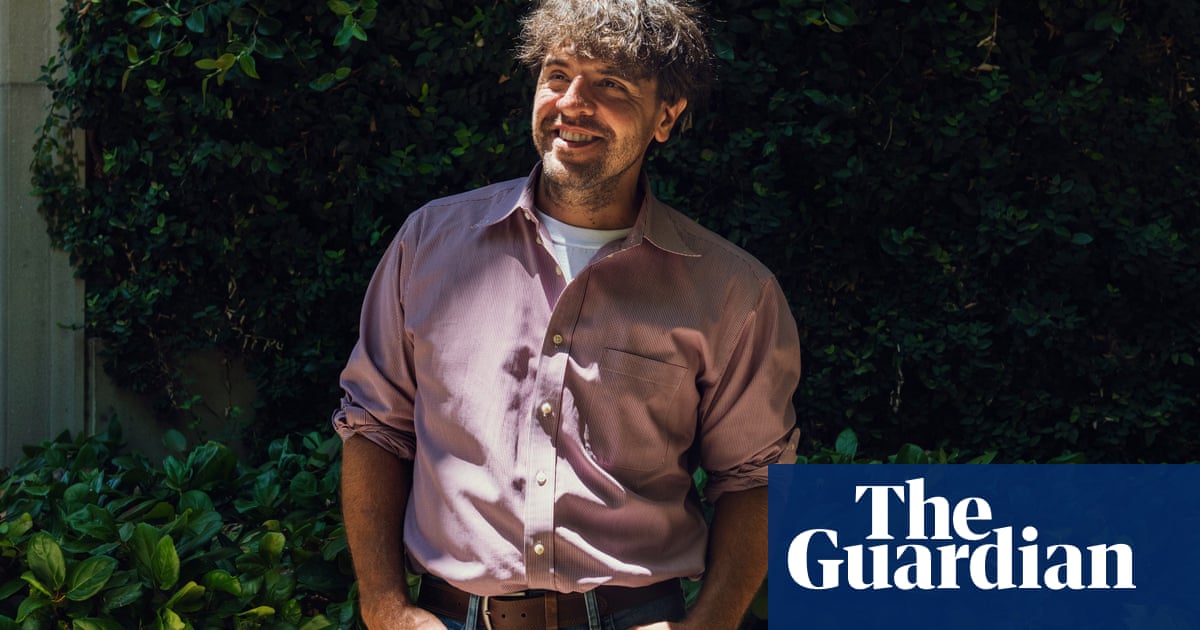
Download Neuroscientist Karl Deisseroth: ‘Coronavirus has changed us all’ PDF Free - Full Version
Download Neuroscientist Karl Deisseroth: ‘Coronavirus has changed us all’ by Karl Deisseroth in PDF format completely FREE. No registration required, no payment needed. Get instant access to this valuable resource on PDFdrive.to!
About Neuroscientist Karl Deisseroth: ‘Coronavirus has changed us all’
Whatever path the pandemic takes from here, says Karl Deisseroth, the pioneering American neuroscientist, psychiatrist, bioengineer and now author, “Coronavirus has affected us all and it has changed us all.<p>He has been finishing his book, Connections: A Story of Human Feeling, an investigation into the nature of human emotions.</p><p>This is the basic methodology of optogenetics, a technique that Deisseroth pioneered in 2005 with his team at what is now the Deisseroth Lab at Stanford University.</p><p>Optogenetics is now its own field, its techniques and principles used in hundreds of laboratories across the world to advance understanding of the circuits of the brain and the consequences of conditions such as schizophrenia, autism and dementia.</p><p>Deisseroth has another great leap forward on his CV, too: see-through brains.</p><p>In 2013, his team figured out a way to drain away the opaque fatty matter in a mouse brain and instead suspend all the brain cells in a scaffold of hydrogel, a transparent, jelly-like substance that allows for extraordinarily detailed brain imaging – a significant leap forward from the standard fMRI scan.</p><p>If you look at it, one route to understanding how those symbols are transformed into feelings might be looking at how the brain works.</p><p>The two fields are usually seen as distinct – brain v mind – but the insights gained in consultations with patients have seeded many of Deisseroth’s experiments.</p><p>How can inspiration flow both ways?” Connections is Deisseroth coming “full circle”, he says, back to his “original and greatest love” – writing.</p><p>At times, it recalls the case histories of Oliver Sacks, at times the sweep of Yuval Noah Harari’s Sapiens – though Deisseroth says a closer model is The Periodic Table by the poet-chemist Primo Levi.</p><p>“We can not only record from the activity of tens of thousands of neurons while the processes that correspond to feelings are happening – we can directly turn up and turn down the representation of these feelings with great precision.</p><p>And all of that neurobiology maps on to this fundamental question of what a feeling is.” There are many moments where Deisseroth’s case histories echo the strange times we are living through.</p><p>Is that something that was more valuable at a different time in the long march of evolution?” He speculates that the manic state – “in some ways the highest expression of what a human can be” – was a circuit in the brain waiting to be tripped; and perhaps such states have helped humans cope with war, famine, climate emergency or pandemics in the past.</p><p>This leads Deisseroth to ponder the case of Joan of Arc in medieval France – a female teenage peasant who, like Alexander, appeared to be an inappropriate vessel for such mania, but nevertheless managed to make a national impact.</p><p>But there’s not much that any individual can do.” In another chapter, Deisseroth contrasts two patients with extreme “social and nonsocial brain states”.</p><p>Meanwhile Charles who was on the autistic spectrum shrank from human contact he suffered panic attacks in social situations and could not meet anyone’s eye, associating eye contact with a “negative-valence subjective internal state” (ie feeling bad).</p><p>“One reason Zoom meetings can be so exhausting is we have to work much harder to create our model of the other person – and that’s before we get on to multiple people,” Deisseroth says.</p><p>He made the breakthroughs in optogenetics while struggling with single fatherhood; he describes an early clinical encounter with a girl suffering from brain cancer as the inspiration for his work; and it so happens that his wife, Michelle Monje, is now a specialist in brain cancer in children.</p>
Detailed Information
| Author: | Karl Deisseroth |
|---|---|
| Publication Year: | 2021 |
| Pages: | 9 |
| Language: | other |
| File Size: | 2.8131 |
| Format: | |
| Price: | FREE |
Safe & Secure Download - No registration required
Why Choose PDFdrive for Your Free Neuroscientist Karl Deisseroth: ‘Coronavirus has changed us all’ Download?
- 100% Free: No hidden fees or subscriptions required for one book every day.
- No Registration: Immediate access is available without creating accounts for one book every day.
- Safe and Secure: Clean downloads without malware or viruses
- Multiple Formats: PDF, MOBI, Mpub,... optimized for all devices
- Educational Resource: Supporting knowledge sharing and learning
Frequently Asked Questions
Is it really free to download Neuroscientist Karl Deisseroth: ‘Coronavirus has changed us all’ PDF?
Yes, on https://PDFdrive.to you can download Neuroscientist Karl Deisseroth: ‘Coronavirus has changed us all’ by Karl Deisseroth completely free. We don't require any payment, subscription, or registration to access this PDF file. For 3 books every day.
How can I read Neuroscientist Karl Deisseroth: ‘Coronavirus has changed us all’ on my mobile device?
After downloading Neuroscientist Karl Deisseroth: ‘Coronavirus has changed us all’ PDF, you can open it with any PDF reader app on your phone or tablet. We recommend using Adobe Acrobat Reader, Apple Books, or Google Play Books for the best reading experience.
Is this the full version of Neuroscientist Karl Deisseroth: ‘Coronavirus has changed us all’?
Yes, this is the complete PDF version of Neuroscientist Karl Deisseroth: ‘Coronavirus has changed us all’ by Karl Deisseroth. You will be able to read the entire content as in the printed version without missing any pages.
Is it legal to download Neuroscientist Karl Deisseroth: ‘Coronavirus has changed us all’ PDF for free?
https://PDFdrive.to provides links to free educational resources available online. We do not store any files on our servers. Please be aware of copyright laws in your country before downloading.
The materials shared are intended for research, educational, and personal use in accordance with fair use principles.

