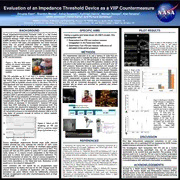
Table Of ContentEvaluation of an Impedance Threshold Device as a VIIP Countermeasure
Douglas Ebert1 , Brandon Macias1, Ashot Sargsyan1, Kathleen Garcia1, Michael Stenger2, Alan Hargens3,
Smith Johnston2, David Kemp4, and Richard Danielson5
1KBRwyle Science, Technology and Engineering, Houston, TX, 2NASA Johnson Space Center, Houston, TX,
3University of California, San Diego, CA, 4University College London, London, UK, and 5Baylor College of Medicine, Houston, TX
BACKGROUND SPECIFIC AIMS PILOT RESULTS
Visual Impairment/Intracranial Pressure (VIIP) is a top human
Using a supine and head down tilt (HDT) model, this
spaceflight risk for which NASA does not currently have a proven
investigation will:
mitigation strategy. Thigh cuffs and lower body negative pressure
1. Determine if an ITD can reduce venous
(LBNP) devices have been or are currently being evaluated as a
means to reduce VIIP signs and symptoms, but these methods congestion in the head and neck Figure 3: Effect of ITD breathing on IJV
alone may not provide sufficient relief of cephalic venous cross-sectional area in the supine
2. Determine if an ITD can reduce indicators of
position. A: M-mode across the IJV
congestion and VIIP symptoms. Additionally, current LBNP
elevated intracranial pressure
without ITD, B: B-mode (2D) image of the
devices are too large and cumbersome for their systematic use as
IJV without ITD, C: M-mode across the IJV
a countermeasure. Therefore, a novel approach is needed that is
METHODS with ITD, D: B-mode image of the IJV
easy to implement and provides specific relief of symptoms. This
without ITD. In panels A and C ECG is the
investigation will evaluate an impedance threshold device (ITD) as
green trace and respiration in red.
The experimental approach is to use a battery of tests that are
a VIIP countermeasure.
currently being used to evaluate the effects of other interventions.
Healthy test subjects (n=15) will participate in two sessions, one
with an ITD and one with a sham ITD (placebo). Subjects will be
Figure 1: ITD and face mask;
evaluated in the seated and supine positions as well as 6º and 15º
military kit shown incorporates
HDT postures. Measures taken at each posture will include IJV
three exhalation vents for
cross sectional area, carotid artery Doppler, measures of cardiac
minimized exhalation back
preload, transcranial Doppler (TCD), optic nerve sheath diameter
pressure and maximum subject Figure 4: Effect of ITD
comfort. (ONSD), superior ophthalmic vein (SOV) Doppler, facial soft tissue breathing on IJV time-
thickness, IJV pressure (VeinPress), optical coherence weighted cross sectional
area in different postures
tomography (OCT), cochlear and cerebral fluid pressure analysis
The ITD provides up to 7 cm H O (~5 mmHg) resistance to
2
(n=1). IJV cross sectional
(CCFP), otoacoustic emissions (OAE), and intraocular pressure
inspiratory air flow, which upon each inhalation effectively turns
area was time-averaged
(IOP). Blood pressure, ECG, heart rate, and transcutaneous PCO
the thorax into a vacuum pump that lowers the intrathoracic
2 over one full respiratory
and PO will be monitored throughout the experiment. Blood
pressure (ITP) to facilitate venous return to the heart. The ITD is
cycle at 15° head up tilt
2
samples will be drawn and archived for potential one carbon
FDA-approved and was developed to augment venous return to
(15HUT), Supine, and 15°
pathway analysis.
the heart and increase cardiac output in patients with head down tilt (15HDT),
each posture with and
hypotension and during cardiopulmonary resuscitation (CPR).
without ITD breathing.
While the effect of ITD on CPR survival outcomes is controversial,
30 degree head up tilt
Vascular
Jugular
it’s ability to lower ITP with a concomitant decrease in intracranial
ultrasound
pressure (ICP) is well documented1. A similar concept that creates
Carotid
negative ITP during exhalation (intrathoracic pressure regulator;
Ocular
ITPR) decreased ICP in 16 of 20 patients with elevated ICP in a
ultrasound
10 degree head up tilt 20 degree head down tilt Figure 5: Noninvasive indication
hospital pilot study2. ITP and central venous pressure (CVP) have CCFP
of ICP changes in response to
been shown to decrease in microgravity3,4. However ITP drops
Jugular Jugular
ITD breathing at different
Carotid
Carotid
more than CVP, indicating an increased transmural CVP. This
postures. Tympanic Membrane
data collection (15 min)
could explain the paradoxical distention of jugular veins (JV) in
Displacement (TMD) values in
upright / washout (5 min)
microgravity despite lower absolute CVP and also suggests that n=2 trials each panel. A: subjects
JV transmural pressure is not dramatically elevated. Use of an ITD at 15° head up tilt (15HUT),
Supine, 15° head down tilt
may lower JV pressure enough to remove or relieve cephalic seated supine 6º HDT 15º HDT
(15HDT), and Supine with ITD
venous congestion.
breathing (Supine+ITD). B:
subjects at 30° head up tilt
(30HUT), Supine, 15° head down
tilt (15HDT), and 15° head down
Tonometry OAE
Figure 2: Effect of ITD
tilt with ITD breathing
(15HDT+ITD). Higher TMD
breathing on ITP and
displacement values indicate
ICP in a porcine model
lower ICP.
(from Convertino et al.) 1
OCT
DISCUSSION
REFERENCES
Pilot data demonstrate substantial reductions in IJV cross
During spaceflight experiments Braslet thigh cuffs reduced
sectional area and in estimated ICP as measured by CCFP. Human
cardiac preload but only reduced the internal JV (IJV) cross
subject testing is planned for February 2017.
1. Convertino VA, Cooke WH and Lurie KG. Inspiratory resistance as a
sectional area by 23%. The addition of modified (open-glottis)
potential treatment for orthostatic intolerance and hemorrhagic shock. Aviat
The investigation team recognizes that ITD use as a routine
Mueller maneuvers resulted in an IJV area reduction of 48%5. This
Space Environ Med 76: 319-325, 2005.
countermeasure during spaceflight may not be particularly
project will test the ITD’s ability to lower ITP in each respiratory
2. Kiehna EN, Huffmyer JL, Thiele RH, Scalzo DC and Nemergut EC. Use of
comfortable in its current form and function. The purpose of the
cycle, acting to: 1) reduce venous congestion in the head and
the intrathoracic pressure regulator to lower intracranial pressure in patients
planned work is to 1) use the ITD as a tool to further understand
neck and 2) reduce ICP based on noninvasive indicators. The
with altered intracranial elastance: a pilot study. J Neurosurg 119: 756-759,
VIIP, and 2) establish the effectiveness of this methodology before
expected mechanism of action for relief of venous congestion is 2013.
embarking on more in-depth investigations to develop and validate
that in microgravity (or an analog), blood is relocated toward the 3. Videbaek R and Norsk P. Atrial distension in humans during microgravity
a countermeasure with optimized crewmember acceptability.
heart from vasculature in the head and neck. Reduction of ICP induced by parabolic flights. J Appl Physiol (1985 ) 83: 1862-1866, 1997.
4. Buckey JC, Jr., Gaffney FA, Lane LD, Levine BD, Watenpaugh DE, Wright
would occur as a result of reduced ITP1.
SJ, Yancy CW, Jr., Meyer DM and Blomqvist CG. Central venous pressure in ACKNOWLEGEMENTS
Once validated, the ITD would be an exceptionally easy
space. J Appl Physiol (1985 ) 81: 19-25, 1996.
countermeasure to deploy and test on the ISS. Dosage could be
5. Hamilton DR, Sargsyan AE, Garcia K, Ebert DJ, Whitson PA, Feiveson
Funded by a NASA Human Research Program Omnibus grant
altered through 1) duration of application and 2) inspiratory
AH, Alferova IV, Dulchavsky SA, Matveev VP, Bogomolov VV and Duncan
through the Human Health and Performance Contract (HHPC).
resistance set point. Effects could be additionally enhanced
JM. Cardiac and vascular responses to thigh cuffs and respiratory
Special thanks to the JSC Nutritional Biochemistry Laboratory (S.
through co-application with other countermeasures such as thigh
maneuvers on crewmembers of the International Space Station. J Appl
M. Smith and S. Zwart) for assistance with blood sample archiving
cuffs or LBNP. Physiol (1985 ) 112: 454-462, 2012.
for potential one carbon pathway analysis.